

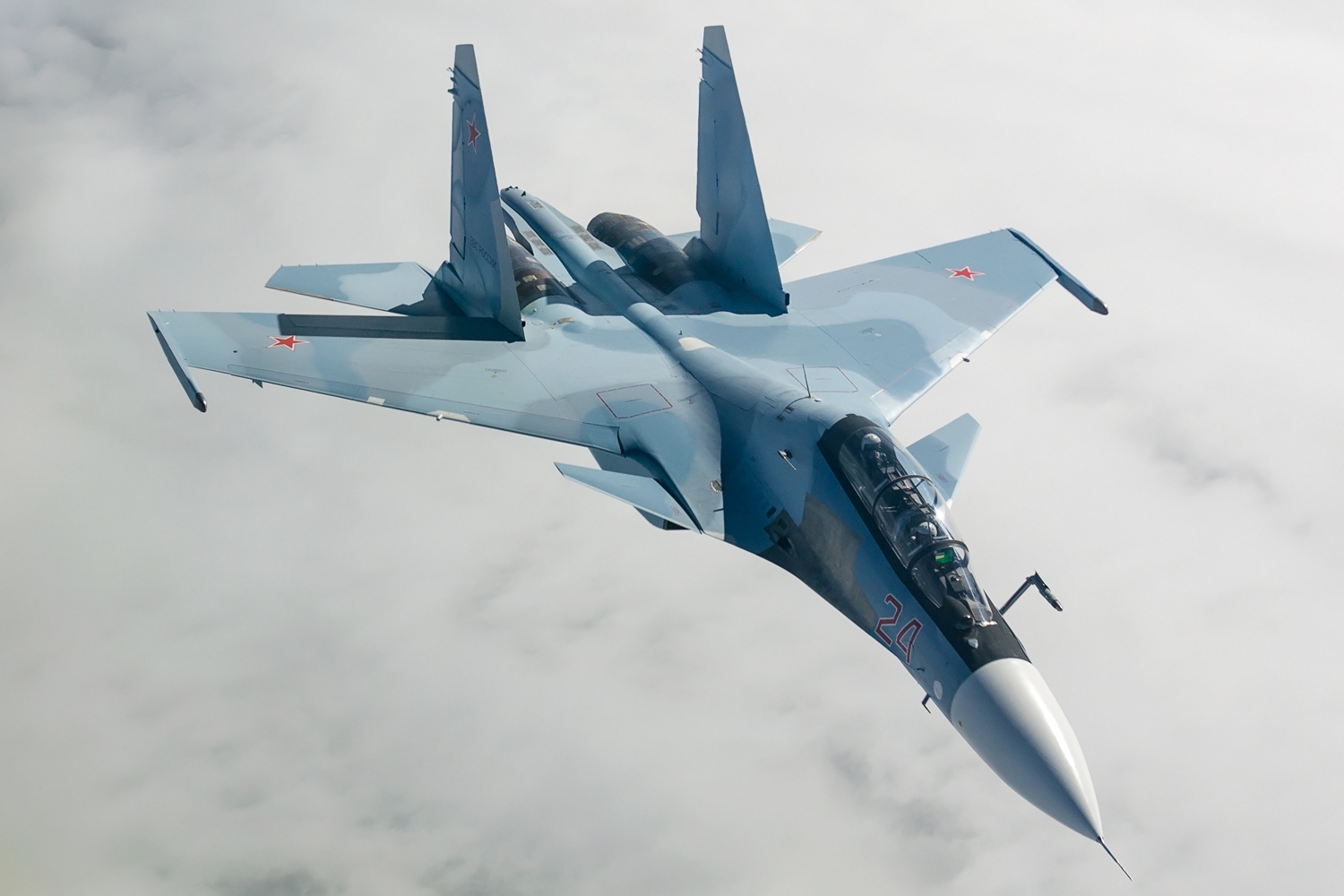
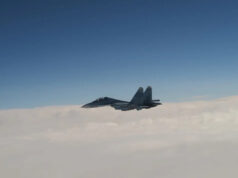
A Russian Su-30 fighter jet entered Estonian airspace without permission on 18 March, marking the first such violation reported this year.
The aircraft crossed into Estonian airspace near Vaindloo Island for approximately one minute during the afternoon, according to Estonian authorities.
Officials said the jet did not have a filed flight plan and was not in communication with Estonian air traffic control at the time of the incident. The Italian Air Force detachment based at Ämari Air Base responded to the incursion, launching a reconnaissance flight as part of NATO’s Baltic Air Policing mission.
The incident prompted a diplomatic response, with Estonia’s Ministry of Foreign Affairs summoning the chargé d’affaires of the Russian Embassy and issuing a formal note.
Airspace violations in the Baltic region are closely monitored by NATO, with allied aircraft regularly scrambled to intercept or observe Russian military activity near alliance borders.
This marks the first confirmed breach of Estonian airspace by a Russian aircraft in 2026.
The Sukhoi Su-30 is a twin-engine, two-seat multirole fighter developed by Sukhoi from the Su-27, with its first flight in 1989 and entry into service in the early 1990s. Designed for all-weather operations, it combines air-to-air and strike capabilities and is known for its high manoeuvrability. The aircraft remains in production, with multiple variants tailored for domestic and export customers. More than 630 have been built, and it is operated by several air forces, including those of Russia, India and Algeria.
The platform has evolved through a number of variants such as the Su-30SM, Su-30MKI and Su-30MKK, reflecting differing avionics, mission systems and customer requirements. The Su-30SM, introduced in 2013, is among the primary versions in Russian service. As of 2024, the Russian Aerospace Forces were reported to operate around 130 aircraft across different sub-variants, alongside additional aircraft in naval aviation.
In terms of design, the Su-30 has a crew of two and measures just under 22 metres in length with a wingspan of 14.7 metres. It is powered by two afterburning turbofan engines, enabling a maximum speed of around Mach 2 and a service ceiling of approximately 17,300 metres. The aircraft has a range of about 3,000 kilometres at altitude and is capable of sustaining high g-forces, reflecting its role as a manoeuvrable combat aircraft.
The aircraft is equipped with a 30 mm cannon and up to 12 hardpoints, allowing it to carry a wide mix of air-to-air missiles, precision-guided munitions, anti-ship and anti-radiation weapons. Avionics vary by variant but typically include phased-array radar systems, infrared search and track, and helmet-mounted targeting.





I am sure Rutte will send Putin a strongly worded letter saying “he should never ever do that again……please” 🤦♂️
🤡
In your head, rent free 😘
We really need to be far firmer with Russia.
Issue them a formal warning that any Russian aircraft, missiles or drones that enter NATO airspace will be shot down without warning.
Then, when it happens again, actually shoot down the next Russian aircraft/missile/drone that violates any NATO airspace.
Turkey shot down a Russian drone and all Russia did was bluster and make idle threats.
To be fair, there’s a massive difference in Turkey vs Estonia’s military capability and also in shooting down an unmanned drone to possibly killing a Russian pilot…
I agree though, we should be firmer with russia, and crucially help Ukraine more.
Turkey shot down a SU-24 that entered its airspace in 2015. I think that is what Steve is referring to.
Regarding Baltic air policing, that’s done on a rotating basis by NATO. I believe it is Italy’s turn at the moment, so they’ll probably be using Eurofighters which are as capable or more than anything Russia has.
Realistically, jets on a NATO QRA mission probably wouldn’t fire immediately, even if airspace was violated, unless fired on first, or the aircraft was heading towards a sensitive target, or there was clear evidence of imminent attack.
The Russians always make these incursions above territorial waters around Baltic islands. They know that if it’s shot down, they will be able to dispute the location, because it’s in the sea some way from the mainland. They know that this ambiguity complicates decision-making for any NATO reaction. Ultimately it’s just stupid posturing, in a carefully contrived attempt to make NATO appear unresponsive, when in reality there is no real threat.
I couldn’t agree more.
So Russia violated a NATO countries airspace yet again, and NATO did nothing… yet again. Pathetic!
Never learn 🙄