

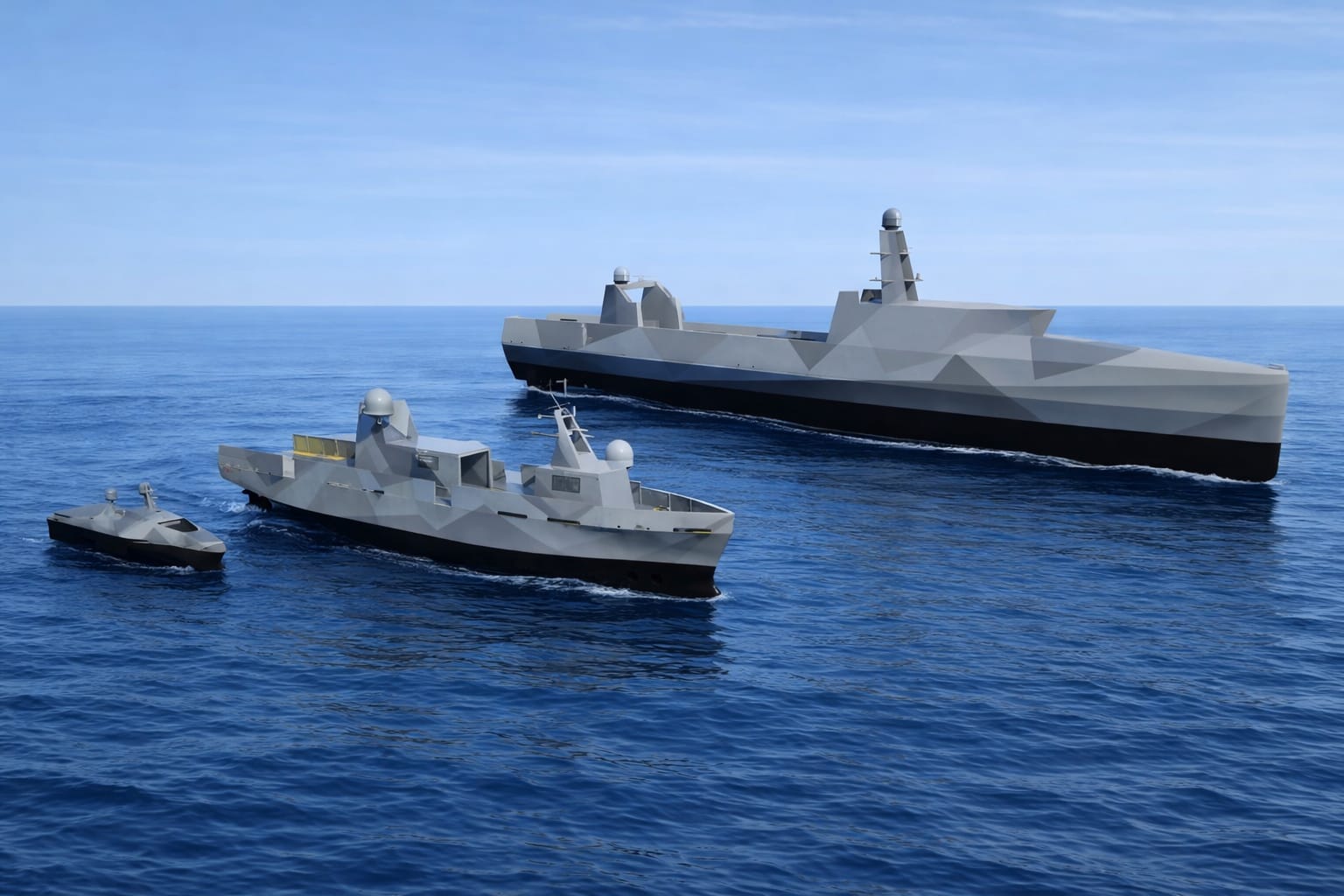
A modular family of uncrewed surface vessels designed for sustained undersea operations is being developed by BMT, building on its MODUS concept first revealed in 2025.
Speaking at UDT 2026, Jake Rigby, Head of Innovation and Research at BMT, described MODUS as “a family of uncrewed vessels” rather than a single platform, spanning designs from around 20 metres up to 70–80 metres, with early work focused on underwater warfare applications.
The concept is rooted in structural pressures facing Western navies. “As equipment gets more and more complex, but budgets remain broadly the same… we have a limited number of hulls,” Rigby said, adding that crewing constraints are also becoming a limiting factor. Autonomy, he said, forms part of a wider “hybrid navy” approach rather than a standalone answer.
MODUS is designed from the outset as fully uncrewed, which has driven a departure from conventional naval architecture. “We’ve ripped up the rule book on how we traditionally design these vessels,” said Chloe Yarrien, Maritime Autonomous Systems Engineering Lead at BMT, noting that traditional design tools are built around crewed assumptions.
The programme builds on several years of internal research, including work on highly autonomous warships and large uncrewed surface vessels. That earlier work identified the need to define clear operational roles before addressing technical challenges in detail, leading to the current MODUS concept structured around six design principles: autonomy, modularity, availability, buildability, adaptability and affordability.
BMT has prioritised three initial use cases where uncrewed systems offer the most immediate value: persistent data gathering, seabed warfare and anti-submarine warfare. These include hydrographic and oceanographic survey, monitoring of critical undersea infrastructure and acting as part of a distributed ASW barrier. “We wanted sort of 30 to 60 day missions where this vessel could be out on station, working around the clock,” Yarrien said.
Rather than pursuing a single modular hull, the company has opted for a family of designs, concluding that a one-size-fits-all approach introduced unnecessary complexity and cost. The result is a tiered set of platforms, broadly aligned to different operating environments, from coastal to open ocean.
Removing the crew has a significant impact on design trade-offs. Rigby said that while internal volume increases by around 30 per cent, this shifts the constraint from space to weight. “You see the free space and think you can just fill that with fuel, but you still have to be hydrodynamically efficient,” he said, with weight becoming the key driver for endurance beyond 30 days. Reliability also becomes critical, given the absence of onboard personnel to carry out routine maintenance.
The larger variants, reaching up to around 75 metres, are intended to support demanding roles such as towing sonar arrays in the North Atlantic, where seakeeping remains essential. Rigby noted that size in this context is driven by performance rather than cost, adding that “steel is cheap and air is free” when compared to the expense of complex systems.
A recurring theme throughout the discussion was that autonomy requires different operating concepts. “If we just look to employ these vessels in the same way that we employ crewed vessels today, you’re not going to see the change,” Rigby said, pointing to the need for new deployment models and force structures.
During the discussion, BMT also outlined how MODUS platforms could act as motherships for smaller uncrewed systems. Medium and large variants are designed to deploy and recover additional assets, including remotely operated vehicles and other off-board systems. “By packaging them… like a sort of Russian doll piece, you enable that as a package to operate for 30 days plus,” Rigby explained, highlighting features such as moon pools and modular launch and recovery arrangements.
The integration of these vessels into wider force structures remains an area of ongoing work. Rigby said operational analysis and war gaming have already been used to explore how crewed and uncrewed systems might operate together, while Yarrien noted that thinking around hybrid fleets is still evolving alongside customer requirements.
The question of whether platform design should follow operational concepts, or vice versa, was also raised during the session. Yarrien described it as “a bit chicken and egg,” while Rigby pointed to a phased approach as the practical way forward. “That is exactly why we’re proposing that stepping stone approach,” he said, noting that the MODUS concept has already evolved over several years of development.
BMT is now looking to move into prototyping and experimentation, starting with smaller platforms before scaling up, while continuing to refine both the design and its role within future naval force mixes.


Does the UK now lead the world in Design Concepts ?
Will we ever buy any ?
I suppose it’s good there’s a booming trade in naval architecture, at least those skills are being retained. That’s as optimistic as I can possibly be
We had to re-take the lead from Mad Vlad’s model aircraft carrier collection?
Ahh but there were some fantastical models in his collection. 😁
I particularly liked the aircraft carrier with a ski ramp on the angled deck as well, that was good fun.
And the pagoda destroyer, that was nice too.
PAK DA designs are pretty special too !
We always have, it’s just that the rest of the World notice and take the idea, invest and make all the money out of them.
Yes, It does seem that way.
And spend decades trying to catch up again
Probably five, it’s all the MOD can count up tom
i can’t get my head around the endless unmanned this,uncrewed that. george could youbang together a piece that brings everything together so that dummies like meknow what th F is ging on?
So BMT don’t think their 40m monohull can do Atlantic ASW even with a yacht style keel underneath, interesting. The big 75m one is therefore probably the leading T92 contender at the moment then?
What happens If these boats have problems at sea, do they have to be maintained and looked after like manned platforms or do they never need touching ?
I’m a sceptic I suppose but everything needs attention at some point.
It’s apparently becoming quite a common situation in the commercial shipping industry for machinery spaces to be sealed and only maintained on a regular basis, like an aircraft engine would be. I assume that’s what they’ll do for these by optimising the equipment not to need constant access as a warship’s usually would, and then after each patrol they can do the maintenance that’s required.
As for what happens if it all goes wrong at sea, even the 10m USVs have duplicated power management systems so I suppose they must be able to limp home on one shaft. If the mission equipment goes then the whole patrol would be scrubbed most likely.
I get the Aircraft Engine example, It’s amazing just how reliable they seem nowadays.
Interesting times ahead for the RN If any money can be found.
Yeah the Trent 700 reputedly does 50,000 hours at a time (six years) before needing to be taken off the wing for deep maintenance. Obviously there will be a lot of analysis and tinkering being done in between that but considering that some important parts of the engine are operating above their melting temperature continuously that’s quite impressive.
Commercial engines like the Trent have a much easier life that say the EJ200 fitted to a Typhoon. The main stress to the commercial engine is during take-offs, when the engine is pushed to the max for thrust for overcoming the aircraft’s take-off weight. Once up to altitude it throttles back and pretty much stays there for the duration of the flight, even during landing it will be throttling back, with small increments in throttle for runway alignment. Besides, big fans on Trent’s don’t like to accelerate quickly due to the fan’s mass. Compare this to the low by-pass EJ200, which does constant throttling up and down, plus its has to also operate at supersonic speeds, where the shockwaves overtime fatigue the blades. hence why they have much lower maintenance cycles.
Something like Babcock’s USV will likely be diesel powered for efficiency and plodding along doing its patrol. The problem comes if this does become a loyal wingman T91/92 that operates with the T26/T45/T83. As it will need to be able to keep up with a carrier task group that will be going between 20 and 30knots. So either the USV has lots of powerful diesels or uses a jet engine for high speed sailing. As soon as you include the jet engine, cost significantly ramps up. Whilst diesels take up much more space, needing a bigger ship.
There’s also the fuelling question. Babcock say they are looking at a duration of at least 30 days. But is this just at a patrol (plodding) speed, or would it include sprints and drifts, along with high speed runs to a conflict zone/tasking area? Accelerating and high speed cruising will eat in to the fuel carried. Therefore necessitating a larger vessel, to hold the fuel.
There is a though that neither the T45 nor the T31 have any ASW capability, unless a Merlin is embarked. Could the pairing of a T92 ASW sloop be the answer, an expensive one at that? I don’t agree that the T91 nor the T92 showed be uncrewed, but instead should be lean manned. As that would give them the ability to operate on their own, as well as providing any maintenance/damage control.
What’s the general speeds of these drone ships? What’s stopping a faster craned cargo type ship or a fishing trawler scooping them up or towing them away or even a military ship or sub taking them out if illegal or not?
The small ones tend to travel at 5-10kts to maximise range. These 40-70m ones will probably doing commercial ship speeds, 15kts or so.
They’re also pretty big and heavy, any operation to capture one would be dangerous for the crew of the other vessel and require a lot of planning not to mention that they are all festooned with cameras. Wouldn’t be a ‘one of our bombers is missing’ moment.
Still pretty slow if only up to 15kts. It would have to be taken out if not captured. Would these things have a “self destruct” button then? ..lol…that would make them extremely dangerous!
The aim must be to quickly build these vessels with no living quarters apart from a limited number of accommodation cabins. No need to heat unmanned compartments (apart from heat-sensitive equipment/weapon bays), and little to no food storage means simpler, lighter designs and potentially much cheaper to build. One factor to consider is a higher risk of total loss with no immediate damage repair teams being permanently onboard. Such vessels as described above need to be based on the premise of potential high loss rates offset by digestible unit cost.
Nice to see a company actually acknowledging the performance in weather of their drone ships. So many seem to get so caught up on the “it’s autonomous” part they forget it still needs to trail Russian subs in poor weather
At what speed as I think the subs are likely to be a bit faster?
Hmm. I can see wholly unmanned vessels doing persistent surveillance. But once they are armed, a whole range of problems arise. If those require a man in the loop, the best place for the man is onboard. Minimally crewed is much less risky.
Visually a lot of these autonomous designs do look like pre WW1 efforts for some reason. Wonder why eliminating the crew suddenly changes the visual dynamics making it more crude and utilitarian compared to a modern warship or is it warboat.
It’s the same with Electric Cars. They all look naff.
Most modern “SUVs” look naff, electric or not. Horrible boxy rectangles on wheels.
Very valid questions. I’m sure “They” have thought this through though 🤔.
China has a massive fishing fleet.
Yes, I’m with you on that too.
Everyone and his dog seems to “pilot” an SUV nowadays. Chinese Land Rovers at “bargain” prices yet no proven history of long term reliability/durability as being reflected in second hand values.
Big rust Issues being seen In various countries relating to SAIC Vehicle brands ( Including Maxus, MG and IM ) MG’s are being sold in huge numbers now and Maxus are a real rival in the commercial market.
“You get what you pay for”
Chinese SUVs are seemingly taking on and over down here in Aus though other Japanese, UK, German, Italian and US brands are still here. Indian too. Love seeing the 🇬🇧 Mini’s around plus Jag’s and Bentley’s. Can’t afford any of them though…lol.
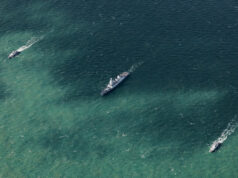
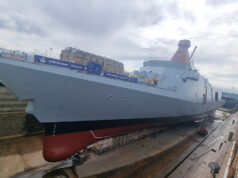
Which one do you think looks like a pre WW1 design? The pentamaran looks weird, the middle one looks like a the hull of a three masted ship and the big one looks like Damen bought Steller Systems.
The middle and top one both look somewhat archaic visually to my eye, not a criticism of their functionality mind. My great grandfather worked on pre dreadnoughts and slightly beyond and I have a lot of images from Thames Ironwork days up to 1912 where everything from torpedo boats for Romania (Căpitan Nicolae Lascăr Bogdan-class) through HMS Albion 1896 (the launch of which nearly killed my grandfather as a young boy, the newsreel of which chills me tbh) and post Dreadnought HMS Thunderer (the last launched 1912) of which there is newsreel of at the Dardanelles. Always very stark looks about those vessels, you could say very purposeful I guess, no frills, cold functional and can’t help but see a similar look at least in part to these subconsciously, as well as for example the Romulus from HII and others.
Just for a laugh….can I propose a mini oiler/tender mothership to go around and refuel drones out on patrol. What do you reckon? That’ll probably have to manned! Lol.
I don’t ever comment but for this I feel I need to. I’m a merchant navy OOW currently employed on PSVs in the north sea, and I do think fully autonomous ships are still quite a way away. Main reason being, everything breaks. Just during my year of seatime as part of my cadetship I saw:
Navigational computers (ecdis) fail
X band radar fail due to worn carbon brushes
One of the engines tried to throw a piston out of the engine
Constant and I mean constant rusting of absolutely everything
Fire fighting monitors and drencher systems siezing
Pipe failure spilling marine gas oil all through the engine room
Most of these failures were fairly minor and easy to fix. However, fixing these without a person onboard is difficult, to say the least.
Further points I’d remark on would be the simple redundancy and damage control capabilities you can get from a manned crew with the capacity to navigate by mark 1 eyeball.
I don’t think unmanned ships are impossible and I think if anyone will throw the money at such problems to find work arounds it will be the navy. However, I do not at all see such vessels being anything other than a specialised tool.
Oh and to Mr Torpedo J, slight correction. Whilst it’s true that engine rooms do operate unmanned these days that doesn’t mean completely unsupervised. The system allows engineers to sleep during the night when nothing is happening but during the day – or night if undergoing cargo ops with an oil rig – the engine control room is manned by engineers. Additionally, they make walk abouts of the engine room at least once a watch. One part of their job is honestly just keeping the ER clean – oils do accumulate a little here and there and of course that’s a massive fire hazard. Further, whilst we’re not doing full engine rebuilds at sea, I will say the engineers do have to do enough work in the ER that I think it would be wrong to describe the ER as “sealed”.
Commercial shipping companies love the idea of making us all completely redundant and automating further but there’s not all that much they can do on that front currently – and I’d be surprised if it’s ever cheaper to have a robot with dexterous arms and fingers rather than a couple of underpaid Filipinos.