

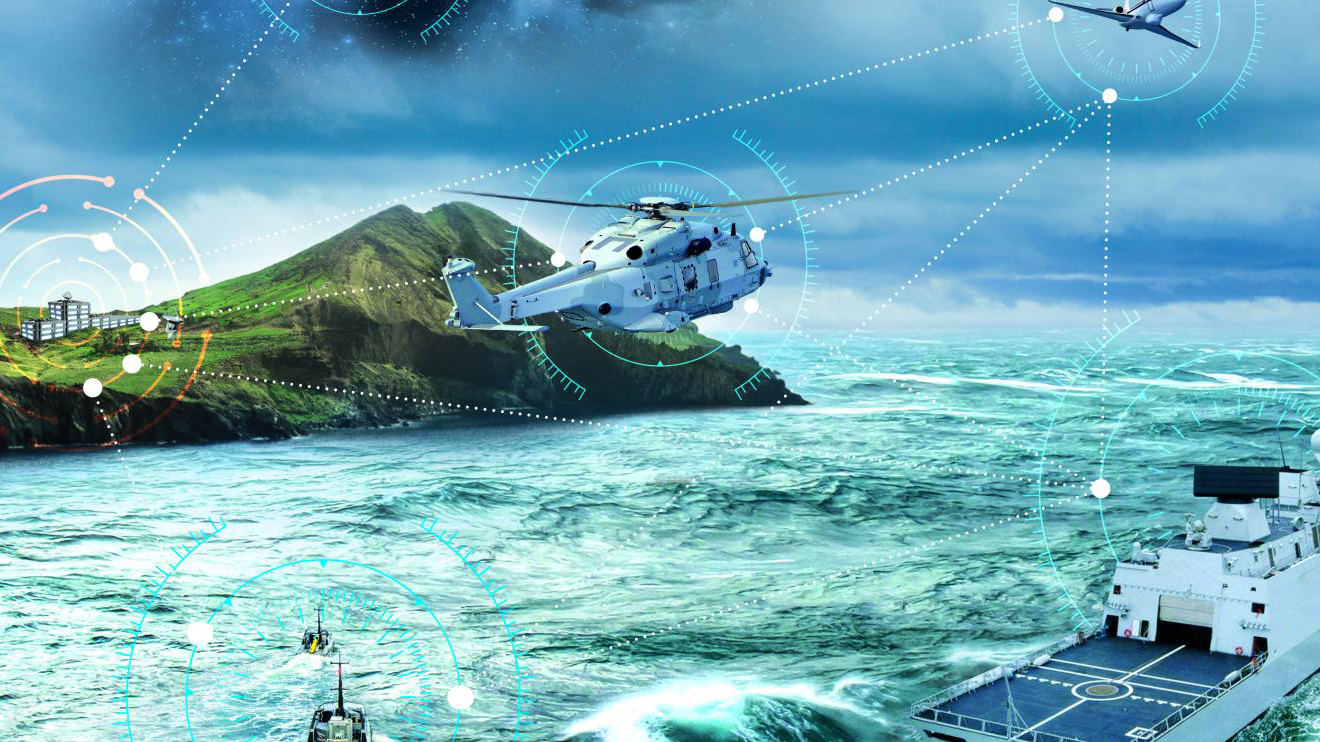
Navies face mounting pressure to improve the resilience and lethality of their forces but remain far from achieving the collaborative combat capabilities needed to meet modern threats, according to Thales’s Naval Defence Advisor Eric Chaperon.
In an interview published by the company, Chaperon set out what he sees as the major challenges facing naval forces, arguing that the shift from analogue to digital systems remains the core obstacle to effective collaboration between platforms.
He said that saturating attacks combining drones and missiles can no longer be defeated by individual platforms acting alone. “The key to operational superiority today is to boost overall performance through coordinated actions,” Chaperon said, adding that threats “must be detected, classified and then engaged as early as possible and in an orchestrated fashion, while ensuring that each unit preserves sufficient combat capabilities for future engagements.”
On the timeline for collaborative combat becoming a reality, Chaperon was candid about the scale of the challenge. “The era of collaborative combat is still in the early stages, partly because the technologies needed are still being developed, but also, and possibly most importantly, because naval forces have a long way to go to complete the switch from analogue to digital, which is the key enabler of collaborative combat.”
He posed the central question as: “How do we move ahead without waiting for the entire fleet to complete this digital transformation, which will take decades?”
Chaperon outlined several areas where incremental progress could be made, including faster collection and exploitation of sensor data, greater use of simulation, and the development of AI-powered processing initially focused on surveillance tasks such as fusing radar and electronic warfare data. He said the development of a naval cloud would provide real-time access to shared data between units, supported by robust connectivity through meshed networks and satellite communications.
He also pointed to the growing role of connected naval drones with swarming capabilities as force multipliers for both defensive and offensive operations, alongside improved electromagnetic spectrum management tools and stronger cybersecurity protections.
Chaperon said that achieving these goals would require broader collaboration with industry partners and the development of modular solutions with room to adapt to emerging threats. He cited Thales’s recent AI work with partners Dassault and Naval Group through the cortAIx accelerator as an example of efforts to help government customers process data faster.








I’ve gained $17,240 only within four weeks by comfortably working part-time from home. Immediately when I had lost my last business, I was very troubled and thankfully I’ve located this project now in this way I’m in a position to receive thousand USD directly from home. Each individual certainly can do this easy work & make more greenbacks online by visiting
following website——>>> http://www.giftpay7.vip