

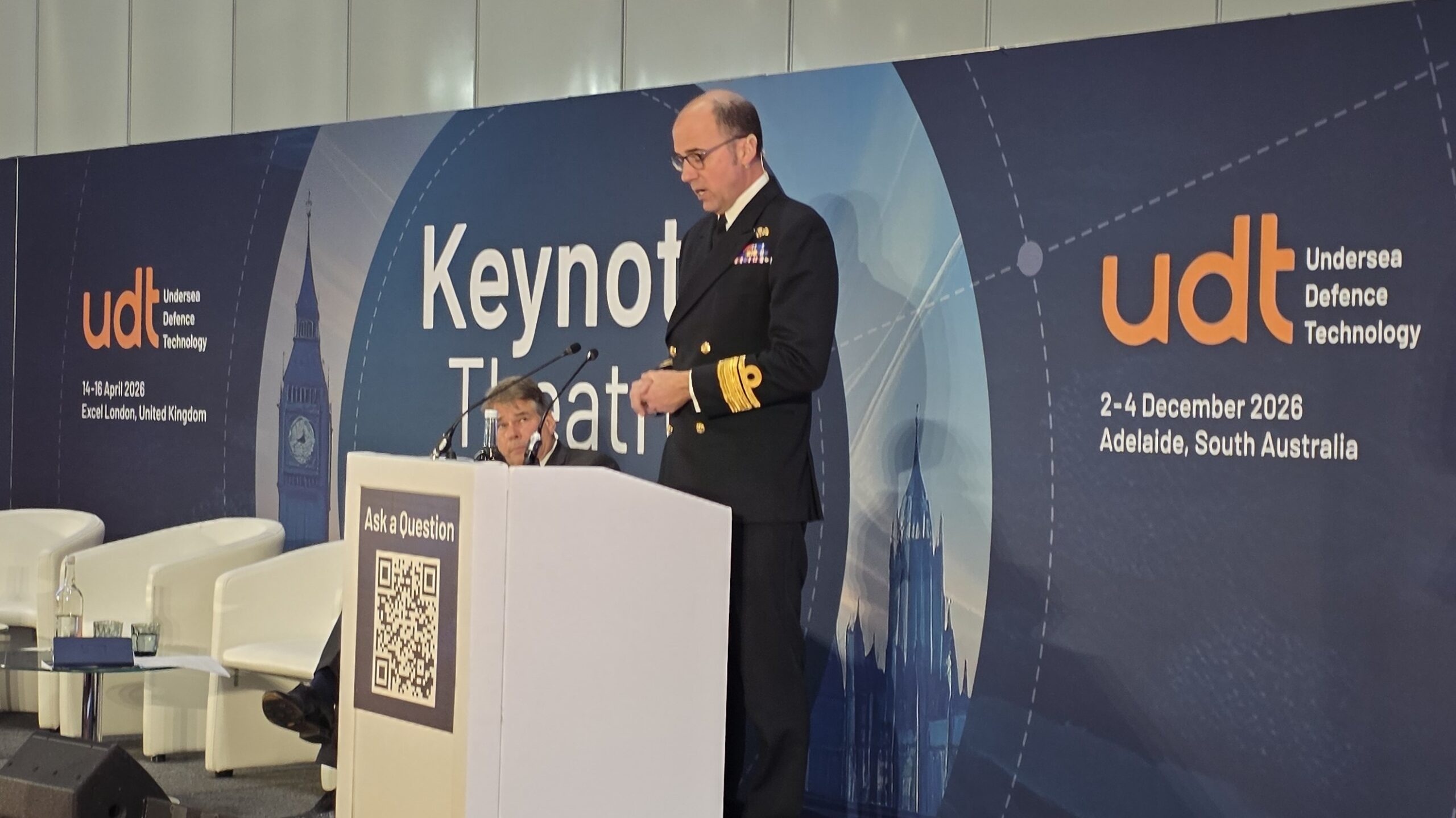
Autonomous maritime systems have demonstrated clear advantages over traditional crewed platforms in real-world survey trials, Rear Admiral Angus Essenhigh OBE, UK National Hydrographer, said at UDT 2026 in London.
Speaking during a keynote session, Essenhigh described how the UK Hydrographic Office tasked an industry partner to survey the same area using both a crewed vessel and a set of autonomous systems under identical conditions.
“I gave them a chunk of sea. I divided it in two. I said, send out your crewed vessel to do that half and send out the autonomous systems to do the other half,” he said.
The results were uneven. The crewed vessel suffered a breakdown and had to return to port before completing the task, while the autonomous systems continued operating.
“The autonomous systems brought us the data, and they did it within the timescale set. It was of high quality, and we were able to put it straight in at our highest quality into charts,” he said.
The trial was repeated to validate the outcome. “I didn’t trust them. I thought it was a fluke… they smashed it out the park, did it again.”
Essenhigh said the comparison highlighted the practical advantages of uncrewed approaches, particularly when considering cost, endurance and risk. Autonomous systems removed the need for large crews at sea, with operators able to monitor progress remotely via satellite communications, while still delivering usable bathymetric data.
He pointed to wider benefits including flexibility and reduced environmental impact, adding that such systems allow surveyors to remain ashore while maintaining continuous oversight of operations.
The remarks were during a broader discussion on the growing importance of hydrographic data in the undersea domain. Essenhigh warned that advances in autonomy depend on the availability of reliable, high-quality datasets and standards.
“Technology alone is not the answer. Its value is only realised when it’s built upon authoritative, coherent and trusted hydrographic data,” he said.
He also highlighted the role of new data standards, including the International Hydrographic Organisation S-100 framework, which enables machine-readable datasets needed for higher levels of autonomy.
The keynote formed part of a wider programme at UDT 2026 examining autonomy, data integration and the protection of critical underwater infrastructure, with industry and government speakers focusing on how emerging technologies can be deployed at scale in an increasingly contested maritime environment.


I’ve gained $17,240 only within four weeks by comfortably working part-time from home. Immediately when I had lost my last business, I was very troubled and thankfully I’ve located this project now in this way I’m in a position to receive thousand USD directly from home. Each individual certainly can do this easy work & make more greenbacks online by visiting
following website——>>> http://www.giftpay7.vip
Encouraging news.
There are probably a plethora of issues that could prevent a crewed vessel from going to sea, and doing its job. An autonomous vessel however, is immune to H&S issues, crew strength, bad weather etc etc.
The autonomous vessel was probably brand new, how old was the crewed vessel ? Comparing apes to oranges to get the result you want ?
*apples 🤦
“Comparing apes to oranges to get the result you want” – actually, that’s a pretty good phrase to describe a blatantly unfair or unrealistic comparison. It may have been an accident, but it’s worth remembering.
Interesting this guy’s father held same position 30 years back and became 1SL. In 2015 he and some others bucketed on HMG saying how bad things were for UK armed forces. Fallon replied that foriegn aid and support for womens rights should be included in defence budget WTF…..
Google paid $200 a hour on the internet..my close relative has been without labor for nine months and the earlier month her compensation check was $51005 by working at home for 10 hours a day….. Everybody must try this job now by just use this
GOOD LUCK. http://www.giftpay7.vip
How does this trial validate the advantages of the uncrewed vessel doing the survey? Di the crewed vessel do the survey or not. All they said is that it had to return to port. So the assumption is it couldn’t do the trial. All the statement says is that the uncrewed vessel was available and the crewed one was not. It’s a biased conclusion at best, as it doesn’t prove anything. The proof of the pudding would be to compare the survey data.