

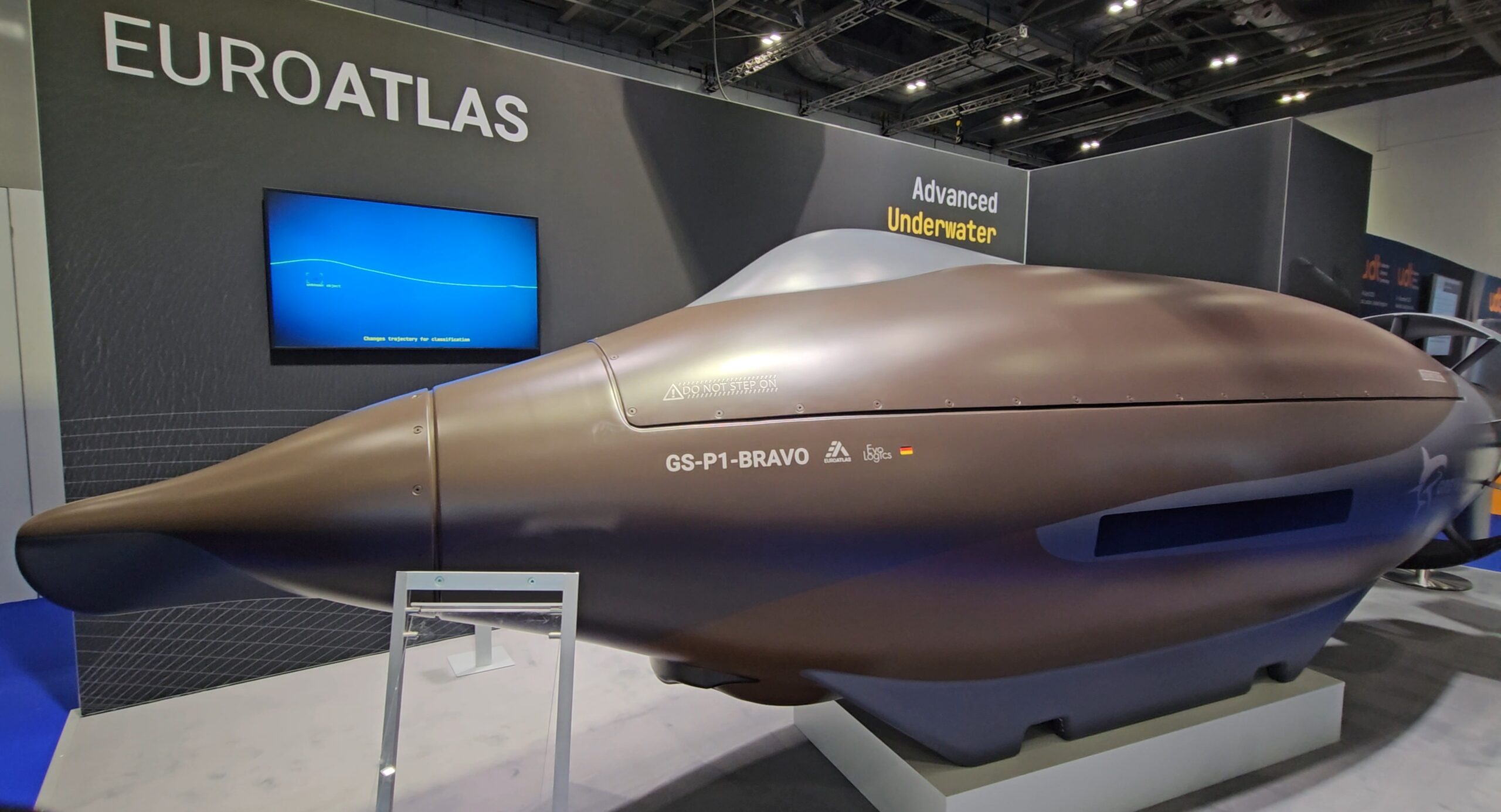
EUROATLAS is showcasing its GREYSHARK autonomous underwater vehicle (AUV) at UDT 2026 in London, presenting a system designed for long-endurance operations across a range of missions including infrastructure monitoring, mine countermeasures and anti-submarine warfare, the company said.
Speaking to the UK Defence Journal at the event, Verineia Codrean, Chief of Strategy at EUROATLAS, said the platform is built around autonomy, allowing it to operate independently for extended periods while retaining the option for human input where required.
“It’s an asset that can work and operate on its own, and it can perform a variety of missions without a human in the loop,” she said, adding that human operators can still be brought into decision-making where necessary.
The system is designed for long-duration deployments, particularly in roles such as monitoring pipelines, subsea cables and wider seabed activity. Codrean said the vehicle can remain on the seabed for extended periods without constant oversight, enabling persistent surveillance in areas of interest.
In terms of development, she said the battery-powered version of GREYSHARK has reached a high level of maturity. “This is a system that is fully developed and it’s ready to be deployed… it’s TRL eight,” she said.
A second variant, based on hydrogen fuel cell technology, is under development and is intended to significantly extend endurance. According to Codrean, this version could remain underwater for up to 16 weeks without the need for refuelling or recharge, making it suited to environments where recovery is difficult or impractical.
“That’s where the unique aspect comes… it can be deployed in areas like the Arctic where you simply don’t have the luxury of being able to recall the AUV,” she said.
GREYSHARK is also designed as a multi-mission platform, capable of carrying out intelligence, surveillance and reconnaissance (ISR), critical underwater infrastructure monitoring, mine countermeasures (MCM) and anti-submarine warfare (ASW). Codrean said the system can switch between mission types without being recovered or reconfigured.
“It can switch between these types of missions within seconds, so you don’t need to recall the AUV to change the payload,” she said.
She added that autonomy allows the vehicle to respond dynamically to events beyond its initial tasking. For example, a platform assigned to monitor infrastructure could investigate suspicious activity detected nearby before returning to its original mission.
Codrean suggested this approach could reduce reliance on high-value crewed assets in certain scenarios. “There is no need to include other expensive or strategic assets, like a submarine, to catch this kind of activity, because it’s already there and can detect it,” she said.
On customer interest, she said the company has seen strong engagement from international navies, although details could not be disclosed. She noted that interest varies depending on geography, with different users prioritising different mission sets.
The system is designed to operate across a range of environments, from high-biofouling regions to Arctic conditions, with adjustments such as specialised coatings used to address local challenges.
Looking ahead, Codrean said the programme is moving through a series of multinational trials and exercises. These include ongoing sea trials involving several European navies focused on infrastructure protection, as well as planned participation in NATO-linked exercises such as REPMUS in Portugal.
“We have a series of exciting exercises coming our way,” she said.


Why does it look like a Shinkansen Bullet Train I wonder. Very different to Hermes.
Sorry I meant Herne
Blunt the nose and it looks like shuttle from Enterprise.
Truth be told, Hydrodynamics and aerodynamics are not exactly dissimilar give or take a couple of wriggles re resistance to flow and density. Question is they say ASW capability, but what can it do except cry foul if it finds a sub………unless its missing bits and it can sneak up on one and drop a limpet on the hull?? Is it not better to have something that can “prosecute” a discovered target?
Armed UUVs are likely to remain a little ways in the future; by virtue of their environment, they require a greater degree of autonomy than surface or airborne drones, and independent weapon release is, ethically, still a no-no.
Seems something out of a Jules Verne book.