

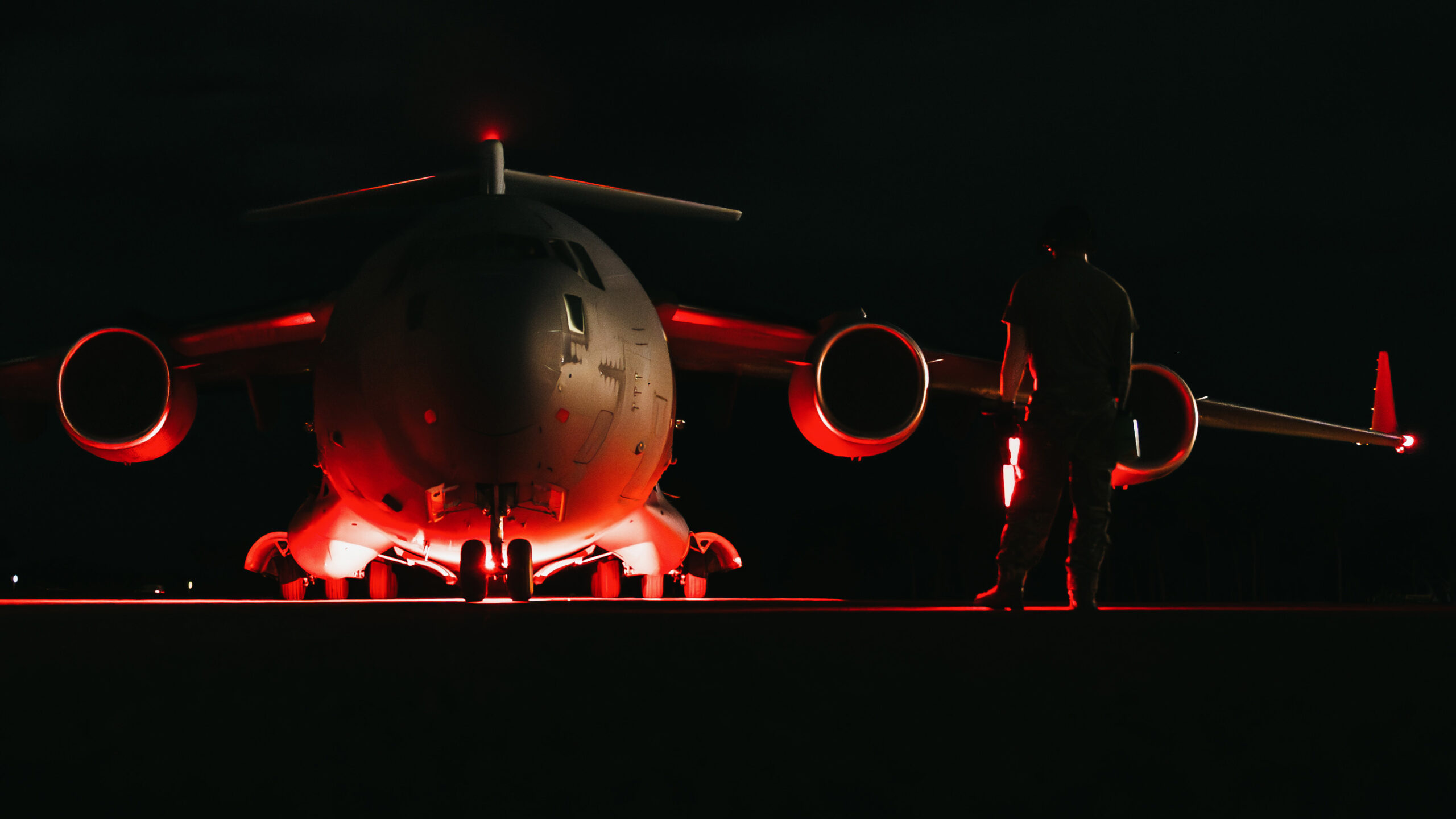
A new open-source map traces what appear to be the main routes used by U.S. Air Force heavy airlift aircraft between North America, Europe and the CENTCOM theatre, and while it’s built from publicly available data rather than classified sources it gives a pretty unusually clear picture of how American military logistics actually function at this kind of distance.
The graphic, titled Operation EPIC FURY, was put together by DefenceGeek, a senior editor at the UK Defence Journal, using flight tracking data from platforms including Flightradar24 and ADS-B Exchange.
The Logistics Map – Where the Cargo Goes #FreeIran
— Operation EPIC FURY —While I continue working on pulling together all the specific numbers for C-17A “Globemaster III” and C-5M “Super Galaxy” cargo flights in/out of CENTCOM over the last 4 months (several spreadsheets… pic.twitter.com/6mCmmRLxhf
— DefenceGeek 🇬🇧 (@DefenceGeek) April 18, 2026
It covers C-17A Globemaster III and C-5M Super Galaxy movements and was built up over several months with contributions from a wider OSINT community, trying to capture the consistency and scale of the flow rather than pin down individual sorties.
Aircraft depart the eastern United States and move through staging points in the UK and mainland Europe before continuing into the Gulf, with a second route running via southern Europe and North Africa and a third shown in an inset covering movements around the Arabian Sea into key Gulf hubs, which together give a reasonable sense of just how layered the network actually is.
The C-17A can operate from austere airfields and get cargo directly to forward locations, while the C-5M handles the really outsized and bulk stuff over intercontinental distances, and between them they seem to give the network both the flexibility and the volume that keeping operations going at this kind of distance probably demands.
Military aircraft don’t always broadcast their positions and routing shifts around, so there are obvious limits to what this kind of tracking can tell you, but the broader pattern that builds up across months of aggregated data is hard to just wave away. A decade ago pulling together a picture like this would have meant access to classified systems or pretty serious surveillance infrastructure, and the fact that it can apparently now be done using publicly broadcast signals and commercial platforms is a fairly significant shift in what outside observers can actually see.
More on OSINT
ADS-B is worth understanding here, because the system was designed for air traffic control rather than surveillance, which means aircraft are required to broadcast their position, altitude and velocity automatically using unencrypted signals that anyone with basic equipment can receive. Platforms like Flightradar24 and ADS-B Exchange pull that data together through networks of civilian receivers to build a near real-time picture of global air traffic, and what used to be limited to state radar networks is now, at least partially, accessible to anyone who knows where to look.
Military aircraft can and do limit their visibility, but enough emissions tend to remain that if you’re watching consistently over time you can still establish pattern, cadence and structure even when individual movements drop out of view.
Modern OSINT work like this involves aggregating hundreds of observations over months, comparing frequencies, identifying which airfields are seeing consistent traffic and mapping the flows between them. Individual flights disappear and transponders get switched off, but when you’re building a dataset across several months a pattern-of-life starts to emerge that’s fairly difficult to obscure entirely, and this map works exactly that way, pulling coherence out of repetition rather than trying to be precise about any one movement.
The broader implication is fairly simple, in that open data has widened who can observe this kind of military activity, pulling in journalists, researchers and loosely organised online communities alongside state intelligence agencies. A decade ago putting something like this together would have needed access to classified systems or serious surveillance infrastructure, whereas now the barrier isn’t getting hold of the data at all, it’s knowing what to do with it once you have it.











And, all of those planes use Nato airspace and Nato bases. Someone better tell the guy.
Waiting for the US to pull out of NATO.
That means everything, yes?
Not just the bits you want and the bits you’d rather keep in Europe to enable your own power projection and Intelligence picture.
I don’t want that to happen, by the way, as I appreciate our US cousins and loathe our own political class, but if Trump and others, including some here, happily belittle European allies, then off you go, and we await the consequences.
It cannot work both ways.
Start now generating extra home based cash by doing very easy and simple job from home. Last month i have earned $19753 from this job in my part time. This job is just awesome and its earning are greater than 9 to 5 office job. Join this right now by follow instructions here…
>>>>>>>>>> http://www.giftpay7.vip
Everybody can earn $250+ daily… You can earn from $19845-$38514 a month or even more if you work as a full time job…It’s easy, just follow instructions on this page, read it carefully from start to finish… It’s a flexible job but a good earning opportunity..
go to this site home tab for more detail thank you…… Jobathome1.com