

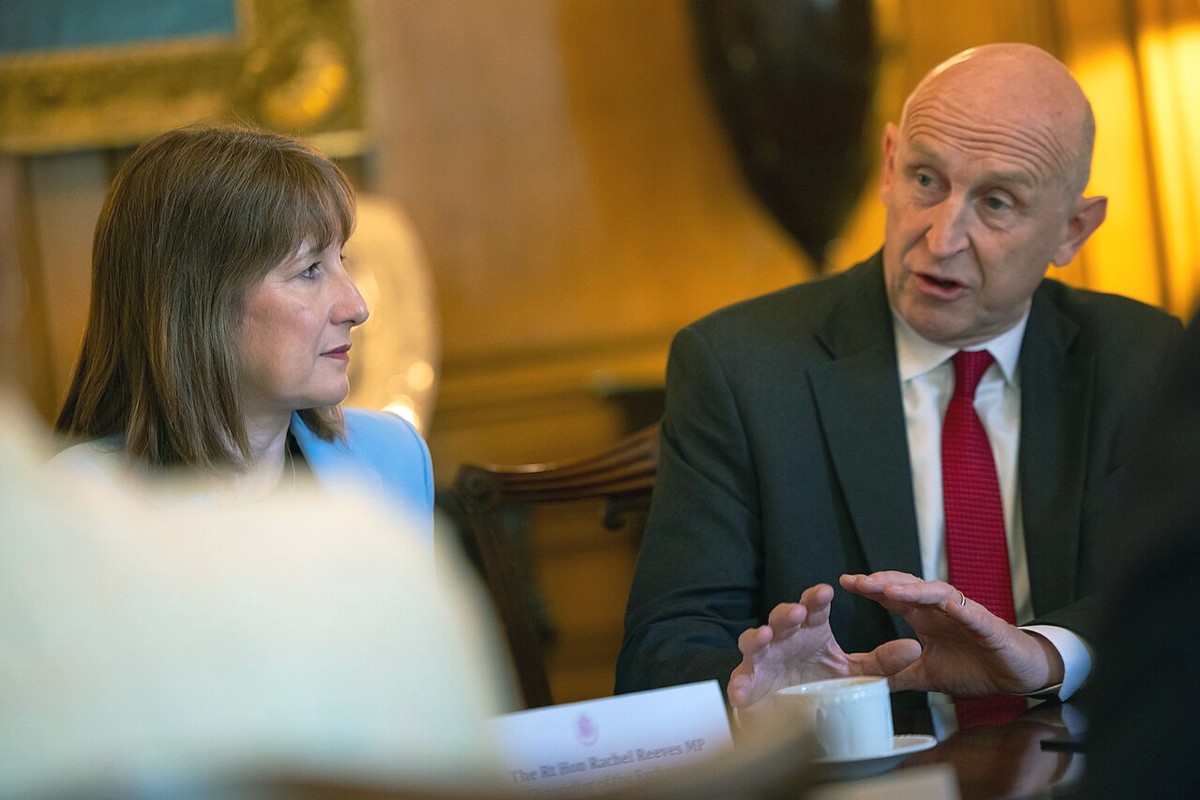
The Defence Secretary and Chancellor have met with leaders from UK banking, venture capital and strategic finance to explore how private investment can be leveraged to accelerate defence readiness and drive economic growth, with the government announcing a Ministry of Defence-led sprint to examine how that investment could be structured.
The meeting took place through the Defence Investors’ Advisory Group, which brings together leaders from the UK financial sector to advise the government on investment priorities, and which the Defence Secretary announced will be expanded and placed on a permanent footing as part of a deeper partnership between government and the financial sector.
As part of that expansion, industry secondees will join the Ministry of Defence through a new Defence Finance Zig-Zag secondment programme, aimed at embedding private sector expertise directly within government.
John Healey said: “In a more dangerous world, our national security is the guarantor of our economic security and investment confidence. A strong UK economy needs strong UK defence. The Chancellor and I are determined to bring together investors in a new partnership that delivers for our security, for our economy and for hard-working families up and down the country. As part of this, we are exploring how private investment can be leveraged to help build the defence capability Britain needs, creating jobs, making defence an engine for growth and making every pound go further.”
Chancellor Rachel Reeves said: “National security is this government’s first responsibility, and in an increasingly uncertain world we must explore how we can leverage private sector investment and expertise to keep the country safe. Alongside the largest sustained increase in spending since the Cold War, this government is committed to working with the financial sector to explore how we accelerate the creation of defence capability in ways that creates jobs, supports economic growth and always has value for money for the taxpayer at the forefront.”
Cathal Deasy, Global Co-Head of Investment Banking at Barclays and a member of the advisory group, said: “These steps are about building the right long-term framework for partnership between defence, industry, and finance. Clearer priorities, better engagement routes, and more modern delivery models will help attract private capital at scale, support innovators and supply chains, and strengthen resilience across the UK. We are seeing strong appetite from our clients to invest in UK defence and this framework provides the infrastructure to modernise our defence capability, including the estate and energy systems, while ensuring the UK can respond with greater speed, flexibility, and endurance in a more contested world.”
The announcements sit alongside a £20 million fund to offer accelerated contracts to small innovative British startups with limited or no previous MoD business, and build on earlier efforts including a venture capital roundtable held by the Defence Secretary last year and a Dragon’s Den-style event where defence firms pitched directly to major investors.











Jesus wept “how we accelerate the creation of defence capability in ways that creates jobs, supports economic growth blah blah blah” ffs! How about accelerating adding the means to kill the enemy quicker than they can kill us? That after all is the fundamental basic of military defence, the military cannot defend with spreadsheets and bank accounts! The woman just does not get it!
The Strategic Defence Review (What) was a plan to transform to All Of Government meaning Foreign Office, Treasury and MoD aligned to the same expectation of capabilities, funding and delivery.
The Defence Investment Plan (How) is the first test of that transformation so is bound to be hard though CDS was clear that how fast the What gets done depends on political will so threat assessment and funding priorities.
That aligns to the second SDR Transformation to All Of Nation meaning a shared understanding that the Peace Dividend delusion is over and we are not safe, so it’s time to pay the insurance premium for freedom or learn ruzzian.
It’s clear from USA that Nikita Kruschev was correct that they would win by internal defeat of the political will for national security. The FSB kompromat operation on #47 has been their greatest success and much better value than kinetic war. He does whatever they want.
In the ruzzian war in Ukraine the first country to surrender was the USA.
FSB are well ahead in the destruction of NATO Article 5 commitments, again great value since they know that they can’t win a conventional kinetic war with NATO.
So the funding is critical to the delivery that you prefer, which isn’t feasible without HM Treasury and the Financial Sector moving from high cost government spending Bonds (Gilts) to low cost Defence Investment Bonds. The banks aren’t going to do that without carrot and stick encouragement, which is what this is lead by Defence and Treasury to one common objective. Sadly spreadsheets are how people understand proposals and their consequences…
And armchair experts pontification ignore the existence or risk.
Christ, I thought Defence was in the Business of Killing, not economic growth and Quarterly returns.
The Peace Dividend delusion is over and we are not safe.
Time to pay the insurance premium for freedom or learn ruzzian
The Peace Dividend delusion has allowed politicians to safeguard their electoral prospects by shifting Defence spending to social provision and even war in Europe hasn’t enabled them to pivot back to Defence.
We bailed out the bankers in 2008 and now its their turn to invest in Defence since their business depends on peace and stability. Lower risk means lower cost for Defence Investment Bonds than standard Gilts.
Thus the 3.5% GDP Defence spending target for 2030, and 2.75% GDP for 2026 are affordable without tax increases. A long term investment plan for national security.
A requirement for a banking licence. Ethical investment means defending people that you expect to profit from.
Over to Finance Ministers to make it happen. Banks must do their Duty or face Windfall Taxes.
“3.5% GDP Defence spending target for 2030…. 2.75% GDP for 2026”.
Where did these fantasies come from? We hope to get 3.5% in 2035, at least two General Elections away, and an increase to 2.6% in 2027/28, including another chunk going to security not defence itself. The reality is we’ll be lucky to get 1.8% to spend on UK defence capablility this financial year, with less than 1.3% spent on conventional capability.
Private finance will come with the expectation of repayment by government at some point, with a generous repayment percentage. The banks won’t buy low-interest war bonds unless coerced.
I agree we don’t need to raise taxes to increase Defence spending, but the targets government are aiming for are still pathetic.
So another Airtanker PFI? A vehicle fleet with restrictions on use, integrating new defensive technology or communications kit without high penalties. A private company providing cyber defence or Comms, with workforce that can strike ? Sounds like a typical good idea from a politician.
Not quite. It’s more the reality check that public funds (taxes) Alone can’t meet the threat assessment and political will for the first responsibility of government which is Defence.
So the only way to get back to 3.5% GDP Defence spending in the short term is to engage private funds in the opportunity of industrial growth in Defence (carrot) keeping the Windfall Taxes (stick) in the other hand.
As Ukraine has demonstrated, if you’re good enough (combat effectiveness) the investment will come and growth will follow. Probably peace, too, as deterrence requires demonstrating your capability and determination..
Private Investment Companies put money into products that have a good chance of returning a profit. That means they invest in companies that they think have a product the MOD and other DOD’s are going to buy. If the MOD doesn’t buy anything no amount of capital is going to increase our Defense capabilities.
The basis for this investment dialogue is to align the SDR demand with investors willing to take these risks and opportunities. It’s about converting demand signals into justification and confidence to invest. Understanding the MoD purchasing framework and processes so that risks and commitments are essential for that justification.
“ Understanding the MoD purchasing framework and processes so that risks and commitments are essential for that justification.”
That is easy;
– don’t buy anything; or
– if you do buy anything buy it as late as possible; or
– kick the can down the road
Nobody can understand defence procurement: it is stop start by design mandated by in-year-spending-freezes that kill small companies and investment interest.
The stand out quote fir me
“a Ministry of Defence-led sprint”
🤣🤣🤣🤣
Honestly, you have to laugh, anything but publish the fu#king DIP!!!!
I didn’t laugh – I groaned.
I am beyond laughing at this.
The big problem is that now that Starmer has no authority we are probably going to get Red Ange or Andy Burnham.
Burnham genuinely doesn’t understand how close UK is to bond market problems.
So there might be even less money in the tea biscuit jar to support a defence uplift.
It is all very well Starmite blaming the previous governments for the mess we are in, there is a grain of truth in that, but he hasn’t done what he should have done and delivered a fully funded DIP which took on all of SDR’s suggestions.
If there was a fully funded DIP them he would be able to say ‘on it’ and ‘fixing it’ as it is he is just saying ‘cut it some more’….if it was about finding the money then it could and should have been done last year.
I do wonder if Robertson wasn’t given the green light to push the issue out for all to see by No 10 to force the issue.
Now defence has been overtaken by Mandy/Olly Robbins etc in the new cycle.
I’m afraid we are in the extraordinary situation of a sitting lame duck government, only one third into it’s only term.
Defence will be drip fed on life support, with a slow grudging shift to 2.5%.
Its up to the next probably Tory/Reform, coalition government to unlock serious spending and reset priorities.
Do we want 11% ( and rapidy growing) GDP on welfare, or decisive action to reduce this and shift finance into defence.
It will ‘never’ happen under Labour, as it didn’t under bumbling Boris’s Neo Liberal Party.
Reform, suitably prepared for government ( they arn’t their yet) and a reset Tory Party is in reality, the only hope and only game in town.
The problem is that Fromage doesn’t have a policy platform or know how to move beyond populist soundbites. He has also boxed himself in by committing to the pension triple lock.
I can see Fromage stepping back soon after Reform is elected to be replaced by someone quite hideous.
To a certain extent changing things for *future* pensioners would make a very large difference and well as *future* benefit claimants as it would change the long term spending curves which is what is rattling the bind markets as long range the finances don’t add up or allow the headroom for taxation levels that allow for growth.
Yep, thats why I mentioned Reform arn’t there yet.
They need realistic policies, however combined with a rebuilt ( genuinely) Conservative Party, it might work.
Let’s put it this way, there simply isn’t any other choice.
Labour were doing badly enough by themselves, but with Wacko Zakos Green Titty Whispering Cult, taking some of their voters away and absolutely no possibility they can form a coalition, Labour is toast, a one term ‘dead man walking’ if you will….
As if having a Russian asset in the White House isn’t bad enough, you now want one in Downing Street too 🤦🏻♂️
First of all the funding is there, it’s this governments priorities are wrong. Unnecessary green energy one of many. Secondly its political gimmickry . She looking for a way to break her fiscal rules without seemingly accelerating debt. But bonds are debt whoever owns them. If we go bankrupt and many economists say that’s likely this further debt will make the cuts that come more painful. With Labour in charge in that scenario we will be lucky to have any armed services left.
Actually I’d say a good mix of green and renewables as well as nuclear are vital for national security. As the current debacle in the ME show energy independence is vital.
How, when the world is facing a crippling crisis due to Iran, can anybody fail to grasp that alternative energy sources are vital to a stable future? How much more obvious does it need to be? How much bigger a demonstration of a glaring vulnerability is needed?
Precisely this ^^^^
This government has chosen its path, its choosing not to carry out the vital defence investment needed, but to double down ‘investing’ in welfare and net zero.
I can only hope people remember this and never vote this bunch of clowns into power again..
Green energy is one of the few things that’s lessening the impact of Trump’s folly in the Straits of Hormuz.
Not sounding desperate at all. I am sure a North Korean bitcoin investment fund would happily join this initiative
Always more talk but nothing happens. Defence needs a massive boost now, today, not next year and not over a decade. Get real, we’re in an emergency here with few to none working ships and subs and aircraft carriers. A total refit of 2 carriers is needed too with a catapult and arrestor wire system. Get the refit done and and at the same build a third super carrier. Get on with developing the next Gen aircraft too, bring Canada and Germany in so long as no work is taken away from the UK. £60 billion defence budget which also includes pay, pensions, MI6 and GCHQ and trident is unfair and in reality more like a 40 billion budget. It needs at least a 20 to 30 billion boost this year!
I’ve gained $17,240 only within four weeks by comfortably working part-time from home. Immediately when I had lost my last business, I was very troubled and thankfully I’ve located this project now in this way I’m in a position to receive thousand USD directly from home. Each individual certainly can do this easy work & make more greenbacks online by visiting..
following website—.,.,.,.,.—>>> JobatHome1.Com
‘…we are exploring how private investment can be leveraged to help build the defence capability’
It cannot be, except under duress, given the bureaucratic, sclerotic and underfunded defence sector in this country.
A dynamic defence sector in Britain has to rely on the export market for volume sales. Yet the regulatory framework since 1990 has made defence exports increasingly difficult.
And this government will do nothing to reform that sclerosis.
What would Lord Hermer say to that?
His actions speak louder than any words…
Another lunatic idea from Reeves and our useless defence secretary. Tax followed by tax on business and individuals and then “please get us out of the mess we’ve created” If we were watching Yes Minister we would laugh, but this…
If only it was that funny. You rightly put your finger on it. £40bn in tax rises and all of it spaffed up the wall. If defence is the first responsibility of government, then fund it first.
I tnink the MOD and the politicians would fit in well at the Depertment of Administrative Affairs. All they do really. Administer, plan, talk etc etc. No action ever.
The “fund it first” call is one I’ve made several times, and politicians only answer is waffle.
Today the ONS revealed that government borrowing in the year to 31/3/26 was £132b. 4.3% of GDP and twice the amount spent on defence.
Concern about UK debt levels is likely to increase borrowing costs, adding to the overall shortfall.
There is little chance of a significant increase in the defence budget unless other spending areas are constrained or reduced. That has been attempted and abandoned under backbench pressure.
The two international commitments to AUKUS and GCAP will put even greater strain on funding over the next 10+ years.
I do not see how existing programmes and stated ambitions like MRSS and FAD can be paid for. The continued delay in the DIP shows this stark reality.
We have to get better value and make more effective use of existing assets. Availability rates of some equipment is woeful- SSNs out of action for years, F35 operational readiness only around 35%.
Accessing private finance won’t happen. Even discussing it is a waste of time.
I’ve gained $17,240 only within four weeks by comfortably working part-time from home. Immediately when I had lost my last business, I was very troubled and thankfully I’ve located this project now in this way I’m in a position to receive thousand USD directly from home. Each individual certainly can do this easy work & make more greenbacks online by visiting
following website——>>> http://www.giftpay7.vip
I have no problems if they can find some new and innovative sources of extra funding for expanded defence spending. It needs to be done sooner rather than later because:
(a) War isn’t coming to Europe, it’s already here
(b) Finding funds is going to be even more difficult once the economic tsunami created by the closure of the Straits of Hormuz hits us. It could make 2008 financial crisis look like a hiccup.
Christ above, I thought Defence was in the Business of Killing, not economic growth and Quarterly returns.