

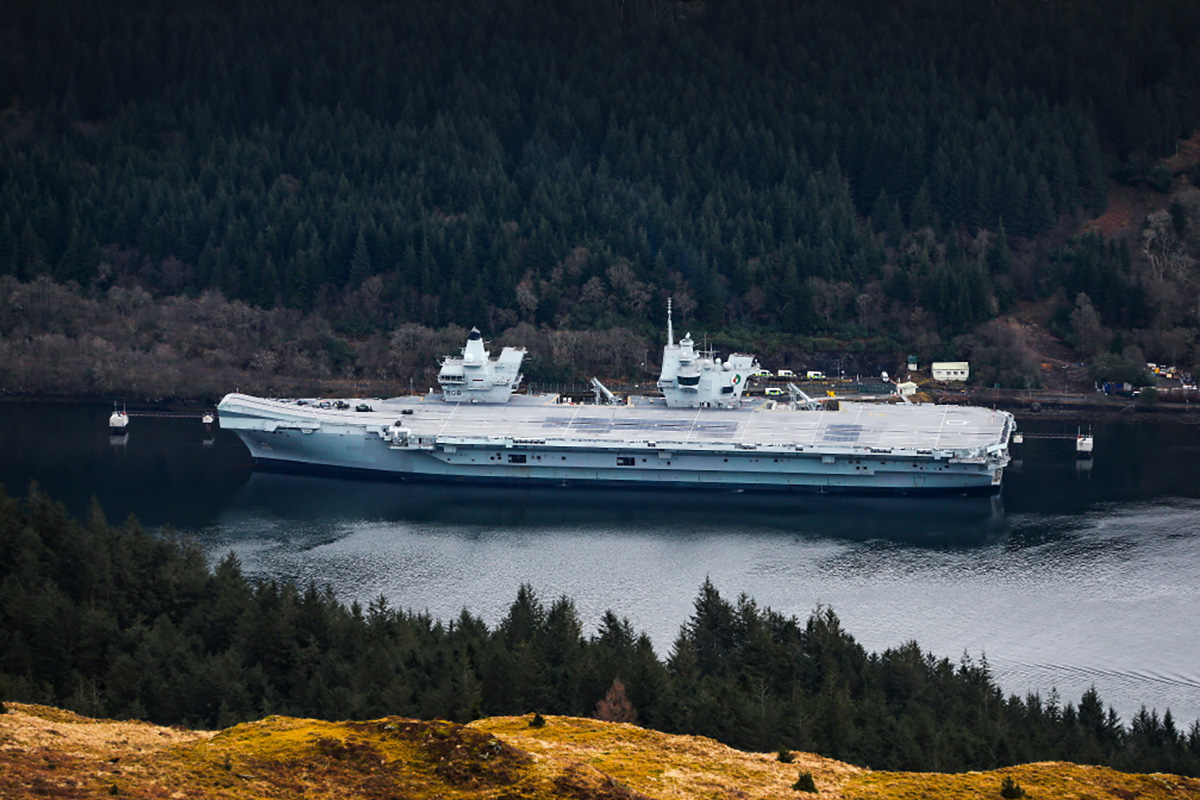
HMS Prince of Wales has arrived in Scotland to load ammunition ahead of Operation Firecrest, the Royal Navy’s major deployment to the North Atlantic and High North, the UK Defence Journal understands.
The 65,000-tonne aircraft carrier left Portsmouth earlier this month and is visiting Glenmallan for a routine logistics visit, taking on ammunition and supplies before the deployment gets underway. Glenmallan, on the western shore of Loch Long in Argyll, is home to a munitions facility and has historically been used by Royal Navy vessels for ammunition loading ahead of major deployments.
Operation Firecrest, announced by the Prime Minister at the Munich Security Conference in February, will see the carrier strike group deploy across the North Atlantic and High North, with HMS Prince of Wales leading the force. The operation is designed to deter Russian aggression, protect critical undersea infrastructure and demonstrate the UK’s ability to project force at scale within a NATO framework, coming against a backdrop of a 30 per cent increase in Russian naval vessels threatening UK waters over the past two years.
The deployment will include activity under NATO’s Arctic Sentry mission and exercises alongside NATO’s Standing Naval Maritime Group 1, which is being led by the UK throughout 2026. Parts of the operation will fall under NATO command, including close cooperation with Joint Force Command Norfolk.
The Ship
HMS Prince of Wales (R09) is the second of the Royal Navy’s Queen Elizabeth-class aircraft carriers and currently serves as the Fleet Flagship. Commissioned on 10 December 2019, the date marking the 78th anniversary of the loss of her Second World War predecessor to Japanese air attack off Malaya, the ship displaces around 65,000 tonnes and measures 280 metres in length with a 70-metre-wide flight deck. She was assembled at Rosyth Dockyard from blocks built across shipyards around the UK, with construction beginning in 2011.
The carrier is designed around short take-off and vertical landing operations, operating F-35B Lightning II fighters from a ski-jump ramp alongside Merlin and Wildcat helicopters. She can embark up to 36 F-35Bs and four Merlin helicopters in standard configuration, with surge capacity for significantly more aircraft. The ship is powered by an integrated electric propulsion system using Rolls-Royce MT30 marine gas turbines and Wärtsilä diesel generators, giving her the ability to move approximately 500 miles per day. She can accommodate around 700 ship’s company with total onboard personnel rising to around 1,600 when the full air group and command staff are embarked.
In 2025, HMS Prince of Wales led the UK Carrier Strike Group on an eight-month deployment to the Indo-Pacific under Operation Highmast, conducting over 1,000 F-35 sorties and engaging with more than 30 nations before returning to Portsmouth. She now heads north for Operation Firecrest, her most significant NATO-focused deployment to date.





Is it 65000 tons or 85000 tons?
It’s 65000 tons with British crew but at least 80000 when the Americans embark.
Other answers include…
It depends on load
and also which Ton/Tonne/short/long measurement is used.
I’ve gained $17,240 only within four weeks by comfortably working part-time from home. Immediately when I had lost my last business, I was very troubled and thankfully I’ve located this project now in this way I’m in a position to receive thousand USD directly from home. Each individual certainly can do this easy work & make more greenbacks online by visiting
following website—.,.,.,.,.—>>> JobatHome1.Com
“Annie” are you okay,are you okay Annie.Dont post that naff phishing stuff here pleade.
68,000 tonnes of north sea marine life sanctuary if this thing ever went into action.. im sure the Iranians could strike usa carriers with Russian &chines ISR and targeting capabilities. But it would have blowback and potentially escalate into a global war. We need to purge our nation of traitors & invaders and build up industrial capacity and technology before our tranny pedophile government mouth off to real powers that could cut our cables in a flick of a limp wrist!
I think she came in at 68000t in the end, anyway that will be her standard displacement, usually some fluids and stores, some crew i.e. enough to move about. 80000t will be her deep load, with full everything from baked beans through spare parts & weapons, full fluids, expeditionary crew (i.e. marines) and 40+ aircraft.
Depends on how many busses are on board to measure how long she is.
Brom, good point. Wkipedia says: Estimated at 80,600 tonnes (79,300 long tons; 88,800 short tons) full load
By all definitions that I have read, including many American ones, she is a supercarrier, no matter what Trump thinks.
Depends if you categorise ‘super-carrier’ as merely a matter of tonnage, or of capacity, or of capability, or as a mixture of the three.
The term super carrier refers purely to tonnage.
I don’t give a monkeys at the tonnage myself, as long as it does it’s job, is effective, and has sufficient aircraft that have the weapons needed.
65k, 70k, it’s bigger and better than the Invincibles. Who cares? It’s not Top Trumps.
The British have used ‘standard displacement’ in all official documents for ships since the Washington treaty. This is essentially the ‘unloaded ship’ number. This was a cheat-code essentially to get around limitations on actual fighting capabilities. Full load displacement is pretty much always much higher on a warship. E.g. a Ford or Nimitz class is not 100,000 tons standard. I believe they’re actually closer to 80-85,000. However, USN practice is to claim full load rather than standard.
As far as whether the QEs are or aren’t supercarriers, they are roughly equivalent in tonnage and physical size to a Forrestal, which was the first of the so-called ‘super-carriers’ so they definitely qualify.
Super dooper.
Tonnage is interesting but it’s the number of aircraft carried I would have thought. The U.S.S. runs about 75 aircraft per carrier. As I understand it C de G of France usually embarks around 30 Rafales, a couple of Hawkeyes and some helicopters. So QE/POW are more like the latter. We’re never likely to see her carry any more than that.
The rule of thumb is that it’s roughly 1 aircraft per thousand tons if you’re squeezing them on there. The QEs can carry many more aircraft than they are carrying. Some of that is a money thing. Some of it is a desire to limit the chess-games required to maneuver aircraft.
O.K. As things stand we’re lucky to see 20/24 35’s every year ot two . It’ll be ten years before we ever see 36, if ever.
I know, but that’s a money thing. It’s not that the ship couldn’t handle more.
Agreed. It is money but weren’t getting any or the budget is being fiddled. So the problem remains the same.
Yeah but it is all about money. Unless we have the resources to deploy 36 F35’s on it as it was designed to operate then its not operating to its full capability so as a system it’s sub-optimal. It needs to be seen as a system (Carrier + Aircraft) and the appropriate money spent on that system to make it fully effective. Its like buying a battleship and then skimping on the ammo.
Yes but the F35 is roughly 15-20 times more effective than the Rafale or the F18 so having even a reduced air group of 12 F35 makes Queen Elizabeth a much more capable weapon system.
FYI The Charles De Gaulle normal load of Rafale is 20 and they are only available for part of the year. I’ll take a permanent deployment of 12 F35 available with a surge capacity to 24 any day of the week over that.
So the question is what Jim? I justed stated facts.
Jim, I don’t think anybody is disrespecting the QEs. They’re fine ships. I think everybody wishes there was higher utilization of the space. Ie if you’re going to go big, it would be nice if you could fill the deck.
But the money’s not there. It is what it is. Hopefully, the ‘hybrid airwing’ pans out.
The ships were never meant to be permanently covered in jets. A Queen Elizabeth class is not a Nimitz class. It’s a mobile FoB able to operate helicopters and fixed wing aircraft depending in the mission fit.
It comes with a level of flexibility a Nimitz class or the CDG cannot rival.
People need to get past the “proper” carrier narrative they picked up in the 1970’s.
Eh. The Nimitz class has done similar things. During the deployment to Haiti many years ago, they sent an army division’s worth of helos on a Nimitz with no embarked fast jets. So, the ‘more flexible’ narrative doesn’t match reality. A flat-top is a flat-top. It’s a mobile airfield able to carry, launch, and recover aircraft at sea. You’re making a false-equivalence here. Nobody is saying it’s supposed to be permanently covered in jets. It’s just that on those occasions when it IS acting as a carrier, it would be nice to carry more.
There’s no need to be defensive. I like the QEs. I just wish they weren’t being constrained by budgets and could have a full complement of escorts and aircraft.
Morning Jim, I just think “people” are concerned about numbers available.
And rightly so.
Some “People” also question the worth of having two Super Carriers whilst the rest of the fleet Is being sold off, given away, left to rust up Fareham Creek, almost permanently under repair or just not leaving port.
Also, rightly so.
Don’t take It personally, It’s just people’s concerns.
Well said Jim.
Bollox. The QE’s were designed to carry and operate 36 fast jets.
The problem with carriers is, everyone talks endlessly over aircraft numbers. And yes, that’s what aircraft carriers are for. And naturally people compare to the US Navy carriers, because that’s the image everyone has of what carriers should look like. But we aren’t the US Navy. Even deploying 24 F35s is a massive capability. And it would be 2003 Op Telic Tornado GR4 deployment was the last time we deployed a greater number of a single fast jet type. (32) So that puts it in perspective a bit.
Yes Robert, Our Inventory has most certainly been decimated since then.
It has. Been we have some much more capable assets now.
So does a US carrier stop being super when they offload the aircraft?
The charkes de gaul regularly deploys with many fewer than that. Sometimes as few as 8 rafaels depending on the mission.
CdG routinely deploys about 18-24 Rafale so about 25 aircraft total routinely. The US carriers might have 75 aircraft total but most deployments at least for the last decade or so have been lower (65-70 at best) – about 44 of those are jets.
it’s also a much more fixed wing-heavy air wing that the UK which has much greater capabilities from its helicopters (ASW, ASuW, transport) and has deployed 30+ aircraft (up to 40) for its air wings so far. Moving forward it is likely that a typical air wing might be about 25 aircraft on CdG (~20 Rafale, 2 E-2, 2-3 helicopters for bare minimum SAR a bit of ASW). I expect a routine major deployment for the UK might be akin to CSG25 so about 32-35 aircraft (18 F-35, 10-12 HC4/HM2/AEW Merlins about 4 Wildcat) but that might go up to about 40 if there’s a push for 24 jets as standard. I could also see it going lower for other deployments depending on requirements (e.g. upcoming operation doesn’t really have a need for a large jet complement so it might be a basic defensive squadron of 8-12).
So comparing numbers more evenly you get about 25 for France, 35 for the UK, and 65 for the US – roughly. But there’s much more important factors ultimately. UK is extremely lacking in weapon options for its air wing and has limited AEW while France is lacking in ASW capability and lacking the stealth element, for example.
Things will only get increasingly hard to compare in the future with drones, though. It won’t be as simple as ‘this carrier has 40 aircraft so is more capable than this one with 30’. If you could the small VTOL drones on CSG25, HMS Prince of Wales had a peak air wing of about 50 aircraft across the entire CSG but obviously these aren’t comparable to other platforms. In the same vein you could put 80 FPV drones on a cargo ship and say your carrier is more capable than a Nimitz. The QE-class will increasingly use drones for different roles including a lot of major tasks so we’re unlikely to necessarily see manned aircraft rise significantly, but more likely they will remain the same or perhaps even decrease slightly but improve capability as drones augment the fleet. You might get 18 F-35s, 12 helicopters (only 30 aircraft total) but then 10-20 drones filling strike, AEW, tanker, and ASW roles.
It would probably be easier if all ships were just aircraft carriers but the media pick the terms I suppose.
The number of aircraft and there type should be determined by the objective. Defence policy should be defined by foreign policy but it rarely is. The first is “cheap”, the second isn’t., so it invariably gets cut in real terms if not in pound notes. Numbers are difficult. Thirty plus F35’s and AEW/ASW assets for a strike carrier? Hybrid with a future F35/Drone mix? A strike/amphibious over the horizon insertion capabilty? Global Britain said the previous government. The Hi North says this government. What will the next one say?. It’s like watching a demented tennis match with defence being the ball bouncing between the cheapest and easiest court.
As for the aircraft there is a lot of talk about the F35 and if it were some sort of super weapon. At the moment in can drop a bomb and only 5/6 of those whilst retaining stealth. Spear 3 had an ISD of 2025, the 2028, now early30’s,. The Anglo/French Future Cruise? Who knows? For AA a pair of asraam on wingtips?, four Meteor(not confirmed) in the internal bay? We also have to do something quickly about AEW.
Commitment and direction are the two most vital requrements now. The problem is that the forces and industry are not getting either.
The topic of Strategic requirements is a difficult one because it’s never historically been something that changed so rapidly, and shouldn’t be specific to any particular government. Historically we’ve been Euro-centric since the withdrawal from East of Suez, but that whole stance shifted with Brexit to the global Britain approach. That lasted about 6 years before rapidly returning to Europe with the Russian invasion of Ukraine. Arguably that reflects the reality of defence requirements in the UK and where the real danger is coming from, so one would hope this policy shift will remain regardless of government (though with increasingly extreme parties in play who knows what drastic changes could be made). There are also so many hotbeds of activity beyond Europe that may demand our attention.
As it stands I think the QE-class have largely gone in a good direction considering everything. They are much more versatile than France’s option at least in the way we operate them so far (e.g. with an increased ASW focus), but as you say it’s not specialised the same way our foreign policy approach isn’t. I don’t really see a better option for this really. You could commit to the high north but then they aren’t efficient solely as ASW carriers, and prioritising fixed wing strike overseas above all else would be costly and questionable given the assets available to support them.
It’s a bit of a separate issue but you are largely right about the weapons fit, which is massively letting down the carrier strike element at the moment, although you are missing that fact they operate AMRAAM which is a huge capability given the platform. Meteor might be an improvement but as it stands F-35 with AMRAAM is functionally superior to most of what is being fielded elsewhere. There’s also a move toward getting SDB in soon too which is well needed as a standoff interim capability before Spear comes in. Stratus seems unlikely but a long range heavy strike option is needed too (JSM fills certain roles to a certain extent but has a limited warhead for heavier targets). Then again in the high north Britain is playing to its strengths – ASW and air defence are excellent whereas strike is very limited (but the demand for strike capability against high end adversaries is debatable at the moment anyway).
As I’m sure you know strategy is about having a plan that is consistent but is able to have tactics within it adaptable so as to make any adversary think twice…..at least!
To my mind we need to ensure that all three services are flexible, regardless of their size. Given all the difficulties they have faced over the last thirty years what we need now is calm. The most important action is to ensure that the assets we do have are all deployable as required and that recruitment is stabilised. I would rather have a smaller force of highly capable units capable of quick reaction than the current muddle, whuch for example, has the R.N. not being able to find a destroyer, the RAF not having decent AEW capability and the army hard pressed to deploy in any significant way.
Having established the foundation perhaps there will a government that spends the money to build the house.
Glen Mallan is where the loading jetty is.
The munitions facility is DM Glen Douglas, just to the east and north east. it is a vast NATO facility and the magazines are underground, built into the hills. It is, alongside Kineton, our major munitions store. I understand the Northern Bomb stock is there. It also has a rail link.
One of our critical KPs.
Places like this always worry me. Doubly so in the age of cruise missiles and drines as the are key points of vulnerability. I just don’t trust HMG to give thsm some decent defensive options.
Well G Mallan, Glen Douglas, Coulport, Faslane, Gareloch OFD, and Strone Camp are all close to each other. Maybe some GBAD missile type would cover all?
Neither do I! Douglas at least is very well spread out, and much underground.
Talking of protection, I’m concerned that the MoD Police det that used to guard Glen Douglas was withdrawn as part of recent reductions, the place is no longer listed on MDP website.
I dutifully made a FOIA request, and, as usual, they refused to answer with the standard exemptions listed.
I have driven past Glen Mallan, the road runs right alongside it. How easy to stop further up and fly a Drone into it, negating the ease if munitioning ships without vertrep with helicopters, themselves rare as hens teeth the way we are going.
Yes, as always. SCUM.
O.K. As things stand we’re lucky to see 20/24 35’s every year ot two . It’ll be ten years before we ever see 36, if ever.
You have to ask yourself why some people constantly need to talk down their own country at every opportunity while over inflating the capabilities of others? Is it malice or genuine ignorance?
You’re right Jim. It’s a bit like constantly defending this government. Completely bonkers.
Or defending the forces, yes totally madness.
I’ll change to they “we’re all doomed narrative” right away
Jim it’s just worry mate.
It’s a British disease Jim. We are only happy when putting ourselves down.
There seems to be an obsession with counting jets on our carriers. I understood it for the early HMS QE deployments, but we have 47 F35b jets now, and there were plenty onboard for Highmast (enough so that one could have a holiday in India).
Unless we’re off to start a war wouldn’t 20 be more than enough for any situation that’s likely to happen?
I agree, an obsession with counting jets on our carriers and totally ignoring helicopters while simultaneously assuming every one else’s carriers are running at full capacity and conveniently passing over everyone else’s carrier flaws.
If our carriers don’t have 36 F35B’s on them then they are instantly described as a waste of money and even if they were they are stated as “not proper”.
The entire CVF concept and the doctrine behind it goes over peoples heads and they think because it doesn’t look like an American carrier or a British carrier from the 1950’s that somehow its inferior.
The same people and media for that matter then look at the AMERICA class LHD and fawn all over it without realising that a Queen Elizabeth is an America class on steroids and the F35B may be the most amazing aircraft ever developed.
Just out of curiosity, for anyone slightly in the know about such things, how many F-35 could QE class meaningfully load whilst also having a few refuelling/AWACS drones in future, if funding hypothetically wasn’t an issue? I am curious just how much we are under filling them.
I recall reading on on NL that this design, the “delta” CVF could carry 80, but that is very tightly packed and means moving things around is tricky; almost like a ferrying capacity. I would say 40-50 of all types would be respectable air wing. Say 24 f-35s, 12 UAVs and 12 helos ? Any takers ?
The Queen Elizabeth can embark 40 aircraft in normal load and its reported that it could embark up to 70 in overload conditions although operating 70 would probably affect flight operations tempo.
Not that I want to try it, but the maximum number of F35s on the QE will only be known in an emergency (Falkland war for example), I suspect it’s higher than conventional thinking.
Figures of 70 total Aircraft have long been mentioned In many Defence article/sites.
Some “Experts” on here know better though. 🤦♂️
Of course that depends if one has 70 aircraft in sevice to put on it but that figure might be high on the helicopter side of the mix,..
Don’t start…..! I remember! 😆
It’s like a broken record isn’t it !!!!!
He hasn’t surfaced yet.
I’m amazed at the responses we are getting here these days. I posted a perfectly factual comment, yet several responders have questioned whay I have said. Can I recommend that you all take one more attempt at reading what I said again. From the first word to the Last. All factual.😊
Agreed. It never hurts to reread a post a few times to find the true meaning but sometimes people are just spoiling to disagree, which spoils the dialogue.
I surely hope you are wrong and we see more F35’s before 10 years have passed. I also hope GCAP progresses rapidly.
As far as Jim’s “ask why some people constantly need to talk down their own country at every opportunity while over inflating the capabilities of others?” I am starting to think it’s a British thing, the yanks definitely do the opposite. Who knows what the French do :-).
Absolutely. I’m homest enough to admit I’ve read something quickly in a paper and fired off a response and then thought about it. There are a number of people here who seem to think that criticising the government, any government, is critcising the armed forces. It isn’t. Mixing one with the other detracts from what we should be doing to support our services,. Otherwise why bother commenting at all.
Morning Geoff.
Opinions are like Arseholes,
We all have them,
And they all Stink.
Unfortunately, some also suffer from verbal Diarrhoea 😁😁😁
…and sometimes quite a bit of 🐂…
Hi Geoffrey.
I think you’re right. Save all out war, we won’t.
I like to compare the capability to what was carried on an Invincible before, though, it’s a huge step up. They didn’t carry much more than 20 either, and usually far less.
I don’t compare to the old Ark Royal, as realistically, in todays money of 80 million a jet plus, how much would it cost to replicate a deck full of Buccs, Phantoms, Wessex, and Gannets?
Which Is why some of us question the need for two such large Carriers.
I bet there would be no arguments whatsoever If the Invincibles were replaced on a similar basis, maybe all the focus would then be on the Tornado’s not being replaced ?
I think there would be!
USN with big carriers, and us comparing our puny Invincible type replacements to the French CDG.
Invincible Class were limited, steel is cheap, bigger is more flexible.
You could say the same with the T42s, and why the T45s are bigger, with more space.
The cut of the entire Tornado GR4 force without replacement has been beautifully swept under the carpet mate….They tried by standing up 2 extra Typhoon Sqns to keep the Sqn count up, with the minor detail of no extra aircraft.
Otherwise, Sqn numbers would have collapsed to just 6, 5 Typhoon, 1 F35.
As it is, 7 Typhoon, 2 F35, far too few. I don’t include OCUs or the T&E Sqns.
It’s a British disease Jim. We are only happy when putting ourselves down.
Sure seems that way doesn’t it!
Unfortunately. The joys of social media doesn’t help. And everyone jumps all over the negative news.
If we had new but small carrier’s. We would see even more comments of embarrassing! and disgraceful. Equally if we had 3 QE class carrier’s with 200 F35Bs on order with 10 weapons integrated. People would still moan.
For the love of God, the carriers were built a decade ago. Give it a fucking rest will you.
Yep. The Invincibles, as you know were designed and built as ASW assets, with the Harriers coming on as a fighter. To me the original idea reminded me of the escort carriers from WW2. Convoy escorts and the capability to support amphibious operatioins. The upgrade in the number of Harriers made them more like mini carriers, nowhere near as capable as the QE’s. I will keep on saying, although I will no doubt be shot down by the “everything is alright” brigade, that we need an operational strategy and a commitment to keep both carriers in use, not at the same time, but ongoing with one of them at sea at all times. I doubt if it will happen though.
Looking forward to the day when our F-35s can actually fire Meteor, and stand off anti-surface/ship weapons. I know we need the numbers but part of me feels that HM Government shouldn’t Lockheed Martin any more taxpayers money until they complete these integrations. It’s taking far too long.
If we had new but small carrier’s. We would see even more comments of embarrassing! and disgraceful. Equally if we had 3 QE class carrier’s with 200 F35Bs on order with 10 weapons integrated. People would still moan.
So folks pointing out the total sham of the British armed forces are just “moaning”??
No. But even if things are a lot better some people would still moan. And I’d hardly call our Armed Force’s a sham. We all know were we are short, but we do have some excellent capabilities. And what we do have deployed to Cyprus and the Middle East is testament at what we can do at range. One RAF Regiment anti drone unit has shot down over 100 Iranian drones in Iraq. I don’t see any comments commending them and what they have achieved.