

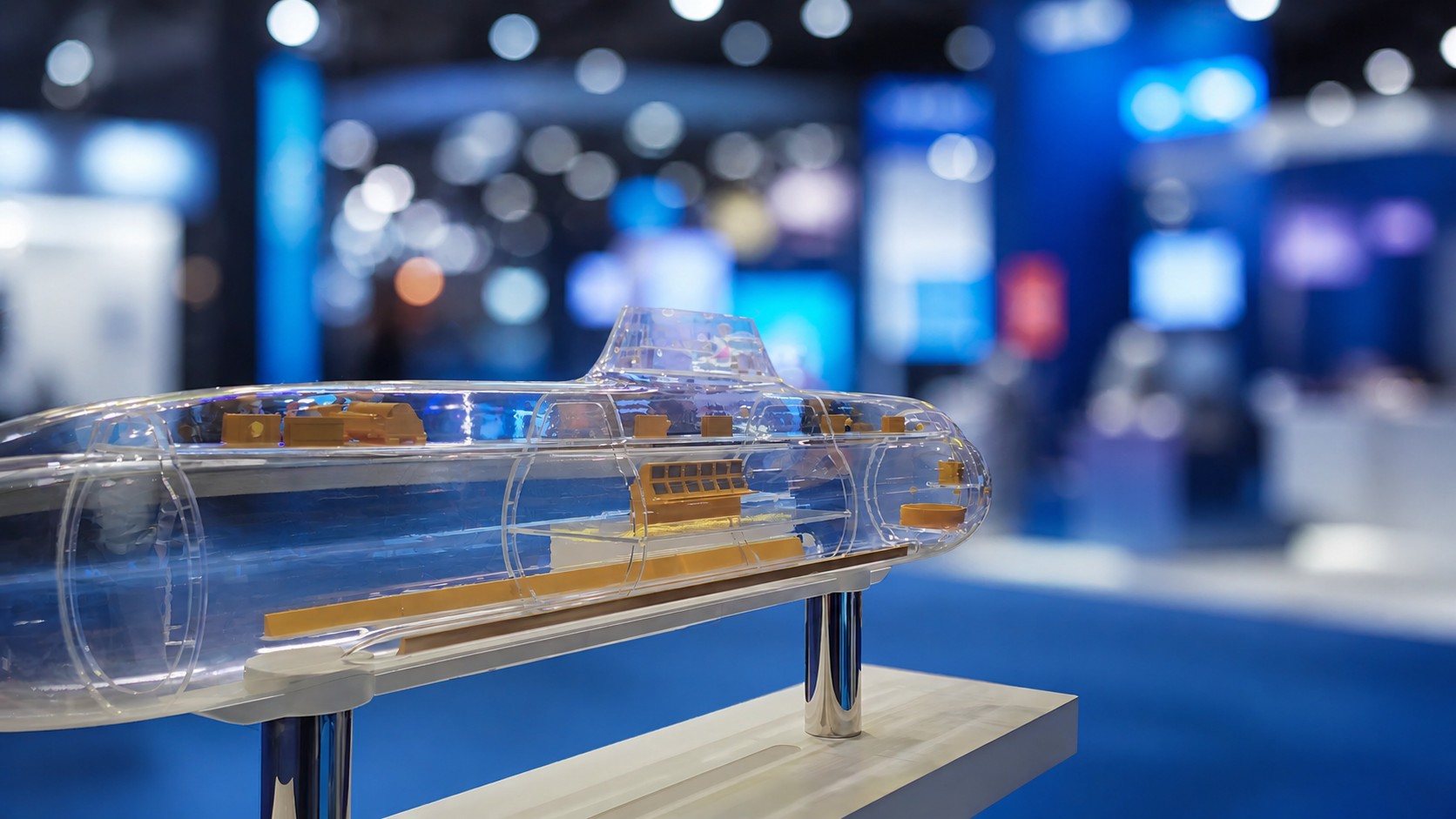
The Combined Naval Event returns to Farnborough this month as the maritime security environment grows more contested by the day.
CNE 2026 opens on 19 May, bringing together more than 2,200 attendees from defence, government, industry and academia for three days of exhibition, conference sessions and strategic discussion, according to the organisers.
Russian activity in the Black Sea and on the Baltic seabed, Chinese pressure in the South China Sea, and Houthi attacks on commercial shipping in the Red Sea have all served as reminders, in recent years, that the maritime domain is no longer the stable global commons it once appeared to be. Autonomous systems, seabed warfare, sub-threshold aggression against critical underwater infrastructure and the sheer pace of technological change all feature heavily across the three-day agenda.

The opening plenary on Tuesday 19 May will hear from General Sir Gwyn Jenkins, First Sea Lord and Commandant General Royal Marines, addressing the Royal Navy’s Readiness Warfighting Plan. Senior figures from BAE Systems and NATO are also scheduled for the main stage, with Admiral Sir Keith Blount speaking to the role of NATO navies in restoring deterrence across the Euro-Atlantic region.
Six concurrent theatres run across the three days, covering shipbuilding strategy, undersea warfare, autonomous systems, digital targeting and seabed protection. Surface fleet modernisation sits alongside dedicated submarine programme sessions including updates on AUKUS, the Polish Orka programme, France’s Suffren-class SSN and the German-Norwegian 212CD collaboration. Mine warfare, which tends to receive less attention than its strategic importance warrants, gets dedicated focus this year, with contributions from Finland, Denmark and Belgium.
The underwater strand of the programme reflects a broad consensus that the subsurface domain has become a primary theatre of competition. Sessions will cover the deployment of uncrewed underwater vehicles, anti-submarine warfare in the North Atlantic, protecting critical undersea infrastructure and the continuing threat posed by Russian submarine activity in the GIUK Gap. Vice Admiral Richard Seif, Commander of the US Submarine Force, and Rear Admiral Andy Perks, Director Submarines at the Royal Navy, are among those scheduled to speak.
Lessons from active conflict run throughout. Ukraine’s experience of asymmetric naval warfare in the Black Sea, including the operational use of sea drones, underpins several sessions, with contributions from the Snake Island Institute and representatives of the Maritime Capability Coalition for Ukraine. The message being drawn for Western navies is fairly consistent: the ability to adapt quickly and field unconventional capabilities at pace matters as much as platform quality.
Thursday’s final day introduces a new Navy Forums format, pairing panel discussions with working group sessions on defence acquisition, investment and personnel. Practical sessions on selling to the MoD, engaging with prime contractors and attracting venture capital sit alongside a ministerial address from Luke Pollard, Minister for Defence Readiness and Industry, reflecting a growing view that industrial agility and commercial access are as strategically important as operational capability.
With delegations attending from Australia, Brazil, Japan, Norway, Singapore, South Korea and across the NATO alliance, CNE 2026 illustrates both the reach of the international naval community and the degree to which maritime security is increasingly understood as a collective responsibility rather than a national one.
The Combined Naval Event 2026 runs from 19 to 21 May at Farnborough, register here.




So that’s what all our Admirals do. Professional b*llshitters waffling to each other about pie in the sky projects while the RN continues to dwindle in size, ability and importance. The management classes are running the show and they’ll tell each other how well they’re doing. They’ve infested everything from politics to industry to education to defence. Until we get rid of these trough dwellers we’re going nowhere but down.
Problem is that for all the asymmetric stuff the heavy hitters are still needed as the heavy threats are still there as well. It is just the threatscape has more dimensions. So a lot of the low end and uncrewed stuff will deal with other low end and uncrewed stuff but fail to deal with the old school….heavy hitters…..
I think some of drive to the naval dronesation is a bit trying to do things on the cheap. Sea is not so easy to dronise like land combat where an aerial fpv can cost only 1000.
It definitely is. I am yet to see a single one of these drone suggestions that has been presented that is actually able to do things it claims. Often the range is pathetic and the speed is woefully inadequate to keep up with the Russian submarine, not to mention they can’t generate enough power for an effective sonar so what do they actually do
The asymmetric stuff is brilliant and absolutely the right move in the littoral I think, but you’re quite right re heavy hitters. Don’t have much of an impact on the world without them
I’ve gained $17,240 only within four weeks by comfortably working part-time from home. Immediately when I had lost my last business, I was very troubled and thankfully I’ve located this project now in this way I’m in a position to receive thousand USD directly from home. Each individual certainly can do this easy work & make more greenbacks online by visiting
following website—.,.,.,.,.—>>> JobatHome1.Com