

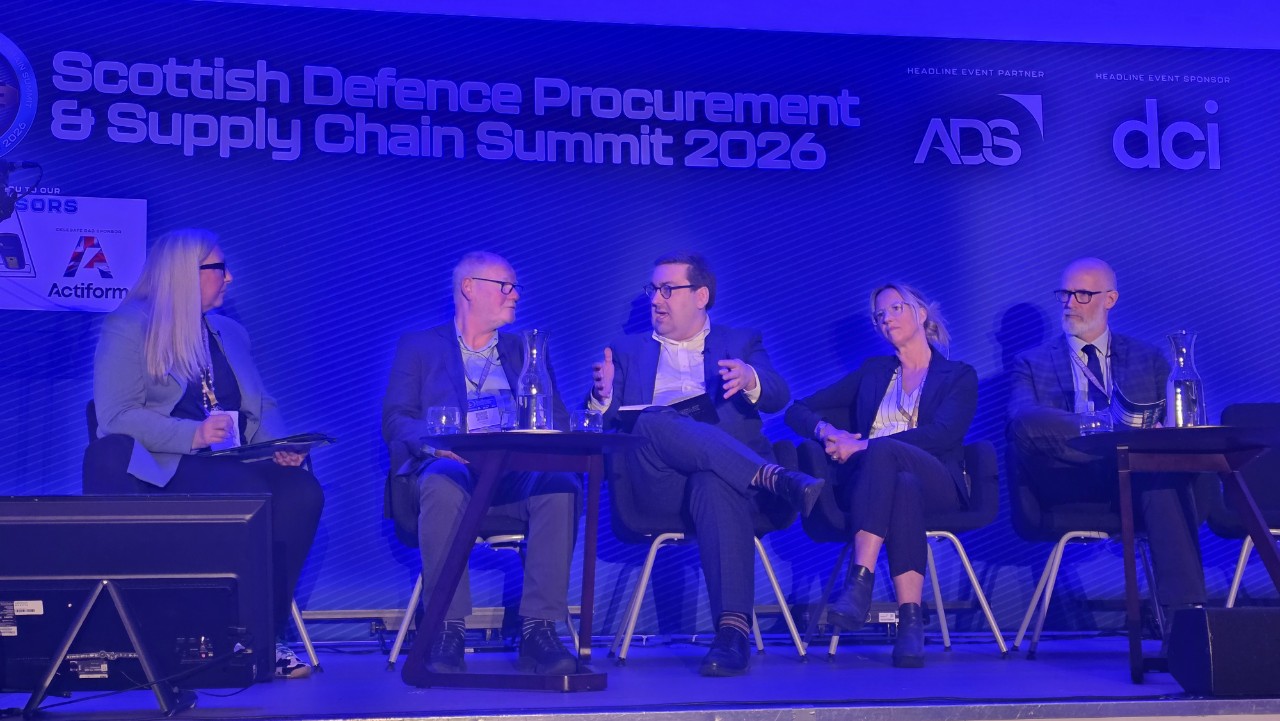
One of the most practical sessions of the day at #SDS26 this week brought together voices from across the defence innovation ecosystem to ask the question Scottish SMEs most needed answered: how do you actually get in?
The panel was chaired by Coreen McCubbin, Chief Technology Officer at the National Manufacturing Institute Scotland, and featured John MacSween, Managing Director of Malin Group; Mark Darvill, UKDI Command Hub Transformation and Development Lead at UK Defence Innovation; Jeremy Wimble, Senior Programme Manager for Defence at TechUK; and Leonore Frame, Domain Specialist for Maritime, Defence and Security at Scottish Enterprise.
If you’re waiting for the tender notice, you’re too late
John MacSween, drawing on 25 years in the sector, told delegates that by the time a defence opportunity appears publicly, the groundwork has usually been laid for years. “Any business opportunity you see in the defence sector will usually have been predicated by anything up to 10 years of shaping and discussion. If the first you hear of an opportunity is when you see an advert, you’re probably too late to the table.”
His advice went further, he told companies new to defence to approach it as a national endeavour first. “How do you support that national endeavour? Approach it with curiosity, try to understand where you fit within that ecosystem, and bring your subject matter expertise to bear on the wider problem without an expectation of a contract initially. By doing that you’re engaging the customer, and credibility compounds over time.”
He was also direct about the importance of having defence experience in the room. “If you’re approaching defence work and you’ve never worked in defence before and you don’t have anyone on your team who has, you’re probably going to struggle. You won’t understand the customer, you won’t understand what they’re looking for.” His practical suggestion was to sign up to the Defence Covenant and bring in ex-service personnel or people with defence backgrounds. On timelines he said that most of the programmes his company works on today are five to ten year programmes, and those conversations started five to ten years ago.
A Scottish defence cluster is coming
Mark Darvill set out the central challenge as one of access, specifically the difficulty smaller companies face in getting close enough to defence problems to offer meaningful solutions. UKDI has built regional defence and security clusters across England, bringing industry, academia, and government together around shared problem sets through what he described as a triple helix model. The results had been marked, both in the quality of proposals coming in and the level of collaboration between companies. “It is most definitely about access. It is about us bringing our problems to you.”
He then made what was arguably the most significant announcement of the session. “We are probably at the point of pulling the trigger on the starting gun for a Defence and Security Cluster for Scotland.” UKDI has now launched 12 clusters across the UK, with a 13th due in Yorkshire the following month. He asked for a show of hands from those who would want to get involved with a Scottish cluster.
The response from the floor was emphatic, every hand went up.
When Brigadier Andrew Muddiman raised the question of whether a single cluster could effectively cover the whole of Scotland given its size and the spread of its defence industry, Darvill was clear that the model is not top-down. “Clusters are not owned by MOD. We work with the region to define what is best for that region. We’re not coming here trying to say one size has to fit all.” He pointed to the South West cluster as a useful parallel, a region with significant but relatively stagnant defence spend that the cluster model had helped unlock.
“It is all about how you make those serendipitous connections between companies that would never normally talk to each other.” On pace, he outlined UKDI’s ambition to deliver new capability into users’ hands within two years, and described dual use not as a bolt-on but as a core strategy. “We are looking at how we can work with companies from alternative sectors to bring technology that has been developed elsewhere.”
Frank words on what is still missing
Jeremy Wimble was positive about recent reforms, singling out the creation of UKDI as the single most significant positive change in the defence innovation ecosystem. But he did not dress up the gaps.
“We are 13 days away from the anniversary of the Strategic Defence Review and we still do not have a Defence Investment Plan. That is having a real negative impact on industry. We are seeing companies having contracts cancelled with no notice, putting SMEs within their supply chains at risk. Nothing helps a company scale like the customer buying things.”
On practical routes in, he pointed to UKDI innovation challenges, the Government Communication Centre’s problem-based approach, describing it as a Q branch that had found a solution to low-temperature battery performance from a frozen food manufacturer by simply defining the problem clearly and putting it out wide, the neutral vendor framework for innovation, industry days at pre-ITT stage, and NATO’s Diana accelerator. “Despite everything I said at the top, there are actually a number of front doors, a few windows, and a couple of cat flaps through which companies can start reaching into the defence ecosystem.”
Regarding the Defence Office for Small Business Growth, he was cautiously positive about its leadership but clear that its value lay not just in helping companies approach from outside, but in driving culture change within the MoD itself. “We need them to be driving change within MOD as well as within industry. We’ve had examples in recent years of tenders that say they are SME friendly, but the required turnover sits above the MoD’s own definition of what an SME is.”
What Scottish Enterprise can do now
Leonore Frame set out the support available to Scottish companies preparing to engage with defence: enabling grants for market research and feasibility work, investment readiness support, the Manufacturing Advisory Service, and capital grants at various scales.
More significantly, she described active work to align Scottish Enterprise’s offer directly with UKDI’s pathways, removing duplication and making the journey smoother. “Let’s not duplicate or try to be what we’re not. Let’s do that together.”
The takeaway
The session was one of the most useful of the day and the announcement of a forthcoming Scottish Defence and Security Cluster was the standout moment, but the wider message was equally important: the support infrastructure exists, the doors are opening, and the companies engaging now, before the contracts appear, are the ones best placed to win them.












I’ve gained $17,240 only within four weeks by comfortably working part-time from home. Immediately when I had lost my last business, I was very troubled and thankfully I’ve located this project now in this way I’m in a position to receive thousand USD directly from home. Each individual certainly can do this easy work & make more greenbacks online by visiting
following website—.,.,.,.,.—>>> JobatHome1.Com
I’ve gained $17,240 only within four weeks by comfortably working part-time from home. Immediately when I had lost my last business, I was very troubled and thankfully I’ve located this project now in this way I’m in a position to receive thousand USD directly from home. Each individual certainly can do this easy work & make more greenbacks online by visiting
following website—.,.,.,.,..,—>>> PayAtHome1.Com