

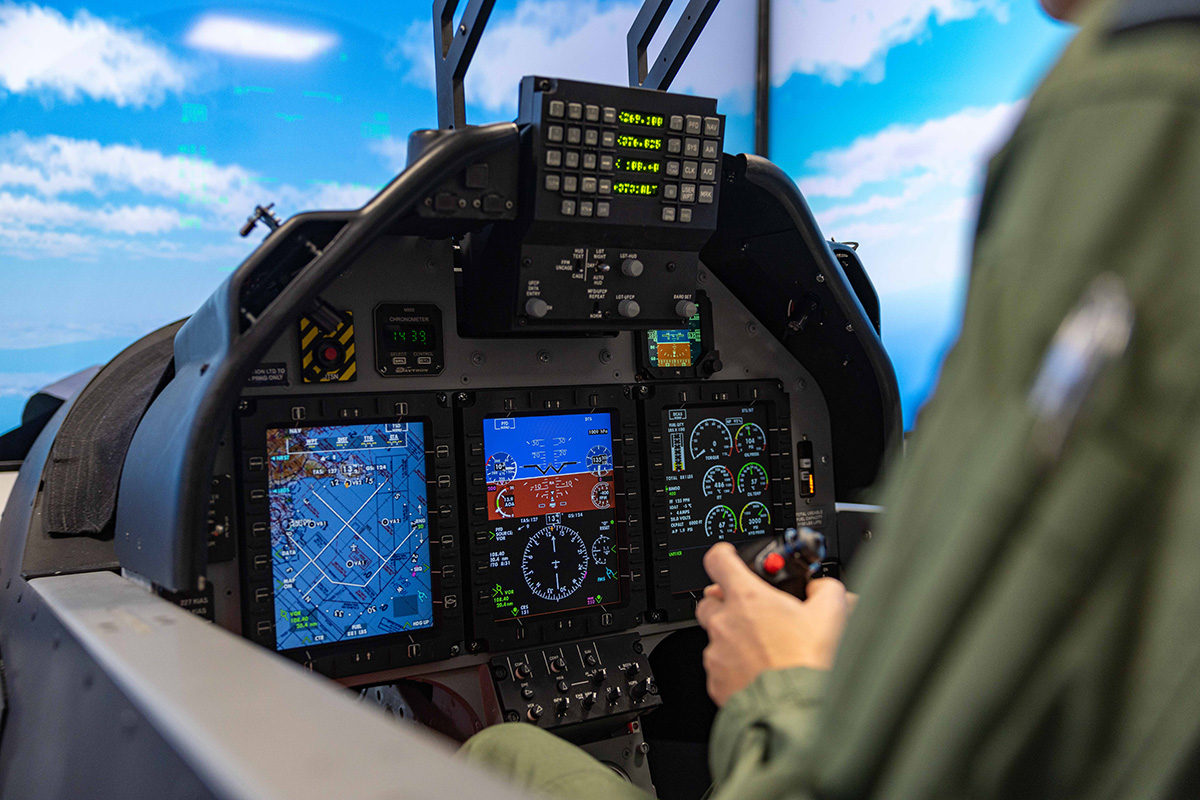
The Royal Air Force is increasingly relying on synthetic training technology to accelerate pilot development and reduce the number of training sorties that need to be repeated, the UK Defence Journal understands.
Air Commodore Rob Caine, speaking as part of an RAF feature on simulation, framed the rationale in terms of cognitive capacity, drawing on research establishing that human beings have only five to seven chunks of conscious capacity at any one time. “Operating within a battle space is so complex; with unmanned threats, enemy fighter jets, ground to air threats, your own friendly forces and maintaining comms channels means you don’t have time to think, oh, where’s that switch, again,” he said. The aim of simulation training is to commit as much procedural knowledge as possible to what he describes as the “unconscious competence box,” freeing pilots to focus on mission objectives rather than basic aircraft operation.
The RAF’s use of simulated training dates to 1910, when a model cockpit was first introduced, though it was not until the 1950s that a computerised simulator was built for pilots. Air Commodore Caine recalls beginning his own training with a cardboard cockpit, a method he describes as genuinely effective for familiarising pilots with cockpit layout before they ever fly. A significant step forward came in 1998 and 1999 with the introduction of the Hawk T1 simulator, which introduced visual systems and a record and replay function allowing instructors to load a perfect demonstration for trainees to observe from the cockpit, complete with stick movements.
A layered training approach introduced 15 years ago now structures progression from computer-aided instruction through desktop trainers and flying training devices before trainees reach a full mission simulator. “We have to be conscious of how we use the tools, and not let negative behavioural patterns develop,” Air Commodore Caine cautioned, noting that certain physical habits practised in simulators do not translate to real aircraft.
At the leading edge of the RAF’s synthetic training infrastructure is the Gladiator system, based at RAF Waddington. The system connects simulators across air, land and sea forces through a single central hub, enabling all three services to train together in a shared environment. Allied and partner nations can also connect directly into Gladiator, allowing RAF pilots to train alongside counterparts from the French, German and United States air forces in scenarios including dogfighting, formation flying and low-level navigation.
More recent developments include virtual and mixed reality headsets that allow pilots to see and interact with elements of the simulator in real time, and augmented reality headsets that can be used during live flying. “Instructors can load an enemy jet of any kind into the programme, and it is projected into the pilot’s headset, it will look and fly just like the real thing,” said Air Commodore Caine. The practical benefit is a reduction in the aircraft and personnel required per training mission. “Normally for such missions you’d need two jets, two pilots and two instructors. Now all you need is one jet, one pilot and one instructor. Each recruit gets more sets and reps of flying training missions, and that’s the greatest determining factor in a recruit succeeding.”
The RAF said the technology has already produced measurable results, with a reduction in the number of training sorties that must be reflown because a recruit has not met the required objectives, and more recruits passing the course overall.
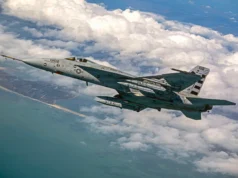


A bit of a tangent, but related to flight training, I see that the Red arrows have decided that from next year on they’ll be flying a 7 aircraft display team, due to the now limited and aging Hawk T1 fleet.
I know they’ve done this once or twice previously due to other reasons like accidents in season etc. But this feels like it might be the first step towards losing them altogether, which would be a shame. To be honest, I’m surprised they’ve survived this long with the scale of the other cuts we’ve seen.
I’ve gained $17,240 only within four weeks by comfortably working part-time from home. Immediately when I had lost my last business, I was very troubled and thankfully I’ve located this project now in this way I’m in a position to receive thousand USD directly from home. Each individual certainly can do this easy work & make more greenbacks online by visiting
following website—.,.,.,.,.—>>> JobatHome1.Com
A new advanced jet trainer is going to be purchased to replace the Hawk T1 and T2. You may have seen BAE Systems have teamed up with Boeing to licence build the T7.
I think the T7 will be far too expensive to purchase and operate by the RAF, I expect fast jet training will be privatised, jointly manned with a leased fleet.
The reds will shift onto a cheaper turboprop aircraft or disband altogether.
I think we will purchase the M346. And the Reds will live on. Some seem determined for them to go. But will cry blue murder if they Government ever did. We need to stop talking ourselves down and about getting rid of great institutions like the Reds. If the French, Italians, Canadians, Spain, Saudi, South Korea and the USAF/US Navy get rid of there display teams, then it’s a fair conversation. Until then, we need to fight like hell to keep them.
Exactly mate.
I hope they aren’t disbanded – the UK have historically demonstrated great pride in their excellent fighter display teams, it would be a huge disappointment to lose them! I wonder how many RAF Pilots were inspired to become pilots as a result of seeing the Red Arrows, the Red Pelicans or the Black Arrows who still hold the world record for the number of aircraft (22!) to perform an aerobatic loop – every effort should be made to keep them!
I agree it would be very sad, but this government has left defence in decline and I really can’t see they have a future past 2029, as things stand.
Unless they shift to turboprops, probably leased examples.
The problem being that they have partially existed over the last 20 years at least as a selling tool for the Hawk and ( I believe) subsidised by BAE Systems.
That aspect is obviously now over, with the RAF increasingly using synthetic training and advanced trainers becoming very expensive, it all becomes very hard to justify, especially with a tight budget.
Can you really order a fleet of 40 very expensive trainers, purely to use a quarter of the fleet to support an air display team??
Very hard to justify unfortunately…
What other option do we have…? Until the corrosion issues, and spare parts availability, for the F35 are resolved we will have to rely on simulators to train our pilots.
F35 isn’t used in elementary, basic, or fast jet training stages.
Only once pilots get to the OCU will they use F35s, and by then they are trained pilots.
Did you read the article
It’s Virtually the Reality nowadays.
Plain common sense, fly the plane to fly the plane, but use simulators to simulate everything from a QRA terrorist airline situation to WW3.
Things have moved on a tad. Flying training isn’t going to stay the same as past decades
This seems to be about the use of simulators for experienced pilots ie not basic flight training. Long overdue. Why did we not have combat flight simulators 10 or 20 years ago?