

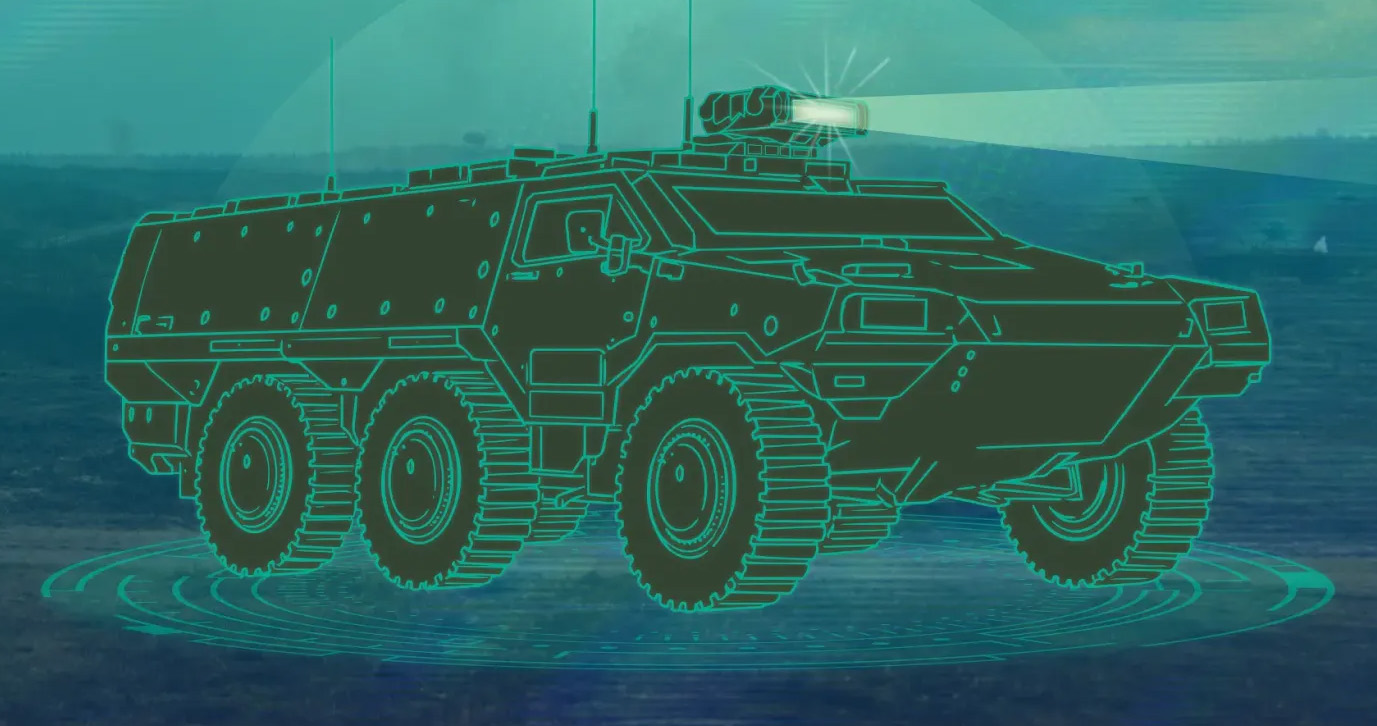
Thales in the UK, working with QinetiQ, has been selected by the Defence Science and Technology Laboratory to develop and demonstrate a concept for a next-generation electro-optic countermeasure under the UK’s Next Generation Soft Kill programme, according to the company.
The work falls under the NGSK effort, which is examining how advanced electro-optic effects could feed into future Active Protection Systems for armoured vehicles. Soft-kill protection differs from hard-kill in that it seeks to defeat an incoming threat by disrupting its guidance, seeker or targeting rather than physically destroying the projectile.
Electro-optic countermeasures sit within that approach, working against weapons that rely on optical, infrared or laser systems to find and track their targets, a category that includes many anti-tank guided missiles.
According to Thales, the project will draw on the company’s background in threat warning sensors, defensive aids systems and electro-optic technologies to investigate integrated ways of countering incoming threats. The concept is to be developed in line with the UK’s Modular Integrated Protection System architecture, an open-standard framework intended to let sensors, effectors and countermeasures from different suppliers be combined on a single platform. Building to that standard is meant to keep the resulting protection scalable across current and future land vehicles rather than tied to one design.
The programme is structured around a competitive evaluation. Several candidate designs will be assessed, with one concept chosen to proceed to prototype development and testing. QinetiQ’s role centres on technology evaluation and assessment, drawing on the firm’s experience in that area to help judge whether the emerging capability is ready for operational use. Through the work, the two companies say they aim to show how integrated sensing and electro-optic effectors can support future protection systems while reinforcing sovereign capability in land platform survivability.
Dstl is the research arm of the Ministry of Defence, responsible for science and technology work that underpins British military capability, and it routinely places concept and demonstration contracts of this kind with industry before a requirement matures into a procurement. QinetiQ, which traces its origins to the former Defence Evaluation and Research Agency, is among the established suppliers for that type of test and assessment work.







Is Project Icarus still running along side this still?
It should be moving in to real world testing this year.
I’ve gained $17,240 only within four weeks by comfortably working part-time from home. Immediately when I had lost my last business, I was very troubled and thankfully I’ve located this project now in this way I’m in a position to receive thousand USD directly from home. Each individual certainly can do this easy work & make more greenbacks online by visiting
following website—.,.,.,.,.—>>> JobatHome1.Com
Interesting. I had to look that one up.
Stop bringing the french in. We must develop this tech ourselves. The french and their intelligence services are also one of the biggest IP thieves along with china.
The US Army selected BAE for the same few days ago… which is more “British”? BAE or Thales UK?
Even after the disaster of Watchkeeper? They’ve proven they’re unreliable, and will pass the buck for a decade.