

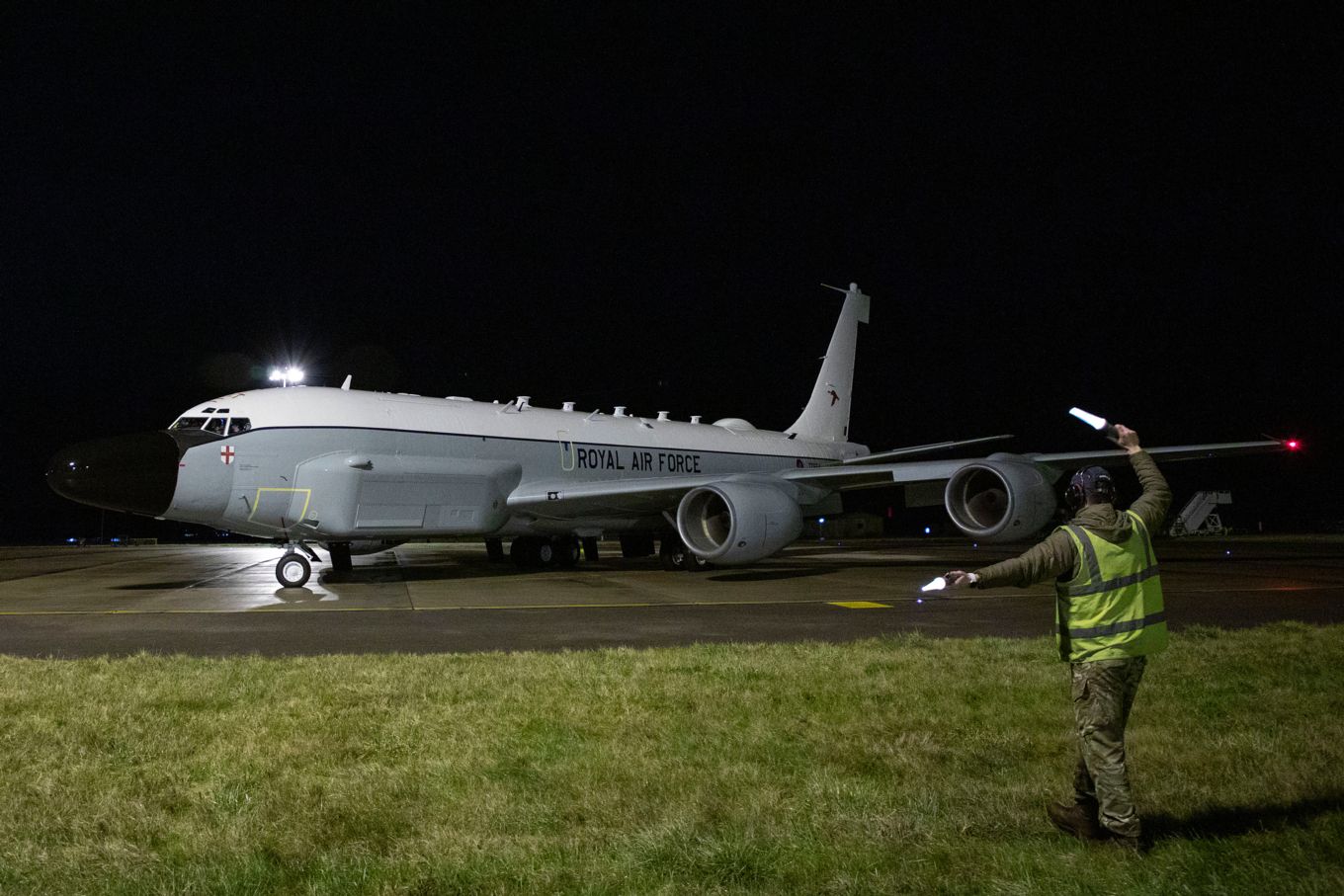
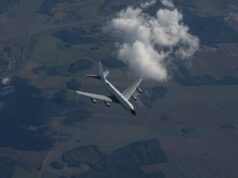
A Royal Air Force RC-135W Rivet Joint carried out a signals intelligence mission over the Baltic region on 27 May 2026, flying from its home station at RAF Waddington and topping up from a United States Air Force tanker before heading east.
The aircraft, registration ZZ666 and using the callsign RRR7227, was tracked on publicly available flight-monitoring data departing Waddington and routing across the North Sea toward the Low Countries before continuing on toward the Baltic. Before pushing east, the Rivet Joint took on fuel from a USAF KC-135 Stratotanker in an air-to-air refuelling area off eastern England.
Tracking placed the aircraft over the Baltic at around 14:00 UTC, holding at roughly 36,000 feet as it worked an area that runs up toward the Baltic states and the approaches to Russian territory around Kaliningrad and St Petersburg.
The RC-135W is the RAF’s premier signals intelligence platform, a heavily modified Boeing fitted with sensors that detect, identify and geolocate emissions across the electromagnetic spectrum. The aircraft intercepts communications and radar signals and passes the resulting intelligence to commanders and allied partners. According to the Royal Air Force, the type is a dedicated electronic surveillance aircraft that can be employed in all theatres on strategic and tactical missions, with sensors that, in the service’s words, “soak up” electronic emissions from communications, radar and other systems.
Flights of this kind have become a regular feature of NATO’s posture along its eastern and northern frontiers since Russia’s full-scale invasion of Ukraine in February 2022. The missions are deliberately conducted in international airspace and are routinely visible on civilian tracking sites, a transparency that serves both an intelligence and a signalling purpose.
The Baltic in particular has drawn sustained allied attention, bordered as it is by NATO members and by Russian territory at Kaliningrad, and crossed by undersea cables and pipelines that have featured in recent security concerns.
The RAF operates three Rivet Joint aircraft, all flown by 51 Squadron from RAF Waddington in Lincolnshire, having acquired the fleet from the United States under the Airseeker programme to replace the retired Nimrod R1. The type entered British service in 2014 and reached a decade of operations in 2024. It is run as a joint UK–US enterprise, with the two air forces collaborating on training, maintenance, test and evaluation, and the exchange of intelligence, an arrangement that lets the small British fleet draw on data gathered by the much larger American RC-135 force.





We need a couple more Rivet Joint aircraft to cover the regions of the world currently giving us concern. Assuming we have 3 Joint Rivet aircraft then one will be permanently under maintenance / refit on a rotational basis so 2 more would allow us to cover the Pacific, Middle East and Europe at a push. The claim that we share intelligence with the US and vice versa I take with a pinch of salt, somethings you do not share! It will be interesting to see if satellite technology and AI take over the roll electronic signal gathering in the future.
Hi Armchair. You’ll need lots of salt then! We are hand in glove in many areas intelligence wise. The US has some material that is not shared of course, and so do we, but I understand that it was minor. That’s no doubt changed with the reports of friction due to Trump, but not stopped.
This aircraft and it’s systems, you do realise that the “supporting chain” for it is embedded with US personnel don’t you? Not just RAF, tri service UK, tri service US, in several unique intell centre’s, some which support Rivet Joints mission. I don’t see how you can exclude when you’re in the same room analysing and disseminating the same data.
Further examples are Menwith Hill in Yorkshire, joint staffed with UK and US personnel, which also spies on uk targets, so MPs in the Commons could turn around and say “we don’t spy on our citizens.” It plugs directly into the BT Fibre Optic network at a place nearby. We used to return the favour at a site in the US in Maryland, called CANX.
GCHQ above the cliffs at Morwenstowe, those golf balls you see in the far distance from Bude in Cornwall. It has Americans in it! Although it’s a GCHQ site with GCHQ staff.
My uncle delivered there regularly and told me.
SUSLO, the Senior US Liaison Officer in the UK, used to sit in the weekly meetings of the JIC. Does he, she still? Who knows. One of our posters probably does.
When the NSAs “Brain” died many years ago ( due to the sheer amount of data coming in I believe) Cheltenham took over and ran the show.
Yes mate, we share, and with Australia Canada and NZ too.
But not all.
Ha, Morwenstowe with all It’s Tech and large balls, yet I get no Internet from Duckpool Bay 🤔
Must take another trip there soon.
I thought of you when I mentioned that.
😎
There were a whole bunch of B1’s flying east again early this morning, plus a couple of Buf’s heading west mid morning. At least the Yanks have aircraft that fly !
Oh to live near an airbase with afterburning aircraft. All we get is wokka wokka wokka all day long.
Nothing wrong with a bit of wokka!
Doesn’t quite compare with F15s on climbout, though, does it?
A Wokka came over last week, I swear you could hear it for 5 minutes before it popped over the tree line.
Surrey and low flying fast air don’t mix!
Wokkas, yes, you hear them long before you see them.
It’s great, I love it but they seem to be everywhere I go now.
I guess Trumps war is to blame for the Increase.
I agree but not all intelligence is shared with our allies and partners and vice versa. That is why we need to do our own intelligence gathering around the world as required. It’s a relatively inexpensive way of being ahead of the game or at least knowing what’s coming your way.
Another few points. The world has been split up into areas of responsibility as part of UKUSA, 5 Eyes.
We don’t need to cover the Pacific as such, that area is covered by our partners. Even when GCHQ had a legacy site in Hong Kong.
When we had far bigger armed forces we also had 3 aircraft for this mission, the Nimrod R1s, so that seems to be the sweet spot for this mission. We have lots of ground sensors as well alongside the Rivets.
Other examples just came to mind, from Ascension to Sounder in Cyprus, part paid for by the NSA. IUSS ( SOSUS ) has RAF and RN staff in the US, data is shared. And look up Crossbow and Air handler, further aerial SIGINT/surveillance/ Geolocation missions where UK staff access data alongside US staff using the platforms of both countries.
👍
Don’t forget we also have a “Halfwit” with a pair of Bino’s spotting Russian ships in the Bristol Channel….. said ship seems to sailed past Morwenstowe un-noticed !
I’d be more worried if it loitered directly off Bude or Widemouth Bay.
Ha, They probably mistook the Sewage Pipe for a Cable and quickly moved up the coast !
Based on the early days of Russians looting Toilets, I think they’re fascinated with how Sewage is dealt with.