

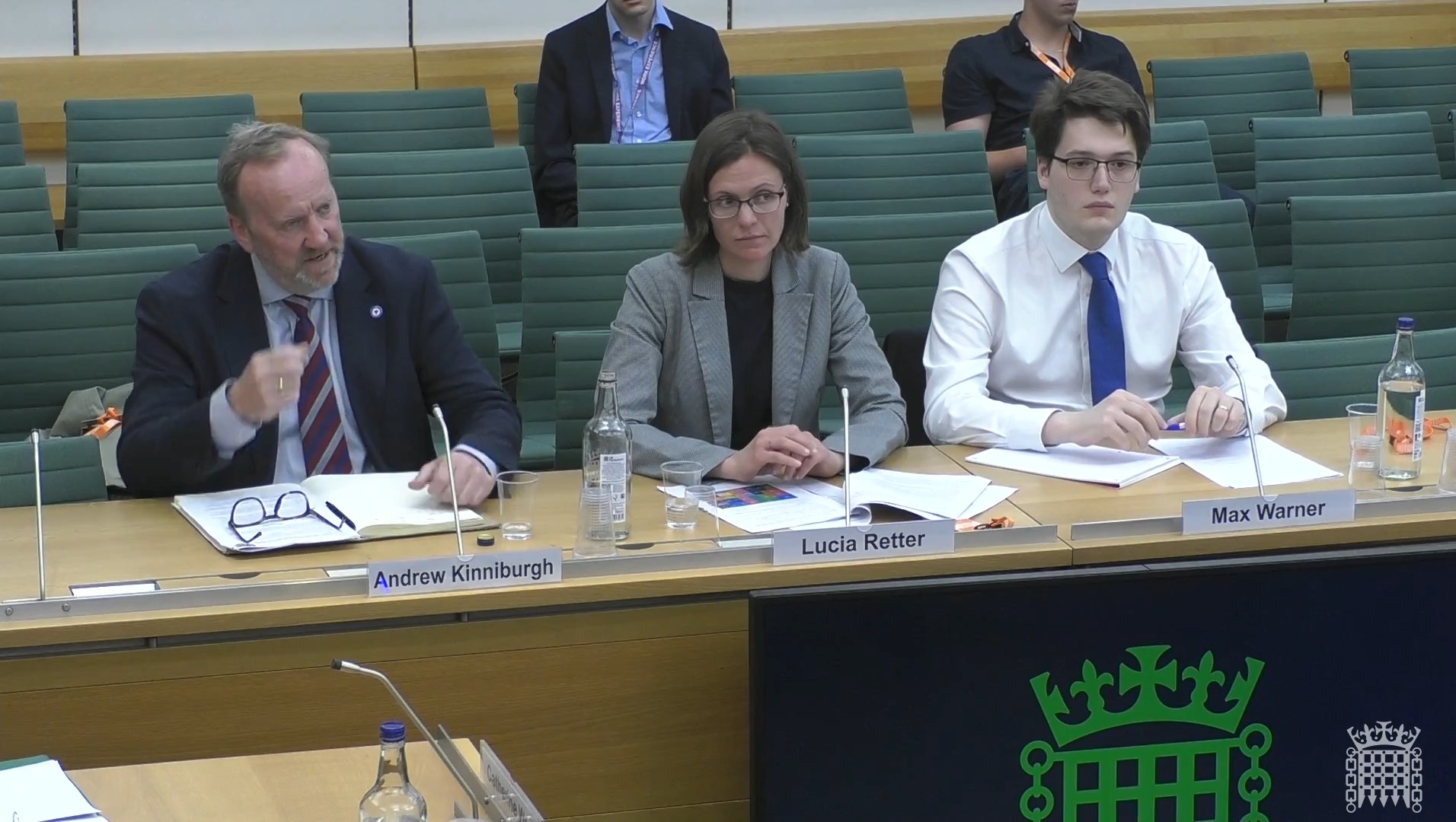
A rising share of British defence companies are being refused overdrafts and working capital by their banks, the Director-General of Make UK Defence has told MPs, in evidence that ranged across the cost of rearmament, the stalled Defence Investment Plan and the state of the country’s defence industrial base, the UK Defence Journal understands.
Andrew Kinniburgh, who represents just under 1,000 defence companies including the major prime contractors, told the Treasury Committee on 3 June 2026 that the proportion of his members reporting problems with financial services had climbed from 11 per cent to 17 per cent between last year and the start of this year. “For instance being de-banked, not being able to get an overdraft, not being able to get the working capital they need through various means, whether that’s venture capital or private equity, or through traditional kind of retail banking and business banking,” he said.
Asked whether this reflected a deliberate move by banks to disinvest from defence, Kinniburgh said the picture was muddied. “That’s the killer question, actually, because there is a mudding of the water here,” he said. “If you’ve got a shaky balance sheet as a business, the bank is going to question you anyway,” he added, saying the difficulty was drawing the line between the absence of the Defence Investment Plan, weak defence spending and those shaky balance sheets. Publishing the plan with a clear timeline, he argued, “will give confidence to the market to all the markets”, and would help let the brakes off on overdrafts and working capital.
The session, which also heard from Lucia Retter, Assistant Director for Defence and Security at RAND Europe, and Max Warner, a senior research economist at the Institute for Fiscal Studies, opened with the committee chair paying tribute to the three Royal Navy aircrew who died when their helicopter crashed in Devon in the early hours of that morning.
Much of the evidence turned on the gap between the UK’s defence ambitions and the money committed to them. Kinniburgh said that without the Defence Investment Plan the country was “stuck on 2.6% of GDP, which is, we would argue, wholly unacceptable, and not enough to give us a credible defence deterrent”. He wanted to see a clear path to 3 per cent, then 3.5, alongside the 1.5 per cent on defence infrastructure, pointing out that a single new submarine effectively means building three sets of infrastructure once basing and maintenance are counted. “You’re actually effectively building three sets of infrastructure for one piece of equipment,” he said. The central uncertainty, he added, was the scale of the financial black hole inherited from earlier years: “There’s no point in us having a plan to 3% 3.5% if then it’s going to get clawed back, because there’s a black hole from previous years.”
Retter said the Strategic Defence Review had been costed against an assumption of defence spending rising to 2.5 per cent of GDP by 2027 and 3 per cent in the next parliament, before the commitment to 3.5 per cent by 2035. The capability gaps the review identified, she said, spanned readiness and stockpiles, digital and technological integration, the fielding of autonomous systems at scale, and the perennial late delivery of equipment. “The gap currently means that our deterrence posture is more brittle than we would like it to be,” she said. “Our messaging and signaling to both allies and adversaries is also undermined because of the gap that we are currently seeing.”
Warner made the point that the review’s own terms of reference had required it to be affordable within lower spending than the government was now planning to reach, yet ministers had accepted all its recommendations. “Now it seems that everyone more or less agrees it’s not affordable,” he said. He cautioned against fixating on spending as a share of GDP rather than on what the money actually delivered. “What matters really is what we’re getting for that money,” he said, warning that with many countries increasing defence budgets simultaneously, prices across the supply chain were at risk of rising.
Pressed on what reaching 3.5 per cent would mean for the public, Warner set out the scale in stark terms. Moving from 2.6 to 3.5 per cent would mean an extra £30 billion to £40 billion a year, he said, equivalent to roughly £500 per person, or about £2,000 for a family of four. That was comparable to adding the entire Department for Transport budget to the Ministry of Defence, he said, and would require the equivalent of three to four pence on all rates of income tax, or a similar rise in VAT. The increase was too large to find through efficiency savings alone. “These are chunky savings you’d need to make,” he said. He framed it as a fundamental choice: “Either we accept the state is going to become bigger and we’re going to raise taxes quite substantially to pay for that, or we don’t want the state to expand and we’re going to have to cut something quite chunky elsewhere.”
The committee returned repeatedly to the consequences of the delayed Defence Investment Plan, which Kinniburgh said he hoped might appear the following week. He said the absence of the plan was deterring even the largest contractors from committing money to the UK. “Those companies are simply not, until they see the defence investment plan, going to put money into the UK,” he said, describing a state of paralysis in which firms weighing whether to invest in Britain, Germany, Poland, the Baltics or the United States were holding off.
On the workforce, Kinniburgh warned of acute skills shortages, citing the cost of nuclear-rated welders, who he said could command six-figure salaries that defence firms could not match. He pointed to a team of 300 welders working for Babcock recruited from the Philippines, arguing the country should instead be training apprentices, but said firms could not commit to taking them on without a clear demand signal. He also raised the looming 50 per cent tariff on certain steel imports due on 1 July, warning it would raise procurement costs and criticising the Ministry of Defence, and particularly the Defence Infrastructure Organisation, for spot-buying standard steel from China that could be sourced in Britain.
Retter argued that the problems in procurement were less about structures than about culture. Reforms had come and gone since the 1960s, she said, all aiming to make procurement faster and less wasteful, but the fundamental enabler was a change of mindset that empowered officials to make decisions without endless layers of approval. She pointed to the speed achieved under urgent operational requirements, such as Operation Scorpius supplying equipment to Ukraine, as evidence of what was possible when external pressure and a higher tolerance for risk were present.
Warner set out how the fiscal rules were shaping where defence money went, noting that the Ministry of Defence had shifted from spending about a quarter of its budget on investment through the 2010s to a planned figure of over 40 per cent, partly because investment spending was treated more favourably than day-to-day spending under the current rules. He also addressed the argument that defence spending would pay for itself through growth, accepting there could be positive spillovers from defence research and development but cautioning that the magnitudes were unlikely to be large.
Retter added a note of caution on the government’s messaging, observing that the UK appeared unusual among European states in justifying higher defence spending primarily on the grounds of economic growth, where Germany, Poland, the Nordic and Baltic states framed it more directly around the threat and the changed geopolitical environment. While the regional economic benefits of defence were real, she said, growth should not be presented as the primary purpose of rearmament.
Kinniburgh agreed that growth was not the main aim but argued defence could be a powerful engine for it, pointing to towns such as Barrow-in-Furness, Yeovil, Helensburgh and Plymouth whose economies depended heavily on defence work. He closed with two proposals he urged the committee to put to the Treasury. The first was redirecting some £1.8 billion of patent box tax relief, much of it currently benefiting large pharmaceutical firms, towards defence. “Take that out of there and put it into defence, 1.8 billion quid, free money, back of the net,” he said. The second was issuing wartime-style defence innovation bonds to fund early-stage research and development, an echo, he said, of the defence bonds that raised the equivalent of tens of billions of pounds in the Second World War.
The committee said its next session on defence spending, held jointly with the Defence Select Committee, would seek to question the Chief Secretary to the Treasury and a defence minister directly, though no date had yet been confirmed.










Tha banks, who we love (?), nervous because of the lack of orders?
Nah, defence of your own country is contentious per education and media complex. This is ESG.
Sadly 👍🙃
I’ve gained $17,240 only within four weeks by comfortably working part-time from home. Immediately when I had lost my last business, I was very troubled and thankfully I’ve located this project now in this way I’m in a position to receive thousand USD directly from home. Each individual certainly can do this easy work & make more greenbacks online by visiting
following website—.,.,.,.,.—>>> JobatHome1.Com
I believe the DIP won’t be published anytime soon due to the threat of higher interest on government loans.
It seems Starmer wants it published before he attends the NATO summit on 7th July. Place your bets…. my bet is no.
I read that John Healey said that’s what the PM wanted. I haven’t read that the PM himself said it. If Healy is flying a kite, is he doing so on the PMs behalf, or his department’s? I don’t think he’d normally attribute to the PM without permission, but political shenanigans seem all the rage right now.
There’s a few other dates before that, Healy has a NATO meeting in the next couple of weeks and the Japanese PM is coming end of June which is when the bridging agreement for GCAP runs out. So I’d put money sometime in June.
‘redirecting some £1.8 billion of patent box tax relief, much of it currently benefiting large pharmaceutical firms, towards defence. “Take that out of there and put it into defence, 1.8 billion quid, free money, back of the net”’
What’s this referring to? Waiving the tax paid on patent payments, to motivate firms to invest in new technology?
No. It’s a reduced rate of corporation tax on profits derived from patents- 10% instead of 25%. It is intended to encourage investment in research.
I wonder if the Logic of arsenals would not entirely surpasse the Logic of Banks. IP would stay property of British people. And no additional taxe from Private sector.
It all boils down to the problem over the years of cutting defence, when will governments realise cutting certain budgets just stores up massive bills later, little increases and often is the way for schools, health and defence. We’ll never know the options for increasing defence budget as most will remain secret, but it does seem welfare is the only budget chunky enough to get sufficient money from assuming health is untouchable
Since it’s obvious that this government will not reduce benefit spending, it follows that public funding is not the answer in a high-tax economy that hopes for growth.
The Defence Investors’ Advisory Group (DIAG) is the UK government’s attempt to deliver All Of Government Transformation (SDR-25) with private funding. So HM Treasury can agree with Foreign Office and Defence.
Taxpayers bailed out the bankers in 2008 and now its their turn to invest in Defence since their business depends on peace and stability. Lower risk means lower cost for Defence Investment Bonds than standard Gilts.
Thus the 3.5% GDP Defence spending target for 2030, and 2.75% GDP for 2026 are affordable without tax increases. A long term investment plan for national security. A legal requirement for a national Banking Licence.
Ethical investment means defending people whom you expect to profit from.
Over to European Finance Ministers to make it happen. Banks must do their Duty or face Windfall Taxes.
I am a professional portfolio manager and I cannot make head nor tail of what you’re trying to get across here
Thanks for your attention. Here is the core reasoning:
Ethical investment means defending people whom you expect to profit from, which lowers risk so lowers costs (pricing for risk).
This cannot be optional so it must be a duty within the national Banking Licence to purchase Defence Investment Bonds or Defence industry Investment for those willing to take more responsibility, let’s call that the carrot. So for those unwilling to do that duty, a windfall tax is the stick.
I hope that is clearer now..
Since Banks are not going to purchase equipments nor do you want them to own IP: you can taxe them so that they pay for the increase spending, you can force them to Loan defense companies and you can lower the amount they will get from defense companies through dividend. This way, British tax payers would not be robbed. This is the logic behind state arsenal. This is why in some other countries you get way better value for money in equipment, because gready behavior are kept out of the system.
Value for money is said to be the motivation for public sector contracts as Cost Plus some percentage. Apparently that percentage is the transaction profit agreed. However what this really does is to insulate the supplier, not customer, from so called cost overruns. So it removes an important responsibility of the supplier who presumably would argue that costs increase because customers change their requirements.
That change is not just driven by the competence of the customer because innovation is by definition unknown. Supply cost variations are common so that isn’t controlled by Cost Plus contracts. It might be controlled by subcontractor contracts if those aren’t also Cost Plus..
Combat advantages come from doing what the adversary can not so innovation is bound to be high risk prototyping not low risk serial production.
So it’s a myth that Defence procurement is bad value and the value is only perceived by combat victory. Of course those advantages are secret for as long as possible so that countermeasures cannot be developed.
So it’s not surprising that taxpayers have no idea of the value that they funded. That decision was delegated to the armed forces who’s life depends on those advantages. Quite a strong motivation!
I think it’s labours long term plan to eventually close down all the defence industries. Delaying the defence investment plan report part of the plan hoping to close the first few of many .
Defence of the nation state is the first responsibility of the government said the Starmer administration so it follows that less national capacity cannot be their intention. Only incompetence would explain their inability to do what they intend..
President Trump wants NATO members to spend at least 5% on defence. Of course he won’t be president forever, but many Americans do believe that Europeans are freeloaders. The American public seems to want withdrawal of military forces from Europe.
And yet still want to base out of Europe for combat operations outside of Europe?
The NATO website shows that the 2014 2% GDP Defence spending agreement is on track (2.16% avg), so #47s alleged delinquency by Europe is just to trigger his ignorant supporters with lies.
UK has consistently spent at or above (2.3%) target.
According to the Telegraph today, the £18bn that Starmer was going to give defence over the next four years, will now be £15bn – just about half of the £28bn he was told is needed to fund his own SDR….. pathetic.
What do you expect? Snowflakes everywhere going on arms are for killing people. Banks handing billions to the rich to buy up all the houses and build more because houses are “safe” government cancelling contracts or taking decades to sign them. Business in general in the UK is basically foobarred.
Lies upon lies, stall and defer and pray to God the Ukrainians hold the line and Emperor Trump dies soon. That is the UK defence posture. This DIP when it’s published will probably only be a few pages of Whitehall triple speak. Wait until Commissar Burnham is in charge it will be free lollipops for everyone, well those who have never worked. If you think Starmer/Reeves et al are hiding from defence commitments wait until that black T shirt wearing Oxbridge surrender monkey is in Downing Street, Day one, a new SDR you can bet on it.
So we apprach this governments 3rd budget probably under 5 months away. It appears theres still no plan for defence. Rumours that after 2 years they don’t even agree on what they need to spend on defence with 20% variations of what the DIP should be is shocking. As with the Tories, Labour’s ideological thinking trumps logic or common sense.
As for banks, when you spend nearly 3 decades indoctrinating people telling them defence is bad they of course end up as decision makers in organisations like banks. So really its no surprise.
Banks do pricing for risk so it’s necessary to inform them of the Defence threat assessment and educate them that they have a duty to lower the national risk by investing in Defence so benefiting their shareholders’ profits. It’s a virtuous circle for them, and their Duty as ethical investors to defend whom they expect to profit from. Win win..