

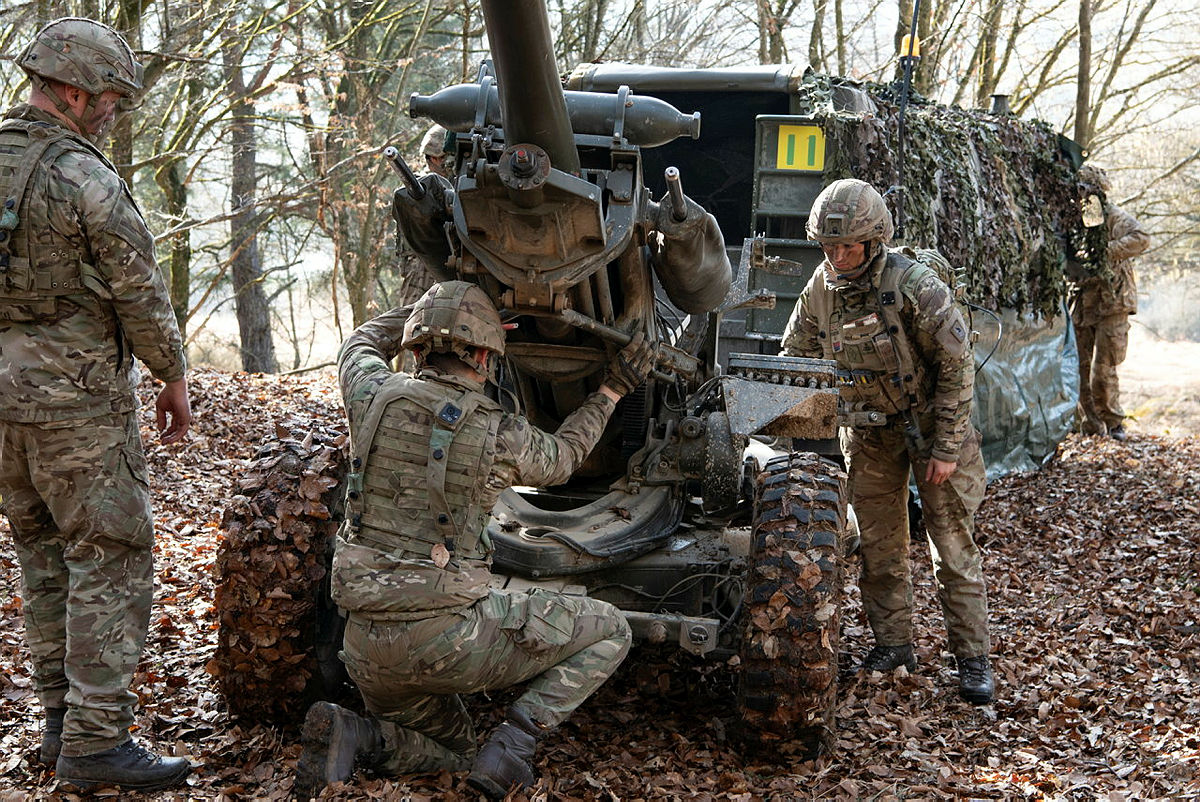
BAE Systems has signed a licensing agreement with its strategic defence partner to support the local manufacture of the Light Gun artillery capability in Ukraine, the company stated.
The agreement, signed at the Farnborough International Airshow, will provide access to BAE Systems’ technical information and the support needed to manufacture an initial gun for testing. The partnership will back the development of a variant of the L119 Light Gun for use by the Armed Forces of Ukraine.
The L119 is a BAE Systems-designed 105mm towed artillery system which the company describes as highly capable and proven, valued for its mobility and reliability. The gun has seen widespread service internationally and remains in use with a number of armed forces, with Ukraine among the operators of 105mm light artillery supplied by Western partners since Russia’s full-scale invasion in 2022.
According to the company, the licensing arrangement builds on its long-term support to Ukraine and its work with Ukrainian industry to strengthen the country’s sovereign defence capability, reflecting a shared focus on developing resilient industrial capacity that can sustain the Armed Forces of Ukraine over the long term. Localised production has become an increasingly common feature of Western industrial cooperation with Kyiv, as Ukraine seeks to build domestic manufacturing capacity rather than relying solely on equipment transfers from partner nations.
Giles Ambrose, Engineering, Technology and Strategy Director at BAE Systems Weapon Systems UK, was quoted in the press release as saying: “Strong defence capability depends on trusted industrial strategic partnerships. This agreement brings together BAE Systems’ artillery expertise and our strategic defence partner’s knowledge of Ukraine’s operational requirements to support the development of sovereign capability where it’s needed most. Supporting Ukraine is not simply about supplying equipment. It is also about working together to build the industrial resilience, skills and capacity needed to sustain defence capability for the long term.”







How useful are light artillery guns on the modern battlefield? I would have thought that their limited range would make them easy pickings for drones.
Most would think the Ukrainians know better than you do.
I’m not saying that I know better, I’m just curious about their effectiveness given the threat situation. Sonik made some good points in their reply, I can see why Ukraine likes them. I suppose there’s also the fact that equipment doesn’t automatically become obsolete if it becomes vulnerable, it becomes obsolete when it no longer has a purpose.
This question was asked with some skepticism when they were first supplied. However as said the Ukranians seem to find them very useful, their mobility probably a big plus. They know how to defend such well hidden assets against drones no doubt. Aah just read sonik and yes he makes the point well, an apparent disadvantage can become an advantage on occasion.
Extra range doesn’t really buy safety anymore because drone tech has caught up range wise. Arty now needs to be either fast moving or very well hidden. The Ukrainians like L118 a lot, because they are much easier to conceal in dugouts under dense tree cover than larger SPGs. Plus it’s very durable, easy to use and simple to maintain.
Louis, The BAES Lt Gun has a range of 17.2km with standard British rounds and 20.6km with base bleed types. This is better than any other towed artillery gun in service in Ukraine in both the 105 and 122 calibre category, and is as good as the 152mm D-20.
Clearly an advantage of Lt Gun is the ease of underslinging it under a medium helicopter., and its rate of fire is decent.
I don’t see why its range makes them more or less vulnerable to drones. Depending on type drones can hit targets that are close-in or very distant.
Ironically, it’s static nature appears to help. Netting, both cam net and straight up nets, with dug in positions and cam and concealment seems to be a good defeater of many drone types.
Interesting how a few months ago Ukraine were complaining about how effective Russian artillery detection radar had become, especially when linked to loitering drones. Has something changed in the way Ukraine employs their static artillery to mitigate Russia’s radar detection and counter-battery response? Both sides through an evolutionary process have become very good at concealment. Though from my understanding Russia can still be very lazy in this regards. It’s my guess Ukraine aren’t employing their L118/9s in a “grouped” battery line, but in a more dispersed nature, coordinated via radio. making them harder to pin down when firing in say a random pattern.
Don’t think so, but both can be true at once. As said netting and cam in static positions can be effective against drones and other loitering munitions, while digging in can provide good protection against fires.
It’s likely that both sides are very short of radars and most often rely on basic optical spotter drones to identify firing positions.
Low muzzle flash is another useful attribute of L118 here, it’s very hard to spot in good cover and they are careful not to fire at night etc.
Ukraine war is largely a static conflict more reminiscent of WW1 than NATO manoeuvre warfare. Tactics are developed accordingly.
Great fun but Ukraine can’t build anything
Bullshit.
Well, except for all the stuff they’re building.
Maybe I’m stupidly optimistic but surely they wouldn’t have got funding if people thought the factory would be blown the hell the second it opened? That seems like a rather poor investment choice.
Ukrainian Mil industry is extremely capable. They already build Bohdana howitzers and look at all the crazy stuff their missile and drone programs are turning out.
They are building masses with a lot more to come like a new ballistic missile, but then you almost certainly know that. They were of course a powerhouse within the Soviet Union in much of its weaponry.