

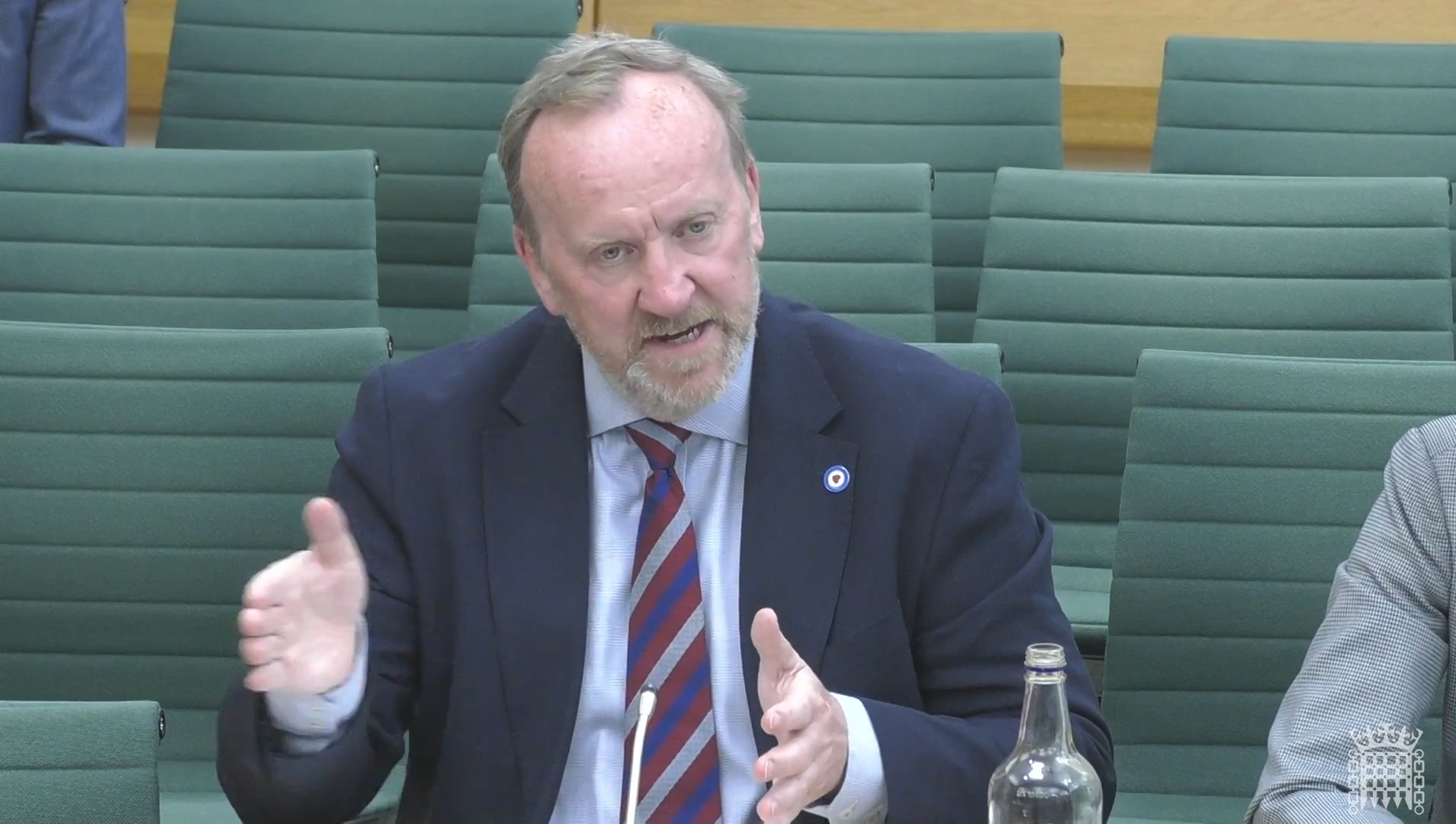
Putting off the bulk of Britain’s planned increase in defence spending until the years immediately before the 2035 target would be a serious mistake, the Director-General of Make UK Defence has warned MPs.
Andrew Kinniburgh told the Treasury Committee on 3 June 2026 that the government should resist the temptation to make only small increases in the next few years before a late surge to reach 3.5 per cent of GDP by 2035. “We need to be really careful not to fall into the trap of saying we’ll back load this,” he said, warning against the idea of “tiny incremental increase for the next few years, and then at the end we’ll suddenly put a load of money in”. Such an approach, he said bluntly, would be “a disaster”.
His argument was that the value of later spending depends on investment made now. The research, science and technology funded today, he said, was what would improve productivity and capability later on, so deferring it would blunt the effect of the money spent at the end. He illustrated the point with a 30-person company that had designed an automated robotic welding jig expected to save a large defence firm £35 million over a decade, an investment in productivity made possible because the smaller firm could see an order book stretching ahead of it.
The session was examining how the UK will fund its defence ambitions, and the committee pressed Kinniburgh repeatedly on what a credible spending path would actually look like year by year. He was unable to give the profile of annual increases the committee sought. “I’m not sure I can answer that question, to be honest,” he said, arguing that the figures depended on what the equipment programme required rather than being a simple block of money. “We’re not just asking for a block of money, it depends what the capability is that we require to deliver for the military,” he said.
Lucia Retter, Assistant Director for Defence and Security at RAND Europe, supported the warning against deferral, framing it as a matter of credibility with allies and adversaries alike. She pointed to Germany, which she said had set out in some detail how its own spending increase would be profiled and what it would be spent on. A clear signal of that kind, she argued, was exactly what needed to enter the public domain, both to demonstrate commitment to NATO and to deter potential adversaries. Back-loading carried real risks, she said, including the possibility that programmes would later be cancelled under a future government or changed economic circumstances.
Max Warner, a senior research economist at the Institute for Fiscal Studies, offered a more cautious view of long-range commitments. He said he could see the value of certainty for industry but did not regard a fixed 10-year spending plan as an unambiguously good thing, since governments generally avoid setting budgets that far ahead and like to retain the freedom to respond to changing economic and fiscal conditions. Even a published 10-year profile, he suggested, might not prove credible, since spending plans tend to shift over time, though he accepted there could be a case for some intermediate targets.
The committee said its next session on defence spending, held jointly with the Defence Select Committee, would seek to question the Chief Secretary to the Treasury and a defence minister directly, though no date had yet been confirmed.










Not much there that anyone here would disagree on. I don’t see how these sessions can influence government decisions, though as it’s all stuff the select committees should know anyway.
I’ve gained $17,240 only within four weeks by comfortably working part-time from home. Immediately when I had lost my last business, I was very troubled and thankfully I’ve located this project now in this way I’m in a position to receive thousand USD directly from home. Each individual certainly can do this easy work & make more greenbacks online by visiting
following website—.,.,.,.,.—>>> JobatHome1.Com
This government fight tooth and nail to avoid spending and committing. 2035 is an easy can kick into another Parliament and another person’s problem.
Sadly true Daniele – For me, the pivot point was the 2004 defence review topped off with the 2010 cuts from Cameron. The results were predictable-no capital accrual to scale up replacement programmes (type 26 to replace the type 23 is a perfect example) and off course nothing left for force level expansion to fill the gaps from the 2010 cuts. Defer, deny, delay is the catch cry for both Tory and Labour.
Whilst I understand the strategic need, for me the SSBN replacement programmes is a massive financial millstone.
2035 is the classic, not my problem move. It’s not the next parliament, it’s the one after, at which point no front bencher is realistically expecting to still be there.
It’s going to get worse with Burnham in charge.
does he know something we don’t?
Labour won’t survive beyond 2029, so this 2035 Target means fuck all in the grand scheme of things.
Puts a lot of pressure on the next government to honour it regardless of their political affiliation. But quite rightly one parliament cannot bind another, every parliament is sovereign. That’s the law we have lived and prospered with for hundreds of years.
Not sure prospered is the word for it. The short termism it creates has wasted billions upon billions and been a lead weight round the countries ankles.
So how come all the richest countries in the world are democracies.
What about China.
China is not rich, it’s ranked 73rd in the world. It has the same per capita GDP as Argentina.
It’s people might not be rich, but the state has the resources and the dedicated people to make relying on monetary measures inaccurate or deffo out of wack. I don’t think they’re above going into the weeds when it comes to national image and if it’s to be believed, they’ve become America’s equal, minus the last 80 years of Debt and World Hegemony that they needed to maintain to get such a debt in the first place.
And China is renowned for their long term planning or views beyond themselves, even if it was tied to each leader, their leader gets in and stays there till they die and the successor has a similar or copy and pasted vision the last one had.
We won’t see a considered reply to this
I’ve tried to give one.
Governing parties frequently(and inappropriately in my view) try to make treaty commitments with the clear intent to bind their successors. It doesn’t actually bind them but the undoing takes a lot of work.
He is right about not backloading defence spending but there is also an argument to be made about not front loading. Massive increases in spending into an institution as leaky as the MoD would result in massive waste.
Sustained increases of 0.1% per annum of GDP up to 3.5% by 2035 seems about right.
There is every chance as well that Russia falls off a cliff and the threat dissipates. Countries like Germany and Poland that sucked far too deeply on the peace dividend and are much closer to the threat environment than the UK and France needed to panic buy. We need something different, sensible sustained investment.
Yes agree, you need to plan funding increases and know how, why and when you are spending your money.
The amounts we are talking about are too small to worry too much about the effects of front loading. I know that it’s tens of billions of pounds, but as long as it goes alongside permissions to spend without jumping through too many layers of governance hoops it will be relatively easy to spend it well. That doesn’t mean perfectly, and people, especially the Treasury, will always be able to point the finger in hindsight, because anything innovative carries risk and there will be failures. Nevertheless, if that allowance is made, MOD has shown it can purchase and spend well for Ukraine where the governance rules were limited.
Even if the Russian threat dissipates again, we can’t afford to drop below 3.5% again, especially if we keep the current rules as to what is classed as Defence. It’s too damn difficult to restore when the next threat from wherever re-emerges.
Largely agree, relatively modest but consistent incremental increases in defence budget may well prove to be the most cost-efficient pathway to eventual rearmament. MoD temptation to gold-plate procurement programmes would be restricted, because there would only be minimally sufficient funding available in the MoD coffer to achieve SDR goals. This model, of course, would be instantly OBE, upon the outbreak of hostilities. 🤔
A 0.1 per cent increase will just tickle the figures. The UK economy is flatlining and has been for the last year. Betweeen the Spring budget and the November “statement” from Reeves defence expenditure in real terms has gone down, albeit not by much. Official figures show a real sum defence budget of £62.2 billion in 25/26.
The problem with moving forward at a cash balance increase of 0.1 per cent is that defence inflation is currently running at between 4 and 5 per cent .There was amuch heralded announcement, which I whoeheartedly support, about close ties with JEF countries. This is good news but guess who comes at the bottom of the member states for expenditure as a percentage of GDP? Correct, the United Kingdom. Unless Labour grasps the nettle there will be no real increase in the defence budget for a decade or more.
Hi Geoff, I suggest you read read what I wrote,
Not sure where you get a Cash balance 0.1%
The figure I referred to is 0.1% of GDP annual increase.
I’m awre iof what you said Jim. It’s in my first sentence. A cash baknce is a different figure that has to do with the amount of money increasing as a percentage of GDP, allowing for inflation, and the money taken out, currently a balance of 0.1 per cent.
Wouldn’t it be nice if this were laid out clearly in some form of Defence Investment Plan? Rather than having the current Defence Investment Pause.
I have never understood why defence of the realm should be subordinate to economic and fiscal considerations – the level of threat to the UK can be existential and is the first responsibility of the Government. Yes, we want new schools/hospitals/benefits but this should not override spending to defend the country. Sadly it is already becoming apparent that backloading is actually the intention regardless of the threat level (presumably the bad actors will cooperate by not making any serious moves until after 2035?). I had hoped that the change in rhetoric signalled a genuine wake up moment, it now looks more like putting off the real decisions for the next lot in government to deal with. Hence all the projects with in service dates somewhere vaguely in the “mid 2030s” or even later.
The debate should not focus on some arbitrary monetary target. Rather we need to define precisely what capabilities we need and plan long term to deliver and support them. We have had 10 year equipment plans since 2012 ( the last in 2023) but looking at the design and build timescales of key equipment- submarines, warships,combat aircraft and even some vehicles, a 20 year plan would make more sense. This should cover all core capabilities. But in addition we need a contingency reserve to cover UORs, much as we have had in the past.
The biggest problem the UK defence budget faces is the proportion already committed to two very costly programmes- GCAP and AUKUS. GCAP keeps UK in the combat air business so is economically and militarily useful. Whether the AUKUS agreement can deliver the same is more questionable: DNE is already absorbing over 40% of the entire defence budget. Until SSN availability is vastly improved, it is not unreasonable to question whether increasing numbers makes sense.
Absolutely agree. I have been arguing his for years. Th defence budget should logically follow foreign policy. Build one and achieve the other from it. The twp programmes are important of corse but what has to be sacrificed to move them forward? Rumour has it that GCAP, like every thing else it seems, will now be delayed until 2040. So worn out Typhoons and a handful of F35’s to see us through? No, it doesn’t make sense. As for AUKUS if as the current govermnet suggests we are going to concentrate on NATO why are we spending tens of billions on nuclear submarines? We need to look at the world again. Not as an SDR but as a political neccessity.
The treasury needs to be brought into reality of defence, you can delay GCAP but if you do that then more Typhoons and F35s are needed to reduce flying time and wear on current aircraft.
All these 3.5% figures in 2035 are fantasy as in 9 years time we might be in peace dividend world again ( or ww3), nobody knows but the government is gambling on back loaded (jam tomorrow) money that won’t be required, bad news is that it will as the UK absolutely has to replace equipment in those timescales as no longer is there ships / aircraft spare that have light loads that can last longer.
Sorry for the delay Adrian. Yes, I agree but I can’t see the treasury taking any notice. They never have. We have had thirty odd years of cuts. First the “peace dividend” which all natins scrambled to take advantage of, maybe with some justification, but of course we went oo far. Since we have had Blair/Brown cuts. delays and underfunding, followed by Cameron etc.. and now Starmer who is completely clueless.. Action needs to be taken now, not in 2035 but as you rightly say it is all a fantasy. The country is in serious trouble and defence is somewhere below pot holes in the minds of most MP’s.
We have the SDR. Any further discussion on what to do will just be a further delay in doing it. We can fund it below-minimally, minimally, adequately or maximally, and that will be decided by how much money we are prepared to put in. No prizes for guessing where we are now on that scale.
You can’t predict the future. You can’t define precisely what we need at any moment in time, much less what we will need by the time it arrives. You do the best you can, apply a certain level of flexibility and a certain level of extra for opportunistic decisions to be taken on the day.
Yes it’s so simple, we should define defence spending based on what capabilities we need rather than what we can afford as a % of our economic output 🤦♂️
I see it now, I don’t understand how the government don’t get this. 😀
All we need to do in invent a crystal ball and ascertain what capabilities we need 😂
AUKUS, both Pillars 1 & 2, are worthy of investment. A more numerous, efficient and technically advanced SSN flotilla can only reap benefits for the UK in the current and probable future geopolitical environment (especially if equipped w/ SLCM-N eventually). Participation in Pillar 2 advancements/development programmes in AI, quantum computing, cyber, space, etc., are intuitively obvious. 🤔
Be ready to fight and maybe our opponents will be discouraged to try it on.
Interesting…. Labour doing a runner – leaving defence in the toilet.I can only hope they are utterly destroyed in the next general election and never get power again.
What made you think Labour are doing a runner (I assume implying they have left a hidden bomb for a future party)
All of this is being discussed to addrsss that exactly.
Whether it does or doesn’t is a separate matter. It might be unpopular here but overall I think Labour in 2 years have done better than say 7 years of the previous Tory government. I AM NOTTTTT saying they are perfect. The least I would give them are efforts to diagnose a problem and suggestions to address it
That’s separate to whether they are picking the right problems
(Damn, so many caveats needed now a days to make a nuanced point that isn’t either or)
Hay I think the Conservatives did a rubbish job too. The reality is from the 1980s on our eubbish politicians have failed tge country. Their first duty is to protect tge country but tgey have bled our militaty dry. We mow only have 5 frigates 2 working destroyers … the Type 23 should have been replaced years ago but our leaders thought tgey would role tge dice on a pleasant world under written by the US. Guess what their dice tole failed and now tge sh⭐️t has hit tge fan. The French sent a full carrier group to the med – we sent a single ship after two weeks. Yes I AM implying that Labour are going to do a runner because tgey will loose tge next election and they know it. So before they leave tgey will screw the country so tge next government is blamed…rgat is tgeir only hope of getting back into power. Don’t get me wrong tge Conservatives are just as bad. It would be nice to have a competant political class for a change!
Of course we would all like to see defence spend front-loaded, because we need a shedload of new equipment orders right now to get the forces back up to some semblance of our previous fighting strength. But it is really a pretty pointless debate because it ignores financial reality.
We may if lucky get from 2.34% of GDP in 2023/4 to 2.5% by end 2027/8. Whethet we like it or not, that is all the money that can be squeezed out of the public coffers right now, and even that has required a year-long arm-wrestle with the Treasury. It is not really the nation’s fault that the MOD and the services, particularly perhaps the RN, have managed to create a £28bn black hole in their accounts and once again need bailed out by the reluctant taxpayer.
So basically, the option of front-loading doesn’t exist. There is not the money. There is probably not even the money to plug the black hole.
The only option thereafter, to get to 3.5% of GDP by 2035, is to, as Jim says, increase defence spend by
0.1% of GDP a year on average starting 2028/9. (It would actually have to be 0.125% a year). That is feasible and affordable. But it would have to be more to account for defence inflation, which continues to soar.
So by 2035, rhe defence budget would be close on 50% larger than it was in 2024.
The Treasury committee members asking how much we should really be spending is a bit of a laugh. We have 4.5 combat manoeuvre brigades and would need to increase that to about 14 minimum prior to any serious conflict. The navy would need to increase from the planned 60 ships and subs to over 100 just to be able to discharge its current allotted tasks properly. The RAF is about one-third of minimum necessary strength. The answer to the Treasury committee would therefore be minimum 8% of GDP please!
As that is never going to happen, let us just aim for a future 3.5% and accept that the forces will just have to cut their cloth accordingly. Or HMG can come up with a defence bond or defence loan scherme that actually injects some real money into the pot.
Cripes,
Have occasionally wondered whether RUSI (or any other reputable consultants) have contemplated a realignment of British forces to create an Anglo variant of the USMC (w/ the addition of nukes)? Especially if UK adopts a fortress UK defence model? RM expands, BA, RAF, RN become support functions. Impossible?!? Perhaps, but the jarheads have compiled an enviable track record over, hell, virtually the 250 years of the republic, often despite sub-minimal resources. 🤔
It’s been mentioned before. Though the current crop of muppets in Parliament are seriously against any form of expeditionary military nature. Hence Labour’s NATO first mandate. It would take a serious ethos change within Parliament to get any traction.
40% of the equipment budget.