

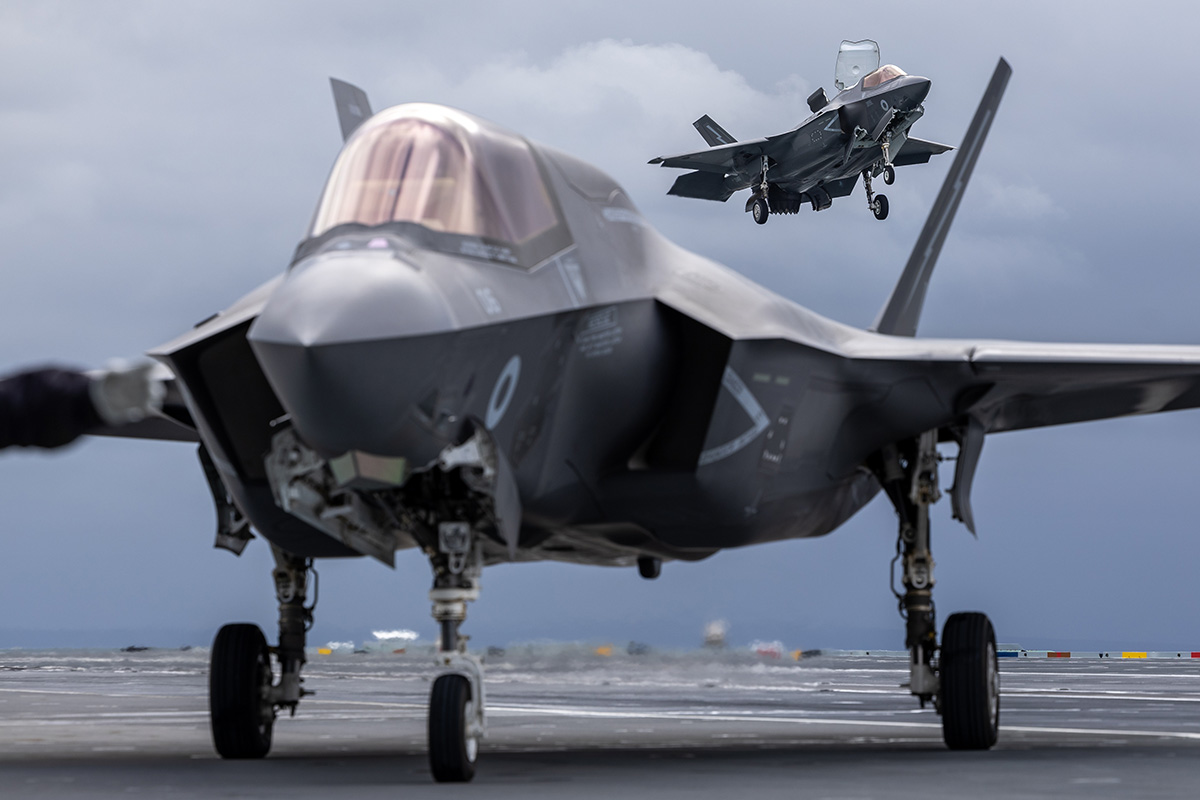
F-35 Lightning jets have flown in the skies over Finland for the first time, launched from the deck of the aircraft carrier HMS Prince of Wales as part of NATO’s premier air warfare exercise, a vast drill rehearsing the alliance’s response to an armed attack on one of its members, the Royal Navy has said.
The fifth-generation jets, drawn from 809 Naval Air Squadron and operating alongside Merlin and Wildcat helicopters from the carrier’s flight deck, provided the United Kingdom’s aerial contribution to Ramstein Flag 26, a huge workout of allied air power stretching across the length and breadth of Europe. The squadron is one of the United Kingdom’s two front-line Lightning formations, alongside the Royal Air Force’s 617 Squadron.
Sorties were launched from the North Sea, frequently in weather the Royal Navy described as unseasonal for June, with air-to-air refuelling tankers extending the stealth fighters’ reach for sustained, long-range missions deep into Europe, on occasion operating 700 miles or more from their floating base, an illustration of both the reach of the carrier and the endurance of the F-35.
The scenario behind the exercise tested the alliance’s ability to respond rapidly, cohesively and decisively to an attack on a member state, the kind of event that would trigger Article Five of the North Atlantic Treaty and demand a collective response from all its nations, a premise that has taken on fresh weight amid repeated Russian provocations along NATO’s eastern and northern flanks.
The scope of Ramstein Flag 26, which takes its name from the large United States air base in southwest Germany, was vast, spread across 20 locations from Norway to Spain and Finland, with HMS Prince of Wales and her carrier strike group, including the destroyer HMS Duncan and the tanker RFA Tidespring, operating at sea. Around 150 sorties were flown each day by up to 150 NATO aircraft from 18 nations over the 11 days of the exercise, ranging from land and carrier-based F-35s through Typhoons, F-18s, Swedish Gripens, French Rafales and Mirages, to tankers, transport aircraft and Reaper drones.
Among the more striking sights were F-35Bs landing, refuelling and taking off again from Finnish highways, a feat performed by United States Marine Corps Lightnings, while 809 Naval Air Squadron’s jets paid a more conventional visit, making use of the facilities at Pirkkala air base near Tampere, around 100 miles north of Helsinki.
The aim throughout, the Royal Navy said, was to ensure that many different types of aircraft, carrying different sensors and weapons and flown by pilots with half a dozen different first languages, directed from headquarters hundreds of miles away, could work together seamlessly and effectively against the latest threats.
The Commander of the UK Carrier Strike Group, Commodore Rich Hewitt, said the coordination of the group with 18 allied partners was “a powerful testament to the skill of our sailors and aviators”, adding that the strike group was now “fully integrated into NATO’s frontline defence”. Operating under NATO command, he said, the fifth-generation capability generated from HMS Prince of Wales delivered “a deliberate message to any potential adversary”, that the Royal Navy and its allies together provide the “precise, synchronised combat power” needed to secure the Northern Flank.
Away from the flying, the exercise also tested the carrier’s medical organisation, with the Royal Navy noting that a conflict on the scale of the Ramstein Flag scenario would almost certainly produce sustained and serious casualties. HMS Prince of Wales carries a comprehensive hospital suite, including an operating theatre offering Role 2 medical support able to perform urgent surgery on the most severely injured before they are transferred ashore, backed by a medical team of around 20 on call around the clock and a Maritime Medical Emergency Response Team, a kind of flying ambulance that delivers life-saving aid on the spot, all of which were put through a series of casualty drills.
The deployment continues a period of intense activity for the fleet flagship and her F-35s, which have already taken part in the Arctic Sentry vigilance mission and the NATO anti-submarine exercise Dynamic Mongoose, and underlines the central role the carrier and her embarked jets now play in the defence of NATO’s northern and eastern approaches at a moment of heightened tension with Russia.






Cue Jim’s next comment.
Interesting that USMC F35Bs operated from an austure location yet our did not.
Something I’d like to see regarding our aircrafts survivability and flexibility, even here simply to refuel.
Mate I was going to ask the difficult question; what is the benefit of having the carriers launching jets in the North Sea in a real scenario? They clearly require AAR tankers flying from large land bases.
So the logic is, if those basis are in fact then the requirement for ACE is more limited. We can’t come from an unexpected direction because the tankers need to go somewhere so that’s a combat indicator.
Which brings me back to – what’s the point? The only benefit I can see to the carriers of ACE is the F35 specific maintenance facilities on board.
I suspect that we are back in the position of a limited fast air wing for air defence in a sea control battle group… or, use them as a platform to launch massed one-way drone strikes akin to the Ukrainian strike on Moscow.
Some typos in there –
– if the basis for tankers ARE intact…
– benefit of the carriers OVER ACE
Blimey…it is. And it is a valid point I’m not really qualified to answer.
So to reply best I can, which isn’t much and what I think is meaningless, I might be going off tangent somewhat with my thoughts. It’s all linked and relevant for my mind, anyway.
I support having Carriers for their out of area power projection, end of. But, of course in an ENATO scenario that flexibility will of course be more limited.
At the moment, for me, at least they are well defended airfields!! Because you’re right, the need to top up limits their strike package options.
I’m happy with them in the scenario of your last paragraph in defensive naval group fighter cover NATO context. Strike wise, the other elephant in the room is if the jets are also needed elsewhere as some imbecile got rid of the Tornado GR4 Strike/Interdiction force. I understand Lightning Force is not dedicated just to the carriers, and rightly so.
The carriers were bought as expeditionary assets. Things change, one adapts with what one has depending on the scenario. Better than wasting tens of billions. The carrier itself isnt the issue, but using it in this role is as you say where land bases are available.
Or are they?
Take out runways, you take out the tankers, fast air operations, and the extra flexibility of the 35s being able to fulfil the Cold War role of hitting the Kola ftom the north via AAR.
But there are lots of “what ifs” in there. Some, like our Robert on UKDJ, ironically himself of great carrier experience, think Russia cannot hit a barn door and that the vulnerability of our fixed bases isn’t a given.
I used to agree, but no longer.
It’s why the mention of the USMC F35 operating from roads caused me to raise my eyebrows, I’m sceptical we can do that, and disperse fast air more widely, at any realistic scale, despite the spin from the RAF.
So that leaves the carrier flexibility again. They move, are harder to target, have air defences, our airfields do not, not in any real sense beyond a handful of Rapid Sentry.
Maybe a carrier based AAR solution is needed as much as the ASC AEW requirement.
What’s the French solution? They also have a carrier. Or is Rafale much longer ranged. Can another F35 be set up to do buddy refuelling?
To enable UK F35’s and Typhoons to operate from UK roads, the UK Pot Hole Budget will have to be Increased to far In excess of the UK Defence Budget.
I think the pothole budget has gone on creating pot holes.
Probably true.
Apparently a special task force has now been set up and given the job of looking into this black hole.
Deckchairs and Tea & Biscuits provided along with Hi-Viz and hard hats.
Rafale does buddy refuelling, but that is needed for CATOBAR as jets have to wait in the circuit for a while before landing on. That’s why F35B’s limited range isn’t as big a gap in a carrier context as it looks, though the Rafale can carry external tanks for a boost.
The Stingray will significantly improve the USN’s AAR capacity but I don’t understand why they couldn’t use converted Greyhound C-2s for nearly the same effect.
But the contention is that AAR is an issue for our carriers because even operating in the North Sea, they need Voyager operating from U.K. airfields to reach the “combat” area in Finland.
I also understand that a Voyager also followed the CSG around the Pacific.
But to me, the question is not around AAR capability on the carrier, it’s whether carriers are actually viable in the fight we are likely to face now.
Would it be more effective for example, to use them as launch platforms for massed one way effectors? F35 for air defence?
Carrier-borne AAR has been mentioned, on and off, on this site for a number of years. I’m all for a future AEW solution that, hopefully, is more powerful than the current Crowsnest. Re:AAR, some have said on here that running an additional F35B in buddy config is indulgent for so few asssts, faor point, but that’s where threads have gone off talking about, fuel load, endurance and launching all that weight from a carrier that doesn’t have CATOBAR.
I believe F35B lacks the hardware to act as a buddy tanker. Obviously it can receive fuel via probe and drogue.
Rafael is equipped to refuel other aircraft.
One problem that Tempest is designed to solve is range. A couple of sources suggest it will be able to cross the Atlantic on internal fuel , a combat radius of 1500 miles.
Well let’s hope when It gets to the US, It doesn’t waste It’s payload. 🎇😍
quite amazing really, like a coward running away from a fight, then bigging himself up