

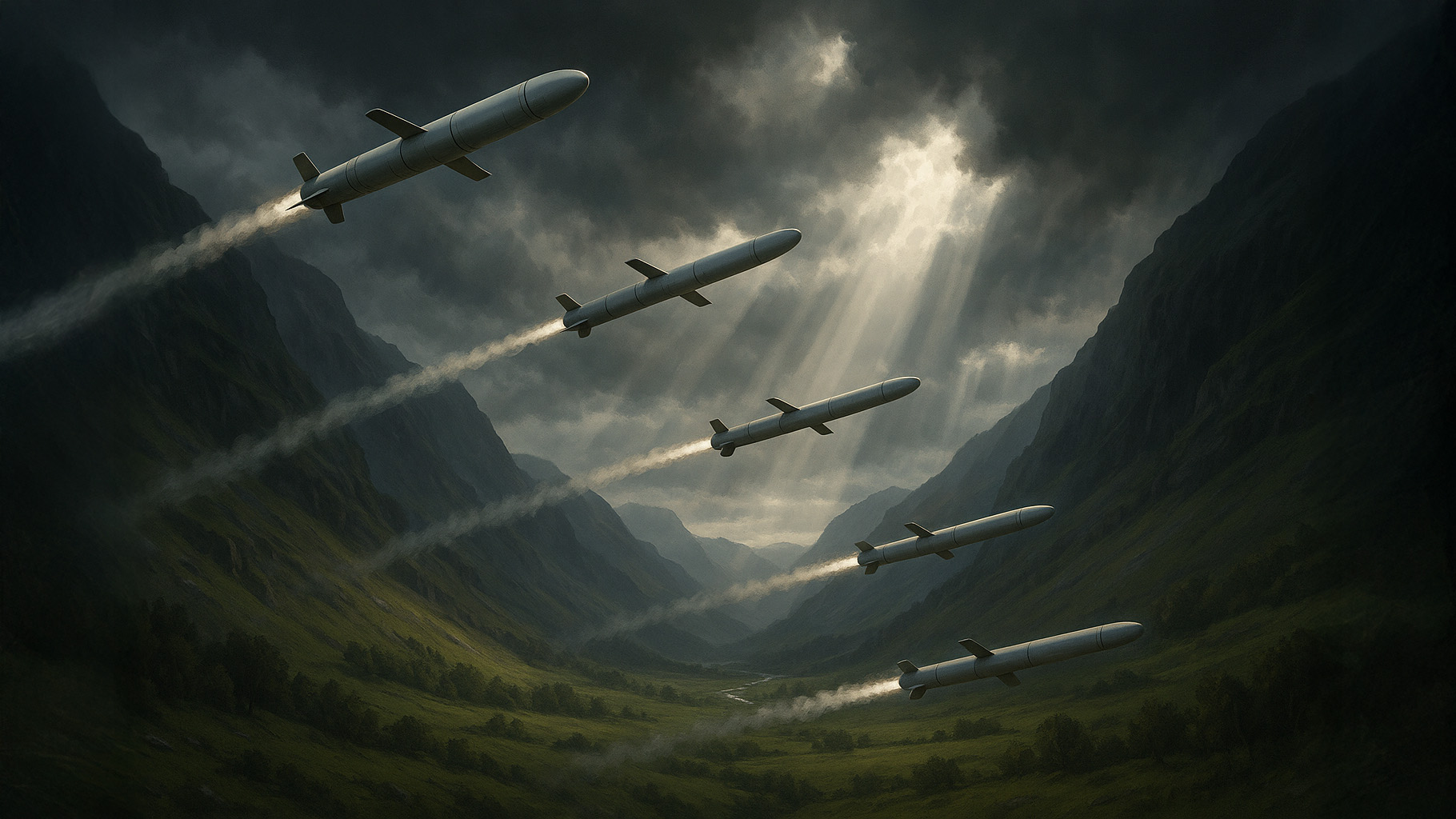
Britain and five European allies have agreed to press ahead together with the development of new long-range strike weapons, moving their joint effort from a planning exercise into standalone delivery groups, with the United Kingdom leading work across several of the most significant areas, the Ministry of Defence has said.
The decision, set out in a communiqué endorsed by the defence ministers of France, Germany, Italy, Poland, Sweden and the United Kingdom, marks the next phase of the European Long-range Strike Approach, known as ELSA, the cooperation the six nations launched two years ago in recognition that the ability to conduct conventional long-range strikes had become a critical capability in modern warfare.
The Ministry of Defence highlighted the British role in the effort, saying the United Kingdom had led or jointly led several of the clusters of work, notably on air-launched long-range strike, ground-launched long-range strike and low-cost long-range strike, and describing cooperation with NATO partners on enhanced strike capabilities as crucial to collective security.
The aim when the six nations launched the approach was to pave the way for cooperation across the European defence industrial and technological base, so that the right equipment could be developed, produced and delivered in appropriate numbers and to an appropriate timetable, an objective that has taken on fresh urgency as the war in Ukraine has shown the value of being able to strike deep behind enemy lines.
Over the past two years the nations grouped the work into distinct clusters covering the whole spectrum of long-range strike, from sensors through to the weapons themselves and the platforms that launch them, agreeing common requirements within each and seeking interoperable solutions. Those clusters span airborne early warning, the suppression of enemy air defences, air-launched strike weapons, a European multi-missile launcher, ground-launched systems across several range bands reaching from a few hundred kilometres out to beyond 2,000km, and low-cost long-range strike based on one-way-attack effectors of the kind seen in Ukraine.
Several of those clusters have now reached enough maturity to continue as standalone ELSA Implementation Groups, each led by one or more lead nations and focused on concrete development and procurement projects, building on a network of national experts and open to new partners, with some of the work already translated into cooperation projects.
The ministers described the approach as having proven effective by first relying on a small core of nations to accelerate agreement on requirements and achievable solutions, before expanding to let cooperation projects emerge, in effect serving as what they called “an incubator” for European capability, and said ELSA now represented “a meaningful advancement in European cooperation” in long-range strike, reaffirming their determination to accelerate its acquisition and development.
The push carries particular weight given the warning from NATO this week that deep precision strike is among a small number of capabilities that, for now, only the United States can provide, alongside command and control, intelligence and surveillance, and air-to-air refuelling, areas where the alliance has told European members they must improve.
By pooling their efforts on everything from intermediate-range ground-launched missiles to cheap one-way-attack drones, and with Britain leading much of the work, the six nations are attempting to build a sovereign European deep-strike capability of the kind that has become central to the war in Ukraine and to the wider question of how Europe shoulders more of its own defence.




In the end “defence” is never a deterrent and it never wins wars.. only offence.
You deter another nation going to war with you by your power to pile hurt on that nation.
You bring your enemy to the peace table by inflicting pain and more pain.
So in the end we need a sovereign capability to continually hurt and bleed our enemies until they give up or preferably never start..
That is
At the nuclear end.. strategic and sub strategic weapon systems that have the capability to destroy 1 target or 70 cities + 1 capital with ABMs
At the conventional end the ability to continuously conduct strikes to a range of 2500-3000 Kms none stop and for as long as it takes.
I’ve gained $17,240 only within four weeks by comfortably working part-time from home. Immediately when I had lost my last business, I was very troubled and thankfully I’ve located this project now in this way I’m in a position to receive thousand USD directly from home. Each individual certainly can do this easy work & make more greenbacks online by visiting
following website—.,.,.,.,.—>>> JobatHome1.Com
So that’s Backestop (200kg+, cruise missile 600km+ range) for just Ukraine? Nightfall (ballistic missile, 600km, 200kg), and now ELSA (cruise missile 1,000 km+). Obviously, depending on the contenders, it will have varied specs.
I’ve gained $17,240 only within four weeks by comfortably working part-time from home. (zk) Immediately when I had lost my last business, I was very troubled and thankfully I’ve located this project now in this way I’m in a position to receive thousand USD directly from home. Each individual certainly can do this easy work & make more greenbacks online by visiting
following website—.,.,.,.,.—>>> Homeprofit1.site