

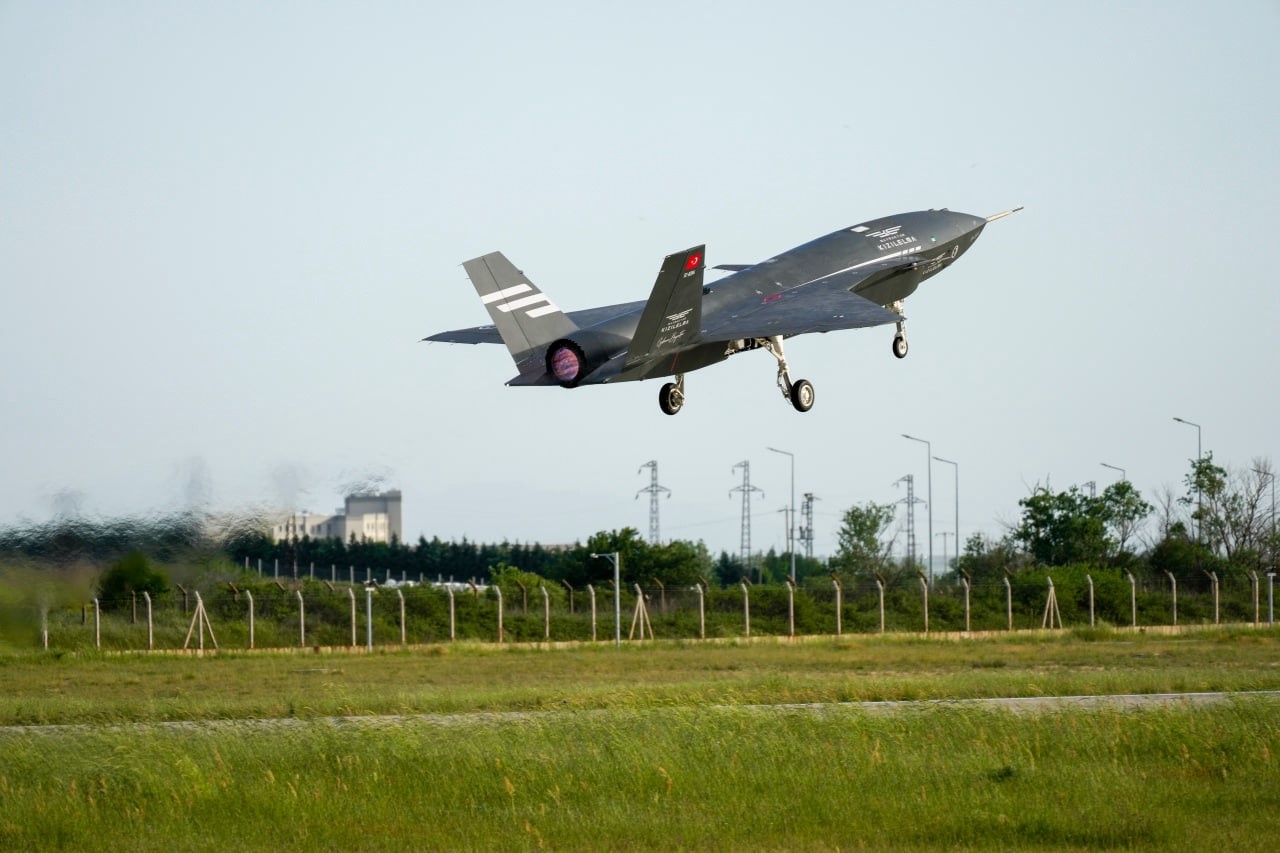
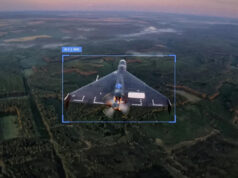
Leonardo and Baykar have completed the first phase of live testing for their K-SWARM programme, with Italian M-346 jets and the Turkish-built Bayraktar KIZILELMA uncrewed fighter aircraft flying joint autonomous formations over Turkey, the companies stated.
The trials, conducted in May at one of Baykar’s flight and test centres in Çorlu, marked the transition of the K-SWARM effort from simulation to live operations. K-SWARM is aimed at designing and developing interoperability between crewed and uncrewed aircraft, an area that sits at the centre of current thinking on the future of combat air. The flight campaign involved two Leonardo M-346 airframes, a Leonardo-owned Fighter Attack variant alongside an Italian Air Force T-346A acting as chase aircraft, paired with the KIZILELMA uncrewed fighter.
According to the companies, the missions assessed and validated next-generation algorithms underpinning collaborative and coordinated operations between the platforms. After an autonomous taxi and take-off, the KIZILELMA used Smart Fleet Autonomy algorithms developed in Baykar’s Hardware-in-the-Loop Laboratory to autonomously rejoin the M-346, with the crewed aircraft then assuming full control of the drone. Using a newly developed onboard avionic suite, M-346 pilots commanded a series of formations, with the KIZILELMA executing position changes, separations and rejoins in response. An advanced radio frequency data exchange system kept the platforms synchronised, protected by Leonardo’s GCC Tactical Platform, the company’s proprietary cyber defence system providing real-time monitoring and command and control of the flight formations.
The companies described the work as a major milestone in the development of crewed and uncrewed teaming, which is widely treated across NATO and allied air forces as one of the central enablers of future combat air systems. The concept involves pairing manned fighters with one or more uncrewed wingmen capable of carrying sensors, weapons or electronic warfare payloads, with the crewed aircraft acting as the mission lead. Variants of the idea sit at the heart of the United States Air Force’s Collaborative Combat Aircraft programme, the United Kingdom’s work under the Global Combat Air Programme on adjuncts to the Tempest fighter, and France, Germany and Spain’s Future Combat Air System effort, alongside a growing number of national programmes outside the principal Western blocs.
The KIZILELMA platform is itself one of the more closely watched entrants in that field. Developed by Baykar, the firm best known internationally for its TB2 and Akıncı strike drones, KIZILELMA is being designed as a low-observable, jet-powered uncrewed combat aircraft capable of operating from short runways and, in later variants, from Turkey’s TCG Anadolu amphibious assault ship. Pairing it with the M-346, a Leonardo trainer and light combat aircraft already in service with several air forces and used as the platform for Italy’s International Flight Training School, gives both companies a route to mature crewed-uncrewed teaming concepts on relatively affordable platforms before scaling them to higher-end fighters.
Leonardo said the algorithms and tactics tested in Çorlu were developed at its Avionic and Flight Control Innovation Labs and at its product capability and concept laboratory, PC2LAB, in Turin, linked through to an M-346 Full Mission Simulator in Venegono. Baykar said its facilities had integrated advanced smart fleet autonomy capabilities into the crewed-uncrewed teaming algorithms, with KIZILELMA’s autonomy features simplifying the integration process.




Serious question (no seriously).
So does the Pilot of the manned aircraft now have to do the work of two or Is the Intention to enable the Drone to think and act for Itself ?
If the latter, what’s the point of the manned aircraft ?
If It’s still the Pilot that controls the Drone, then does he get double pay ?
Confused from Cambridge. 🫡🤔
The theory of man-machine teaming says that tasks which are hard for a human are often easy for a computer and vice-versa. The idea is that pairing gives both an easier time. I don’t know much the human has to think about relative to just flying a plane, but there will be an element of order and forget. The ratios I hear about are greater than 1:1, so I’d expect the pilot to control more than two aircraft, but with a looser lever of control. We can expect to see some swarming behaviours from CCAs, and the pilot might treat the multiple drones as a single system of systems and order it accordingly.
If you saw dark star a small sci fi paradox on Vietnam the intelligent missile argues with the crew.
A combination of the two I would have thought and the article seems to suggest that when it says the unscrewed system joined the manned aircraft in formation and then the pilot was able to assume control of it. I suspect, certainly at this stage the pilot is in ultimate control yes, but the ‘drone’ autonomously follows base criteria itself like operating in a joint flight envelope mirroring the manned aircraft so the pilot doesn’t have to literally control it, with the ultimate aim of being as and when appropriate given pre set instructions to operate more independently on an independent mission profile ahead of the manned aircraft or a separate role from it within other pre set parameters with it returning to the former at a later point (assuming it survives). No doubt these trials will test such matters and eventually push envelopes to determine exactly how they will operate together and reduce the need for direct control, but one presumes the eventual aim is for the pilot to have input only when necessary, immediate defensive responses for example and when a pre planned largely more independent role for the ‘drone’ is required and during a mission instructed to set off upon.
Excellent assessment there Spy. Thanks.
I think I might train as a Pilot.
Yes, that’s how I read it too.
The drone was given an instruction on the ground to go and link up with the M346. The pilot then took over authority from the ground station, and told the drone to execute a series of manoeuvres from a selection of commands, which the drone then executed without the human pilot needing to control a separate joystick or anything.
Mate- I’m sure the pilots wish they had a back seater RIO/WSO for that. Time to bring back the Tornado F3? 😂
It has been noticed that the J-20 and SU-57 both have twin-seater variants, possibly due to the requirements of flying a fighter jet while controlling UCAVs. There are no F22 or F35 twin-seat variants and on F35B it would be impossible due to the lift fan, so I assume the US plan for the pilot to do everything.
But in one of the podcasts by the RAF on the development of GCAP the crew of Tempest was described as being much more like a WSO than a pilot. The actual flying of the aircraft would in most cases be done autonomously, with the pilot instead focussing on fighting the machine and managing his or her ACPs.
Cheers for that TJ- interesting insigthts
it was a weird pitch on the outset of tempest, they were suggesting tempest could be maned / unmanned. we are going full circle with having 2 crew in the chat. lets see how this wingman thing develops still not fully convinced, same for hypersonic missiles, not fully convinced.
Look out Netenyahu….this country is serious, and has mass.
Ha, that would be an Interesting scenario.
Sometimes, although I don’t have a problem with lsrael, they need to realise that others inhabit the middle east.
Turkey is occupying 3 countries partially: Iraq, Syria, Cyprus. But since you don’t see it in the Activist Profession=Journalism all is dandy.