

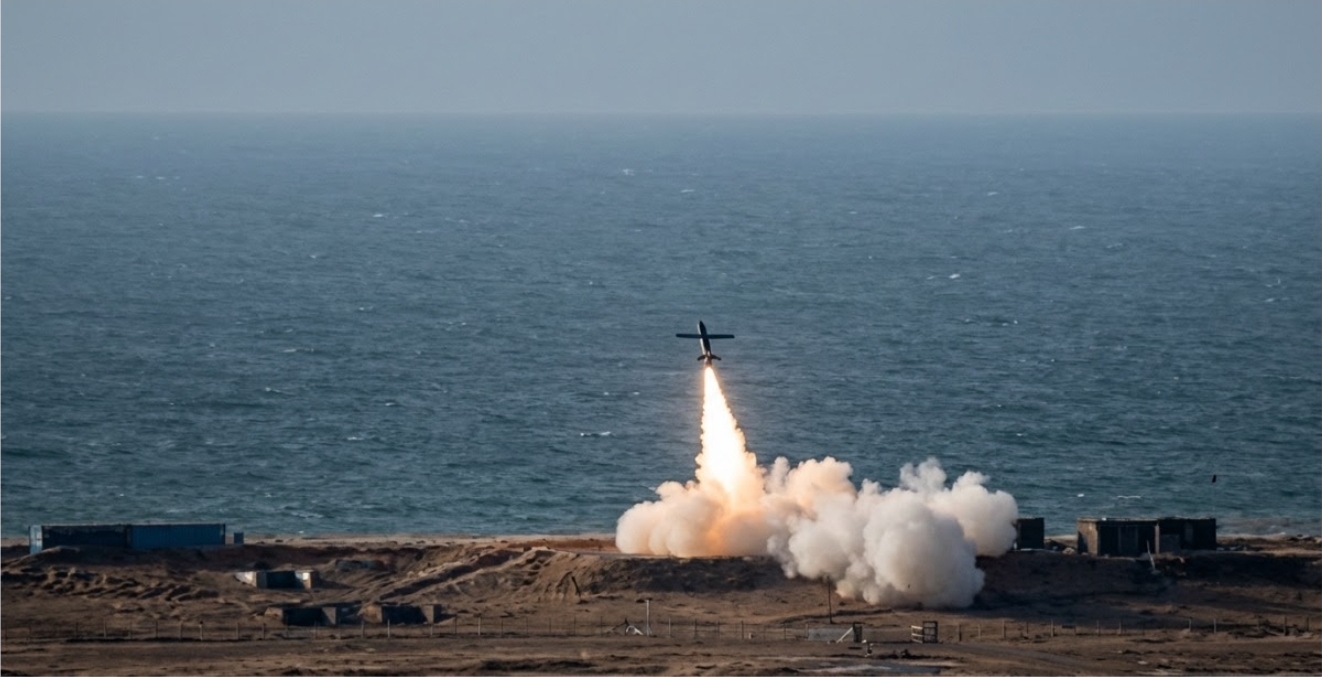
A British company has showcased a new home-grown deep-strike system designed to give the United Kingdom an affordable, sovereign alternative to the cruise missile, as part of a Ministry of Defence drive to field long-range autonomous weapons more quickly, the company has said.
MGI Engineering displayed its TigerShark system this week at an industry event marking progress on Project BRAKESTOP, the MoD initiative to accelerate the development of long-range autonomous strike systems through closer work with the defence industry, bringing together senior officials, industry representatives and programme stakeholders to review the first two phases of the work.
The Oxfordshire firm has been awarded a development contract by the MoD and has been advancing TigerShark as the platform to be adopted under the programme. The system is described as a high-speed, long-range autonomous one-way effector, developed and manufactured in the United Kingdom for deep-strike missions against high-value targets, and intended as an affordable and scalable alternative to traditional cruise missile capability.
According to the company, TigerShark can carry a payload of up to 300 kilograms at speeds of up to 750 kilometres per hour out to a range of 900km, and is built to operate in contested environments, using advanced navigation that allows it to function in conditions where satellite positioning signals are jammed or spoofed. Its modular payload bay and open architecture are designed to allow new payloads, software upgrades and future capabilities to be integrated rapidly.
The chief executive of MGI Engineering, Mike Gascoyne, said Project BRAKESTOP was “a positive example of how the MOD and industry can work together to accelerate development” and get the right capabilities into service quickly. TigerShark had been developed, he said, to give the United Kingdom and its allies “a sovereign, affordable and scalable deep-strike capability” well aligned with the demands of modern conflict.
Project BRAKESTOP is a Ministry of Defence initiative designed to speed up the development and fielding of long-range autonomous strike systems by bringing together government, industry and technology partners through a faster, more agile procurement process, seeking to mature sovereign UK capabilities that can deliver precision effects at range in contested environments while applying the lessons of recent conflicts such as the war in Ukraine.
MGI Engineering, founded by the former Formula One technical director Mike Gascoyne, said it aimed to scale up production of TigerShark in the final quarter of this year and into 2027, drawing on engineering and testing methods from the aerospace, motorsport and defence sectors to shorten development timelines, and would continue to support Project BRAKESTOP as it moved forward.










Is Tigershark really going to see the light of day .🤔
Yeah, supposedly is going to supply Ukraine as well as us. Makes sense, get a hot production line at scale with tight feedback loops – while not using any American components.
It’s hard to criticise this if some of these details are accurate
I still think it’s a bit on the pricey side. From what I’ve seen it’s £400,000 for each effector yet doesn’t have performance much better than a Shahed which costs $7000-50,000 depending on what variant.
What I am looking forward to however is Nightfall, a ballistic missile of Mach 4.5, 600km range 200-350kg warhead and just £800,000 for each effector. Now that will be brilliant.
I’ve gained $17,240 only within four weeks by comfortably working part-time from home. Immediately when I had lost my last business, I was very troubled and thankfully I’ve located this project now in this way I’m in a position to receive thousand USD directly from home. Each individual certainly can do this easy work & make more greenbacks online by visiting
following website—.,.,.,.,.—>>> JobatHome1.Com
I’ve gained $17,240 only within four weeks by comfortably working part-time from home. Immediately when I had lost my last business, I was very troubled and thankfully I’ve located this project now in this way I’m in a position to receive thousand USD directly from home. Each individual certainly can do this easy work & make more greenbacks online by visiting…
following website—.,….,,.,.,.,.,.,.—>> PAYAtHOME1.COM
To be fair, that would be for the prop Shaheds, I think the jet ones are more comparable to the tiger shark and are more than $70k. They’re also constructed by forced labour in Siberia, which saves a bit compared to a UK production line!
I think the key will be how resistant they are to jamming and how good their guidance/seekers are; they are some of the more expensive components and Shaheds aren’t great in either capacity.
This much faster than the Shahed drones and more sophisticated navigation as well.
I agree the price point is about 4x what is needed.
The Shahed usually carries a warhead of around 50kg, whilst Tigershark is up to 300kg. For me, the intriguing part is how do they get accurate navigation, when it’s flying through a GPS denied area, in a package costing £400k?
Dead reckoning accelerometer and a Samsung phone camera + Google Maps 😂
All airliners have inertial navigation systems as backup to loss of GPS, with resetting them on the to-do list before each flight. Though sophisticated ones can reset themselves from GPS will in flight, so only the jammed leg of the mission would need the INS.
The quantum clock based one being developed in the U.K. has virtually no-drift at all but is too big for this kind of use currently.
All depends what’s inside it I guess. If is 3 to 4 times more effective and immune from interception than a Shaheed then it is a far better system, let’s be honest if we were building them how much would a Shaheed cost us to build, I doubt the Iranians or Russians will sell us any and they would be totally ineffective against them if they did.
Why have I lost my icon. Any 18 year olds around who might have an answer?
Jacob K, the Tigershark’s performance is so much better than a Shahed.
Yes the TigerShark is more expensive, potentially into the mid-to-high five figures, but it offers a much higher probability of mission success per launch. If your goal is to destroy a high-value, hardened, or well-defended target, the Shahed may require a large swarm to ensure a single hit. The TigerShark is designed to achieve that effect with fewer launches, potentially providing better “bang for buck” when high-value destruction is the goal rather than simply creating a distraction or overloading sensors.
Sitting in the “The Precision Strike Gap” $400,000 – $600,000, the TigerShark sits. It is significantly more expensive than a Shahed, but it is “cheap” relative to the target it destroys. If a £400,000 drone can neutralise a £10 million radar installation or a command-and-control node that a Shahed cannot reach or penetrate, the TigerShark has a better “cost-per-kill” efficiency than a swarm of cheaper drones that might all be shot down.
A modern anti-air interceptor missile, like an AMRAAM or Patriot PAC-3, costs between £770,000 and £3,000,000. As UKDJ has alluded, by keeping the TigerShark around the £400k mark, the UK creates a favourable exchange ratio. Even if one is intercepted, the defender has spent significantly more than the than the attacker.
Its warhead/utility ratio is much better, the TigerShark carries a 300 kg warhead. A Shahed’s 50 kg warhead is insufficient for many strategic targets, like bunkers or large logistics hubs. The TigerShark provides “cruise missile” kinetic effects at a fraction of the cruise missile price.
At £400,000, the manufacturing does not require the “exquisite” supply chains … gold-plated connectors, aerospace-grade custom alloys, or highly protected integrated circuits, that drive the cost of traditional missiles into the millions. It allows for the use of automotive-grade components and civilian-sector composite manufacturing.
“Cheap enough” means a weapon is disposable. If a commander is willing to risk sending it into a highly contested environment, knowing there is a high probability it will be destroyed, the weapon is “cheap.”
If it costs £2 million, a commander is psychologically and strategically pressured to ensure it hits its target, often resulting in complex, multi-layered mission planning. If it costs £400,000 and can be produced in batches of 20+ a month, the commander can afford to be more aggressive, using them to “probe” air defences or strike targets of opportunity that wouldn’t warrant an “exquisite” weapon.
Its not difficult to avoid using American components but it will be diffiult to avoid using Chinese components. The problem wont go away by changing the supplier.
Yes.. the next stage if for each of the three systems ( MBDA, MGI Engineering and Rotron Aerospace) to as I understand it provide 14 or so weapons and launch vehicles to Ukriane.. Ukraine will then “ field test” them and the manufacturers each have to prove they can produce 40 a month.. the final production weapons will then be picked and the production supplied to Ukraine.
Good to have at scale, but, as shown in Ukraine and Russia, shot down in vast numbers for the few that get through, and how capable is its 300kg against hardened or buried targets?
An alernate to, not replacement on the cheap for real cruise missiles. As long as HMG accept that.
Storm Shadow’s warhead is not hugely bigger at 450kg and this doubles the range at the same speed. Behind the drone stuff Tigershark, the most out of the three Brakestop contenders, is really just a cheaper cruise missile. It’s a pity the wings and fins are fixed because it would otherwise be a good way of cheaply filling VLS cells with a reasonably effective strike weapon.
The other contenders are MBDA’s Crossbow, which is a super bare bones 1950s looking missile with an external engine and straight wings, and Rotron’s Sky Lance, which is propeller powered but carries the same payload in the same footprint as the others to 1200km and with a smaller payload can go 2700km. If we want to distinguish between Brakestop and Stratus, Sky Lance is the one to go for.
Personally for VLS cells cheaper option I’d say Nightfall would be brilliant.
Mach 4.5, 600km range, 200-350kg payload (changes every source I see) all for just £800,000. Brake stop is slightly longer ranged but at its speed far easier to intercept and still £400,000.
I’ve gained $17,240 only within four weeks by comfortably working part-time from home. Immediately when I had lost my last business, I was very troubled and thankfully (s1) I’ve located this project now in this way I’m in a position to receive thousand USD directly from home. Each individual certainly can do this easy work & make more greenbacks online by visiting
following website—.,.,.,.,.—>>> Homeprofit1.site
I’ve gained $17,240 only within four weeks by comfortably working part-time from home. (d10) Immediately when I had lost my last business, I was very troubled and thankfully I’ve located this project now in this way I’m in a position to receive thousand USD directly from home. Each individual certainly can do this easy work & make more greenbacks online by visiting
following website—.,.,.,.,.—>>> Homeprofit1.site
The latest for Nightfall is 200kg to 500km, but most short range ballistic missiles are shorter and wider to give the required motor thrust and so don’t fit in VLS cells. There is an RFI out for potential new VLS silos for the RN which [might] allow bigger weapons but we will have to wait and see.
It is interesting that you know all these technical details for a..17 year old?
It’s a wondrous thing Indeed.
Now now.
It’s OK mate, I just remember when I first came here and he told me off…… “You’ll be the ruin of this place” he said 😁😁😁😁.
Bless, I always love a challenge.
In my defence, having reviewed the email record, you and DM were making girth and length jokes under an article about helicopters.
Size Isn’t everything 😊
18 tomorrow, I’ll have you know!
Google is a wondrous thing, the Defence Sourcing Portal makes each new RFI and the smaller contract competitions open to the public up until the deadline, so I trawl through it occasionally looking for anything new.
Most people only read the news articles and don’t use them to go and look at the company/government websites to get information straight from the horse’s mouth.
Even I don’t look at the “Defence Sourcing Portal.” Didn’t know it even existed.
And I call myself a researcher. Bah…..
Ok, I’m doomed. I go through various “sources” with a fine tooth comb for titbits of info and you’ve just named another I wasn’t aware of!
Oh dear…..Just looked.
Potential Goldmine .
It’s mostly stuff like ‘Provision of laundry services to RAF Brize Norton’ but some good stuff pops up there every so often. As far as I know I was the first outside the MoD to know about Project Vanquish and hardly anyone has noticed RFI 715865497 for IAMD silos optimised for unmanned surface vessels, which is necessary because neither mk41 nor Sylver are designed for long periods with no maintenance.
Indeed. You’ve just doomed me to more hours spent staring at a screen.
I’m not knocking it, I’ve found plenty of stuff that’s not even wide public knowledge looking in detail at some quite innocuous seeming things online which HMG helpfully published.
So laundry services at Brize might lead you to other things.
Not sure I want to know any more about that tbh
@Spy.
Exactly. So I don’t go into any more detail here.
I want to know, as I want the knowledge.
I did mention once about a certain subject that I thought was more known than it was and got a gentle bollocking by Davey!
And to add, young padawan, you’re well along to being a fully trained sleuth!
Your training is almost complete….( said in the voice of the Emperor!)
Well spotted. First news of the IAMD silos for me.
Well I was 62 yesterday so I guess we are both celebrating birthdays.
Happy 18th for tomorrow 👌
And happy 62nd for yesterday!
Get a room you two.
I believe that might just be Illegal.
I’m 83 – does that make me the oldest geezer on this blog?
Jeez I am over 70 and still doing the Fan Dance…..happy birthday youngster.
Honestly these kids John, 62 is hardly out of uni in my book, 18 barely out of maternity.
😅😅
I bloody wish I could mate.
For Info, I’m currently sat In a lovely layby over looking the Bristol Channel (Again) and I can see the Brecons rather clearly.
The day started off with thick wet Fog so I had a nice little stroll around Lynmouth, then back up Countisbury Hill to the top of Porlock.
Got an early start to get back home to see the kids so It’ll be an early night now.
😅😅
Stick to the wheels son….you told me why.
You even older git 🤣😂
No stranger to Senny then!
That cattle grid? Think l preferred Shankhill 🤣
You old git..
Seconded!
I’m impressed. I suspect you won’t have much of a problem establishing a rather impressive career… or if you do we truly are fooked.
It’s Engineering for me, as you would expect from my madcap ideas.
All up in the air for a bit as I have my last A level on Monday, but if anyone here has contacts who might be willing to sponsor a placement for next academic year while I reapply to my ideal university I’d be very chuffed!
I’m pretty good academic wise too.
My honest advice is this.. save and invest…don’t spend money you don’t have and save as much of what you do have as you can..
I wish someone had told me this..
1) save to buy a property.. essentially totally abuse the hell out of the life time Isa.. get one on your 18th birthday ( on that day) for 1 pound.. and over the year fill it with £4000 exactly.. because the government will give you 25% of what you put in up to £4000.. essentially you get a free £1000 a year from the government.. that gives you £5000 a year to buy a house.. you still get interest as well.. keep sticking in £4000 a year after 10 years you will have £50,000 + compound interest ( £10,000 of which the government gave you) to buy a property that is under £450,000 ( you must buy under £450,000).
2) max your employees pension contributions from day one of working.. put in as much as you can.
3) over pay your mortgage
4) anything extra you can save put in a stocks and shares ISA.
5)The only thing in I would buy on credit is your house via the mortgage.
If you follow that.. you may have to scrimp a bit in your 20s and 30s when others are flashing it.. but by the time you are 40 you will be mortgage free, debt free, with money in the bank, an investment portfolio and a healthy pension.. ready for later.. you can cut your hours and live more ( because you will be finding your 40s harder graft both physically and mentally).. and in your early 50s you can Jack in work as much as you want and only do what you want to do… I only followed half of that advice half as well as I should have.. so I’ve only got to semi retire in my early 50s instead of fully retire.. ( got to wait till 60 for the full fuck the world hand me my sun lounger situation)
Having the lovely car on finance, paying for lovely holidays on the credit card, jacking your mortgage up to the max and paying the minimum into your pension.. May make you feel wealthy and successful in your 30s.. but will it be worth it when your still slugging your guts out in your mid 50s working every hour with 400,000 of mortgage and no pension till your 67.. I have a lot of friends like that and they are not happy bunnies…
I just worked out that saving money meant I was not out and about doing stuff.
So I blew It all on cars, Bikes, Beer and women.
“One Life, Just Live It”
I’m guessing the last one is Maths/Further Maths? Genuinely absurd how late they leave them. Just about gave up revising for them in the long run, and got very lucky.
Yep, Further Mechanics 2.
It isn’t even a compulsory exam but I signed up before looking at the date.
Also judging by the exams I’ve done I might not even need it as a module but I really enjoy mechanics so I’m carrying on regardless.
I’m also rooting for him.
Our country Is In desperate need of “Smart Arses” 😂😂😂😁
I was 18 once, & no it wasn’t VE night. Anyway, enjoy your year of being 18, as you only get to do it once.
600km isn’t much good on a warship unless you whack an radar seeker on the end of the missile and use it to hunt other warships.
But ….that would be a different weapon entirely.
Yeah, exactly. The proliferation of stand-off shore-to-ship missile systems in the littoral and coastal zones means that large warships are significantly safer standing-off out at sea. Space-based sensing makes targeted large fixed infrastructure (the ideal target for these slow, cheap, light systems) doable, negating the need to close with the target.
The result is that something like MdCN becomes the minimum for a warship.
Won’t all VLS missiles require booster rockets or pretty powerful motors which would add to unit cost? If these are on cheaper side they’d be rail or cannister launched wouldn’t they?
The stormshadow warhead is a bit of a technological terror.. that is it provides way more penetration than you would expect, the Bomb Royal Ordnance Augmented Charge is essentially a massive shaped charge that enables the sending of a the second penetration charge to go through 16 feet of hardened materials way more than any other 500kg range missile warhead.
Dumb eyeballs.. i read that as technological error..
Did we ever fit the BROACH warhead to anything other than Storm Shadow Jonathan?
The U.S. us it in the AGM154C JSOW.. this is the anti shipping version and bunker buster version of the JSOW and the French scalp.
It’s been a massive export success story.. when you think the UK purchased 900ish storm shadows, but has build and sold 10,000+ BROACH warheads.. its still the only cruise missile ready and sized ( 500lb range ) tandem charge warhead on the market.
There was a debate on another forum yesterday about how effective the BROACH warhead might be for anti-shipping if we are unable to get both STRATUSes.
If you look at the picture of that Kilo that got hit by a Storm Shadow in dry dock the primary HEAT stage blew an entry hole by the forwards diving planes, the secondary then carried on all of the way after of the sail and blew out both sides of the pressure hull.
With variable timing on the main warhead that would absolutely do the business detonating in the middle of a 64-cell VLS farm.
It’s massively effective.. infact it’s the warhead on the The AGM-154C, JSOW, which is specifically designed to engage maritime targets.. it incorporates an infrared detector for the terminal phase guidance and the BROACH warhead, the first charge (WDU44 heat warhead) drills a 15-20 deep hole in the ship the the larger WDU blast frag flies straight through that hole and explodes deep in the ship.
It’s one of the reasons I don’t understand why we don’t buy some AGM-154cs for the F35Bs…essentially we build 30% of the weapon in the UK, the RAF already know how to manage the bit that goes bang ( and the rest is just a simple glide bomb).. it’s essentially a shorter range ( 130km ) verson of the storm shadow.. but with terminal infared guidance to kill ships…
Interestingly if someone did ever launch a heavily armoured ship.. you would use this weapon to kill it as it would defeat any armour conceivable.
Aah now I know how it made a mess of that Russian submarine a year or two ago. Very impressive.
Now you even beat me to that, leave a few crumbs for us oldies, it keeps us out of care homes.
My wife said something similar when we first, erm, ….. 🫂💪🧑🤝🧑
What have I told you about smoking the “peace” pipe at the weekends 🤣😂
No one is suggesting these are a replacement for more hi end weapons. That’s FC/ASW. But we need the options to deploy these types at scale.
Agreed.
But you know my scepticism of politicians jumping on something cheap to avoid the inconvenience of paying for proper defence.
Look at Pollard the other week with his “1000 ship navy” of autonomous Pacific 24s, other Kraken types, and the bigger USVs talked about.
HMG cannot it seems even find the money for a handful of additional ships in the 2030s like a batch 2 of T31! And he babbles on about a 1000 ship navy.
Hello?
I’m waiting for those to do the multitude of tasks a Frigate can do or one of these small quadcopters deploying 1,000 miles into the Atlantic to take down a sub.
Without enablers, they cannot yet do that. In fact, what is even confirmed that they can do? Apart from the UKR experience in a closed sea with suicide boats?
There hasn’t been any promise of additional T31s. As things stand the Escort force will be 19. Every Navy is planning unmanned. It’s clear as day it’s the future of warfare.
I know there hasn’t mate. That’s my point. There should be, alongside the new stuff. It is the future, yes, but does it work now?
And are we sure it will work in the future? Is anyone?
They talked about the Internet in this way until Cyber and surveillance got so comprehensive that I read that Russia went back to using typewriters. They work, and cannot AFAIK be TEMPESTED.
The SF use Pencils, reliable.
The RN got rid of main guns, hey presto, NGFS was then needed.
I’m not knocking the Drone stuff, hope we buy it in bulk. But I remain extremely wary of relying on it and
one day I foresee us suddenly acutely short of other “conventional” kit we could have used in a given situation and it’ll be “oh, the Drones cannot do that” which HMG neglected to buy because Drones are the new be all and end all.
Its been made pretty clear the unmanned stuff is to compliment not replace the conventional. Are we going to get more escorts and fast jets that we don’t already know about. Probably not. Manning is the biggest constraint. But they can certainly extend the sensor range and weapons to deploy with our T26s or T31s or a Typhoon/F35/Apache/Merlin.
We can hope that the use autonomous systems in blue water vessels to reduce crews to the bare minimum to do the geopolitical flag waving and manage grey warfare via constabulary capability.
If they were switched on they would not go down the rabbit hole of a fully autonomous blue water naval vessel.. because no matter how good a warfighting vessel it is, it cannot do the vast bulk of what a navy is for.. sub kinetic war activities such as geopolitical pressure and messaging, presence, and all the gray warfare stuff ( what you could round up as security, constabulary and surveillance)… only a crewed warship can do this.
If they were really thinking it through they would create warships with essentially sealed spaces that can essentially operate without crew..but then put in berths and facilitates for the crew you would need for all the sub kinetic activities.. so the crew are there as a command function, with a constabulary element, an emergency maintenance function and maybe manage smaller autonomous air capabilities or even a small ship flight.. essentially the autonomous ship runs itself and the crew are there to make it commissioned warship in the wider sense.. then when you go fully kinetic you can make the choice to remove the crew which allows you to essentially sacrifice it without human loss ( because sometimes warships do need to put in a place they are not coming back from).
If you make them about 3000 tons with space for only 10-20 crew you can pack a 6000 tons frigates level of capabilities on them for high end war and the rest of the time run them for half crew cost of a rivers class OPV.
Give it the standard fit of 24 CAMM… give it the ability to take a containerised narrow line towed array.. give it a flight deck, small hanger ( wild cat size) a couple of boat bays for autonomous mine warfare boats and other autonomous vessels, a 57mm on the front and a 40mm on the back.. and fill the capacity you have left with a hole you can drop MK41 silos into..
Call it a type 32 general purpose autonomous corvette, build loads of the things.. give 10-20 of them a CO and a basic constabulary crew and call them HMS..and have them as replacements for all the rivers and mine warfare vessels, keep the rest ( 20+ ) without a crew as companion autonomous vessels for the crewed escorts, carriers etc…. Then if your switched on you have a a few hundred reservists trained up as crews for them.. so you can if need be commission those crewless vessels as well to replace your HMS lossses.
Call it the flowers class.. suddenly the RN has more MASS than it had in the Cold War.
“Call it the flowers class.. suddenly the RN has more MASS than it had in the Cold War”.
Or call it Black Swan ‘sloop of war’? Are we seeing the emergence of a seed that was planted in 2012?
The Black Swan ‘sloop of war’ concept was a proposed solution to the problem of ever increasing cost and crewing requirements of frigates and destroyers and reducing fleet numbers. It was envisaged as 3000 tons, 95m, with big flight deck, small hangar, stern ramp, crane, directed energy weapon, 30mm, mission bay with 20m containers, core crew of 16 rising to 40 with boat handlers. Suggested profile similar to some of the Kongsberg Vanguard designs.
Afternoon Mr Blay sir. I seem to recall It was going to be “At Least 5 T31’s” not so many years ago, then we had the mythical 5 x T32’s …..
I guess we could also mention the 138 F35’s but that would just be silly ! 😁
Anyway, Let’s hope we see the 12 AUKUS Subs at least. 🫡🤔😒
Anyone seen those other MCM Mother ships yet ? Or Is Stirling Castle going to remain single !
We await the DIP!
And another 30 years when it’s all forgotten as another government do something else.
I keep reading about us fighting tomorrows wars. I think that the NOW seems to be equally forgotten.
Much of MoDs budget is for a tomorrow that never comes.
Need to invent time-machine 1st..
Yep, Unless the DIP has any surprises it’s the 8 T26 and 5 T31s plus the weapons upgrade to T45. We’ll see what comes of the Multi role strike ships and maybe just maybe we will get 12 AUKUS. I think we all know we aren’t getting 138 F35s. Not with Tempest to fund. Let’s see what the tranche two order looks like. I could see the F35A getting dropped. And maybe some additional F35Bs ordered in the early 2030s to replace some early tranche. Even with a considerable increase in defence spending i think its clear it’s a choice between increasing conventional kit or more drones/missiles. Not both.
The Chinese and USN are still pursuing big ship fleets though. Really silly this “19” box thinking. You’d only need to lose a few to whatever and you’re back to where we are today. Any additional ships would help the RN to spread itself out and maybe help command some of the “remaining” 981 usvs. Port visits, flying the flag, humanitarian ops can’t be done by drones. Like to see the OPV fleet built up a bit, at least replacing the B1 Rivers maybe with 3-4 if they’re not increasing the number of frigates.
I’d love to see another 5 T31s ordered to get us to at least 24 Escorts, and new OPV replacements that could take up many of the RNs day to day tasking, then add all the unmanned stuff. But I just can’t see that happening with the budget constraints and manning issues. Even with a 3% defence budget next week it would still be a stretch. I wish we had 26 or 30 Escorts. I just try and keep my predictions within the reality of the budget available.
Hi M8 I’m not entirely sure we have really taken a step back and looked at the wider Macro implications of the longer range affordable effectors and daft as it sounds it may come down to a cost / effect analysis.
Yes there are a high volume shot down but the mass of the attack ensures some get through and do a lot of damage, which is their immediate objective.
But unless it’s just a low cost Kinetic weapon (an AA gun), the interceptor weapon be that an interceptor drone or SAM costs more due to the need for accuracy and speed than the offensive weapon.
So if you attack with say 500 weapons and only 50 get through and the defender has used up 1000 weapons defending, what happens if they do the same the next day ?
This is I think one of the really BIG lessons from the Ukrainian war, the missile attacks on Israel last year and the recent war in the Gulf. The US, Russia and Israel have burned through a huge number of their most expensive sophisticated weapons and are struggling to produce / afford to replace them.
It’s a bit like the WW2 analogy of the German technically advanced Tanks losing out to the inferior but vastly more numerous Shermans and T34’s except without the crew loses.
I do wonder if we should just cut back on the number of ultra high end weapons (still have enough for high value targets) and churn out much larger volumes of cheaper disposable weapons after all as Stalin said “quantity ha a quality of its own”.
On another subject any death in the Rail industry is a tragedy, my wife works at the Network Rail control centre here in Derby planning and scheduling track maintenance (big very expensive machines). Our thoughts and prayers are with the family of the driver 😞
Yes we need mass of lo tech low cost but longe range cruise missiles / drones we shoukd seem to have 10s of thousands of these and ideally to be launchable from surface, sea and air (of simple/ transport) planes that sit back 100s miles. Sun sea launch maybe next but that is when it gets expensive.
Condolences to driver’s family Bedford not that far from here next line over.
These type missiles seem like they’d potentially good for coastal area denial anti-shipping and not just land attack. Might make up for the lack of ashm’s.
I have been discussing this with some ex Signalman colleagues of mine. Seeing the photo yesterday it was obvious an ex colleague had signed on duty and will not sign out again.
I’m keen to know just how this happened as I’m aware of the things in place that are meant to prevent this.
They have their theories already but not fair to speculate until the RAIB have done their jobs.
I missed that by 30mins yesterday, arriving at Bedford Station to see chaos begin to unfold. They couldn’t give details, but you could tell the staff were extremely spooked.
This kind of crash shouldn’t be possible so hopefully they’ll identify the failure asap.
Condolences to all those in the rail industry for losing one of their own.
Blimey….
You are right, it shouldn’t be possible.
I’m concerned it was a “Wrong Side” failure of the Signaling. Because if it wasn’t it makes even less sense.
Condolences for the driver’s family and healing for all those injured from us here in Aus. Like millions of people we use trains every day. This is so unfortunate.
👍
In the end we are looking down the barrel of a long war with Russia and high end is not how you win long wars.. you want to throw vast amounts of pain at them.. because they will in the end run dry air defence wise..
Personally I like skylance as a UK weapon.. not the one I would pick for Ukraine.. but defo the one I would have stocked up for the UK with an open production line.
Easy to build..cheap, 400mph ( so you need an actual proper missile to kill it), flying at 100meters.. and a range of 2700km with a 150 kg warhead..
Hello Moscow have that in your face every single day until you fuck off…
Yes, TJ chose that one of the three as well. Our resident weapons experts!
Let us hope the DIP will encompass this weapon in the numbers we will need.
Yep doubt it. Al cairns said so.
I’m confused how is this not a missile? I keep seeing reference to suicide drones, one way drones and what ever this is but aren’t they all just missiles but slightly different? What’s the actual difference?
Vibes now. Really there’s no difference, we have jet powered missiles and jet powered drones. Seemingly price and whether they think they’ll get more sales by saying the D word is the only difference these days.
Speed and range in kilometers.
Perhaps because they will fly over countries that use kilometers.
Engineers use metric. They probably told the spokesperson the metric and spokesman couldn’t be bothered to convert into miles.
No.
I like mine better.
What is the delivery system for BRAKESTOP? Is it just truck-mounted?
Ignore.
Yes because everyone except the Yanks use them now.
My car has MPH as do the road speed limit signs.
I’m with you mate.
Sorry, that should have been “Yanks and dinosaurs”
Ah, I love It when a Vulcan uses that as an argument.
See the thing Is Mate, Dinosaurs were around for hundreds of millions of years and It took a massive Asteroid to kill them off, whereas us Humans (I know you are half of one) were only walking around fully erect (💪) for a few thousands of years, so your argument Is a little short on substance.
MPH is good, It doesn’t need changing, unless you just love following Sheeple.
It will confuse the enemy defences by driving on the left. 😉
What is the delivery system for BRAKESTOP? Is it truck-mounted?
All three competitors use some variation of rail launch rather than vertical, partly because they all have fixed wings and fins so they need assembly before launch. MBDA have shown a launcher in a lorry-mounted container but it could be anything really.
I kind of gathered it wasn’t vls.
So its a V1 with GPS?
A “Google Bug” !
(It’s only us with the ability to play with words what will know what the feck I’m on about… again) 😁
🤣🤣
Wasn’t there a project to develop a common railed launch-system for a truck that could be used by multiple kinds of drones? A common launcher.
I have found a Project Volley for a common UAV launcher but that’s only up to 125kg.
Crossbow is the only one of the three that needs a rail launcher anyway, the other two have an angled rocket booster which lifts them off a cradle.
“All three competitors use some variation of rail launch…”
Hmm, a cheaper alternative to traditional cruise missiles? So just exactly what capabilities does it posess that make it worthwhile? Is it ground huggjng, terrain following like Tomahawk, with the ability to evade enemy air defences? Or is it a basic fire and hope for the best job? I would like to see it directly compared against a ‘traditional cruise missile’ before spending a penny on it.
Compare TigerShark with Storm Shadow.
Storm Shadow weighs 1300kg, has a 450kg warhead, 550km range at 1100km/h and costs around £2M. It is also reasonably low observable which has helped it pass through Russian air defences.
TigerShark weighs 800kg, has a 300kg warhead, 550km range at 750km/h and costs £400,000. The range can be extended to 900km by throttling back to 650km/h.
As far as I can tell both have INS and terrain mapping guidance with some form of terminal target identification.
So the advantage of Tigershark lies in the optimisation for range over warhead size and the ability to fire 5 for each typical cruise missile. Against a defended target Storm Shadow’s capability is necessary but for high volume attacks a cheaper option is needed.
aka Shahed on steroids
Nightfall and Tigershark both have a range of about 375 miles so where are we going to launch them from. We would need to have the launchers in Poland or the Baltic. Nothing wrong with that. Just thinking (or typing) out loud. 🤔
With the RA where our forward land elements are, Estonia.
With the bulk remaining with our Corps, the ARRC held in reserve to be committed where SACEUR deems.
That’s the official version.
That a chunk of it is needed to keep a BG in Estonia, therefore no longer reserve but committed, and Starmer Grandstands about forces in Ukraine meaning triple hatting with same minimal forces being in 3 places at once, while being starved of money, resources, and more people, is totally irelevant.
Even I, who support a RN RAF first strategy, want the Army bigger than it is to resource the ARRC and our two Divisions properly.
sadly, almost everything to do with the army over the last twenty years has been nonsensical. It’s like a pantomime. We’ll have this, oh no we won’t. We’ll reorganise like this, oh no we won’t. The result, of course is no tanks to speak of, no artillery, A CVT that doesn’t (?) work and some odds and ends to come somewhere down the line.
Using the good techy stuff to kick the door in might allow these to cause damage. Moscow has shown us what can be done after AA systems are screwed. Still, lets see what the new Kim IL Jong from Manchester thinks of defending the UK eh? My bet is on more of the same…
Politicians as they stand are obsolete.
What qualifies him or frankly anyone else in Westminster for running a 1.3 trillion economy?
Has anyone in the Labour Cabinet run a business? Has anyone got industrial experience? Plenty of lawyers, sure.
A nation should surely be run by the wisest and brightest in various fields to form a concensus on the best course?
Instead, we have the generation game of giveaways to get votes fueled by ideology.
I’d read Burnham is just another who happily sat by with the Grooming Gang scandal and he welcomes illegals in Wigan with open arms, so that particular issue which is a hot potato to millions of the electorate ( and me ) will continue.
On Defence? No idea for sure, he’s made nice noises, as did Starmer.
Sums up my light infantry thinking that mate. The political dross that inhabit the fetid swamp. Bond markets will keep him in check hopefully. And he is no match for Orange Man. Country is split end of. We actually need Putiin to kick off to show what a bunch of traitors inhabit Westminster. That is why proxy war is bad. You need to fight your own corner. Then the dross have been too busy suckling the Chicom title. Better stop there pointy ears might call me a fascist 🤣🤣
Where did you read that about Burnham? Your dodgy social media sources again?
Burnham was raised with a Catholic formation ( today’s Times). Although he no longer practises I would expect his policy preferences will reflect Catholic social teaching on the common good, the universal destination of goods, solidarity and subsidiarity. The common good would suggest more nationalisation; the universal destination of goods would suggest things like levelling of council tax and maybe some kind of land tax. The universal destination of goods is about fair sharing of the Earth’s resources- land, food and a decent job are a right. A land value tax, for example, would be a disincentive to hoard underutilised land. Solidarity is to do with recognizing the interdependence of human relationships – mutual rights and responsibilities, employment rights etc and – decemg treatment for refugees and immigrants. Subsidiarity moderates solidarity by recognizing individual autonomy and destiny, so expect continued ‘devolution’ to local mayors and democratic accountability – maybe more local taxes or NHS re-organisation / funding?
The way too much extrapolation based on a single fact. There’s plenty of Catholics in all political parties – sadly even Reform/Restore too. This is because since Vatican II the focus in Catholic teaching has been more about taking the personal responsibility to created your own informed conscience rather than just blindly following church pronouncements.
Point taken on your Vatican 2 point on individual conscience; though I think this is directed more at attitudes and personal decision taking on issues like communion for the divorced, abortion and same sex relationships. My examples were really focussed on link between catholic social teaching and theories of economics. You are right – there are overlaps there too – Kemi Badenoch’s offer to work with the govt on welfare changes is politically clever but can be rationalised in terms of catholic social teaching. There’s less difference between the major parties than is commonly supposed. Pat McFadden’s leaked whatsapp message let the cat out of the bag. ‘Good’ policy is about helping those on benefits to change their lives rather than who can we tax so that we can pay more benefits. The govt increase in taxes on small businesses turns out not to be in the common good ( the economy) because it infringed on individual autonomy. The country does have an alcohol problem but Ms Reeves is a bit of a puritan 🙂
Whatever misgivings you tech guys may rightly or wrongly have let’s celebrate the fact we have built something that does apparently its job without involving the US or France both about as reliable as a chocolate teapot. Scrap the 35 A nonsense replace with bs .When you can only realistically put 1 carrier to sea 50 jets is enough. Put our restricted cash to bringing in Gcap ASAP which unlike the F35 we largely control as long we have a large store of any bits built overseas
It’s a V1 with a car GPS strapped on. Cutting edge…
# google bug.
( I mentioned It earlier, quite liked it !) 😊
Isn’t that when your web browser has a piece of faulty code?
Yes…. that also. 😊