

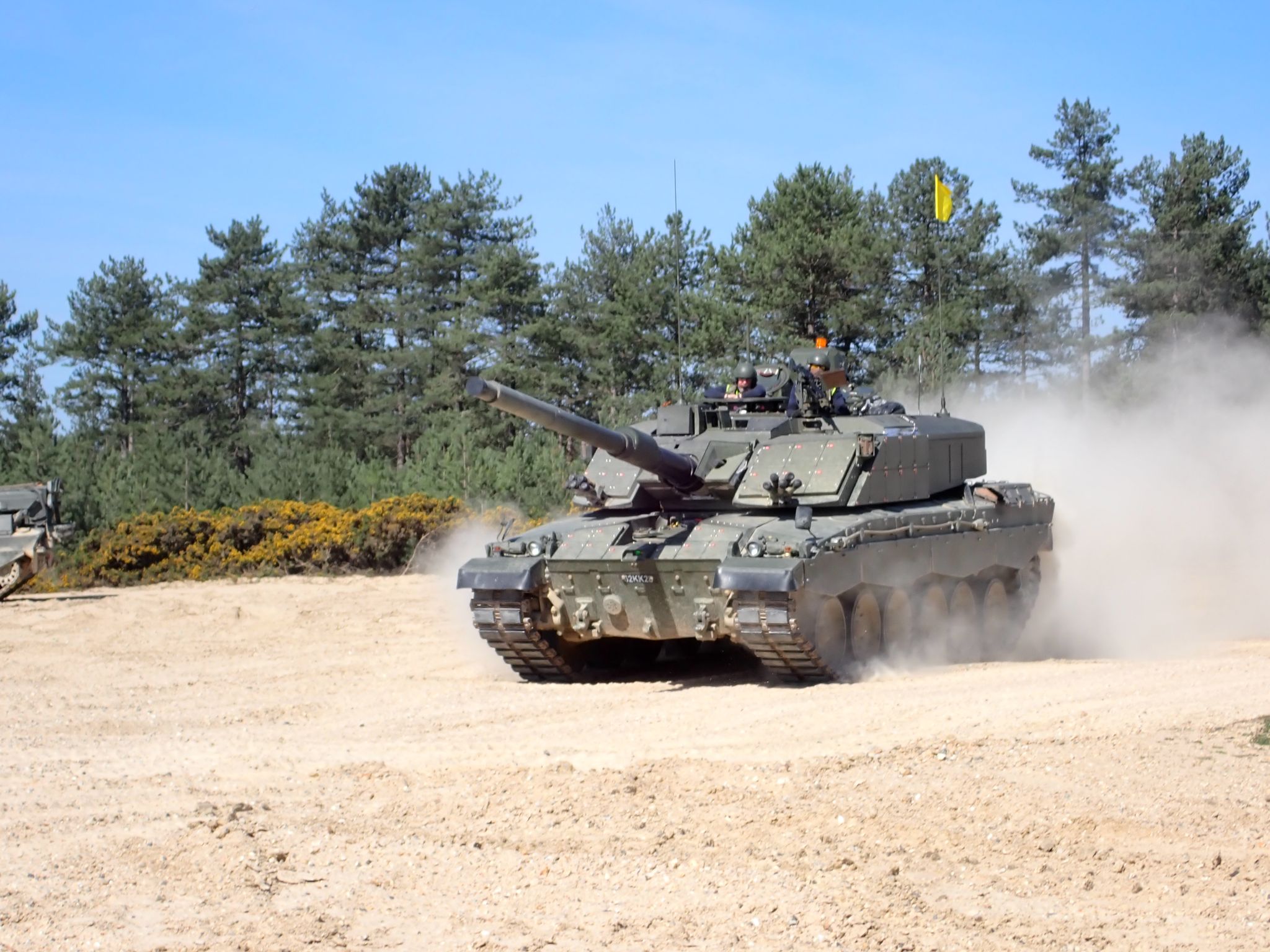
The British Army’s planned Initial Operating Capability date for the Challenger 3 main battle tank is under review, although no formal reapproval has yet taken place, the Ministry of Defence stated in written answers to parliamentary questions.
Responding to a written question from Conservative MP James Cartlidge on whether the Defence Secretary had authorised a change to the Initial Operating Capability for Challenger 3, Armed Forces Minister Luke Pollard said the “Challenger 3 manufacture phase timing will be confirmed after the demonstration phase trials prove the performance of the tanks.”
He continued: “This complex programme has been impacted by some supply chain delays; the Initial Operating Capability and Full Operating Capability are under review but no formal reapproval has yet been undertaken.”
It would seem, therefore, that there is potential for a degree of slippage in the schedule for what is intended to be the British Army’s principal armoured fighting capability into the 2040s. Challenger 3 is being delivered by Rheinmetall BAE Systems Land, the joint venture established in 2019, under a contract awarded in 2021 to upgrade 148 Challenger 2 hulls to a new standard centred on a fully digital, fully stabilised turret mounting the 120mm L55A1 smoothbore gun.
The smoothbore main gun, replacing the rifled L30A1 carried by Challenger 2, allows the tank to fire NATO-standard ammunition and to use programmable rounds, and is one of several changes intended to bring the platform back into line with current Western main battle tank standards after a long period in which Challenger 2’s gun and ammunition stocks placed it on a divergent path from its allies.
In a separate written answer responding to Conservative MP Ben Obese-Jecty, Pollard addressed reports of unresolved turret gearbox issues affecting the programme. The minister said Challenger 3 remained in the demonstration phase and that “the design continues to be refined by the manufacturer to ensure the vehicle meets its required performance standards.” He added: “As design maturity has improved, the Prime Contractor has refined elements of the design, including the Turret Power Traverse Gearbox, to meet those requirements. This is normal engineering practice and is not assessed to impact the delivery timeline for the tanks.”
The Turret Power Traverse Gearbox is the mechanism that allows the turret to rotate under power, a fundamental function for any modern main battle tank and one with direct implications for target acquisition and engagement times. Refinements to gearbox design during demonstration trials are not unusual on armoured vehicle programmes, however.
The Initial Operating Capability for Challenger 3 is targeted for 2027, with Full Operating Capability planned for 2030. The MoD has not yet provided revised dates publicly, and Pollard’s answer indicates that timings will be set following completion of demonstration phase trials rather than reset in advance of them.






Is it certain that of the remaining hulls not up for conversion to Ch3 standard that they are all beyond help or in too bad a state to merit conversion?
Many were left to rot at Ashchurch in sheds with the rooves full of holes.
Hi Daniele, of all the information that MoD has it is perhaps the condition of equipment in storage (RN/Army/RAF) that is most hard to find out, unless you do another of your FOI requests!
When Cameron ‘mothballed’ 159 CR2 MBTs in 2010 (together with a large number of AS-90s, 62 or 63, I estimate), it was to save money in the wake of the global financial recession. The technical term we used was to transfer tanks from the active list (where each one has a role or purpose) to the inactive list (where none has). Equipment on the inactive list is no longer wanted and no funds or labour at all is expended on maintenance, hence a financial saving is made.
With limited (or none?) CFE at Ashchurch in 2010, such equipment would have rotted fast – as we know so many old sheds were usually not watertight. Plus, they were fair game for cannibalisation by the Equipment Support Manager. This sorry fleet has atrophied to 75 CR2s over the years, as actual scrapping took place with a gas axe or similar.
Thus we have 213 tanks in the active fleet split between: the armoured regiments; RBSL; possibly some in Store Equipment Fleet (Germany) in Ayrshire Barracks, Mönchengladbach; a number in Ashchurch split between the Repair Pool and the Attrition Reserve; the Trg Org (RAC and REME).
In an ideal world the condition of the 213 would be fair to good with an availability for use of about 70%.
The 75 tanks in the inactive list in Ashchurch, as mentioned, are bound to all be in a very bad condition.
The MoDs recent claim that we have 288 tanks is a poor joke – that is 213+75 and those 75 are off the books.
The other thing that we don’t know is what the Platform Presentation State is for consideration of a CR2 for conversion to CR3. In theory it might mean that a tank lacking much above the turret ring might still be considered a suitable candidate as it gets a new turret anyway.
Too many unknowns to say more than that.
Russia managed to reactivate ten thousand tanks from the 1960’s that had been sitting outside in Siberia with no cover for five decades.
I find it hard to believe that sitting in a leaky shed for ten years in the UK would put a vehicle as well manufactured as a challenger 2 in a state of repair that its hull was unrecoverable for conversion to a CH3 with a replacement turret, suspension system and engine.
Makes you wonder. Although Russia’s operational requierments will no doubt be far lower than ours.
Jim, the Russians had several advantages compared to keeping our 1990s tanks in their damp, humid sheds: their 1960s tanks (designed in the 1950s) were low-tech with robust and simple electrical systems and little to nothing by way of sophisticated electronics; Siberia has a dry, cold, non-humid environment; working tolerances for machined components were less precise so seizures of rubbing and rotating components would be less likely; perhaps too there had been less cannibalisation.
Your point that CR2 hulls should not be badly ravaged in poor conditions is a fair one, however I have not seen a tank hull that has not been maintained for 16 years. Also I am not sure that the CR3s get new engines – both MoD and Forces News say it is an upgrade of the existing engine.
there were reports that Russian build quality were so poor on the T54/55 and T62 that when handed over in a new state to Warsaw Pact members, that the first thing, said members did was to rebuild the engines.
In fariness, apparently Russia has had an ongoing saga with engines.
Regards the numbers, It’s standard mate, it is called “spin” and luckily we have enough informed posters and researchers to shout “bullsh**” when needed.
Question is how skilled are the people handling this, C2 is quite old and modifying the existing hulls creating this hybrid of new on top of old sounds not trivial
But the US hasn’t built brand new Abrams in years. They strip down old hulls to bare metal and then rebuild at Lima.
No reason we can’t do the same with Ch2 which is a more modern platform.
Peter S, it sounds like you are describing Base Overhaul (BOH) which we have always done in the British Army. It used to be that about every 7 years (but varied according to mileage) we would take an AFV or artillery piece and conduct BOH – the equipment being delivered complete to CES to a Base Workshop REME (in Germany it was 23 Base Wksp at Wetter) and several in the UK (with tanks being done at 18 Base Wksp REME, Bovington (later called ABRO Bovington, then DSG Bovington etc before being contracterised (Babcock))
Vehicle was de-kitted of CES, stripped totally, welds checked and re-done if necessary, every removed item either refurbished or replaced, vehicle rebuilt, sprayed and tested.
I am surprised that you suppose that we never did this.
I am not certain of the situation now that Babcocks provide Base level repair/maintenance. It was of course a very expensive and time-consuming process which was why it was streamlined some 20+ years ago and termed Base Inspection & Repair (BIR) but everyone seemed to keep using the old Base Overhaul term. Perhaps someone will know if Babcock does BOH or BIR roughly every 7 years on AFVs etc?
Like the Americans we built no new MBTs after the two orders of 1991 and 1994 for CR2 were met.
The US remanufactures at scale, typically as part of an improvement programme. It has large numbers of hulls from the original manufacturing run. Thus the many different sub model designations. Ch2 has, I believe been maintained largely in its original condition.
What I don’t understand is why our future tank numbers should be constrained by existing hulls. The basic hull ought to be the easiest part to build.
Hi Peter, there are several constraints operating on the number of tanks in the future ORBAT: one was the original and long-standing plan to reduce from 3 armoured regiments to just two (only recently rescinded) and of course lack of money to upgrade a larger number.
RBSL has said that they could manufacture new CR2/CR3 hulls from scratch. We might also be able to buy back the 38 CR2E tanks from Oman, who have finished with them.
That last buy back comment on Oman’s tanks sounds doable, even affordable(?) and very sensible. To build up some buffer stock.
The real question I think is “Is it doable and affordable at the rate of 5mil per tank?” My ongoing suspicion is that the answer is no, and additional CR2 upgrades would be in the 7-10mil range.
Whether the ORBAT reduction to 2 armoured BCTs makes sense, I’m not sure. But even allowing for Ch2s proven survivability, we really need an adequate reserve. I agree that funding has been a constraint, but compared with the unit cost of Ajax, or the price of a “new” Leopard, the Ch3 upgrade looks good value.
Planned MBT numbers for Germany, France and Italy are a bit higher, 296, 200, 200 fully upgraded units. £250 m more for Ch3 should allow us to match those numbers.
Until the DIP is published, we don’t know how tight equipment funding over the next 10 years looks.
The reduction to 2 (now 3) makes sense because there isn’t the support for a third armoured brigade. Realistically the army has enough Infantry and Cavalry for 5 Brigades, but there are shortages in artillery, mechanics, etc to enable that.
Sidenote: 2 R Yorks apparently has been re-orbatted to 11 Brigade.
Many of the U.S. M-1A2 SEP 2/3 hulls, wheels, drive sprockets and turrets are from the original M-1 and IP M-1 production runs of the early 1980s, prior to the M-1A1. Remanufactured at Anniston Army Depot over & over again, but always the original base vehicle.
When cr2 went from base repair to economic base repair it was less extensive. The gun clamp bushes and shims no longer replaced. The barrel vibration would likely travel to traverse gear box.
What is the point of this enterprise?
We’re getting a truly underwhelming amount of bespoke tanks, that are already showing problems during the development phase. They’re not enough to make a significant difference on the battlefield in comparison to those operated by our continental allies.
We’re not building new tanks either, so the skill-base in the UK isn’t being properly maintained either.
The BA needs to decide whether it wants to carry on having tanks, or if it can do without. If they pick the former, then invest in a MOTS design such as the modern Leopards, Black Panthers or Abrams and grow the fleet with the savings. If they don’t want tanks, scrap the current fleet and reallocate the resources.
A similarly frank conversations needs to be had with regards to the Apache fleet. What value is the BA gaining from operating Apaches as ‘drone motherships’, as opposed to simply operating the drones on their own, and scrapping a capability that is rapidly being discarded by modern ground forces? Both Japan and South Korea are already cancelling or reducing Apache orders in favour of UAVs. Poland is purchasing them, but then again, Poland is purchasing everything.
I think CH3 is a practical measure to wait and see what happens with tanks but I do very much agree on Apache. It’s a real pity the army spent billions replacing them just recently. Kind of shows why the Army is in such a state, spends billions replacing the wrong platform to keep up with the Jones in the USA to carry out its preferred colonial policing task while totally neglecting artillery, GBAD, Armour and drones.
I think Apache may be increasingly difficult to deploy and much of their utility will be better employed from cheaper UAV’s.
With regards to CH3, I appreciate that given the evolving usage of tanks in Ukraine, performing iterative upgrade programmes on our existing fleet would be a good idea. However, I don’t think it is practical given the lack of available funding. Long, protracted upgrade periods mean that large parts of the fleet are out of service, or unavailable for other reasons, making contingencies difficult to plan for.
If the BA is willing to wait for significant periods to receive its upgraded CH3s, then perhaps that money would be better spent investing in rapidly deliverable Black Panther fleets from South Korea, or, should the BA necessitate that new tanks be of the top standard, German Leopards. I think recently, Poland received some 80 modern tanks in under two years. The BA would then be better positioned to respond to any emerging situation. It would be more pragmatic than the current plan, under which the UK suffers significant continuous degradation of the tank force.
Essentially, my argument is that CH3 works if delivered quickly as an interim option. However, that doesn’t look to be the way the programme is panning out. I fear greatly another Ajax.
Apache is one of those capabilities I simply don’t see as surviving in its current role. Russia, Ukraine and now also the Royal Navy have used helicopters as counter-UAS assets (though the three British Wildcats did not engage any UAS during their deployments around the Eastern Med), but I question whether that is because of their inherent proficiency in that role, or instead because there is a lack of dedicated C-UAS capability across the three nations. Obviously, Ukraine and Russia have plenty of C-UAS assets, but their UAS threat is proportionately much larger. The RN (and the BA more broadly) lacks a variety of dedicated C-UAS solutions, but proportionately did not face so great a drone threat in the defence of Cyprus.
Leh, What is the purpose of modernising our tank fleet? Really? Because our current fleet is old, should have been modernised regularly and significantly throughout its service but wasn’t – and now needs this to be done.
I agree that the number is underwhelming – we ordered 386 MBTs for the post-Cold War army in two tranches in 1991 and 1994. Why such an army now needs only 148, especially when the threat posed by a resurgent Russia is greater, is beyond me…it is simply a huge Defence cut to save money.
Problems during the development phase – I have only heard that the Turret Gearbox needs replacing with a beefier type – have you heard of other problems? Nothing goes totally without issues during development projects.
Certainly other nations have more tanks but so what? It is the pooling of equipment by 32 nations that is what NATO does – we only have half a dozen SSNs, only 3 x E-7 Wedgtail, only 9 x P-8 Poseidon, only 3 x RC-135W Rivet Joint aircraft – pooled with Allies the use of small numbers of high quality equipment will be very helpful.
We invented the tank and have produced some high quality tanks over the years, albeit with flaws. The upgrade of 148 is relatively low cost at a bit over £800m. You could not buy 148 new Leo2s or any other new foreign tank for that sum – you would be lucky to buy 30-35. Give up the tank? We would not be a serious practitioner of armoured manouevre warfare if we did that. What would do its job instead? We are under remit to deliver, amongst other component parts an armoured division to the ARRC, one of SACEUR’s two strategic reserve corps, so we cannot give up the tank.
CR3 is taking longer than it should to get to FOC (2030 or a slip of a further year or two). The tank has an OSD of 2040 as I recall. It is very much an interim solution, but it will be a good one – arguably Ajax in contrast will continue to be a troubled child.
I remain to be convinced of loyal wingman drones for Apaches – the crew would not have the time to control them so they would have to be autonomous. If they were autonomous why do they need to be associated with the manned AH?
I mentioned this to Jim above, but I’m asking ‘what’s the point’ not because I don’t understand how modernisation works, but because the effort does not align with any reasonable goals. In reality, I’m being provocative to get people thinking about alternative ideas, rather than being stuck in the current procurement dogma.
I’ve seen it reported that the tank is significantly overweight even beyond the turret, which is hardly surprising, considering that the CH2 was already a chunky vehicle. I’ve also seen it reported that a solution is yet to be found, and that delays of up to two years are possible.
If the UK wants to quickly modernise the fleet, then investing in MOTS solutions would enable faster deliveries, greater capability and easier integration with NATO partners in Poland and Germany. Specifically, you suggest that the the size of the fleet is less impactful overall, because it will be joined with a NATO fleet more broadly. If that is the goal (and I agree it is a laudable and pragmatic aim) then it would be better to unify our tank fleet with our allies, rather than pursue a bespoke upgrade purely to claw back some loose change, or for an even worse reason, ‘national pride’.
You compare this to our SSN fleet, but I think that the numbers are very different. Britain makes up some 15% of the total ENATO submarine force, and maybe 8-10% of total national AEW coverage (and significantly more of the coverage in its class), and maybe 15-17% of MPAs across the alliance. The Rivet Joints are the only true aircraft of their class (and so would be 100% of those available to ENATO). In contrast, the British tank fleet currently sits at about 4% of the total ENATO fleet, and looks to drop to about 2% in the coming years. In other words, the proportions are an order of magnitude out. By the late 2030s, the British fleet will probably be perhaps 1%, or even <1% of the total ENATO force, given German expansion.
I point this out to say that losing the British tank fleet it numerically incomparable to losing the British submarine, MPA, AEW or ELINT/SIGINT fleets. So, my argument here is that as it stands, the British tank fleet is not even unremarkable, it's simply non-existent in comparison to planned alliance forces from other nations. £800m would buy the RN a pair of T31 frigates, or a single new T26 for Atlantic ASW. It would fund four additional MPAs (and some change), or five-six additional F-35Bs. The RN could purchase some 600 additional Storm Shadow cruise missiles, or maybe 1800 of the new Project Brakestop less sophisticated cruise missiles. It could theoretically replenish the entire stock of Tomahawks ever fired by the UK and still have enough to fund another frigate. The RAF could equip every fighter in its inventory with a pair of Meteor BVRAAMs for that kind of money.
Now, are those worth trading for your tank fleet? Could you achieve the same effects? Probably not. It's quite hard to hold defended ground with a cruise missile barrage or with a frigate out at sea. That said, perhaps a better question would be what would provide more value to the alliance as a whole – those 148 CH3s or the potentially 1800 additional cheap cruise missiles that money could buy instead? I don't pretend to know the answer, but the question is an important one.
Now, of course as you say, you're not going to procure a similar sized Leopard fleet for the price of the CH3 upgrade. However, it is precisely that kind of scrimping that has crippled procurement in the UK for decades. My argument would be to invest a larger sum of money now in procuring 200 or so Leopards or K-2s, making use of joint purchases with various smaller Eastern European states.
Deferring modernisation in the manner you suggest through the use of interim upgrades/solutions is a habit that has repeatedly bitten several of the major equipment types across the British military. Most notably, a failure to order new frigates for the RN, or two invest in enough F-35Bs to replace the Tornado rapidly. The effect seems almost invariably to be that the UK ends up operating sub-par, hard-to-maintain equipment long after it should have been retired.
As I said to start with, I'm being provocative mostly. I do think the tank is important, and that the UK should possess them. However, I baulk at the idea that 148 elderly tanks are much use to the UK, or are a pragmatic use of funds. If the total 227 were being brought into service again, it'd be a different picture, but as it stands, my 'what's the point' is more of an exasperated, than a genuinely confused, question.
Basically, my argument boils down to 'do it properly, or don't bother doing it in the first place'.
As to the Apaches, I agree entirely. It's not quite the same dynamic as a warship or even a fighter jet, where the larger platform is needed to power a large sensor array and house human decision makers. Maybe, though, they could function as something of a very sophisticate relay point for multiple separate drone systems.
“The effort doesn’t align with any reasonable goals.”
I mean hardly. The CR2->CR3 upgrade is dirt cheap compared to MOTS alternatives. Swapping to Leopard or Black Panther (Abrams is a non-starter) would mean the same change would cost more than double, and for what? No MOTS vehicle offers a substantial improvement of CR3 that would justify the price tag. We are not Romania looking at replacing TR85’s and T55’s.
At this point, the sensible decision is a low cost upgrade of the tanks we have in inventory to stay in line with NATO capability wise, and, in due course, when the next generation MBT from Europe has come along, we buy that.
The argument about aircraft and submarines is a moot one: We are one of the big nations in NATO. We are expected to do our part on the frontline, not feed Russian mashkriovka tales of “perfidious albion” by abandoning the East to just play at ASW work. Also arguing that spending more money on K2’s or Leopards is a good idea is a bit bunk. You don’t spend more per tank and get more tanks. Going for Leopard would probably mean a considerable downsize, maybe to a single divisional regiment rather than three. If the money was available, a much better use would be additional support to get a third armoured infantry brigade by moving some assets around or standing up some extra CS and CSS.
IOC and FOC have always been 2027 and 2030 respectively. It is said, but not in this article, that the MoD is so panicked by the thought of ‘another Ajax happening’ that they wish to avoid doing concurrent work in the CR3 programme and to make everything consecutive – ie don’t do process B until process A is signed off. This will extend the timeline without a shadow of doubt. I remember the last time a slow modernisation programme WCSP was impacted by another programme (Boxer) speeding up and it resulted in a financial collision and that WCSP was cancelled as a consequence hence the end of IFVs for the armoured Infantry. Hopefully no-one will throw a spanner in the works whilst the CR3 programme is slowed as seems inevitable.
It has to be said though that GDUK’s Ajax in my eyes was always an exceptionally high-risk programme and that CR3 is a relatively low risk programme which doesn’t really need being treated this way.
[Hard to believe that it is 10 years to the month that I was working for Rheinmetall on what was then called CR2 LEP]
As always, Graham, intriguing information. Long may it last. I think the CH₃ might be slowed rather than axed. To axe MBTs at this time would be seen as crass, and rightly so. Sadly, the MBT is being judged as limited in scope in regard to modern warfighting; even Germany and France are deliberating, allegedly, on how to proceed with crewed or remote turrets. There is a growing market for a remote MBT, and the recent military equipment exhibitions have shown a number of medium tanks with unmanned turrets. I would welcome a UK company to develop a remote MBT to work alongside CH2/CH3 and reinstate a heavy armour industry in the UK once again.
Just a hypothetical but if there’s problems with CR3 and Ajax what about getting a light tank to fit between the two then? Might be able to share the same chassis of a future IFV. Or, even a block putchase of Leopards to be based in Europe?
And how is the Boxer program going, is that all okay?
Quentin, good question. The US cancelled their medium tank as it was adjudged to be something or nothing. If one goes by appearance, it looks as if it were developed in the 60s. I still believe a medium tracked tank armed with a 120mm gun could address footprint issues that have caused some Western tanks to get quickly bogged down. Weight is a crucial issue in Ukraine and a medium-sized tank could help to reduce this hinderence?
MBT designers are currently at a crossroads as images of Western and Russian MBTs explode in increasing numbers on the Ukrainian battlefields, and even if they had comprehensive air cover, the tanks would still be prone to drone storms and rapid drone-dropped mines. The human costs in terms of tank crews have been alarming, and the fewer number who man them, the better; hence the crewless turret debates.
Boxer numbers are still not being published, nor are numbers so far assembled, apart from vehicles issued to Bovingdon for crew training.
The biggest issue was the poor state of infrastructure and storage at MOD Ashchurch, which I believe has finally been sorted. I spent 5 years based there, and apart from the hanger modernised by GD for them to do the Bowman Conversion, apart from 1 or 2 decent “new” hangers, all the other storage sheds, were ones with little to no upgrades, that had been built pre war and during the war, and had been used by the US Army for storage before D Day.
Stuff arrived form the US into Liverpool, came down the A38 and via rail, sorted and stored and Ashchurch and then moved down to the West Country in preparation for the D D Invasion and subsequent movement to the continent in 1944/45.
Sheds were simple steel frame with asbestos roofs. Pre War build had brick side, “in-war” build were asbestos sides. Holes in roofs, doors that didn’t close, and about as weather-proof as an infantryman’s trench.
Despite the best efforts of the staff who worked there, vehicles and equipment deteriorated as poor facilities and limited resources to inspect and service.
Mark, Many thanks. I was a MoD Equipment Support Manager at DLO Andover for tank derivatives (variants) in 2000-2002. I also was ESM for the withdrawn CR1 fleet. I went to Ashchurch to look at ‘my’ CR1s as we had to spruce them up before sale to Jordan, a process that had already started. I had not been to the Depot before and was very shocked. The sheds were as you describe with many broken windows letting in rain and pigeons. There were large pools of stagnant water on the ground. The atmosphere was very damp. The sheds mostly all looked to be WW2 era to me.
Why was Ashchurch Depot even used for storage or some quid spent on fixing up the roofing? Seems like criminal neglect. Hope the Army’s current expensive equipment is stored on better conditions.
Quentin, Ashchurch was used for storage of vehicles because it was and still is the army’s only vehicle storage depot! We used to have many vehicle depots in the UK and some on the Continent.
The conditions I describe were for tanks withdrawn from service and all about to be sold to Jordan. I am not surprised that the worse sheds were used for that. I di not look at other sheds apart from the CR1 shed. This was also 24-26 years ago. There have been major improvements to the site since then, especially in the last 5 years, and there is a fair bit of CHE there too.
If you look at Google Earth and use the historical footage function you can see just how old some of the sheds where, and see how many of them have gone in the last couple years.
Don’t worry King Andy will teach the Army to get their tanks to walk on water like him. More likely is he will order review of the review into reviews and push everything he can down the line until we all speak Russian.
They can buy [potentially brand new and] used hull(s) very cheaply from different countries if they _really_ wanted to …
I don’t think they would do that though because budgets are tight and they would end up paying a lot for ‘not much capability increase’. The money is better spent in different areas rather than on simply ‘more MBTs’.
The hulls of the remaining C2s in UK storage are not worth upgrading, it’s been said many-a-time.
Also there is usually an engine upgrade but this is not a requirement. A C2 might get a new turret, for instance without upgrading the engine, and this is within scope for the remaining tattered C2s. Perhaps this is part of Base Overhaul though idk.