

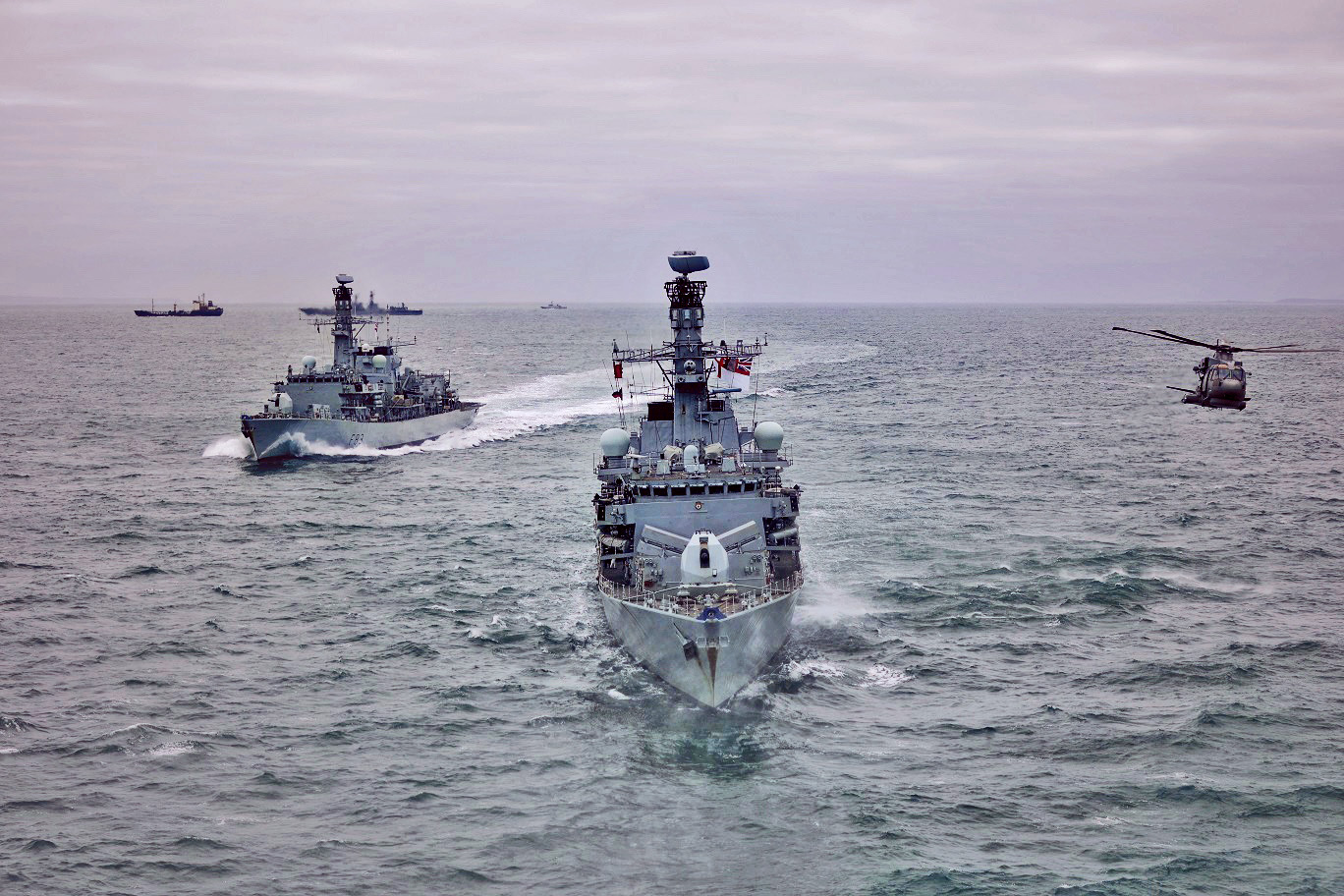
Two more of the Royal Navy’s Type 23 frigates are to be retired as the ageing class begins a phased withdrawal running up to 2033, the Defence Investment Plan said.
The two further retirements were spelt out by the Minister for Defence Readiness and Industry, Luke Pollard, who told journalists the poor material state of many of the ageing ships was a serious factor behind the decision, noting that he spoke as the member of parliament for the Devonport constituency where the Type 23s are refitted.
In the document itself, the change was discussed as part of a wider reset, with the plan saying that putting the shipbuilding pipeline back in order had forced “hard but necessary decisions,” among them the phased retirement of the older Type 23s after decades of service, while new ships were due to come online across the same window.
The Duke-class frigates had until now been expected to serve to around 2035, so the 2033 date in the plan draws a line under the class a little sooner than the Navy had been saying.
The significance of two more departures lies in how few are left as the frigate force has already fallen to around five ships fit to deploy after a run of retirements that took HMS Lancaster out of service late last year and HMS Iron Duke this spring, with HMS Richmond due to follow before the end of the year, so a further cut falls on a fleet already stretched thin across carrier escort duties, the protection of the deterrent submarines and standing NATO tasks.
The Type 23s were built for a life of around eighteen years, and many are now into their fourth decade, worn by corrosion that costly life-extension refits have slowed but not stopped, which is the reason the Navy has struggled to keep them at sea as long as it once intended.
That difficulty has produced some uncomfortable value-for-money episodes, with Iron Duke withdrawn barely sixteen months after a refit that cost the taxpayer more than a hundred million pounds, the kind of outcome that has drawn pointed criticism from naval commentators. Pollard laid the blame for the wider squeeze on the late ordering of the replacements, the Type 26 and Type 31, which he said should have been ordered earlier by the previous government and were not, a delay he argued had also held back the dockyard work the fleet depends on, and he pointed to 10 Dock at Devonport, which he said should have been started sooner, and to Project Royal Oak, which he called “the biggest naval base upgrade in 50 years.”
Pollard spoke about the decision inside the broader reshaping of the surface fleet, in which the planned Type 83 destroyer and Type 32 frigate, both inherited from the last government as concepts with no money attached to them, have been dropped in favour of a common combat vessel and a hybrid navy in which uncrewed platforms operate alongside crewed warships. “I can’t field a CGI against Putin,” he said of the cancelled designs, arguing that funds tied up in unfunded artists’ impressions were better spent on ships the Royal Navy could actually put to sea, and that the new uncrewed sensor and missile platforms named in the plan would sail with the frigates rather than replace them outright.
The replacements are in build in Scotland, with Type 26 anti-submarine frigates under construction by BAE Systems on the Clyde, the first of them HMS Glasgow due to start sea trials this year, and five Type 31 general-purpose frigates being built by Babcock at Rosyth, the thirteen ships together meant to restore the escort fleet over the coming decade.
Some of the Type 26s will be operated jointly with Norway under a ten-billion-pound deal that Britain has presented as a reinforcement of NATO’s northern flank, an arrangement that has also prompted questions among naval observers about whether ships from the production run could be sent abroad and leave the Royal Navy short of the eight it has promised itself.





Trying to keep the 23s going is increasingly expensive, I’m not surprised at the early out of service date
Consider how many extra T31 could have been procured if these ships had been replaced in a timely manner instead of the costly life extensions they have received that have added relatively little additional service life. Part of why defence is in such a bad place.
Are any of the T23 sonars going to be reused anywhere, could they be potentially put on the T31s at a later date or be used on LUSVs?
This however is a consequence of the cancellation of the GCS which should have followed before the youngest T23 was a decade old, and ultimately the cost in loosing the capability vs the cost of replating / structural inserts is debatable
.
.
I am of the camp, you made your bed now you need to sleep in it – so the refit cost, no matter the cost, are necessary to maintain the capability.
.
.
What it says when the UK further cuts down what should be its eminent fighting force (The RN) is, the UK is not serious about defence in these changing (i.e. requiring sovereign hard-power) times.
Yawn the refit was the 50% of the cost of a type 31 and it won’t last 6 years. Theres no magic money tree that can stop metal fatigue. The laws of physics are don’t change because you are OUTRAGED. The hull has was designed to last 18 years, its gone well past that and its hit the limit of what is actually possible to do. The only way to keep the 23s going is to build new hulls.
Many ships can and have exceeded their design parameters and the T23s are no different – The Leanders, Amazons, Vanguards for examples were designed for similar hull lives and some had careers well in excess of that. This isn’t emotion that you incorrect comment about (with capitals 😅], but engineering and complex projects, something not everyone can understand, granted.
.
.
Again, as I stated before, this is cause and consequence for earlier decision making and if those decision makers didn’t consider the refit and increased maintenance costs, then that is their own stupidity and/or arrogance in compromising defence capabilities unfortunately with no accountability.
.
.
Of course, a major contributing factor in these decommissioning decisions by the RN is funding, which impacts maintenance (including refitting), equipment fits (example the towed arrays not been fitted to all Dukes) & personnel levels.
.
.
And with that, I’ll leave it there.
This however is a consequence of the cancellation of the GCS which should have followed before the youngest T23 was a decade old, and ultimately the cost in loosing the capability vs the cost of replating / structural inserts is debatable
.
.
I am of the camp, you made your bed now you need to sleep in it – so the refit cost, no matter the cost, are necessary to maintain the capability.
.
.
.
What it says when the UK further cuts down what should be its eminent fighting force (The RN) is, the UK is not serious about defence in these changing (i.e. requiring sovereign hard-power) times.
How fast can the type 9x be built?
Haven’t even designed them, laddie.
Feels like we’re gonna be building 4 ship classes instead of one for the same price when you factor in all the double costs, like anchors and engines and power for their jobs, then someone’s gonna cancel them all and build a Type-83.
🤡
“Feels like we’re gonna be building 4 ship classes instead of one for the same price”
I assume the major cost saving is in wages.
18 years seems ridiculously low mind, will they outlast the 3 predecessor T-22s still in service I wonder, could be a close run thing.
It’s a function of the hull and plate thickness loss.. they simply build them for the original hulls to only take about 2mm of hull plate thickness loss before replacement or major works…that’s at best 20 years..
The T23 structure was designed to Naval Engineering Standards with Naval Overseers survey. It was only later that they were taken into LR Naval Ships classification. LR were evidently unaware of negative tolerancing of plating thickness in design, which was at least 1mm. The plating was ordered to +/_ 0.5mm. So the plating was probably being condemned at least 5 years before really necessary; maybe even 10 years. The conservative approach that LR take is probably more the reason that the T23s had so much structural plate replacement.
Hms Richmond has already been paid off, she is currently being stripped of parts on Plymouth.
Question is, will the Brazillians buy these two and refurb them?
Straight to the breakers. The hulls are shot, the last refit cost 150 million
Ah, so we pay for the refit, THEN we sell them to Brazil for pennies.
Or does that only apply to the Albion class.
Building a ship with a hull designed to last only 18 years was the first mistake.
Late ordering of replacement, second mistake.
Two huge mistakes that are now compounded by the slow pace of building replacements.
So will we be down to the last 3 or 4 T23s before the first of the new ships are fully commissioned and worked up?
I think the current 5 should survive for another few years as the next 1/2 are due an upgrade 6 year inspection are younger than the ones retired!
So first type 31/26 for 2027/2028. Hopefully have a fleet of 4 type 31 and 3 type 26 for 2030
Not one T23 has yet survived its 6 year post lifex refit.. they have all ended up being binned.
Yeh, I think the last straw was when the Morris Minor centre said they couldn’t help with spares.
Keeping fingers crossed for Kent.
They are in a desperate state with plenty of hull plating now literally paper thin.
Well when you think they were built with 8-10mm of hull plating and a well maintenance ocean going vessel will lose about .1mm a year of hull plating.. after 30 years service that’s around 3mm lost.. if it’s poorly maintained and around welds ect it goes up to about .2mm per year so up to 6mm lost over 30 years.
That all depends on arising commitments. If the current plan for the T23s, is to do only Northern Atlantic patrols then that’s probably doable. But chuck in another Red Sea operation, sending one down to the Falklands or Indo-Pacific region. The mileage will eat away any future availability and decrease the life left in the T23s. Basically the RN is screwed if something kicks off again.
I would agree, the T23 maintenance support team has an absolute nightmare on its hands, the remaining T23s need to be ‘extremely carefully’utilised to squeeze the remaining limited life out of them over the next 5 years.
I would assume they are all receiving regular detailed hull inspections now, inside and out, looking for problems and trying to keep them operationally available.
The north Atlantic is very much harder on a ship re dynamic stress than sitting in a mill pond like the Red Sea or gulf. If you don’t think it can plodder about the Middle East.. you apposolutly don’t send it to UK or North Atlantic, North Sea.. we have some of the hardest seas and oceans on the planet in our little patch.
“Late ordering of replacement, second mistake.”
False. There was not late ordering, it is political obfuscation.
T26 has been 10 years in building, no one in the world have a frigate taking 11 years from start to commission except maybe a banana republic.
Err no, they had a design life of 18 years. The replacement should have been ordered by Blair
Can you look at a calendar please. HMS Glasgow was laid down in 2017, a typical 1st in class frigate take 5 years to build in Italy/France. So first T26 should have been commissioned in 2022, others following in 2023. T31 which is not a new ship but a variation should have been 4 years.
Oh for god sake the first 23 was laid down in 1985 giving an out of service date of 2003. The last one should have been out of service in 2017. You are talking nonsense
To be fair they would have been fine to 25 year with just standard refits.. 18 years was always more about drumbeats for industry than sensible maintenance of frigate numbers. The big pissing away of money on trying to keep the T23s running beyond 2025 years and giving them brand new systems when they were all but nackered, so the insanity started with the lifex program in the late teens… so for instance Argyll should have gone for 2016 and st Ablans the last in 2027..
so in reality the crunch years were 2009-2011 if a frigate programme had been laid down straight after the T45 programme there would not have been the same issue as we have now..
If the March 2010 FCS project had just been allowed to run and then deliver a design for contracting in 2011it would have been all Good as it was it was restructured he design came out in 2012 a year late and the treasury played games until 2015.
So yes the brown government could have ordered one earlier.. but the great big “don’t step over this line unless you want to fuck the navy” was stepped over by Cameron and Osborn in 2011/12… and the purposefully delayed a frigate order until 2015 when they knew it was to late and would cost the county both in wasted treasure and military capability.
Cameron is a 100% slimy leach. A posh boy who never had it hard in his life and BS his way to the top. He personally took a wrecking ball to all the public services which saved a few quid for us only to spend even more trying repair the long term damage. No thoughts on sensible reforms just lazy blindingly short sighted cuts. Luckily he got stopped by Parliament from involvement in Syria’s civil war but still managed to cause unending problems in Libya.
The man who brought us the BREXIT referendum and despite saying if he lost he would stay on then immediately resigned. He then subsequently got caught blatantly asking for favours for his chums from the new Government.
The reward for this posh low life was a life peerage, made Foreign Secretary and a £100k per year pension, which he doesn’t need.
A one off bad egg well ask Kier Starmer about his decision to appoint Peter Mandelson.
The decline in our leaders is reflected in our country’s standing in the world and if Mr Burnham can repair half the damage caused in the last few years he will have done well.
Cameron..Belived in Soft power …0.7% International aid and all that … Never belived in Hard Power beyond intervention forces…
The cameron/ Miliband SIRIA vote of 2013..Set Britain on the Pacifist/ Demilitarised Road its found itself on for the last 13yrs..!!
Lifex for t23 was an true act of Desperation… that’s why we’re in this hole… Dare say 7/8 yrs with t45 with lack of Anti Air Destroyers for QECs will lead us down same path..
And Back to t83..?
We should be in a lot better place with the T45s they essentially build an extra couple decade of hull plate life into the T45 compared to the T23.. my understanding is hull plates on the T45 are 10-15 mm compared to the 8mm on a T23.. you don’t want to loss more than 25% of you hull plate thickness or down to 6mm so the T23 could loss 2mm hull plate loss is about 1-2mm every decade.. so after 20 years a T23 hull would always fucked.. where as a T45 hull could lose 4-9mm of hull.. if well cared for that’s 40 years.
The US build its ships with thicker hull plate that’s why they can run them for 40 years.. with the T45 we finally build a destroyer with thick hull plate… for the T45 it will be more about systems going Obsolescent.. but as its systems have had a massive update.. that’s a lesser issue as well.. we can easily run the T45s into the 2040s without the T23 hull falling apart issue.
Intresting ..sure I heard the legend class cutters of the USCG had thick ice class plateing…
The base of the new USN Frigate.?
“Oh for god sake the first 23 was laid down in 1985 giving an out of service date of 2003”
You really lie! service starts when it is handed to the client. first 1990, last 2002 commissioned. With MLU the 18 years can be extended.
If one T26 was commissioned in 2022 like it should, then 2 per year in 2023, 2 in 2024,2 in 2025, 1 in 2026.The RN order would have been complete this year.
Knowing the error of the first mistake should have constrained the Treasury from making the 2nd. It should have been a simple case of no you’re just going have to fekk off somewhere else and make your cost savings there or perhaps you just won’t be able to spend 0.7% of GDP on vapid foreign aid. It’s a simple case of reality biting.
I find it interesting that even with an uplift in recent years plus the extra funds that cuts are still happening. Just how badly was the budget covered up under the last government. Not saying the current government is any better at covering up budget holes but it does raise questions that should be asked in the house.
The last government, the one before that, the one before……ad nauseum
All political elites talk a good talk while ripping the guts out of capabilities
Politicians they don’t see the dangers until its to late… money was far to important to them than defence,
The Armed force seem to be able to cope therefore they can cope syndrome.
All’s well and good in a benign Environment..But we no longer live in a benign Environment ..but even know they still cling to that mantra..
DIP is a Token defence deal at best…
This must surely mean the RN nadir and that we can expect 2 or 3 of the new frigates to hit trials within 12 months.🤞
A T31 derivative looks favourite for the DIP ‘common combat vessels’. Stretched, better radar? Are the Danes interested? Any chance of more than 6?
We are not getting 6 San Antonio’s for MRSS but 6 UK spec Enforcers sounds credible.
Surely this decision could only be taken if they know some of the new T26 or T31 will be in service sooner than thought?
You overestimate the Government massively.
No. Ultimately you cannot send sailors to sea in vessels that are unseaworthy.
This is not a decision, a decision requires agency… these ships are just no longer sea worthy.
More to do with the ships at risk of breaking up due to metal fatigue
So the navy gets smaller and smaller. Now we are due Type 9x as soon as it gets drawn down the local primary school. Of course it’s all the last lots fault. It makes you wonder what this lot did for 14 years. They certainly didn’t point out the now obvious problems.
I absolutely fcuking despise Labour – they are nothing but parasites
“Begins a phased withdrawal”. hmmmm.
I ain’t being funny but, did anyone not notice that this started happening more than a decade back ?
Who wrote this ? 🫡🤦♂️
Spindoctors.
So we will have 9 escorts. Single digits. Never did I think I would see the day. Truly horrific for the once great Royal Navy.
Still trying to get my head around all the announcements. Can’t help but feel many are cuts disguised as modernisation. Time will tell.
The excuse for selling one or both aircraft carriers is that Mohamed Starmer’s government has the objective of dismantling the Royal Navy, and it is fulfilling that objective.
This was well known 6 months ago
We really need to stop this retire without replacement mentality its hurt us very badly and is so short cited .
This is not a retire without replacement.. this is can’t let people sail in a death trap we have no choice.
Sorry I should of said , retire before replacement .
Yeah but the good news of course is the three extra T31 they announced in the DIP in order to speedily regrow the fleet and bringing it up to a class of eight inline with T26 – oh sorry didn’t they report that bit ??.😁👎🇬🇧
No, they didn’t as such. But the DIP does say that MHC -2 ( 6 Kongsberg Vanguards or similar, and 3 offshore supply vessels) is funded. In addition the DIP also says, in respect of the B1 Rivers, that they are ‘reviewing OPV procurement and deployment’. I’m hoping there’s an outside chance that the 3 B1 Rivers might be replaced by basic T31 ‘patrol ships’ – just don’t call them frigates.
So Somerset and Sutherland, both will be gone before the end of 2028 I think. There won’t even be 3 Type 26 and 31 combined in active service by then….
The frigate situation will get worse before it can get better.
Quote frpm the DIP . ‘Phased retirement of older Type 23s up to 2033 while up to 7 new ships will enter service in that period.’
Yes 2033 is the planned retirement of the entire class. I surmise that both Somerset and Sutherland will be retiring before 2029 (Somerset in 2027 and Sutherland in 2028) because those ships are barely younger than Iron Duke and Richmond which retired this year. And the less ships you have, the more intensively the remaining one are used and the faster they degrade.
The 7 new ships they’re talking about may be 4 T31 and 3 T26 or 5 T31 and 2 T26.which isn’t glorious… Especially when you consider the fact that they plan to retire the T45 starting 2035 with a non-proven concept. 2035 is literally tomorrow.
From a NavyLookout post on X, this seems to be referring to HMS Richmond and HMS Iron Duke, since it had not been officially confirmed previously that they would be scrapped. So the RN will still have five Type 23s in service.
I have no idea what this article means. Which two T23s are we talking about? Are we saying that Iron Duke, which we all knew was effectively dead, is officially dead? Are we saying that HMS Richmond will never sail again (except maybe under a South American flag). If so, this is no news. All old hat. Or is it saying that Sutherland and Somerset will be retired this year? If so, that’s actual news.
As it stands this article seems to tell us nothing in the guise of something.
Two sonar equippped ships being retired means two fewer ships for the CASD mission.
Wr dont have a navy, we don’t even have a flotilla any more and they are going to send some more absolutely needed warships to turkey so other people get a job .. there is nothing good in this bullshit for the UK, no jobs, no defence.
Down to a 9 ship surface fleet…?
Whats the betting the last three even make 2030 ..?
And the t45 gone by 2038…??