

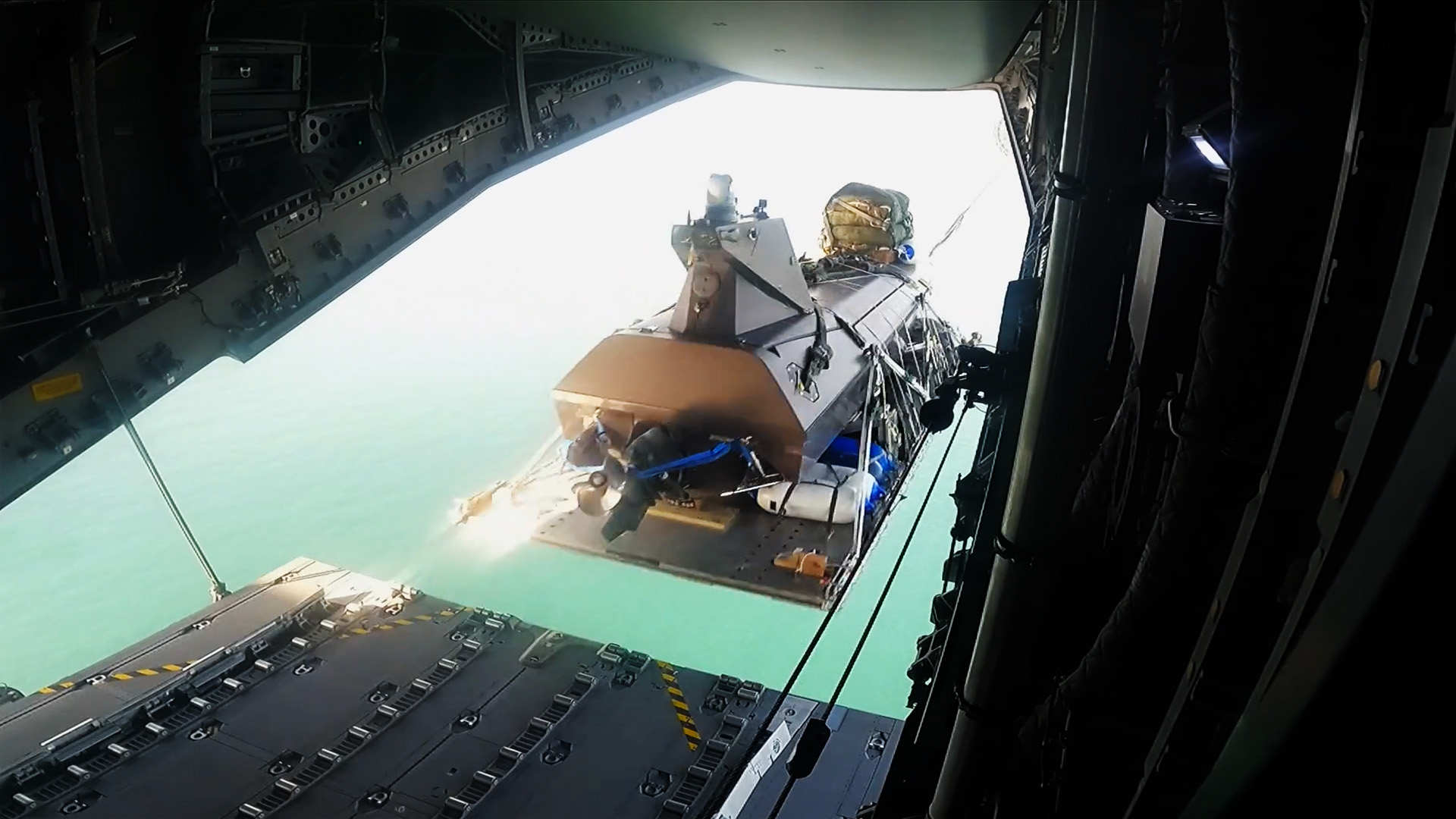
An uncrewed surface vessel has been airdropped from an A400M transport aircraft for the first time anywhere in the world, in Royal Navy-supported trials that parachuted a K3 SCOUT drone boat into the sea from 1,300 feet ready to operate, the companies behind the demonstration have announced.
Kraken Technology Group and Capewell, supported by the Royal Navy under Project Beehive, completed the extracted-load airdrop during a series of trials in which a Beehive-specification K3 SCOUT was deployed multiple times on Capewell’s Universal Maritime Craft Aerial Delivery System into waters of up to Sea State 4.
According to the companies, the demonstrations proved a new force projection capability to rapidly insert high-performance uncrewed vessels into contested or difficult-to-access maritime environments, with the campaign conducting four live airdrops in six working days using the same boat and platform.
The trials paired Kraken’s optional airdrop kit for the K3 SCOUT with Capewell’s reconfigurable Type V parachute-based delivery platform, which can airdrop various maritime vessels directly into military zones, and culminated in the validation of a new IN-Release system, a configurable electro-mechanical release mechanism enabling reliable, synchronised load disconnect across a range of aerial and maritime applications.
In an extracted-load airdrop, a drogue parachute pulls the load out of the aircraft’s open ramp before the main canopies deploy, the technique long used to deliver vehicles and boats for airborne and special forces, and applying it to an uncrewed vessel means a drone boat can arrive by air and enter the water ready for tasking without a ship, port or crane anywhere near the operating area.
Mal Crease, Founder and CEO of Kraken Technology Group, said: “Working in partnership with Capewell and the Royal Navy, we have demonstrated that K3 SCOUT can be rapidly deployed directly from a military transport aircraft into contested or difficult-to-access waters ready for operation. Kraken, alongside its partners and the Royal Navy, will continue to push boundaries to deliver novel and enhanced operational capabilities with our resilient, modular platforms.”
Mark Lavender, Director of Business Development and Training at Capewell, said: “In collaboration with Kraken we were able to validate the integration of a complex payload with our UMCADS platform while demonstrating the ease with which the system can be reconfigured for alternative mission essential equipment, be they maritime or land applications. This was further validated in that we conducted four live airdrops in six working days with the same boat and platform during this campaign.”
The K3 SCOUT is among the uncrewed craft procured for the Royal Navy’s Hybrid Navy under Project Beehive, through which the service bought 20 of the vessels this year as what Kraken describes as the first steps towards the UK’s Hybrid Navy, and the ability to insert them by air bears directly on the concepts the Defence Investment Plan funds, from the £5 billion committed to drones and autonomous systems to a fleet posture in which uncrewed craft appear where needed at speed.
Kraken, founded in 2020 with roots in offshore powerboat racing and based at Fareham, produces the K3 SCOUT within a range that includes the K5 KRAKEN and K7 SABRE surface vessels and the K4 MANTA surface and subsurface platform, with facilities the company says can each produce up to 1,000 units a year, while Connecticut-based Capewell has supplied aerial delivery systems to US and allied militaries for over 145 years.
The pairing of a British drone boat with an A400M, the type the UK operates from Brize Norton and around which a new NATO pooled fleet project was launched this week, is rather well timed as it shows off a delivery method available across the alliance’s airlift fleets.




Depends on if the RAF buy the UCS MDS, assume they will do?
So many capabilities from this – UUVs, USVs deployments
‘deployment by air bears’ well wasn’t the a400 called the grizzly at one stage 😂
“We” don’t do Humour on here.
Well I Do and I like that … keep It up 😁👌
Next question is, of course, how long can it operate before someone needs to turn up and refuel it? That will determine how useful this is.
I wonder how they work to avoid the chutes and shroud lines coming down and entangling the boat? Or is that deemed acceptable risk?? Could release on proximity i suppose and just drop the last bit. Anybody know how this works?
Was just about to make a similar observation, though really about shrouds, lines and the ‘chute left floating in the oggin for ever, on the surface or under the water, tangling up with screws, etc. Could affect friendly or opposing forces, or marine life.
Not exactly the biggest concern in a war zone I would think.
So It’s acceptable for It to get snagged up then 🫡
Acceptable is the wrong word. But methinks the go/no go decision on a mission in a warzone isn’t going to be influenced by a hypothetical future possibility that the parachute we just used might get snagged on one of our own boats.
The parachute and lines when separated will most likely sink truth be told, been there, done that and received the massive bollocking for it when it escaped me in the bay in South Georgia. ( Kinda surprised me truth be told) It wont do that of course if its draped all over a drone boat trying to auto release from it drop frame. Cant really see it being a huge issue for a large vessel if it were to run over it, pure power would rip it all to bits, smaller craft might not like it, but then the ocean is very large!
650 nm range.
It only takes a team of 8 to unstrap It from It’s cradle and Shute.
Excellent.
20 of 1000.