

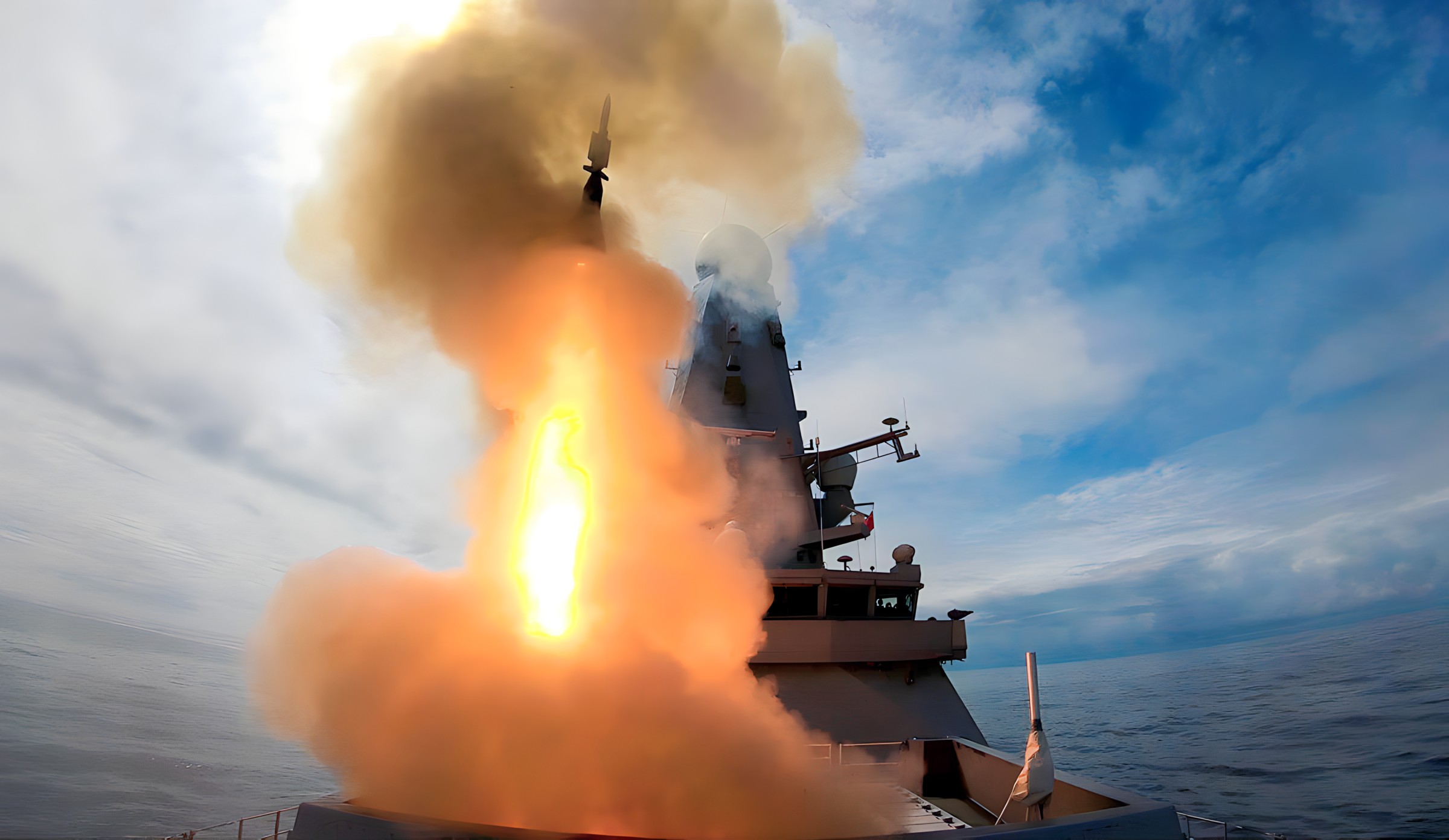
Britain’s investment in homeland air and missile defence will mostly buy better warning that an attack is coming rather than the means to stop it, General Sir Richard Barrons has told the Defence Committee, warning that the iron dome type system many people assume protects London “is not even remotely there.”
Giving evidence on the Defence Investment Plan alongside Lord Robertson, his fellow Strategic Defence Review author, the former Commander of Joint Forces Command was asked whether the roughly £790 million the plan provides for homeland integrated air and missile defence is enough to be ready for possible Russian aggression against NATO by 2030. Setting out what the money actually purchases, Barrons said the bulk of it goes on improved command and control. “You’ll know better that you’re going to be hit by a missile,” he told MPs, alongside “some improvements for the Air Force’s ability to shoot down cruise missiles” and improvements to the Type 45 destroyers “so it has a better capability against ballistic missiles.” The distinction matters because command and control determines how well a country can detect, track and warn of incoming threats, while the capacity to intercept them depends on launchers, interceptors and directed energy weapons held in numbers, and it is that layer, on the general’s account, that the plan barely touches.
“I think many people in the country assume there’s a sort of iron dome over London, at least, and it’s not even remotely there,” Barrons said. The reference is to Israel’s Iron Dome, the layered system that intercepts rockets and missiles over Israeli cities, and no equivalent protects British population centres or infrastructure, with the air defence of the UK homeland currently resting on Quick Reaction Alert Typhoons, a small number of the Army’s Sky Sabre batteries, and whatever Type 45 destroyer is available at sea.
Even embracing the technological change that is cutting the cost per interception, through directed energy weapons such as DragonFire and cheaper missiles from newer entrants, Barrons put the price of a genuine defence far beyond what has been allocated. “Entry level, probably 80 billion pounds over 10 years. Entry level IAMD of my dreams, probably 120 billion pounds over 10 years, and we got a billion,” he said, describing integrated air and missile defence as “the iconic thing that didn’t make it into the review.”
The shortfall sits, in his framing, in the unaffordable half of the defence iceberg. The review and the plan represent only the top half, he told the committee, with at least another £60 billion to £80 billion hole in defence infrastructure, spanning falling-down airfields, ports, housing, reserve forces and cadet facilities, that never made the cut because it was not remotely affordable, and he cautioned that arguing over the margins of the plan should not be mistaken for fixing defence.
Lord Robertson told MPs the homeland threat has transformed since his 1998 review, when Britain considered itself an island with a moat, a long way from trouble. Pointing to Iran’s attempt to fire a ballistic missile at Diego Garcia, 2,000 kilometres away, using an out-of-date Russian system, he said: “We are now within range in a way that we weren’t before.”
Barrons also identified defence medical services as “the most hollowed out bit of defence,” telling MPs that any plan to deploy the Strategic Reserve Corps on the continent must account for mass casualties reaching NHS beds with a system to move them home, and “I can’t see where that exists. That’s not in the DIP.” Munitions spending across the plan, he added, will buy substantially less than the 30-day stocks the services would want to hold. On the government’s claim to have already met NATO’s 1.5 per cent resilience spending target, both witnesses were unpersuaded, with Robertson saying it has never been explained how the figure is met and Barrons observing that the money has visibly not been spent on securing bases such as Brize Norton, mending military ports, gearing the NHS for mass casualties or enabling mobilisation. “Whatever the money has been spent on, it’s hard to see in the military lane,” he said.











Isn’t Sky Sabre being doubled?
Supposedly, yes. And SHORAD to “triple.”
They use the “double” as the headline grabber, to try to divert attention from the fact that there are so few to start with.
Sounds good, which is all part of the spin.
If you have a handful of systems, you still have a handful if you double.
And in war, and I keep repeating this until I’m blue in the face, they might not even be in the UK. They are for the deployable Field Army, so the ARRC.
3x nought is still nought.
Not even close to necessary, due to geo relief coverage maybe even not enough to cover all London and obviously is not a proper system against ballistic missiles and too expensive against Shaheed types.
Side note
Iran to Diego Garcia is about >3500km per Google maps.
Iran to London is about 3700km
Yes which is why there is a NATO SM 3 system in Romania that we pay for and an arrow 3 system is Germany that any Iranian missiles has to cross to get to us.
Sky Sabre is short range battle-field AA
We need long-range and anti ballistic missile defences to defend stategic places like:
Government buildings
Military HQs and bases
Critical Military industries
Ports and storage
Patrick, the army has a mere 6 SkySabre launchers (part of aAD missile system) compared to vastly more Rapier Fire Units previously. These are of course for the AD of deployed army units, and not for the defence of the UK homeland. MoD has ordered a further 7 SkySabre launchers.
Utterly pathetic – dereliction of duty by governments of whatever colour.
I honestly couldn’t tell if the article was some kind of satire.
Successive governments have wanted to project power and influence across the globe, but on the cheap, with no defences if we get attacked ourselves.
It’s like having a knight, taking his armour away, swapping his sword for a knife and selling his horse to replace it with a pony.
Nicely put NoPoet 🙂
Anyone who knows anything about defence would have known that the figure would buy very very little.
As for the rest of the DIP, it is so full of holes and buried bad news that eventually will come out in the wash through FOIA and written answers, as it remains vague in the details – how many.
By design.
Starmer got his moment to grandstand, I PRAY he is utterly humiliated by NATO shortly. And that goes for the next one parachuted in to save Labour’s neck if he does not improve matters.
Sums up Starmer in all things doesn’t it. Emperors clothes or in his case minor functionary’s clothes. Does one laugh or cry at his bafflement as to why virtually no one likes or believes him.
Sad to say, NATO needs to downgrade the UK from the top table and put us in the minnows league. Even then I don’t think the humiliation will shift the government into gear, we’ll just keep plodding along in the slow lane trying to hide among the also rans.
No Iron dome over London ?
Well, at least that’s a bonus then….. 😊
Telling us what we already know …
You usually have a grey dome…
It’s always “Jam tomorrow” with the UK it seems…all over our faces!
Sums up Starmer in all things doesn’t it. Emperors clothes or in his case minor functionary’s clothes. Does one laugh or cry at his bafflement as to why virtually no one likes or believes him.
Starmer is the man who wanted to criminalise people for calling him a w_____ when it would have been far quicker, far easier and also incidentally free of charge for him to stop being a w_____.
He has not at any point shown any interest in defending British interests or the British public. His DIP was clearly always going to be a farce.
The DIP wasn’t really aimed at tackling the immediate issues and this is quite a damning intervention by Barrons and Robertson on a gaping whole in our defences. You can see why Healey and Carns resigned.
hole
Froidient slip I feel
If we’re in a war serious enough for ballistic missiles to be heading our way, chances are the US will have moved THAAD and Patriot batteries over here to protect their own assets and personnel.
Anyone know of any nice campsites around RAF Lakenheath or Mildenhall? 😅
Have you seen the air bases, even embassies in Kuwait and the gulf, despite attempts to prevent it getting out the Americans have been totally incapable of defending them effectively against obsolete Iranian missiles and simple drones, Mildenhall is the last place I would want to be especially after seeing film of the drones (hey maybe they were UFOs) operating all over that place for two days.
Phew! Thank goodness for Number 10 North, then.
Well if the people of London survived one blitz they can do it again (Labour logic)
Well sadly it was Conservative logic to see us as canon fodder back then. Simon Calder’s father was a journalist at the time reporting on the blitz and he personally spent days telling the Govt to get families out of a school in the east End where they had been sent after losing their houses, knowing it was in the middle of a potential bomb run and a disaster waiting to happen. Sadly it took them days before making any effort and when they finally did the Lorries were delayed or lost their way just long enough for it to become the first big civilian disaster of the war. Of course they kept that quiet too.
I agree this is a long cross party scandal, Labour are just the ones that deliver the final message to the public
There is in the DIP a commitment to long-range ballistic missile defences for the homeland, but it’s not funded yet.
This is the relevant section from the DIP. There is obviously more detail elsewhere in the document, but I couldn’t find anything that specifically states there is a commitment to long range ballistic missile defences for the UK?
“The conflicts in Ukraine and the Middle East have demonstrated the critical importance of Integrated Air and Missile Defence (IAMD), which has remained a priority capability area to address during the development of the Defence Investment Plan. This is vital for the defence of the UK homeland (including our NATO Article III commitments), overseas bases, and our overseas territories, as well as our allies.
Capable and effective IAMD for the UK can only be accomplished as part of a NATO endeavour, as we work with our allies to provide layered air and missile defence for the Alliance.
As lead UK Command for IAMD, the RAF is responsible for delivering the timely, resilient, and integrated command and control (C2) that is critical to success.
Under the DIP, £790 million will be committed over the next four years to protecting the UK homeland and overseas bases from air, drone and missile threats.
This will include new radars, sensors and command and control systems, along with further investment in directed energy weapons and counter drone systems.”
Isn’t the SDR thinking that an effective Iron Dome for the UK is not feasible and that the best approach is to acquire a sub nuclear, strategic deterrence layer – UK launched IRBMs with conventional warheads.
Half arsed, MOD state normal,
There is no effective way to intercept ICBMs. US GMD tests in highly scripted attempts to intercept a single missile achieved 50 % success. Defence against an attack in numbers has been judged unachievable.
Lower range slower ballistic missiles are easier to intercept as are slow moving drones.
In the non nuclear field, it is probably better and certainly cheaper to provide counter strike deterrent capability.
Hi Peter please keep your historic data and commons sense to yourself 😀
We need to spend £120 billion on an iron doom for Wigan then start firing missiles straight off the deck of the aircraft carriers like the General tells us.😂
If we got into a nuclear war with Russia at the moment there is ever chance they woukd only spend a few missiles at the UK knowing each one word get through. If we tried to build a system using existing technology this defense (£80-£120billion) then there is every chance Russia sends dozens of missiles and hundreds of warheads from its Siberian ICBM’s which are too fast and too numerous to be intercepted and the UK ends of getting hit by hundreds of weapons.
A UK ABM system should be designed to intercept Russian MRBM both conventional and nuclear to stop Russia doing such a sub strategic nuclear strike or a conventional attack designed to make us back down.
We cannot and should not cripple UK defence spending trying to build a Golden dome style fantasy missile system that ends up simply trigger a new nuclear arms race and won’t even work in the first place because the technology just doesn’t exists and might never exist.
Arrow 3 can intercept an ICBM (according to Google)
Mid range ICBM’s but not the big inter continental stuff. with 1O MIRVS and decoys they can also easily over whelm an exo atmospheric system like Arrow 3. To intercept the big stuff you need a Mid Course interception capability like the GBI in the USA which is very very expensive and not that reliable.
Admittedly you have to see them before you can shoot them, but I would think an integrated system would be cheaper and more effective in the long run rather than trying to boit on the “kinetics” after the fact.
Good Day,
With all these negative comments it seems as expected the Long awaited DIP is a huge disappointment! Are the people in power ( PM, Chancellor, new Defence secretary) aware in real terms what is needed? It seems not! A very sad state of affairs!
The forces it seems will only get the funds needed when we have to go to war! Unfortunately to late!
Nick
I suspect they are far more aware of what’s actually needed and can be afforded given the information they have access to and we don’t.
Despite what the talking heads might tell you and the internet commentators, the British Government is not stupid. There are also a number of hard limits when it comes to ABM systems. Remember the DIP funding package is only set with a four year funding settlement. Much of the funding announcements are not included in the document we have access to.
The handful of ABM system manufacturers are currently making have full order books for a decade. Our Allie’s in the gulf, Ukraine, eastern and central Europe and the pacific need these systems way more than we do and in most instances Allie’s in Europe having these systems like Germany, Poland and Denmark protect the UK as those are the best locations to intercept ballistic missiles from heading to the UK.
The DIP does specifically reference a long range ground based missiles system being procured to intercept ballistic missiles it’s just not referenced in the four year funding settlement.
I suggest much of the water was probably muddied by the good General doing the defence review telling the treasury he wanted to spend £80 billion minimum on ABM in ten years for an entry level system 🤦♂️
Where would you even be able to spend £80 billion on ABM systems in ten years considering you could barley buy a single current system in much less than ten years no matter how much money you had.
You may be right, but I believe you are wrong: that resources would follow the money, that it would only take a fraction of a decade to gear up. But we’ll never know which one of us is right, as nobody is even trying.
THAAD & Patriot are in short supply, but SAMP-T NG, KM-SAM, CAMM, CAMM-ER are available.
SAMP T NG is now in short supply, lots of orders going in now and none of the rest are much use for ballistic missile intercept. Maybe the UK is planning on CAMM MR to be what fills the gap mentioned in the DIP.
Exactly, shared inventories with the RN, how hard is it? Whatever is good enough on the T45s can surely be applied to land GBAD for starters. Why stuck on CAMM for SkySabre? Can it handle CAMM-MR, even options for mixed fires. Italy and Brazil have CAMM-ER. Why not the UKz The CAMM farm silos on the T26s, can they be upgraded to take CAMM-ER? Where’s the CAMM-MR at? Is it going into the T31 mk41s with quad CAMM or CAMM-ER? Some good potential here.
* sorry, meant CAMM-ER fir SkySabre
Britain is not in any way capable of fighting a peer war. We are decades of underinvestment away from being anywhere near ready. We wouldn’t last a strawberry picking season and everyone credable knows it. Every governmemt since 1990 is responsible.
Austerity, austerity, austerity. All in the name of protecting the well off and reducing taxes. Taxes pay for infrastructure which includes NHS and Defence. The NHS needs an upgrade as much as defence does as there is no spare capacity within it to cope with any hot-war. Taxes are or should be based on a fair proportion of income and while the low paid do not have any spare the well-paid do. They are the ones who benefitted over the last 20 odd years of peace dividend and successive governments have dropped the ball. It isn’t as if we have huge numbers of foot soldiers who would be essential, still less the ability to resupply beyond a few weeks of intense combat. We cannot wait to the mid 2030s to fight a war, especially as one is possible by 2030. Far too much money is spent on big projects, over spent, badly specified and years late. It isn’t as if we haven’t seen it coming for the last 5 years in Ukraine. Civil servants and self-interested politicians pontificating and procrastinating.
Taxes are based as you describe with top 10% of earners paying > 60% of all income tax. The problem is that a majority of the working age population take out more than they pay in. Until welfare returns to being a short term safety net and not an alternative lifestyle, UK will continue to borrow each year
The facts are that welfare is not a fund for an alternative lifestyle. Yes, there may be some, but that applies to the other end of the income spectrum. The majority of welfare is actually a subsidy to business to allow them to pay lower wages. What is also invariably forgotten is that welfare money is spent in our economy and works its way through doing some good in the process. Money hoarded at the top does not get circulated and therefore doesn’t add anything to the overall public good. Taxes go way beyond income tax anyway. NI is a tax, VAT is a tax, fuel duty is a tax, . . . . . Those taxes are derived from expenditure so anything that is not spent does not generate tax. The same tax system that is managed to suit those who can afford all the loopholes. And IF we need to spend more on the NHS (essential in times of war and emergency) and defence and the low paid are already taxed to the hilt and are not in a position to pay more tax, which would otherwise reduce the amount of money in circulation up through the economy, where does that extra spending come from? Defence defends the lifestyles and incomes of the wealthy too so as the ones with more disposable income or offshore resources should pay more, especially as nobody else can! Trickle down as a concept is fine IF and ONLY IF those with the most spend more, which failed because instead of spending they hoarded. Trickle up does a lot of good to the economy and society on its way up. And lastly of course reduced disposable income at the bottom end of the spectrum means reduced sales for businesses (as directly evidenced during the lockdowns).
Maybe they do pay more tax (based on what figures?). But do they pay enough tax? If as I said below the low paid are already taxed to the max, why should the high paid not do the same? They and they alone can enjoy the benefits of the loopholes they create, and have more disposable income that remains untaxed. If the low paid have no or little disposable income after tax and living expenses (which also collect tax) then where is the extra tax to come from?
What disposable income remains untaxed? Funds saved in a private pension scheme or in a qualifying ISA. With the gradual disappearance of private sector final salary schemes, governments of all political parties have encouraged these alternatives.
There is no easy way to expand the tax base/take without adverse knock on effects on employment and growth. Ask Reeves.
Reeves is no better than many others. The whole point about tax is that it should be based on ability pay. The low paid cannot pay any more tax, their disposable income was eroded over austerity and peace dividend. I was making a general point as there will be some examples that don’t conform, but the issue people forget is that welfare supports low wages. Those low wages have nothing else to give so the only other way of spending more on defence is either to drastically cut another budget or approach those who do have excess disposable income. Since spending on defence with the possibility of an armed conflict will produce lots of casualties more also needs to be spent on the NHS. During WW2 and the Cold War we had higher income tax levels across the board and the same needs to apply now. Cutting taxes does NOT improve public infrastructure or resilience. Look at the wage gap disparity, well publicised figures that show the income for higher earners comprehensively outstripped those on low wages, and the more disposable income instead of ‘trickling down’ as one ex PM said it actually trickles into off-shore bank accounts and tax avoidance schemes that only the well off can afford. What is completely ignored is that money spent on welfare actually moves up the economy benefitting the whole chain. Why do you think that politicians generalise ‘welfare’ as excessive but fail utterly to actually explain what they are talking about and also fail to show the real statistics? And the wealth drain of higher tax is a complete misnomer. Since their wealth is is either in an off-shore bank account or in stocks and shares does any of that money circulate through the economy? So what would them leaving the country achieve? Firstly their off-shore accounts still aren’t touched, and secondly the companies will still be there!
I think the point is to tax that hoarded disposable income as it is being hoarded! Especially if it is a notional share bonus allocation, taxed at cost at the point of transfer, and then instigate an effective capital gains tax when any is withdrawn. Stopping the loopholes should be enough anyway and structuring the tax system so it isn’t regressive.
What you mean somebody with big ⚽️ should have cancelled HS2?
And yet the UK earns more tax from top earners than almost any other country in Europe.
There’s not enough tax on unearned income. Why should those who work for a living subsidise those who own for a living?
Really? Own was already taxed.
Lets invert it, why people that build a lot have to pay for those that dont?
By definition unearned income is not already taxed! It is only taxed at point of realisation, which can often be never or at best a long time in the future. And taxing it at withdrawal still leaves the rest that is hoarded untouched, gathering untaxed interest.
Austerity. It seems you have no clue what that word means.
Best bet is to get some solar electric panels on your roof a store of water and some purification tablets. At least this time, civilians will have a chance but when the infrastructure is knocked out, electricity, water, dried food etc will be be essential.
I mean Ukraine has about $10b worth of patriot batteries, $2b of IRIS-T, plus the interceptors. The US used ~$6b worth and 3 years production of PAC-3 in the Iran war (Plus THAAD and Naval interceptors) and they still lost a lot of radars and some planes.
I’m not against ballistic missile defence procurement, but people don’t realise how expensive it is before it becomes useful. What do people propose we cut to fund it? If they can’t answer that then I guess they’re in agreement with the goverment that there’s better ways to spend for now.
On this I think you have a point there isn’t a chance that London or any major City can be protected against ballistic missile attack. Having the ability to strike back is probably a better guarantee of safety. Especially as we aren’t going to get the many billions of dollars from the US to do so, even to a reasonable degree of a reasonably sized city. The Golden Dome will be just another vanity project that at best will give some protection to some vital sites, the rest will be left to their inevitable fate. Again creating a lack of certainty in Russia and China will be its prime purpose.
We have gotten into this mindset of GBAD uber alles only due to the ridiculously restrictive RoE initially imposed on Ukraine by the USA. Now that the USA have effectively lost leverage over Ukraine due to Trump suspending aid, and Ukraine are able to hit the Russian homeland hard using Ukrainian domestically produced systems, the strategic calculus has changed. GBAD is only still a hot discussion within NATO because Trump is being a dick withholding Patriot interceptors, If Ukraine had enough shots on hand GBAD sufficiency wouldn’t be provoking much interest.
Am I being silly here but after the type 45s we apparently don’t need destroyers anymore, that’s not to say the Type 45s are the perfect solution by any means but parking one on the Thames has a good go at protecting central London… That in my view should be the way forward as clearly Iron Dome isn’t practical or affordable.
Surely a couple of VLS batteries and a couple of radars are cheaper than a destroyer which includes a couple of VLS batteries and a couple if radars! If we can build destroyers, why not fixed emplacements? Go to the City. Go to Canary Wharf. Have a whip round.
Big target if parked in the Thames but barged defence missile pods and radars maybe?
A full UK missile defence has been estimated at a minimum of £25 billion. We cannot afford that, but a journey of a thousand miles starts with the first step. The EMADS system using the CAMM-ER missile costs $208m per battery, so 6x batteries would cost $1.248 billion. That is a fig leaf, not a full multi layered system, but it is better than nothing.
This is the same muppet that came up with firing missiles off the deck of the Queen Elizabeth. You can imagine the conversation which the treasury when he says he wants to spend £120 billion over ten years on a missile system for the UK and the Treasury asks would the system be able to stop all Russian missiles and he says no.
I want to see the UK with a ballistic missile defence systems. Germany is doing arrow 3 for around £4 billion.the UK could get near complete arrow 3 coverage for £2 billion. Four SAMPT NG batteries would cover most of the country for around £4 billion as a second tier layer. So £6 billion gets the UK a pretty comprehensive ABM system with both exo atmospheric pulse near some coverage for hypersonic weapons and this muppet is talking about an entry level system at £80 billion over ten years.
How did this man ever get the only “professional military” seat on the Strategic Defence Review
I
The 80 billion price tag is just a trick to present this as impossible and block criticism, if they say 6 billion than people might questions priorities, Greece will be doing it (according to early publication) at a cost of about 3 billion but without a exo-atmosphere capability
He is the one criticising the government though. He should be the one saying £6 billion for an entry level system to highlight the government failure but he is saying £80 billion to £120 billion.
That is more than trident renewal or HS2. It’s would gut UK capital spending for a decade and achieve not a lot.
Surely we have the capability to land base some aster 30s? You could have several hubs across the country (Faslane, London, Lossiemouth, Filingdales ect) that would be able to cover the country for a lot less than 80billion?
Its a scary time to think that any passing warship in the channel could launch a few drones at London out of the blue and we would have nothing to intercept it.
Four SAMP/T NG batteries which have a coverage of about 150km in radius would cover most of the country. One arrow battery would provide a high layer defence from an area from Faslane to Portsmouth if you place it around the Humber.
You can get a pretty decent coverage for around £6 billion. Not covering the Highlands and Islands but certainly all the major population conurbations from the Scottish central belt down.
It appears from the headline as if we should be investing a little in antimissile defences of one sort or another. We know what it’s like to lose ships to missiles, expensive in terms of people, combat effectiveness and ships. It’s not an impossible job but if course our government won’t even shell out for defences for the pathetically small navy we have. The Russians with a gdp a mere fraction of ours sent a stronger naval force on an exercise than our entire navy
This lack of UK air defence is utter madness – nay Treasonous. Given also the UKs habit of concentrating its military in such few locations and lack of defence around key strategic points.
Worse is the fact that if Putin decides to make an example of the UK, then we will only have the option of going nuclear. now that is not a good place to be. Far better to have sufficient conventional defence to deter in the first place.
Yes it should be an absolute priority. Many of us have being saying the same here. Ukraine is crying out for more AAW missiles and the UK thinks its unnecessary or making out that its so unaffordable? What’s happening with “cheaper” Star Hammer and Sky Hammer systems, any for the UK?