

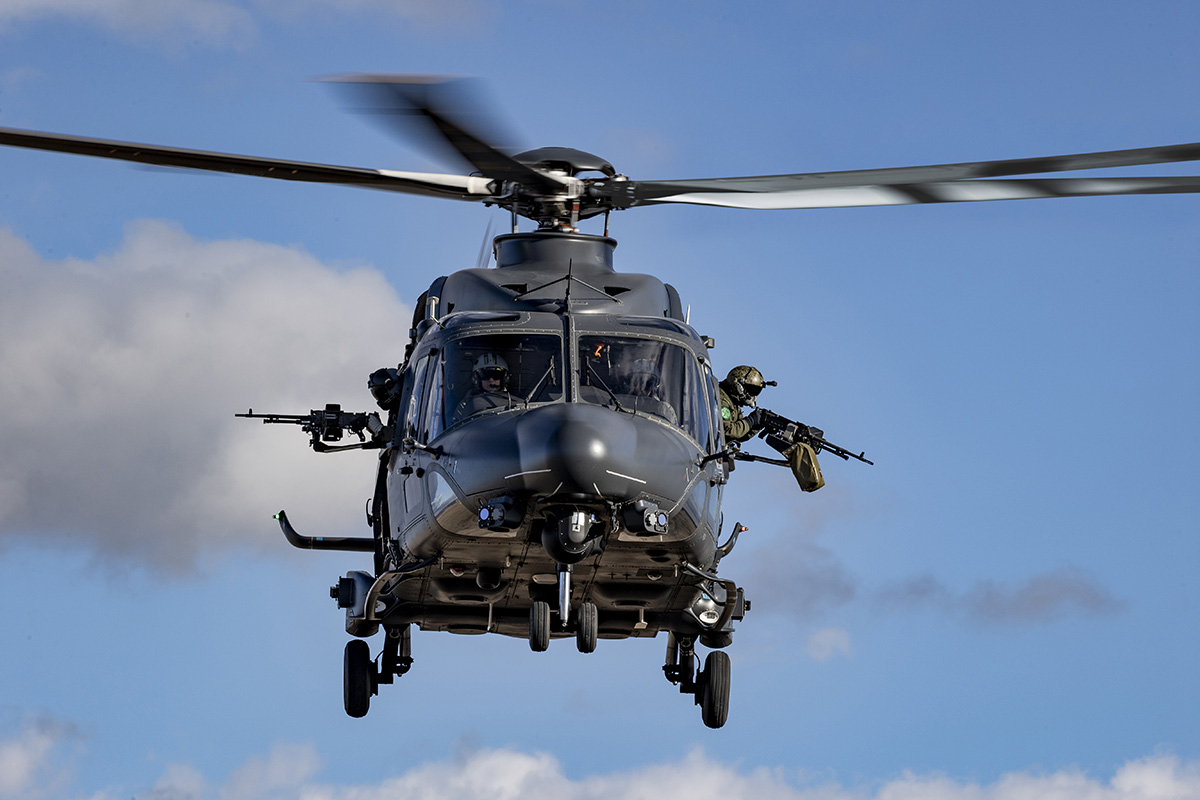
The Ministry of Defence and the Treasury gave conflicting public signals over the £1 billion New Medium Helicopter contract with Leonardo earlier this year, a select committee member has said, in an exchange that exposed friction between the two departments over one of the government’s most prominent helicopter programmes.
Putting the question to Minister for Defence Readiness and Industry Luke Pollard, a committee member said the contract had been announced by the Treasury in February as agreed with the full support of the Ministry of Defence, only for the MOD to be reported separately as having deprioritised the capability.
“Perhaps it speaks to a less than fully functional relationship between the MOD and the Treasury,” the MP said, asking whether both departments had in fact been content with the deal and why the Treasury had announced something the MOD did not appear wholly enthusiastic about.
Pollard confirmed the department had procured 23 new medium helicopters from Leonardo under the billion-pound contract, and that timing had been a factor in the decision. “The validity of the bid that Leonardo had placed was coming to an end, and that would mean that if we delayed beyond that point we’d have to either restart the procurement, or we would be carrying significant risk,” he said, adding that the government had renegotiated substantial elements of the deal rather than simply accepting the terms it inherited.
Those changes included a commitment from Leonardo to base its defence helicopter exports out of Yeovil, which Pollard called “a significant move,” and to make the Somerset site the company’s centre for autonomous helicopter production, building on the government’s earlier investment in the Proteus autonomous helicopter programme. UK content in the helicopters for export has also risen substantially, from around 8 per cent under the previous government’s procurement to a figure Pollard said now sits close to Typhoon standards, in the 40s per cent.
“I think ideally big decisions like that would be taken as part of the defense investment plan, but as the timetable for the new medium helicopter decision and the defense investment plan were not aligned, it was necessary to take them out with that decision,” Pollard said, adding that since the contract was announced the government has awarded a Defence Technical Excellence College to Yeovil and increased places at Yeovil College.
Chief Secretary to the Treasury Lucy Rigby, who was not in post when the contract was agreed, said she understood the decision was about investing in a key industrial site and maintaining an area of strategic UK advantage.
“The difficulties with it stem from the fact that it didn’t align with the dip timing, and therefore an earlier decision was necessary,” she said, “but I think the decision that was arrived at was the right one for the reasons that I’ve set out.”









I know they are not the same but with wildcat being cut early surely we should be looking at more of these, I mean £1billion for 23 and built in the UK is a bargain.
Sensible suggestion if there’s going to be a very real reduction of utility capacity with the cuts of the Army Wildcats.
Too small, its puma sized
Medium lift.
Big enough to carry more than an infantry section
It can’t lift 2.6 tons as an underslung load. No point in moving an infantry section if you can’t supply them or carry supporting weapons
Ummm yes the AW149 can lift a 2.6 ton underslung load.. its max underslung load is 6000lbs.
Surely Wildcat could fill some even if not all of the requirements? Or would that be too sensible an option?
No.
They are too small but could be used in multiples to cover the gap until the new helicopters are ready. Something is better than nothing and all that.
Wildcat presumably cut to pay for it, so yet again, Defence budget used to subsidise Dept of Trade.
Nope.
Given the age and recent losses of helicopters in non combat instances, shouldn’t we be looking to renewing the fleet anyway?
And before the comments about Helicopters and Ukraine appear, even back line and peace time movements with Helicopters is worth their price, as well as the maritime bases they’d be utilised from.
It’s a side benefit that jobs would be supported, but most of all, it would up resilience if things ever hit the fan.
Not big enough. This was supposed to be an interim replacement for the Puma, with a view to buying the Bell MV-75 Cheyenne II when that’s available in the early 2030s.
URL to the report of U.K. buying Bell MV-75 Cheyenne II?…
I think this was the hope. The Puma replacement was original listed as an “interim solution”. The MV-75 with its range and speed, is a significant step change in capabilities over a traditional helicopter. I think the writing is on the wall for conventional helicopters, Airbus is looking at its future rotorcraft, which may be based on the X3. Otherwise it will always be playing second fiddle to the MV-75.
I think it’s been the hope of those of us that were following the progress of the Valour as it was originally known. Not sure the MoD ever stated that.
Agreed the tiltrotor is the future – Bell have said they don’t intend to develop any new conventional helicopters. The question is whether we’d buy American given recent experience.
If Leonardo decided to produce a military version of the AW609 with a production line in Yeovil, then I could see HMG being tempted.
(The question is, when AgustaWestland bought Bell out of their joint venture, was there a non-compete agreement that Bell would focus on military and AgustaWestland would focus on commercial market?)
Tis medium lift with capacity to carry more than an infantry section
I hope that’s true.
We’ve known since 2015 that battlefield helicopters are not a capability that is survivable on the modern battlefield- which led to the US decision to move away from them.
This is purely a sop to industry. I’m still not sure how we ended with this procurement being on the order book at all, other than for the Cyprus / Brunei requirement.
I was a LO to the US experiment on air assault that directly led to their decision and our recommendations to Army HQ were very clear.
What you talking about? helicopters like this are to move troops, causalities and equipment at distance from frontline.
They are still very useful and US is not moving away from them.
Ok Alex,
In operations other than war, helicopters are useful.
In any contested environment, they are a death trap. Over the next decade, the US is replacing the Blackhawk, Kiowa, and ultimately Apache with something much quicker and intended to be much more survivable. Even against Iran, they’ve lost a serious amount of helicopters.
The wargame I was an official observer on in 2015, they simulated an air assault by the 101st Division. It was against a beer peer adversary with their real-world ORBAT.
1st run through they never made it to the LZ.
Second run through they reduced the air defence assets by 50%. They never made it off the LZ as they were destroyed by fires.
The US primary lesson that we put in our report was that you cannot do heli-borne air assault on a modern battlefield. They are too slow, too vulnerable and too easily found. That’s what run 2 showed, you can’t hide them.
And Ukraine has validated it. Helicopters are now used almost exclusively in the rear.
“In operations other than war, helicopters are useful.
In any contested environment, they are a death trap. ”
?! not all environments in war are contested.
“Over the next decade, the US is replacing the Blackhawk, Kiowa, and ultimately Apache with something much quicker and intended to be much more survivable.”
Not true, US will continue with a majority of conventional helos. . And the ones that will be VSTOL are not much moresafe.
It was supposed to be an interim helicopter but now we are stuck with a new helicopter design with limted export potential and high unit costs. Licence build the UH60 if you wanted to keep the work at Yeovil. Instead there’s the development cost and risk of new helicopter is sitting on the balance sheet. Entirely avoidable expenditure which the money could have spent on something that added capability to armed forces
“development cost and risk of new helicopter”
It’s been in production for 25 years.
Er no it hasn’t
Umm it was first flown in 2009 and has 3 current operators.
It’s early for pantomime season, but “oh yes it has”.
Not 26 years “only 17”.
The way I read it is that the Treasury was keen to get the economic benefits of Leonardo in Yeovil: jobs and tax revenue- but the MOD didn’t see Puma replacement as a high enough defence priority to jump up the DIP funding.
Seems a sensible suggestion for a useful sized helicopter. Aren’t real helos still needed behind all the drones? Even to transport drone teams and supplies up to or into and around a battlefield?
Ive been pondering that point myself Quentin, reducing the helo fleet while massively expanding tbe drone fleet.
Especially the armed drones,how will all these additional weapon systems be resuppled and supported???
Replying to Fostersman. Seems a sensible suggestion for a useful sized helicopter. Aren’t real helos still needed behind all the drones? Even to transport drone teams and supplies up to or into and around a battlefield?
My first post delayed. Sorry for double up.
Treasury can just write the cheques and shut up. We’ve all had enough of their so called “value added” to defence projects.
Here’s a wild idea.
Use these as the replacement for the Red Arrows.
Yes, I realise it’ll be an ever so slight change but these are already paid for and the Reds needs new aircraft.
I’m sure nobody will notice the subtle differences in display style.
Oops I was actually talking about the recently retired Wildcat helicopters.
They’re basically free.
Retire the red arrows….nothing whatsoever to with defence and taxpayers are tight arses
Apart from soft power, cultural promotion, promoting national interests overseas, and when the Hawks were being produced, it was advertising for the aircraft and British engineering. Not to mention they got sponsorship.
And promoting recruitment for the armed forces.
It just shows how out of touch lackies MPs are that they are squirming and making promises they know they can’t keep to keep display team going whilst Russia prowls around our borders and threatens our aircraft. You would think the Reds were low priority but not to these treacherous clowns. With so few helicopters in service ditching the Wildcats seems a very off idea even in Neverland.
Medium helicopter is going to get binned anyway and replaced with drones. Why are we wasting time talking about it.
Are you going to volunteer to be in the first troop movement by a drone and not a helicopter then?
I suspect that’s already been done – somewhere.
Depends a little on the hardware & software. It will react faster than any pilot it’s just a question of what it does next.
Volunteer? Hmmm – I like to know what I’m getting into and volunteering is only to be used with caution.
Certainly if I need to get out of a bad situation then a drone is better than f**k all.
“What it does next” hits it on the head doesn’t it? Is it AI or controlled or by some body sitting 300 miles away? If the bods in the back want to get out and walk would the AI ignore them unlike a helo pilot who at least would have a discussion! There are ‘what ifs’ and ‘ifs and buts’ all over this,welcome to the future,good or bad only time will tell👍
“Medium helicopter is going to get binned anyway and replaced with drones. Why are we wasting time talking about it.”
Maybe you should show first where is the flying prototype that finished testing ready to be build?
And Black Hawk and Sea Hawk sales seem to be going very well still. Probably so medium helos are good value for their size and utility.
And Black Hawk and Sea Hawk sales seem to be going very well still. Probably so medium helos are good value for their size and utility.
Alex I’m sure I read somewhere that we are moving to drones or did I imagine that.
If that is the case it is just a matter of time before something as outdated as a medium helicopter is binned.
Assuming they start to move aggressively towards their goal then drone based transport in all areas should start to appear.
If you are waiting for prototypes etc. you may well miss the whole thing. The Ukrainians might test it on the battlefield. Old style thinking – which still exists obviously – might mean we are overtaken by events.
If NMH isn’t coming into service till around 2032-33 is it really required ? Puma gone so capability gap for 6-7 years ! Let’s be honest the NMH isn’t required and is a pure political decision.
If Apache will have wingmen drones then Apache could be dumped and this used instead.
Germany has decided to use standard helos (weaponised) instead of buying “attack” helos.
Certainly looks like it was a a gvmt decision to force mod budget spend (that’s what the article reports)
This is one of the things I don’t understand the army is binning a utility and scout rotor.. because Ukraine has shown how deadly the modern battlefield is for rotors to directly engage… but keeped the order for its new very very expensive attack helicopters… only binning wildcat after it got all is shiny new attack helicopters… when it’s the heaviest armed and armoured Russian attack helicopters that have suffered the greatest number of casualties.. essentially what Ukraine has shown is attack helicopters cannot live in direct engagement on the modern battlefield.. but the army kept pushing that order…
Is this really the ‘modern battlefield’ though? I really don’t think so.
Saturated with drones and air defence systems.. the need for hyper levels of reconnaissance before anything tries to move..and most likely dies.. yes it is…
‘Modern’ battlefield it isn’t is it? It’s a WW1 battlefield in the 21st century! IF we did end up in a shooting match with anybody the whole idea is NOT to get bogged down in this situation! If one side or the other had managed to gain air superiority then I dare say the battlefield would be a lot different to what it is!
You can’t have a military force run by accountants.
Things have a price for a reason.
Even though the Puma’s had a big upgrade in the 2010s to keep them legal and functional, the underlying metal was original 1970s kit. By the time they were axed in March 2025, the fleet was suffering from fatal flaws that made it clear they were at the end of the road.
They were seen as hangar queens; old aircraft don’t just cost more to fly, they require exponentially more hours of maintenance on the ground for every single hour they spend in the air. For a tiny fleet of just 17 active helicopters, keeping them flight-ready was a constant battle of cannibalising parts from one machine to keep another one going. They were too fragile for the future, as modern peer on peer warfare involves brutal amounts of shrapnel, sophisticated anti-aircraft missiles, and electronic jamming. The Puma lacked the heavy armor plating, the advanced defensive sensor suites, and the engine redundancy needed to survive. So, the MoD looked at a fleet of 50 year old ‘exhausted’ airframes that would cost a fortune just to keep safely in the air until 2028, and decided it wasn’t worth throwing good money after bad.
Often in military aviation, “end of life” doesn’t just mean a machine is physically falling apart. It means the aircraft has reached a point where the cost, risk, and effort required to keep it modern and integrated into a 21st-century militar, outweigh its strategic value. Even with the impressive HC2 upgrades, the fleet hit a major end of life wall.
They were run into the ground, given a proper ceremonial farewell tour around the UK … “Bye bye everyone! Yae, we’re off to a farm upstate” … and then gutted for parts/sale to save the budget.
😢
Speaking of which, is there anything new concerning the June 3rd Merlin crash?
We need a prime minister with some balls. The treasury is there to find the money to defend us. It’s that simple.