

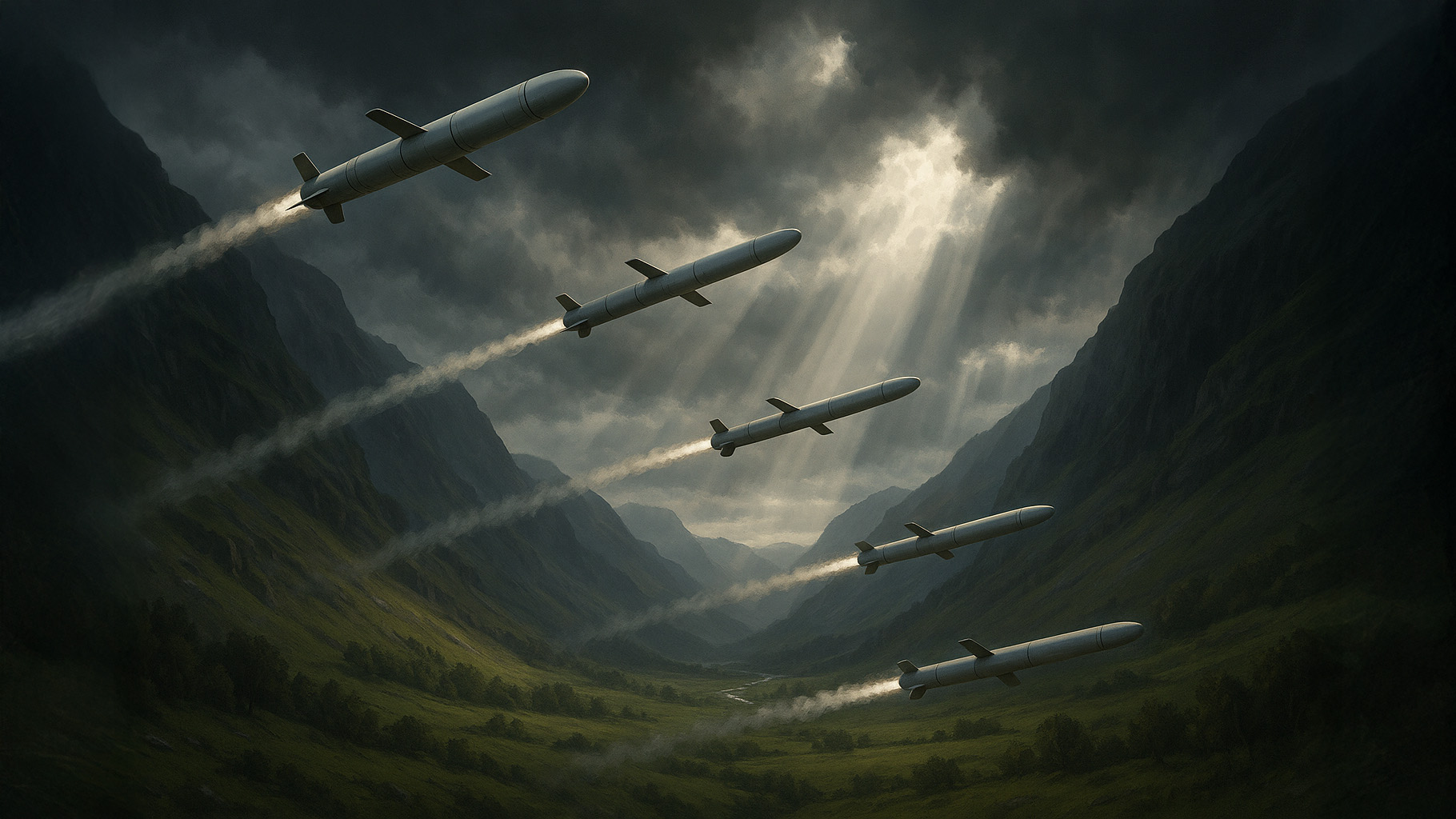
The UK will lead a European initiative committing around a dozen NATO allies to spend $50 billion, roughly £37 billion, on deep precision strike capabilities over the next ten years, Downing Street has announced, in a press release the government published in Russian alongside English.
Prime Minister Keir Starmer was to convene the partner nations at the NATO summit in Ankara to launch the initiative, which the government said will deliver the most advanced long-range weapons NATO will have at its disposal, with the ability to strike targets from no less than 300 kilometres away to, in some cases, beyond 2,000 kilometres, with pinpoint accuracy. Downing Street described the initiative as further evidence of allies stepping up to build a stronger, more European NATO, and said it will put deep precision strike at the centre of the alliance’s defence agenda next year, enabling European allies to share expertise, technology and industrial collaboration to advance capability rapidly.
Starmer said: “I am determined to ensure the safety of the UK and our Allies and to do that, we must step up to deliver a stronger, more European NATO. The UK is already working with partners to develop exquisite capability that will give our Armed Forces the ability to defend and deter thousands of kilometres from the front line, but this UK-led initiative will allow us to step up our cooperation, bringing European Allies together to ensure NATO remains safe and secure for years to come.” The government cited Ukraine’s use of long-range strikes against logistics hubs deep behind Russian lines as evidence of the game-changing battlefield impact such systems can have.
The announcement rolls together the UK’s existing deep strike commitments under a single European banner. Britain has already put £3 billion behind its own long-range fires programmes in the Defence Investment Plan, including £770 million over four years for a joint stealth and hypersonic weapons programme with Germany under the Trinity House agreement, initially focused on ground-launched capability with a range beyond 2,000 kilometres and expected in service in the 2030s, and £1.4 billion for Stratus, the trilateral successor to Storm Shadow being developed with France and Italy, which already sustains more than 1,300 jobs at MBDA in Stevenage and Bolton. The UK is separately joining the American and Australian Precision Strike Missile programme to give the Army a supersonic ballistic missile reaching up to 500 kilometres.
Defence Secretary Dan Jarvis said: “We are building the weapons of the future to keep the UK and NATO secure for decades to come, backed by billions of pounds and working with our closest European allies. Our new suite of deep precision strike weapons will give our forces the ability to strike targets hundreds of kilometres away with great accuracy, strengthening NATO and deterring our adversaries.” Foreign Secretary Yvette Cooper said the capability sends “a clear message to President Putin; NATO is stronger, more European and ready to defend our citizens against the long-term threat posed by him and the Russian state.”
Downing Street said the Prime Minister would use the summit to underline the scale of the Russian threat, citing more than 700 NATO interceptions of Russian aircraft approaching allied airspace over the past two years and a 30 per cent surge in Russian military activity around UK waters, while stressing that the alliance does not seek confrontation with Russia but must be ready to defend every ally.







Wow £50 billion, this is great, I am amazed France is letting us lead it but then after FCAS I can’t imagine anyone wants to work with the French on such a large and important project. £50 billion into cruise and ballistic missiles could easily see anything from 20,000 to 70,000 weapons acquired.
That is the kind of deterrent that would keep any aggressor at bay. The UK is definitely the right country to lead this, UK industry has already proven itself well adept.
We have worked successfully with the French on projects and current projects. I think with FCAS, it was Eric Trappier that kept pusing for more influence in the project.
The only other time I can think of was over the Australian submarine program when they withdrew from STRATUS for a short period of time.
Yes to be honest it’s Dassault who are the real problem in France, MBDA has been a relative model of great cooperation, a real success that in reality would seriously hurt France if, as with Stratus briefly it did pull out of a programme. That was simply a Govt imposed hissyfit to placate internal pressures over Gallic pride and soon reversed when reality struck.
My understanding is that the UK part of MBDA is leading on the subsonic stealthy missile while France MBDA is leading on the supersonic (potentially hypersonic) missile, which shows how important keeping the cooperation going is to both Countries.
Only mentions development, not acquisition.. no?
The United Kingdom relies on a multi-layered, but numerically restricted network to protect critical domestic military facilities.
The primary GBAD asset is the Sky Sabre missile system. This utilizes an agile multibeam radar to engage multiple targets simultaneously up to 25 kilometres away. However, fewer than ten batteries exist globally, with several units deployed overseas to regions like Poland and the Falkland Islands. Airspace protection otherwise relies on RAF Typhoon fighter jets, via Quick Reaction Alert (QRA) operations.
Strategic analyses identify critical capability limits:-
Altitude and Speed Limits: Existing GBAD assets cannot intercept high-altitude ballistic or hypersonic missiles due to low altitude ceilings.
Coverage Gaps: The limited number of available systems leaves several inland facilities unshielded by ground-based missile cover.
Availability: While Type 45 destroyers provide advanced naval air defence, engine problems and the Power Improvement Project mean at least half the fleet remains alongside in maintenance.
To secure physical bases, the Ministry of Defence (MoD) is systematically upgrading perimeter infrastructure under the National Protective Security Authority framework
Standard boundary fences are being replaced with high-security palisade and rigid mesh designs fitted with anti-climb curves
Entry points now feature automated sliding gates with crash-rated Hostile Vehicle Mitigation (HVM) technology designed to stop heavy trucks.
Through Project SENSOREM, bases are introducing AI-enabled thermal imaging and micro-radar to monitor perimeters continuously.
At a time when the Russian FSB is apparently operating inside the UK with complete immunity, having undertaken many successful sabotage operations, I suggest that those responsible for the defence of the realm get real and start taking GBAD seriously.
This is good news.
I am far from a expert in this, but it seems we should be spending much more on home missile defense. You do not have to hit military targets to cause big big problems for the UK. Any big critical infrastructure would be target from supermarket distribution points (there are relatively few of them) to nuclear power stations and similar.
The list is long.
In this uncertain age we need something like a iron dome system l would have thought.
We are dealing with it, more up grades to detect and track missiles, but no money to shoot them down, 2 out of 3 then, seems the clever people at the MOD things thats a great idea.
Deterrence is a lot cheaper. The US used over half of its massive stockpile in a few weeks before suing for peace in Iran. GBAD is very time limited and takes massive investment before it’s actually useful.
Maybe it looks viable based a the numbers of missiles Russia is able to muster up every few days. But if they have a few months or years to build a missile stockpile, then any missile defence will be overwhelmed.
Not convinced about that concept, Israel can only operate such a system over what is a limited area due to massive US aid, that we can’t replicate. Even if we did, the area we need to cover is considerably larger than what Israel has to cope with. Thirdly there is debate as to just how effective it would be against the sort of attack we would be subjected to. Further more it would have to receive constant further investment to remain effective against developing threats and give mass. It smacks of a modern time Maginot line to me and at best enough missiles would still get through to cause serious damage. Far better to as here create the means to hit back at scale but (and this is the weakness) be capable of far better defence around deemed vital installations and targets. Strong defences against drones really should be the immediate priority considering their potential effect to cost ratio and the present weakness here does seem to be deeply concerning.
I will only add, though more as an observer looking in and with no deep knowledge of the various programmes, that despite all of the above I am a little surprised just how many deep strike options we seem to be involved in that seem at least superficially on what we know, to overlap somewhat, while defensive capabilities seem to be barely emphasised at all in present programmes unless I am missing something. While I am not an iron dome advocate we do seem to be falling behind others in some semblance of area defence against threats. Seems on the surface perhaps that deterrence is the vital policy here rather than fighting an actual war, the logic being perhaps that in Russian thinking they will be far more concerned about what we can do to them than they will ever be about about not being able to penetrate our defences.
It’s availability and reliability of systems at the minute. The manufacturing rate is tiny and even if there was cash for Thaad or Patriot we would be in a queue that would take years to deliver a capability. Same with SM3 due to the numbers recently used. Yes it should have been ordered a decade ago but we are where we are.
CAMM -MR with Poland should deliver Aster like performance and we have better production capability. European MBDA led Twister should deliver an exo atmospheric interceptor. We could perhaps join that or another initiative.
Deterrence through huge numbers of conventional strikes weapons could work out cheaper. You are talking £50-100b to deliver Israel like protection to the whole of UK
There was a parliamentary written answer by Pollard yesterday, saying of STRATUS that “the programme is anticipating fielding both the STRATUS LO Air Launched Deep Strike variant and the Surface Launched Anti-Ship variant in the early 2030s”. I can’t tell whether it means that there will be two variants of STRATUS LO or that we will be getting both types, but it’s a decent start. Perhaps an anti-ship LO would be larger (air launched has to fit internally on GCAP) for mk41 and so have a larger seeker and warhead.
Then we recover the high speed strike capacity using this German DPS thingy while the in-theatre strike is now a mishmash of Brakestop, Nightfall, PrSM and the Army’s existing OWEs.
Two varients will be purchased. The deep strike varient is the StormShadow replacement. The anti ship varient will be deployed on T26 & T31.
Ah, but two variants of what? Will we get the supersonic ramjet missile or just two slightly different subsonic, stealthy cruise missiles?
I believe it’s two different designs. The strike is subsonic and stealthy. The anti ship supersonic and very agile.
I thought they were claiming a few years back one version, LO stealthy strike I think would be in service by 2028 and the supersonic anti ship version would hopefully follow in the early thirties. 2028 did seem ambitious, though one presumes it’s fundamentally a much upgraded development of existing tech to achieve that date, but now it seems both are early thirties then.
Welcome as they are, it’s difficult to keep up with all these various programmes.
I think the LO has a land attack and anti ship seeker, can be air and sea launched. Isnt it the same missile , can be carried by aircraft and have a booster fitted for Mk41?
I haven’t seen confirmation we will see the supersonic weapon that France is leading on? That would be a shame as it has capability against AWACS targets?
The PM will “use the summit to underline the scale of the Russian threat”- while totally undermining the credibility of his own arguments by refusing to fund the DIP properly. He seems to believe that ‘leadership’ means sitting on your a**e telling other people to do the heavy-lifting. Actually a pretty standard attitude for a politician.
Pretty much.
I read a damning piece by Nick Drummond on the Land aspect of the DIP, as he was an Army officer.
Full of holes.
Drones funded while mass withers.
The targeting Web funded without the pieces beneath in the kill chain funded to enable it.
The threat of Russian Drones bigged up, then the DIP has a single line devoted to GBAD. Not credible, and that involves the usual “doubling” of Sky Sabre which itself is irrelevant if the starting base number of assets is so small, doubling makes little difference.
It talks about 10x lethality, and acknowledges the progess made in Deep Fires and DPS like in this article, but suggests nowhere near enough is done.
It mentions LMP, but with only 500 million allocated suggests that will only allow a token number of vehicles.
Artillery. Drones complement, not replace, yet there is no enlargement in 155mm pieces.
And on and on.
If you’re on X, the link is there on Nick Drummonds feed, a very good article.
Starmer of course is off with the Faeries on this, he’d not know one piece of kit from the other. Maybe not his job to, his job is to fully fund, and he hasn’t.
HMT Secretary today has stated they haven’t worked out how to find the missing billions to get to 3%, no surprise there.
So yes, some progress, but let’s not drink all of HMG cool aid.
Not sure I agree on the mass withering. Massive increases in artillery of all types MLRS, 155, One Way effectors, deep strike cruise missiles.
Armoured vehicles holding steady in numbers although against a back drop of technology progress in Ukraine that says armoured maneuverer is no longer possible on a transparent battlefield. Maybe that is not the case but I have seen nothing in Ukraine that would lead me to think we should expend large amounts of scarce resources on vast increases in numbers of armoured fighting vehicles or helicopters. More infantry for sure, infantry are more deadly now than ever but you get more infantry with massive increases in reserve forces and the army has chosen not to do that.
The army mantra is to be ten times more lethal. That means the ability to track, fix and strike ten times more targets which in itself is mass.
You need to have a read mate.
On Artillery, 155mm will end up half what we had, and Deep Strike Missiles don’t yet exist. The budget for PRSM buys a small number, ok IF our own is realised.
Armoured Vehicles, the absence in the DIP most highlighted was an IFV to replace Warrior.
GBAD poorly funded and warranted a single line, even though it’s flagged as an real and present threat.
The part with proper funding is in your last paragraph.
…and this guy wonders why the majority of people, even former supporters think he is a tw-t. What goes on in his mind seems barely related to the realities of what goes on in the real world. Used this comparison before but he reminds me of the Priest in the original War of the Worlds film approaching the mass killing machine with a white flag confident in his own sense of importance and seeking to negotiate only to be predictably zapped. Always made me laugh, but such naivety really does have serious comparable undertones.
We need it. Personally I would like to see the UK own a strike missile capable of hitting Moscow when launched in the UK – about 2,500km – as an added deterrent – UK launched because that cuts the need to operate on allied turf. The ability to quickly ramp up production is a major need. That has been demonstred by boith the Ukraine and Iran wars – small numbers just aren’t effective.
Well the Anglo German missile will have a ‘range beyond 2000km’ so maybe that very thought is an active one. Certainly will give them cause for thought.
Yes I believe the launch radius has been selected to specifically allow direct targeting of Moscow from the UK mainland.
Apparently it’s also the key drive for Tempest GCAP range as well.