

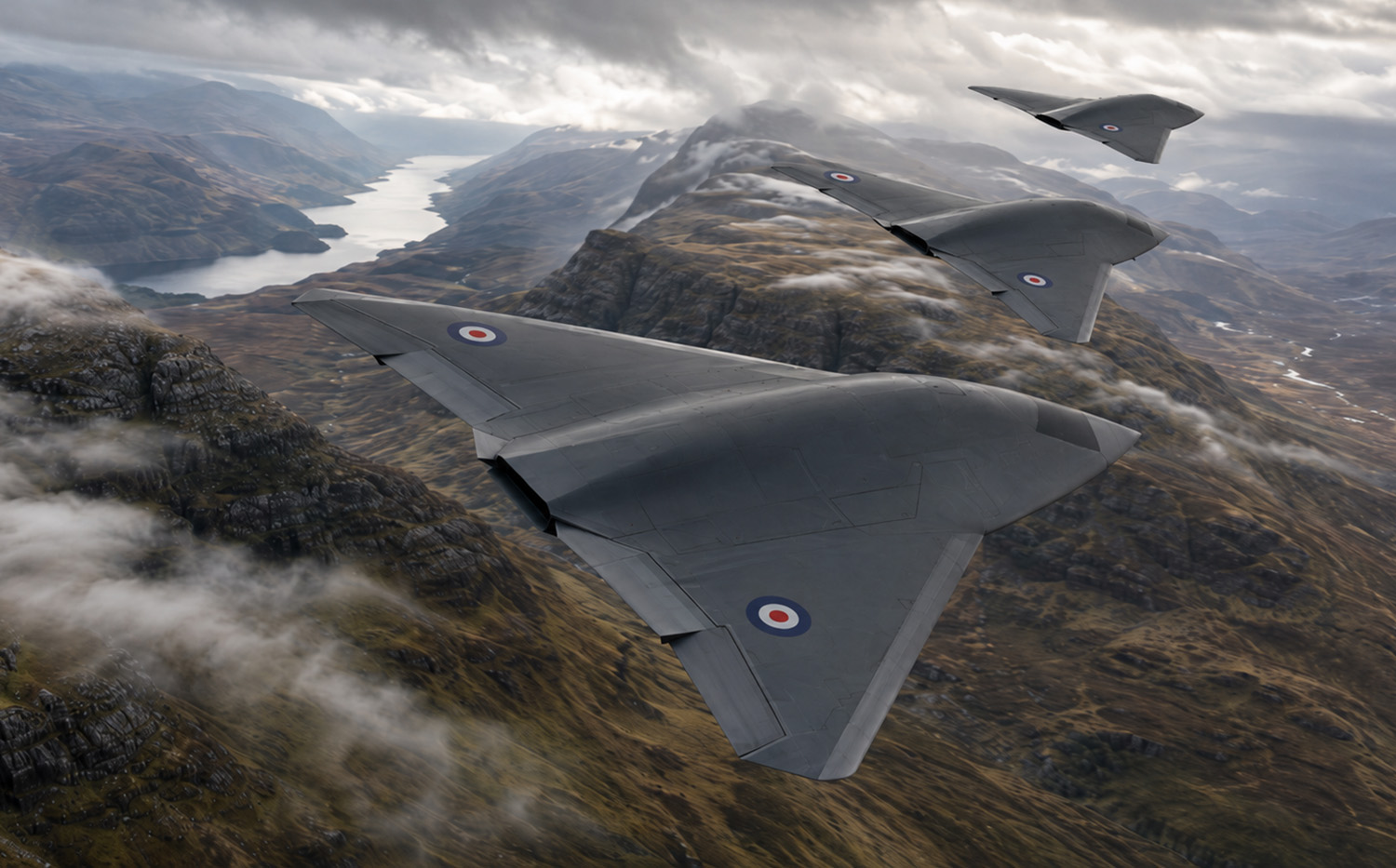
The autonomous fighter jets being developed under the UK’s Collaborative Combat Aircraft programme are expected to play a key role in Integrated Air and Missile Defence through the 2030s, the Ministry of Defence has said, beginning in the air-to-air role, with the Royal Navy working alongside the RAF to shape the programme’s approach.
The detail came in a pair of written answers from Defence Minister Luke Pollard to Conservative MP Stuart Anderson, who asked when the aircraft will contribute to air and missile defence and what the programme’s next steps are.
“Through the 2030s Collaborative Combat Aircraft are expected to also play a key role in Integrated Air and Missile Defence as they augment combat air platforms, initially in the Air-to-Air role to help facilitate control of the air,” Pollard said, as quoted in the answer, adding that “potential further capability uses continue to be explored to ensure the MOD can capitalise any emerging technologies such as autonomy.”
On next steps, the Minister confirmed a jointly shaped effort. “The Royal Navy and RAF are working with the National Armaments Director Group to develop the best approach to Collaborative Combat Aircraft. Defence is working with industry partners to explore proposals and consider the technologies and subsystems that would offer the best overall capability including autonomy, propulsion and payloads,” he said, as quoted in the answer.
The answers add shape to a programme that only gained a public name this week, with Pollard revealing at the Global Air and Space Chiefs’ Conference, as previously reported by the UK Defence Journal, that the Collaborative Combat Aircraft effort will be known as Storm Fighter, developing autonomous jets in the UK to fly as what he described as guardian angel and attack dog alongside Typhoon, F-35 and the future Tempest.
The Royal Navy’s confirmed involvement in developing the approach is a detail with implications, hinting at a maritime dimension to Storm Fighter that would align with the service’s experimentation with fixed-wing drones from its carriers, including Project Vanquish, the jet-powered drone being trialled to serve alongside the F-35B force, and the Hybrid Carrier Air Wing under which the future carrier air group will mix crewed and uncrewed aircraft.
Whether the programme produces a carrier-compatible variant is not stated, but a jointly developed requirement makes the question live.



Will these drones have a self defence suite or will they be sitting ducks for enemy missiles?
Will they have radar and carry missiles or simply launch missiles at the behest of…someone else?
Will one of many autonomous unmanned ships be able to cue these swarms (or at least one or two) of drones?
Will…
AA
Clearly no one in the MOD has thought of any of these things. Looks like “we fear change” is the order of the day again.
Agree, so many muppets that think they have a clue acting like they have come up with some unique insight and everyone in the MoD is an idiot only interested in cutting budgets.
Yes, there are plenty of professional people in Defence. Just because HMG run it on a shoestring does not make people idiots. All these questions will long have been considered and acted on.
Not sure how you know any of that 🙂
‘Clearly no one in the MOD has thought of any of these things’…..what the hell do you know? 😂
Looks like you don’t recognise sarcasm.
“Will these drones have a self defence suite or will they be sitting ducks for enemy missiles?”
Yes, you’d think so, it is hoped that they can survive.
There are 3 tiers:
Tier 1. Expendable. Like a OWE.
Tier 2. Attritable, but more expensive, so hoped to survive. Maybe these?
Tier 3. Survivable. Protector as an example.
“Will they have radar and carry missiles or simply launch missiles at the behest of…someone else?”
Possibly no radar, assume would increase costs too much? Assume launch missiles yes, queued by another aircraft, the Tempest or F35 accompanying them.
“Will one of many autonomous unmanned ships be able to cue these swarms (or at least one or two) of drones?”
Possibly not? But you’d think it sensible that a manned vessel such as the CCV would, for the FAA versions.
Hi AA,
Interesting questions and ones that suggest a spiral develop producing a range of useful capabilities.
“Will they have radar and carry missiles or simply launch missiles at the behest of…someone else?”
I would suggests that a basic ‘missile carrier’ directed by a crewed fighter could be the first logical step and the simplest to implement and if done well could de-risk future iterations. I would imagine it being equipped with larger weapon systems similar to Meteor or Storm Shadow providing extra firepower to the crewed fighter, basically a sort air version of the Type 91 surface drone. Once all the weapons are gone it could autonomously bug out and return to base – that function is already available for FPV drone pilots at your local store! Put is would basically fly along side or in the vicinity of the crewed aircraft which could be a fighter or perhaps an ISTAR aircraft that needed add self defence capability..!
The next iteration would possibly be to give the drone a sensor suite including a radar. With a human in the loop this would imply much greater data transfer requirements and all that that entails but with the human in the loop still making the decisions to fire.
“Will these drones have a self defence suite or will they be sitting ducks for enemy missiles?”
Sensor kit on board the Storm drone could now potentially look after itself but to what extent? However, last time I looked in to this possibility the US were encountering problems with the AI and machine learning. Eventually, the AI seemed to be coming to the conclusion that knocking down all and any crewed fighters was the best way to win – bad day at the office for friend and foe alike it seems! I have not looked into to this recently, but if this is still a problem perhaps limit self defence to jamming, decoys or running away..! My sense of it is that self defence would imply AI and machine learning to be really effective or at least that seems to be the prevailing thinking at the moment or until recently.
“Will one of many autonomous unmanned ships be able to cue these swarms (or at least one or two) of drones?”
As Daniele suggests cuing a swarm of these drones would like come from a crewed ship, but perhaps the data could be generated by a Type 9x and indeed the decisions relayed to the aerial swarm via a surface drone..? When is comes to networks..!
Just my musings.
Cheers CR
And far more relevant than mine those musings are mate, with your background.
Good comment.
Good questions. Same goes for RoE. At what point does the drone engage if there’s no threat to life? Is threat to drone existence sufficient to engage.?This is where drones are vulnerable unless there are clear RoE for the operators beyond immediate threat to life.
I’d say it depends.
Let’s say ten are launched.
1 might have the radar etc. and a couple armed to the teeth might stay back to defend it
Then you might have three with their sights set on launching missiles at the target with the remainder defending these with a mixture of weapons.
Certainly the ones with the serious weapons you wouldn’t want to be detectable.
I still think one of the best ways to deploy these is over the UK with an E7 controlling them. Then it becomes essentially a flying air defence systems with the ability to rapidly relocate and look down on low flying threats and cruises missiles.
In a video game maybe.
I wonder what Storm Fighter’s loitering envelope will be? And will it be able to refuel in flight?
I believe the RAF is looking for a boom refueling capability for Tempest, but it might have implications for refueling drones.
Cheers CR
Given the cost of Typhoon radar, I presume the CCA will operate as loyal wingman, with targeting and missile launch controlled by the Typhoon. So a typical mission that now requires 2 manned aircraft could be carried out by a single manned platform plus loyal wingman. If it works, it could certainly increase mass. If…
I have read on X of other “Storm” Drones that I myself was unaware of, I did not recall reading of them in the DIP.
They were apparently name checked by Harv Symth at the Global Air & Space Chiefs Conference the other day.
Apart from Storm Fighter and the in service Storm Shroud, the RAF want to introduce:
Storm Chrome. A longer ranged EW Drone carrying on from Storm Shroud.
Storm Fire. A long range Attack Drone. Apparently a version of Lanner.
These are to be operated by the RAF Regiment, apparently. Quite how, given that the RAF Regiments Squadrons are all committed to Force Protection Wings
which are allocated to MOBs to protect the various force elements ( AT AAR / ISTAR / Typhoon / Lighting ) I don’t know.
Storm Shroud, already in service, is used by 216 Sqn, assisted by RAF Regiment and RAuxAF Regiment personnel, so unless these Drones are operated in mere handfuls I’m very interested to see who operates them, in what quantity, and what force is left without FP as there seems to be no uplift in RAF Regiment manpower.
Seems the have developed and deployed another capability without our knowledge.
The RAF regiment certainly seems to be rising to the task after a number of years of people questioning its utility.
Lot’s of nice new “Storm” Names ….. I hope we don’t have a Storm Drain.
More concerning let’s hope we never get Storm Trooper.
Ha! They’ve been trying for that for years. At least, DARPA have, so I assume DSTL/DERA as well.
Stormy Daniels?
Had to look up Storm Shroud as I only vaguely remembered it (getting to be the new norm 🙂 ). It is an attritable platform with an EW package designed to undertake Suppression of Enemy Air Defences. It has a top speed of 90km/h (2 stroke engine) and about 10 to 16 hours of flight time, as such it would need to be launched into the threat area ahead of the fighters arriving on the scene. Hence the RAF Regiment as it would need to be launched (literally if I remember rightly) from within the operational theater and as close to the frontline as possible to minimise flight times and maximise responsiveness.
A nice and hopefully a cost effective capability to have but my guess is that it is a bit of a short term solution, so for me the biggest take away is that the RAF / MoD appear willing to bring a platform into frontline service with the possibility that it will either be shot down easily so need to be cheap enough to just take another one off the shelve and / or it is likely to be obsolete in a few years as the technology is changing rapidly.
Cheers CR
I admire them if that’s true, it’s not an attitude (understandably historically perhaps) the military have found approachable but with drones and the like it’s one important facet of a very big picture and the way technology is going a vital way of thinking to get what’s needed and when, but also so that adaptation even replacement can quickly take place too. Gold plated platforms or even silver and bronze ones can’t be the only subjects of the defence thought process now.
Yes, I read a few days back about Storm Fire.. Said they might be able to travel up to 1,000 miles.
1,000km, yes.
Hi Daniele.. Fair enough.. I did actually look at about 4 different websites including Forces News, all said 1,000 miles. I think it’s interesting this drone will come under the control of the RAF Regiment.. Good plan, like the way they now deploy Rapid sentry. I remember when as a kid looking up the RAF number of personnel serving and it said at the time over 4,000 Reg and reservists served in the RAF regiment, more like a brigade size of personnel, wish numbers could be enhanced a little over the coming years.. They play such an important role.
Well, maybe they’re right, I quoted from the report on X, which might br wrong.
Still descent?
The RAF Reg is half that number now.
My issue is, the RAF Reg are for protection of bases and deployed assets, where are the people for adding offensive OWE strikes in the field?
I think the issue here is that with both aircraft and armor taking a back seat in Ukraine and drones doing 80% of the work, in order for the RAF to stay relevant it needs to grab a large chunk of the the drone pie. The RAF regiment could be the forward deployed drone specialists trained as light infantry but with the backing and training of the legacy RAF. In a few years we might not even have pilots and the RAF will just be a mix of controllers, technicians, and drone pilots at home or in the field.
Good point. Turf wars, as otherwise ground launched just seems to duplicate the Army if they’ve got long range OWE.
So being as that is, are we now weakening FP of bases and assets?
I’d have hoped in an ideal world to see more RAF Reg Sqns stood up with the GBAD / CUAS task with a SAM and Rapid Sentry/Skyhammer.
Yes, agree Daniele.. That’s why. I think the RAF Regiment needs to be increased with extra personnel.
*I should of said increased in numbers if they are going to take on these extra roles.
Do we expect Chrome to replace Shroud, or is it a different product?
Wasn’t clear. Aviation Week have an article.
Same thing though…the loyal wingmen could easily be taken out by a volley of missiles.
Then…there will be three (say) assets in the sky but only the typhoon would be able to investigate separate targets/items of interest.
IF the drones were super stealthy that would make sense.
E7 controlling wingmen…same…vulnerability issues.
AA
And how much money are they spending on all this drone stuff compared to cost of buying more manned and loaded up aircraft? With the 40:40:20 rule that “20” will still need to be a substantial backbone.
A volley of missile that cost $2 million each is exactly what we are trying to get them to do.
These drives are attritable.
There will also be non attritable drones with lower rcs and manned platforms too.
Except if the drones are themselves carrying a pair of £2M Meteor then the cost equation becomes rather handy in the enemy’s favour. These drones really ought to turn out more expensive than the munitions they carry or you might as well just build a bigger booster.
A cheap loitering drone carrying a couple of ASRAAM or even APKWS/Starhammer/LMM is quite a different matter.
All this talk about the cost of radars made me think of the Velociraptors in Jurassic Park. While you are looking at one in front two attack from either side. Perhaps one storm fighter, Storm Sense, could have radar, keep its distance from the target, whilst radar-less storm fighters, Storm Raptors, keep low and quiet until they are ready to attack. I think Gripen used the same tactics on F22/F35 in a past wargame. Also powerful radar and EW go hand in hand so Storm Sense could also mimic a squadron of Storm Raptors attacking from the front, keeping the poor F47, I mean Su57, pilots busy.
“Whether the programme produces a carrier-compatible variant is not stated”. The fundamental problem remains that operating large, fast, high performance jet powered CAA’s and ACP’s from the QEC means fitting an EMAL cat and arrestor gear. But the RAF and a cliche in et MOD will fight tooth and nail to prevent that using all means fair and foul. E.g. We now that £2bn price tag that killed in 2012 the conversion of PoW to CTOL, was just a heavily loaded guesstimate with many incorrect assumptions.
Or build a STOVL variant with swiveling exhaust nozzles so that they can utilize the carrier’s ramp for take off and then land vertically or by RVL.
A “Harrier” type drone.
Yes, that was my thought. From a previous article on UKDJ, it seems that the specification is for a high subsonic speed drone that can operate from the carriers without the aid of catapults and arresting gear.
Seems possible that our Tempest partners might also need such an aircraft in the future, as well as a number of other allies with small to medium sized flat top warships.
I think to be a truly useful CCA, it needs to be able to carry the same war load as an F35A over a longer ROA, have a high subsonic speed and 50,000 ft ceiling, be largely AI controlled, with the ability have targets handed to it or sent on independent missions, so a comprehensive avionics suite.
That gents won’t t come cheap, I suspect £50 million a pop if we try to do it ourselves, over a small production run.
I think we need to adopt Ghost Bat to be honest, in quantity.
GCAP is suppose to contain just such a drone. It looks increasingly likely that Germany and other GCAP partners might be heavily involved in the drone side as Japan is said to be not that interested but desperate for the manned fighter ASAP.
However storm fighter won’t be that, it’s more like CCA increment 1 in the US. Cheaper and much less capable.
I suspect it will be more like Jack Daw from QuinetiQ. A jet powered version of storm shroud.
That’s Storm Chrome, surely? Jackdaw and Vampire were the platforms that came to mind there, though I’m amazed the RAF didn’t just use them instead of the AR3 for the initial Storm Shroud as they’re very well-known airframes.
Storm Fighter I am imagining will be like the typical CCA prototypes in the US and Ghost Bat Blk2, carrying a pair of medium AAMs and some sensors to fighter ranges at subsonic speeds.
Why does it have to carry as much as an F-35A? You assert but don’t explain. Why not, for example, half as much but send twice as many? Is that stealthily or wing mounted? Why the F-35A anyway? Why not as much as a Typhoon or a Rafale? The RAF tend to prefer smaller, higher precision munitions than the US, so why pick a US plane as your exemplar?
Was thinking the same thing, not sure how such an inflexible determination at this stage makes much sense, certainly until we see a lot more about capabilities and reasoning behind such platforms and even in all honesty more about how even Tempest plans to fulfil its various roles and interact with them. An F-35 range payload is going to make such a drone big and expensive with stealth/powerplant implications as a starting point. Not sure that’s a wise determination presently.
That’s just my opinion Jon, if the RAF are looking for genuine capability and a real force multiplier, then you need an airframe that’s capable of carrying a diverse load out internally, that’s broadly equivalent of the F35A capacity.
I would add, if the CCA doesn’t have a good degree of mission redundancy ( AI autonomous missions and independent targeting, as well as being assignedtargets by manned fighter), adequate sensors, High subsonic performance, range, altitude and weapons load, then really, what’s the point of it???
A permissive environment, plodding bomb/ AAM truck, that needs the sensor platform to plod along with it???
Also, if it isn’t stealthy, then its going to be bloody obvious where the Tempest is too..
We need to ‘fully’ commit to this, half measures then just dont bother, its simply building a sub standard, poor mans Airforce, better to spend the money on additional Tempest/ F35A instead.
If they can make a VLO airframe that carries 4 AAM to fly up threat of a Typhoon “cheaply” .thay would level the field against 5th and 6th gens or at the very least make the 5th gen expend missiles.
If they are designed to dogfight or seek out targets under their own control then some form of IRST system could be cheaper than a radar.
The frightening thing will be if they make ones that can out turn a manned aircraft and an AI system that out thinks and anticipates a pilots next move.
Manned aircraft might need rear facing missiles.
These things might replace pilots sooner than we think.
What happens when Space x switches off Skyshield.
Good question. It is of course why Europe is urgently seeking and investing in programmes to match at least some of its capabilities and establishing more enhanced secure satellite communications, IRIS2 as one example. It will take years but at least they see the dangers. Britain I fear will as usual ignore the dangers of relying on questionable partners such as Musk and Palantir and hope for the best as part of a ‘Special Relationship’. I suspect post Trump (maybe post Dec somewhat) there will be some relief from the threat but inevitably it’s going return with whatever new form the far right island America crowd come up with so the threat will remain. In which case we are relying on Musk wanting (indeed needing) to sell this technology (his only real profitable sector as things stand and probably into any immediate future, so he would be very resistant to being told he can offer services too. He would work closer with China if he could. The other consideration I suppose is that he could end up in prison post Trump which could send things in various unpredictable directions.
I would hope that we are at least trying to cosy up with non US agencies to try to plan a more independent access to such technologies at least as a future back up. Space X has a lead in these particular technologies but I see no longer term exclusiveness they can employ if others want to invest time and money into something similar. As the dangers are obvious now and Europe, Canada and others are making very real efforts to either exclude US tech companies or tie them in as independent entities free from US influence like the Cloud Act, at least the non US West is heading, in all manner of technologies, in the right direction now. In some cases, like alternatives to Microsoft, Visa and Master and in the creation of the digital euro for worldwide payments it’s happening quite quickly indeed, but overall time is now the big question not if.
The Achilles heal of British air defence.
Sea Storm?
Wonder if they will be able to use spear four would be pretty good.
I heard a new “Storm” Carrier will be built….
HMS Tea Cup.
We aim to get at least one “Storm In a Tea Cup” by 2035.
I also heard that Donald Trump will sue the UK If we name one of these “Stormy Daniels”.
Anyway, “There’s a Storm coming, you better run”. (It’s a song)
The English obsession, always talking about the weather…… or In this case, Whether we will get a Storm…..
I’m sorry, It’s just boredom…… New Bike day tomorrow 😁
Its okay…its “stormal”.
New bike day???
Whats arriving at Halfwit Towers mate???
How does this address Ballistic missile threats?
Being a retired gun bunny ex ra I find this all very sci fi
Not unrelated to the fact that most of the tech bros were as kids deeply rooted into science fiction. Musk in particular, but as I only found out yesterday Bezos too. As for Thiel he was rooted in the darker aspects of World annihilation and it seems thought yeah there’s money to be made in that.
I’m more interested in As90 replacement I also think Rch boxer firing on the move is sci fi the only place I can see that being fired on the move during training is batus
One thing this may do is work around some of the f35 block four delays. If an f35 can talk to these, then the drone could carry spear and meteor for the f35?
Yet another programme that will be cancelled in the future…
RAF chasing unicorns again.
Biggest waste of money ever and should never have been renewed after the 100 year experiment.