

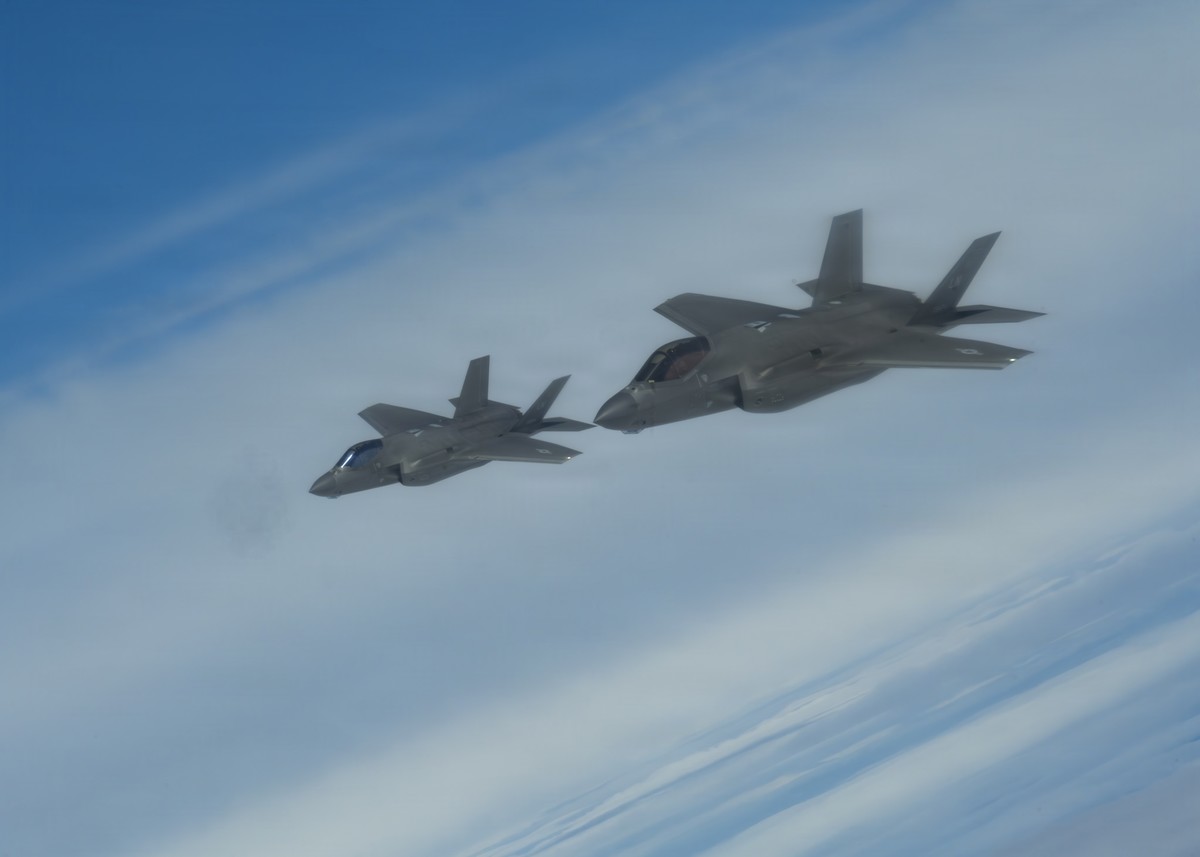
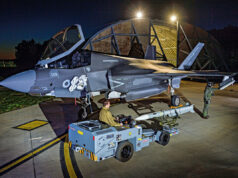
The twelve F-35A aircraft ordered by the UK were not purchased to perform the NATO dual-capable aircraft mission, Air Vice-Marshal Jim Beck has said, with the size and shape of the force that will actually deliver the nuclear role still being analysed.
Speaking at the Global Air & Space Chiefs’ Conference in London, Beck, the RAF’s Director Capability and Programmes, moved to correct a widespread assumption that has followed the 2025 Strategic Defence Review’s announcement that Britain would buy the conventional take-off variant and rejoin NATO’s nuclear mission. “For any clarification, or to avoid any doubt, we did not buy those 12 aircraft for dual capable aircraft capability. We bought them for our conversion units,” he told the conference. “At the same time, we stated we would get back into the dual capable aircraft role supporting NATO. The two are separate.”
Reporting since the SDR has frequently described the twelve F-35As, to be based at RAF Marham, as the aircraft that would carry US B61-12 gravity bombs under NATO’s nuclear sharing arrangements. Beck’s remarks make clear that the initial batch is destined for the training and conversion role, while the RAF conducts analysis to determine what force will be required for the nuclear mission itself. “We’re doing the analysis to understand the size and posture of force that we will need,” he said, describing the two functions as separate undertakings that should not be conflated.
The mission itself, he said, is “very, very specific”: to reintegrate the Royal Air Force into the NATO nuclear sharing framework as a supplement to the continuous at-sea deterrent, not a replacement for it. The move ends a hiatus in British air-delivered nuclear capability stretching back to the retirement of the WE.177 free-fall bomb, the last air-launched nuclear weapon in UK service, and Beck noted that when the decision was announced, “social media went wild,” with most of the reaction positive.
Beck also placed the decision in the context of a deteriorating nuclear landscape, arguing that the number of states with strategic nuclear capabilities is growing while those outside any nuclear framework or partnership continue to shrink, a trend he suggested would be an enduring theme of the future.
Nuclear technology is proliferating more widely, he observed, pointing to expanding dialogue and information sharing between nations on civil nuclear capabilities in regions such as the Middle East, developments he said are here to stay.







They have not been ordered and once the king of the north is in highly unlikely to be.
Other priorities over defence
🤡
When are you going to answer me? You are a Russian proxy, & I’m on your tail, because everyone leaves a trail, comrade cook! I’ve been on to you for a while
Absolute fruitcake who thinks anyone who disagrees with him is a commie! 😂
Even Joseph McCarthy would dismiss you as paranoid.
Exactly 💯
And next month, someone will claim they are to replace the Red Arrows !
All this was stated very clearly at the time that the F35 A purchase of 12 aircraft was for the OCU. Given the maintenance issue in the F35B it makes alot of sense to run the OCU on F35A however this decision makes the most sense in the face of a larger F35A purchase.
It’s also make perfect sense for the UK to join the nuclear sharing role. This is the easiest and quickest way for the UK to gain access to a sub strategic weapon which will deter Russia from using such a weapon against the UK.
The logic seeming to be that Russia may now doubt the USA’s resolve to carry out a nuclear strike against Russia in retaliation for a small nuclear strike on the UK and they may doubt the UK resolve to use a single trident missile with a low yield warhead as a response. A UK F35A carrying a US B61 under NATO command fits inside that gap.
Personally I would like to see us develop our own low yield weapon based on storm shadow but there is no way that’s happening short of a formal removal of the USA from NATO. This is the next best thing.
Along with not purchasing more E7’s, not adding to the UK’s F35 fleet with a large purchase of F35A seems to be the most glaring omissions however from articles today it seems like the door is not closed on either.
F35A remains the best solution for dealing with Russia in any context.
Yep, the OCU role was stated from the beginning.
But the nuclear side is sexier and grabs the headlines, and allowed Starmer to emphasise it in Paris.
I think most assumed, including me, that the 12 would also carry out the nuke role, God knows how with such limited numbers.
I read into this that a second F35A batch might be incoming?
How, with 12 billion on GCAP I’d be interested to see.
I’m crossing my fingers for more F35A’s to be announced. There is no real issue with using the OCU aircraft as part of a nuclear capable squadron but 12 aircraft will not cut it for both roles. Also if we are having a nuclear capable F35A combat squadron it needs to have a bigger role than just B61 employment. It should probably be a UK squadron heavily focused on SEAD/DEAD as well.
Ideally we would be seeing a much larger F35A force as a tornado replacement but that’s not going to happen on top of £12 billion for GCAP.
And on top of the carrier force which really needs about 60 jets to get a war fighting air wing available.
72 A’s for the RAF, the 48 B’s transferred to the FAA. However, the reality is with no F35 order being planned until at least 2030, and GCAP supposed to be entering service around 2035, I can’t see any more F35 being bought at all. I think GCAP will eat the RAF fast jet budget, if it’s to be bought in sufficient quantities.
Is 60 enough plus hybrids for any potential two carrier operations? Accounting for losses attrition wouldn’t something like 72 be better? In any conflict the carriers will want to be fully utilised with back up and the hybrid’s are going to have to be pretty darn good smd plentiful. With the refuelling, are the As and Bs the same? And are they looking at wing tanks which i think the Israelis are with their As?
It is today but in 20-30 years time when the airframes are knackered and only a percentage are airworthy then it becomes an issue. There were not many tornado left prior to them being decommissioned and it’s unclear how many of the 90 odd typhoons could be deployed if needed
No, A’s and B’s do not use the same refuelling system so if we want our F-35A’s to be able to drop their nuclear bombs anywhere other than France or Germany we need to order some enhancements for our voyager tankers to fit them with a refuelling boom. Airbus have already done this is testing but it is an addition cost on top of the fighter aircraft themselves.
Granted the tanker upgrade is something that is needed for a lot more than just F-35A’s. The RC-135s, E-7s and P-8s all use boom refuelling and I think the C-17s do as well but I am not 100% certain of that.
Maybe a purchase of JSM for the As as with many other countries?
I am unsure why you would buy any F35A’s. Surely using that money to purchase more Tempests is the better option? Every pound spent on an F35A is a pound not spent on a shiny new 6th Gen plane. Or am I missing something, Airpower hasn’t been a forté of mine.
Then F35A would allow RAF to prize open access to DNE budget….I’d have thought the play was rather obvious.
Is this to potentially scupper tempest? think I trust Beck less than the Argentine football mgr right now
No way, the RAF want both! Using another budget!
Can’t predict how future governments will respond. Say we had f35A in the RAF and cheaper to buy more, rather than deliver tempest program.
Thankfully Simon that is a very remote possibility for all number of reasons, both military and economic. As much as few will say it, the F-35 is becoming yesterdays design for tomorrows war, it will remain effective for years yet (and is the best among present solutions in many/most scenarios) but would NOT be the preferred overall design if it were decided upon today, far from it indeed. It’s aerodynamic qualities are poor thanks to compromised demanded by its B version (affecting the engine layout too), its range is far too limited, its internal storage is equally far too limited, its engine overstretched and without changes within a few years underpowered despite its size. This could effect the B version especially. The software is, fundamentally due to that feature’s base developmental age, a horrendous problem to update, it’s not modular, weapon incorporation a nightmare and restricts the European weapon sector as a result. The ongoing effectiveness of the aircraft’s stealth qualities (vital to cover its other weaker qualities) is less than certain in next decade and a terrible availability record that many in Congress have said is 50% at best and I believe is even worse in UK service are other defining factors. Add to that the fact its effectiveness relies on direct US support in all manner of ways which is rapidly becoming problematical and transactional at very base levels and worst case scenario might even become non existent in the future and I really cannot see any real likelihood of a threat to the Tempest programme. Yes some of those problems mat hit Tempest, it’s a complex platform, but we are immeasurably better placed to deal with them over the life of the project.
This is only made more the case when to damage relations with our co developers would be so disastrously self harming when the non US World needs to work together as independent Countries covering all manner of defence and economic cooperation just to survive in the face of US hegemony (just see their threats to the ICC and stealing of EU copyright data via the Cloud Act as a guide). Thus it would be potentially lethal to our own defence industry and future capability and cooperation. And if you need more convincing, this is a once in a lifetime opportunity to establish a military version of Airbus in the market for military aircraft sales on a Worldwide basis in light of the failure of FCAS and the now widespread fear of doing business with the US even if they were to be willing to sell the F-47. No there are so many reasons not to commit to F-35 longer term, that something of a tsunami combined with bouts of political madness (never to be disregarded mind) would need to combine to stop it now.
We have to hope tempest succeeds amen
No, RAF wants Tempest.
Problem is managing the OoS dates of Typhoon wrt to Tempest having FOC.
ATM the only solutions are more Typhoon or F35.
RAF doesn’t want loads of F35B as the flying cost per hour is higher than it should be plus % serviceability is poorer than it should be.
Part of the issue is the small F35B fleet: increasing mass would reduce cost per flying hour as well as….increasing mass!
I believe that the F-35A has just c.25% physical parts commonality with the F-35B, and most of that is related to the engine. From a maintenances perspective they are essentially two different aircraft, will all the resulting overheads in terms of spares, tools, procedures, etc. Admittedly there is a lot of similarity from a software and electronics point of view, so a pilot can convert quite easily from the F-35A to F-35B. But overall, I suspect that the RAF has greatly over-egged the benefits and costs-savings in order to delay or even avoid completely buying any more carrier capable F-35B’s. I would love to see most of the F-35Bs transferred to the FAA, and the RAF become primarily a F-35A user. Maybe we will see that in the 2030’s if the Lightening force outgrows Marham and a second base is needed – i.e. Yeovilton .
The F35Bs should have all been FAA to start with. Remember the 1930s. In a nick of time at the end of the decade, the FAA was set up and took up responsibility for naval and seaborn air. Even then they were stuck with obsolete aircraft, but the situation was rectified by the arrival of much more capable planes from the USA through Lend-Lease.
I know; my father flew Albacores on active service with 829 Squadron from St Merryn and off HMS Formidable, and later was first CO of 845 Squadron, bringing the first British sped Avengers (then called Tarpon) across the Atlantic from Quonset Point on HMS Chaser. As a small boy, I was briefed by him all about this!
spec, not sped…..
Great point on the 30s. Despite the investment in carriers RAF influence dominated aircraft design and thus what was available to use, in reality it had no time for naval aviation other than as a base capability with throw away minimally adapted land based designs usually a generation+ behind. It saw it as a threat to its land based capability (probably with some reason mind). Thankfully US designs did save the day just as the carrier was proving its vital role.
Out of interest my partner’s father played a small role in the development of the Corsair for carrier use by the FAA, which showed how desperate they were for effective naval fighters considering the US had already rejected it as unsuitable, indeed downright dangerous in that role. As it proved to be judged the most effective all round fighter of all in post war tests just shows how vital that development was.
RB, your comments mirror what I’ve read. The ‘A’ is a ‘new’ aircraft to the RAF if and when it arrives. A whole different spares inventory required.
I’m clearly not a pilot but given the physical differences between the A and B (wing size, weight distribution) I reckon a pilot will learn as much in a simulator as from flying an A in an OCU and then transitioning to a B. I just wish the RAF and MoD were honest about this stuff.
There’s no point in just 12 x As. If they said all future F35 purchases will now be As and the FAA will take the lead with the Bs, it would look like a ‘plan’.
Being a cynical so an so, I do wonder if there was a transactional element with Trump in this decision. Heard many a suggestion that Trump, as a sop to LM has been operating far and wide using the aircraft as leverage for tariff relief and other economic agreements, though nothing proved from what I have seen. But then the way he does business, with little in writing it probably would not be recorded in any discernible way. Getting us back into the nuclear delivery business might be important to him too which is perhaps why there is confusion over their use with different messages for different ears.
To be fair to Jim Beck he flew tornadoes in Afghan and Iraq and later f35.
Yes, I noted you mentioned this the other day.
Crafty.
Funnily enough when using AI earlier on today to construct how the RAF fleet of aircraft including CCA could look during early to mid 2030’s seemed to show anything up to 24 F35A aircraft. Had not seen that before, interesting..
We’ve often hypothesised regarding F35A procurement for the RAF over the years, first off, they absolutely want it and make no attempt to hide it.
I think the RAF are aiming for a stealthy high/medium force mix of GCAP and F35A by 2040, probably to replace the Thypoon tranche 2 jets.
Its an insurance against any GCAP issues to, F35A will simply replace it if there are any issues.
RAF has a need for 24 fighters to replace the Tranche 1 Typhoons – join the dots
Interestingly, with our part production, F-35A’s are significantly cheaper than new Tranche 4 Typhoons
Adds up doesn’t it.
If we do have a tactical nuke option it would be better to have our own nukes like the French. We do not wish the USA to have a veto on our tactical option. As the USA is now an uncertain partner in NATO it is better to have sovereign deterrent.
This seems to be primarily about saving money. The A model is less expensive than the B model and can be used by the OCU, though it is obviously not carrier-capable. … the rest is likely an afterthought and there is in reality, no money for a restoration of a tactical nuclear role.
The development of a serious tactical nuclear capability would require the investment of time, money and attention, for which the UK has no energy.
Yes Roy which makes sense of my comments above about this having an element of placating Trump to it for some far wider unrelated advantage in another probably trade agreement. So yes it is but isn’t (or much delayed) involvement in nuclear strike.
That said it’s good to at least have the option in the future as World events develop and it will be on Putin’s mind in that scenario though as it might have the opposite effect as a potential deterrence till they are operational one can understand the playing down of this capability.
Jim, I was one of many who got the message that the 12 F-35As would be both for the OCU (in peacetime) and to have a nuclear strike role in General War – the phrase dual-capable was used extensively.
Why has it taken so long to correct the impression that most of us had. Anyway, how does ‘F35A remain the best solution for dealing with Russia in any context?’
I presume you suppose that we would buy a further tranche of A models for the nuclear strike role?
Me too, I read It on here and read most of the comments.
Most people were deffo not positive about this although It Is Stated above In the article that “Social media went wild” with most of the reaction positive. Not sure which segment of “Social Media” he was referring to 🤔
So we have stated the Intention to buy 12 Training Aircraft but not any actual Combat aircraft ?
Something here just does not add up.
Again read my comments above, it’s the only thing about this that makes any sense of the confusion and relative double talk over time, even if it’s purely speculation on my part. But as Sherlock said if ……
The main item the UK could bring to bear in any war with Russia is air power and the F35A is tailor made to deal with the Russian threat. The F35A is the world’s most capable aircraft for SEAD/DEAD operations and Russia has near complete reliance on A2/AD strategy to allow its forces to maneuverer.
That is my ascertain as to why a large force of F35A would be the best thing for the UK to bring to any fight with Russia. The aircraft would also be highly capable in the defence of the UK mainland and a useful component that could be sent to the ME or Pacific if required.
It’s an all round military capability that would be useful in any context we are likely to find ourselves fighting in as opposed to, challenger tanks, chinook helicopters, aircraft carriers or SSN’s, all of which are equally as expensive but more niche roles dependent on certain war time scenarios.
GCAP will take over as King of the Hill before the F-35As get a chance at operations, and the fickle RAF, who haven’t even got the latest Typhoon updates before declaring them history, will do the same to the F-35A less than a decade from now. There will be no more F-35As for the UK as the RAF themselves will get bored of their bauble as a shinier one comes along.
Perhaps slightly unfair Jon…
The RAF have a requirement and a preference for that requirement.
Then the government of the day gets involved and puts that through the politically mandated and MIP meat grinder and the RAF are ‘told’ what they are getting!
Great example, back in the 90’s, the costnof the Tornado F3 modifications package absolutely ballooned. The RAF looked at the options and it turned out they could buy an F16C/D package, with weapons and support for less…
Whats not to like, a muti role combat aircraft avaliable in the late 90’s…. Well, BAE Systems didn’t like it, not one bit, because they thought it would threaten Eurofighter.
So obviously the F3 upgrade was chosen at huge expense, to give us a slightly better interceptor armed with AMRAAM.
The RAF had to wait another ten years to get a austere Thypoon with heath Robinson AtG capability, basically less capable than the F16C it could have had many years earlier.
They had to wait another 6 years before they finally got a Multi role Thypoon.
If the RAF had their way, they would rather have a fleet of 160 F35A and not bother with GCAP.
When does military need trump what the MIC requires mate!
Very true…..
Just to add, I am ‘fully’ behind GCAP, but should it not transpire, then the RAF will get the extremely capable F35A in quantity, so just for once, the RAF won’t be fobbed off with second rate kit, they will see it as a win either way.
If they get CCA right, then the RAF is looking at a bright future out to 2050, with a first rate line up.
Here is hoping your right Jon, but if we end up going to war in the next ten years which appears the danger point then F35A will very much be the aircraft of choice.
It performed amazingly well in Iran against the very same Russian air defence networks we are worried about in Russia.
F35A and Typhoon will also be an amazing combo. I also very much want the UK to have a sub strategic nuclear weapon capability, it’s our biggest capability gap and F35A is the only game in town.
Fair take Jim and Jon. JC makes a perfectly logical point too but probably shows why the armed forces cannot alone make decisions on what equipment they want, there are always bigger pictures to consider and the situation in ten and twenty years and beyond almost as important (on occasions more so) than immediate decisions. F16s might have worked well immediately at that time but would have been a short term fix because bad decisions had been made about what sort of aircraft the Typhoon should have become (especially before Tornado was un-ceremonially cut) and if course cost us millions in export potential as a result. That itself was based upon having the Tornado to do strike.
Could F 16s have done what the F-3 as a long endurance fighter over the expanse of the North Sea was designed to do? Doesn’t seem feasible to me.
Afternoon mate,
In the context of the post Cold war era, it would have been a ‘very significant’ upgrade in capability.
Hypothesising, when we consider the 1992-2001 time frame, we had 7 squadrons of lackluster Tornado F3’s, a sharply focused and dedicated long range bomber destroyer and really rather bloody useless in the post Cold war period.
It made perfect sense for the RAF to dump the F3, dump the Jaguar and replace both fleets with a buy of F16C/D and weapons.
7 squadrons of F16’s would have given the RAF a dog in the fight…
Alas, the MIC obviously got its way, clearly sufficient paper bags of money and non executive boardroom positions were offered and accepted, so we wasted huge amounts of money instead on a structural upgrade and a mild MLU, making the Tornado F3 a ‘slightly’ better aircraft, one where the brave F3 crew had at least a ‘slim’ chance of surviving an engagement with a Mig29 or Su27, via a head on AMRAAM shot, as opposed to no chance and certain death!
The doctrine at the time was quite literally get your missile away asap, then go low and fast and run away as fast and low as you dared!
But hay, the shareholders at BAE Systems were never going to strap themselves into an F3 and get thrown into the fight somewhere in the world, so who cares…
Nothing much has changed.
RAF won’t have GCAP in significant numbers, until at least early 2040’s!
The reality is that Russia cannot match NATO in conventional force terms. As a result, Russian doctrine emphasizes the early employment of tactical nuclear weapons in any peer-on-peer conflict where Russia has a marked advantage over NATO – both in actual forces and given NATO’s near total reliance on American nuclear weapons. So the F-35As main utility would be as a way to enhance UK tactical nuclear capabilities and reduce current alliance on the American nuclear umbrella. But for that to be credible, you would need far more than 12 aircraft, and you would need a fundamental doctrinal shift in the UK. … the UK simply has neither the will nor the money for any of that. In that sense the DIP is really all about “muddling through”.
You would also need a UK nuclear weapon to arm them with.. if the US are not committed then it’s essentially fuck all use carrying a US keyed nuclear weapon.
I don’t disagree but F35A is the quickest solution and doesn’t have to be the only solution. It’s designed to be a deterrent as well not actually used.
Russia might hope America prevents employment by NATO forces but that’s a big hope on Russias part. The use of a B61 by Britain is an easy out for the USA in a conflict. Don’t forget if Russia used a nuclear weapon first everyone from Washington to Delhi to Beijing would be absolutely horrified. Russia would be an instant pariah state. Would any US president including trump go out of their way to revoke Authority from SACEUR (because that’s what they have to do, no nuclear football, NATO already has the codes) and even then you still run the risk that Britain fires its tactical trident weapon or France uses ASMPA-R.
If Russia wants to hit the UK and knock out our tactical nuclear response it then has to use its weapon on RAF Marham and hope the aircraft haven’t moved but it probably also has to take out RAF Lakenheath as well to knock out the B61’s.
Now Russia must hit two UK targets and one is a US airforce base with thousands of America personnel and billions of dollars of equipment and nuclear weapons.
Now Russia’s little threatening nuclear strike on the UK has turned into a multiple targets including hitting the USA. That would probably instantly generate a strategic response form with the USA or UK or both. Also factor in SM3 in Poland and its ability to knock out any Russian ballistic missiles unless it’s a mass volley and Russias picture gets more and more complicated. All these layers add to the deterrent factor.
We get all that deterrent capability just by buying 12 F35A’s which we can also use for the OCU squadron.
The UK has a minimum deterrent force that essentially only seeks to deter a direct nuclear attack on the UK itself. It simply does not have the depth to extend deterrence to other NATO states. Only the US can do that. If the UK wants to build a deterrent capability that is independent of the US then it is going to take concerted effort and massive expenditure. The DIP has demonstrated there is zero will to do that.
Is the thinking that it is sufficient uk nukes can take out Moscow. I think we are in a good space, having the burden of trying to ‘win’ a nuclear exchange is too much. We have a 24 hour 2nd strike deterrence in a world where nukes cannot be uninvented. How we respond to the bear or others is their nightmare.
So would the UK use a nuclear weapon independently to defend Estonia? If not, then it all comes back to the reality that it is the US (and only the US) that ultimately deters Russia. Mark Rutte essentially said as much when he pointed out that Europe has no hope of defending itself without the United States. … and the DIP illustrates that, for its part, the UK has no will to try to take up that challenge.
There are no direct answers, as stands America breaks out the tactical nukes for , uk and France is not public how they respond to Estonian getting a Russian nuke. There’s loads of scenarios maybe the bear damages a civilian nuclear reactor.
My thought entirely it’s even more tied to US political self interest than Trident at least in theory. And if we did develop a uk or cooperative warhead would it work or be operationally usable on a F35 A without US agreement.
The issue with the nuclear strike role is that we only have use of them in a NATO or US alliance context, and in that context, Russia should already be deterred from using tactical nuclear weapons on British forces. If not, then the decision to retaliate with F-35 dropped nukes will not be our decision to make anyway, it’ll be down to the US, and what’s in their best interest to give the go ahead, which is the same regardless of us participating in the nuclear sharing role or not. Because of the limitations on this, I don’t think it is worth the additional costs to participate given that we already are one of only three NATO members out of 32 that bares the expense of providing the strategic nuclear deterrent. We should be looking to sufficiently fund and maintain the commitments we already have before inventing new roles to fritter away our already strained budget.
On the other hand, the reasoning behind employing F-35A for OCU does make a lot of sense.
Tactical bombs if dropped on Russian soil beginning of the end, tactical nukes dropped on Russian forces in friendly territory, well let the Europeans do it, their turf.
In danger on trolling here and apologies, but Q1. Are we to understand the reason we buy f35A is to train pilots for the f35b ? Q2. Conflicting statements: we are not buying f35A to drop gravity A bombs / we want to integrate with nato capabilities. Both statements cannot be true?
Jim beck is NOT clear 2 statements can’t both be true: 1.purpose is not to drop gravity A bombs 2. Support integration with nato nuclear capabilities. Are we meant to believe we buy f35A to train pilots for f35b ? Is that due to higher maintenance on f35b in stovl mode which likely improves in land operations.
His Simon you very much can use F35A to train F35B pilots. The aircraft have near identical controls. Even hover mode is actually controlled by the auto pilot not the pilot.
The B61 employment is not a full time mission. It’s just another weapon the aircraft can use like any bomb. NATO only does one training mission a year with it as far as I know. Having the F35A means the UK can participate in these annual training exercises, that is the deterrent factor as the bombs are already stored in the UK.
“The logic seeming to be that Russia may now doubt the USA’s resolve to carry out a nuclear strike against Russia in retaliation for a small nuclear strike on the UK and they may doubt the UK resolve to use a single trident missile with a low yield warhead as a response. A UK F35A carrying a US B61 under NATO command fits inside that gap.”
That’s a nonsensical argument.
If the USA doesn’t have the resolve to carry out a nuclear strike on Russia then it’s never going to give NATO permission for a UK F35A to carry a U.S. owned B61. The latter would be seen by Russia as a nuclear strike by the USA.
Beck’s arguments don’t hold water or fly. He wants more for the RAF doesn’t want to share with navy regardless if good for the nations defence. He should make his point and resign if he is so concerned.
He should be hauled before the CDS and Minister to explain himself.
Essentially yep, unless we have a sovereign weapon to drop then it’s really pointless… and we don’t.
I disagree, in such an arrangement the US has plausible deniability as the weapons are employed by NATO and not the US. The US would have to go out of its way to stop employment.
It might choose do do this but the easiest oath for the US would be to allow the UK to employ the weapon and the US to stand back and say it was NATO and the UK that did it not us.
In such a scenario Russia would be going out of its way to avoid an all out nuclear attack on the USA.
Again it’s just one more layer of complication designed to muddy the water and detter Russian aggression. It’s one more potential step on the escalation ladder than we suddenly have access to.
It has ZERO plausible deniability.
The bombs are property of the USA.
They are guarded by US servicemen.
They cannot be deployed without permission of the USA.
True but unless the Russians are going to escalate with a nuclear strike on the US it might be willing to chock back that deniability. Mind you by then predictability will be in woefully short supply.
The first word of you answer was sufficient.
The Russians wouldn’t see a strike on the USA as an escalation, they’d see it as retaliation for a strike on Russian with an American nuke.
🤦🏻♂️
The least you can do is learn English
Mr ‘Call Me Bullshit’ is incapable of recognising English when it’s used. 🤷🏻♂️
Not surprised given the incoherent gibberish that he spouts.
🥱🥱 keep on living the dream that you are a superpower comrade, you’re not!! You’ve been caught out, I’ve monitored you on various websites that show what you are! & I’m on to you & one day I’ll get you!
“I’ve monitored you on various websites that show what you are”
So Mr ‘Call Me Bullshit’ is delusional, claiming abilities he doesn’t have. 😂
“I’m on to you & one day I’ll get you”
Makes empty threats he can’t deliver on. 😂
You’re a delusional fascist.
Don’t need to do any ‘monitoring’ to see that.
However, the scenario you’ve outlined also significantly depends on the person sitting in the White House. If they say no, then the F35As we purchase won’t be allowed to do the nuclear response role. If the UK developed its own warhead that could fit in a ASMP equivalent, getting it integrated on to the F35 is going too take too long. So I’d fully expect GCAP to take over that role, as we will have better control over integration priorities than the F35.
“All this was stated very clearly at the time that the F35 A purchase of 12 aircraft was for the OCU”
That is an 100% outright lie. Here’s the original RAF announcement:
“RAF F-35A marks a significant step in delivering a more lethal Integrated Force and joining NATO Nuclear Mission
25 Jun 2025
The RAF will be equipped with twelve new F-35A fifth-generation aircraft, as part of the Security Defence Review. The procurement of F-35A marks a significant step in delivering a more lethal “Integrated Force”, to maintain operational relevance, which deters, fights, and wins.
The F-35A aircraft will be available to fly NATO’s nuclear mission in a crisis, deepening the UK’s contribution to NATO’s nuclear burden-sharing arrangements, and deter those who would do the UK and our Allies harm. It reintroduces a nuclear role for the RAF for the first time since the UK retired its sovereign air-launched nuclear weapons following the end of the Cold War.
This complements the UK’s own operationally independent nuclear deterrent, strengthens NATO’s nuclear deterrence, and underlines the UK’s unshakeable commitment to NATO and the principle of collective defence under Article V.”
“Were not purchased.”
Nothing is being ordered until the 2030s now on current plans.
I think they are looking at delivery in the 2030’s rather than ordering. If you order F35 in the next production lot you are looking at delivery in 2030 or later. I suspect the reason we don’t have more detail is ongoing negotiations with LM.
Hi Jim,
I read somewhere recently that we are in discussions with the JPO but the issues and delays around the technology upgrade 3 and version 4 of the software were the big hurdles.
LM really need to get a grip on these issues.
Out of our 48 F35B aircraft;
1 lost at sea,
3 are with the trials units in the US,
12 have the technology 3 upgrade, which has proved so unreliable that these aircraft apparently spend of the time looking impressive in the hangar! 2 of these 12 are stuck in the Azores as these developed faults in flight and have been there for months was the last I read.
That leaves 32 aircraft routinely available for the OCU and frontline squadrons… goodness only knows what the availability of those 32 aircraft is like, great I bet.
It is a miracle that we ever mange to generate any kind of air wing for the carriers..!
Cheers CR
The 24 on the Carrier were literally scraped together, or so I recall reading on various sites.
Of coarse, there was a lot of Spin attached.
The ones that were stuck in the Azores were fixed and came to the UK at the end of May. Do try to keep up.
We were assured (at the time) that the one lost at sea would be replaced, everyone seems to assume that it didn’t get replaced?
Can’t imagine you are going to order one aircraft so will be added if at all to a new lot. Have we actually confirmed any new orders since then? Fact is until the latest technology 3 upgrades are at least stable and reliable and version 4 software capability at least has a confirmed path to introduction (based upon that) and is on a stable footing there is reluctance to concrete more orders. Juggling all that on one side and timeframes for delivery on the other plays into the hands of delay due to there being limited funds. The US is already taking delivery of aircraft without radars due to these factors.
So… how many of the things does he think we are going to get?
We can build our own cruise missiles, so why don’t we duel role them? They can arm all our fast air, maritime strike & land strike as nuclear capable!
The reason for not having cruise missiles armed with nuclear warheads has been done to death. Its not happening.
I think you missed the point, I said duel role & capable of being nuclear tipped! Any adversary would have to take those missiles into consideration, nuclear armed or otherwise, 12 aircraft they know are or 400 missiles they don’t know if they are or not!
The reason for NOT doing this has been done to death.
If your cruise missiles can carry either conventional or nuclear warheads then as soon as you fire one your enemy is going to assume the worst and respond in kind.
It’s guaranteed nuclear Armageddon by accident.
Exactly. And it has been done to death, and will no doubt again.
Lib Dems proposed it once as an alternate to CASD I recall and it is also not failsafe against a first Strike, regardless of the other reasons you point out.
Well let the US, Russia,China, North Korea etc know, because it seems they don’t agree with you all.
Ukraine certainly plays with not knowing what some of these missiles are tipped with on a daily basis of course. Not being nuclear armed any more obviously limits their options in retaliation, though had they still had nuclear weapons what would have happened, I suspect only an actual nuclear attack would have had a response but difficult to be certain. At what point (talking sub strategic nuclear ballistic missiles), before it hit would you know it was a nuclear weapon? Surely whether the weapon itself is capable of dual use is little different to having a specific similar nuclear missile that’s only nuclear tipped in your arsenal unless pre launch activities that would show a difference, can be detected accurately.
The French are in this situation are they not?
👍 true, what I was saying is ambiguity, saying a nuclear attack sub is in the South Atlantic, as has been done, is an example of deterrence, can they take the chance? Of course not! Same goes with nukes & conventional forces, it’s about escalation, how far are you prepared to go? can you hurt me more than I can hurt you? I was on the last Lionheart & the consensus at that time was full on nuclear within 24hrs, no country would risk that would they? ‘Mr Bullshit’ as I have been christened by an idiot!
John 👍
Bullshit!
Ok, we’ll call you “Bullshit!” From now on.
Strange choice of name. 🤷🏻♂️
How old are you? Are you still at school?
And who’s we? You’re not going to gang up on me are you? I’ll tell my mummy if you do!
So you only want me to call you by your new name of “Bullshit”?
Can do, not a problem.
Other commentators please note that “Bullshit” still wants you to call him “John Mayall” for the time being.
How old are you?
How long since your dementia diagnosis?
I better get my fishing boat out
😂😂😂
He shoots, he scores! ⚽️
Too soon with the football puns.
Strategic nukes deter Strategic nukes, tactical nukes deter tactical nukes, NATO is a defensive alliance so who’s going to fire first?
Strategic nukes deter nukes.
Fixed it for you.
Not really, would it escalate to the strategic level if we were hit with a tactical nuke?
Answer: NO
Would we reply with a tactical nuke?
Answer: YES
There, fixed it for you
That you think the place would be habitable after exchanging tactical nukes is hilariously deranged. Exchanging strategic nukes which just give us a quicker more merciful end.
Low yield tactical nukes would not make everywhere inhabitable though would they (well there is enough military minds esp in a Russia who believe that). The Russians frighteningly tested the use of low yield tactical nukes on the battlefield ahead of their own advancing forces.
Even if that is madness it leaves so much scope for their use for what’s deemed a tactical advantage. We have no idea if they would have been used in Ukraine had China not set it as a red line. I fear otherwise a single low yield nuke immediately killing relatively few may well have been used as a ‘demonstration’ and as part of an immediate call for surrender, would have been a real possibility by now. It would have an immediate effect comparable to Chernobyl explosion or Fukushima (perhaps more/less based on their choice) which I fear would have been perfectly acceptable to the Russian leadership as an alternative to their present situation at some stage. In any conflict with Europe the scope is far greater, somewhere in Central Europe, Finland, Norway the North Sea, Shetlands, I suspect if we have nothing similar to respond with it might be very persuasive especially amongst the European population. Not sure I want to find out.
The bomb dropped on Hiroshima was 4 Kilotons.
The bomb dropped on Nagasaki was 29 Kilotons.
That puts them in the below 50 Kilotons maximum warhead size for tactical nuclear weapons.
Pretty sure the citizens of those cities would have disagreed about the survivability of those tactical nukes.
The USA put a redline on the use of a nuke, by Russia, in Ukraine.
But that would have been the use of a nuke against a country with no nukes.
In a war between two nuclear powers, you’re not growing to get either side accepting being hit by nukes without retaliating with its own. Etc. etc. etc.
Have you ever served in the military?
Oh, forgot to tell monkey brain the bomb dropped on Hiroshima was 20 kilotons, not 4!
Have you ever been committed to a lunatic asylum? Because you’d pass the entry requirements.
Took you a few days to come up with that tirade didn’t it, I’ll ask again, have you ever served in the military? I know you didn’t, because you talk rubbish. I wish we could carry this on face to face but I also know you’re a gutless prick!
Yeah, I agree 👍 but you don’t want to go around beating special needs people up do you?
You are an uneducated, lazy wannabe who thinks he’s better than anyone else. You know nothing about defence matters. A keyboard warrior who is frightened by his fat shadow, that’s why you hide behind a fake name, but you’re used to hiding aren’t you?
I’m retired actually, & you are retarded! You are a wannabe soldier who never had the bottle to join ‘cos you & I know you couldn’t hack it. Now put your dummy back in & be quiet 🤫
The thing is Russia has a ton of duel warhead weapons and France has an airlaunched cruise missile that does not go screaming I’m a NUC as it flys towards the enemy..
Any F35A could be a nuclear strike…
There was once and argument but that’s long gone people now hurl ballistic missiles that could be nuclear or conventional.. a cruise missile is a cruise missile and how will Russia know either way..
An F35A could at any time drop a nuclear weapon…
So not having a nuclear armed cruise missile for miss identification is a steaming pile..
You prevent mistakes by your nuclear doctrine and targeting…
I agree, we are the only nuclear power that doesn’t have nuclear cruise missiles. Even Israel has them.
Shortish ranged cruise missiles employed by Typhoon based on storm shadow would not be a threat that upset the balance of European nuclear chess. But it would give us and anyone in Europe operating Typhoon or Gripen an escalation run not based on the USA or France.
Long ranged ground based cruise missiles in the UK probably would upset the nuclear balance in a way that was dangerous as they could be easily viewed as a first strike weapon.
Agreed. Spock has a point but the same goes for any missiles fired at it if they have free choice, which they don’t in Ukraine. They will convince themselves at some point or use it as a threat because of the theoretical possibility, to use a tactical nuke against NATO especially if it’s EURNATO at some point, its near inevitable they have no moral compulsion not to it’s just tactics to them. And if France has that capability already then should we try to persuade themselves to give it up? Fact is even if we did the Russians, real or as their own excusable first use ever believe that they had done so. And if we did, the Russians would see it as such weakness that they would further convince themselves the use of a few tactical nukes would win them the war and give them effective subjugation of Europe (even without occupying forces) which they desire to achieve, but in reality need to achieve eventually to merely resist a growing China looking to get its lands back and growing ever more controlling of the Russian economy. It’s in reality the only way they could militarily win against NATO or even Europe so if Putin or an equally deranged leader could see their eventual fall to China in the future without that exploitation and nullification of Europe as an independent entity (controlling it directly or indirectly following the Ottoman lessons) at some point that will seem a perfectly logical weapon to exploit to achieve that goal and actually worth the risk. It’s Europe’s Greatest weakness and not having a response won’t make that less likely, far from it indeed.
So you think we should follow Russia’s strategic and tactical doctrines?…
Seriously? 😂
You’re overlooking some major facts:
(a) Russia hasn’t fired any cruise missiles at NATO so we haven’t had to decide yet
(b) You’re assuming Russia will react with the same professionalism as NATO if a cruise missile of unknown warhead type was fired at it.
What I’m saying is Russia will not have a clue what is coming at it anymore anyway. If a number of NATO aircraft intruded into Russia they would have zero idea if it was a nuclear attack or not.. so the conclusion that if we had a wider range of nuclear tipped cruise missiles would likely cause Russia to assume a nuclear attack is flawed… that separation has never really existed.. the only separation is the scale and the fact a strategic counter force or counter value attack is utterly obvious… you fire ballistic or cruise missiles at one or two air bases and some air defence systems.. your enemy will assume a tactical attack and wait to see if its nuclear before ending the world…. You fire ballistic 60 warheads at Moscow and other major Russian cities in one go and yes they will end the world…
In the end it does not really matter what sub strategic system we have as long as it’s sovereign.
, the rules are clearly set when and why you use it and you don’t fire a lot of them at a lot of targets….
If you followed your logic we would not be able to fly any jets close to Russian airspace incase they think it’s a nuclear attack….
And to have an effective deterrent sometimes you need the same weapons as your enemy, even if your doctrine is deterrent…
“your enemy will assume a tactical attack and wait to see if its nuclear before ending the world”
So you’re assuming that they will assume…
🤣😂🤣😂
Well Spock you are making a whole range of assumptions yourself I’m afraid. In the Russian mind I’m afraid they simply are not valid assumptions. No scenario is inevitably a safer one here but I can all but guarantee that not having tactical weapons controlled within Europe will ensure tactical nuclear strikes by Russia within Europe if they aren’t winning a war and very possibly even if they are, if progress is too slow. They simply see it as an advantage to be exploited, if there is no risk that their families or forces may be similarly targeted they will almost inevitably use that advantage. Few believe the US would retaliate to nukes being used in Europe, their retired planners almost invariably admit that. Would Britain or France use a strategic response, that’s a small risk too as it would be the end of Europe and probably Russia as a functioning State. But if we have no tactical weapons and Russia dies they will if necessary use them and claim we did have them exactly as they do with Ukraine. Who is going to argue with them?
“not having tactical weapons controlled within Europe will ensure tactical nuclear strikes by Russia within Europe”
Except there are ZERO such weapons.
Europe does not have control of any tactical nuclear weapons.
I may be making assumptions – though you fail to actually point any out – but unlike you I don’t claim to be a telepath reading the Russian mind.
Russian professionalism? I’ve heard it all now! 🤣🤣🤣
Look who is too thick to understand the concept of sarcasm… Mr ‘Call Me Bullshit’ himself.
All RAF bullshit. Operating a tiny fleet of a different type is totally uneconomic. After all, that’s the reason the RAF chopped the Sea Harriers.
Standard then…..
That was budget cuts, something had to go rather than an actual clean decision
It’s a very different story if it’s used in the OCU.
Rubbish. Operating a small fleet is operating a small fleet.
Forgive my ignorance, but if you had a c50 fleet of Bs, wouldn’t you by Bs to train people on?
Meanwhile the carriers run on with a pathetically low number of F35B’s. Which means that in anything more than a minor conflict, they will be pretty much useless. Oh dear I forgot, they will be full of amazing drones. Doing everything, EW. ASW, inflight refueling, anti shp, combat air, The capabiliities of these mythical machines will be something to behold. We are seeing the demise of the FAA before our very eyes. Accelerated by the machinations of a perfidious RAF.
.
Haha…. It just so happens I’m once again in Portland and currently watching two MCM Autonomous boats (each with 3 crew on board) being followed closely by 3 RIBS (each with 3 crew on board) and a fast raider. They are at the entrance of the Harbour doing very slow manoeuvres not far from the Mounts Bay (and a Tide).
Uncrewed Drones are certainly the future !!!
Oh and off Chesil, there Is Stirling Castle, HMS Middleton, A T23, HMS Blazer, Wildcat and a French work boat, all In close (ish) proximity.
It’s a busy place again today.
You have got good eyesight or very powerful 👓 or a 🔭??
I have both !
But to be fair, all of them were pretty close so easily spotted from my high vantage points.
Always something Interesting to see In Portland.
So what’s the point in them then? Might as well have bought additional F35b for carrier ops optionality.
If you ask me, the whole idea made no sense from the start. Even with the nuclear role, it made no sense.
If the UK is serious about increasing it’s nuclear punch, it ought to increase it’s resilience against US interference and domesticate the weapons & their servicing as much as possible.
If we want more layers, then Tempest plus nuclear tipped Tratus is the obvious modern solution with actual real world utility.
12 x F35A with a nuclear dumb bomb never made sense.
They effectively do give more f35b’s! The b models tied up by the OCU who be available for front line squadrons.
Cheaper and less maintenance intensive for the OCU than the F35B. The OCU aircraft are the ones clocking the most hours and pilot training is being slowed down by aircraft availability.
The aircraft have identical controls systems so it’s easy enough to use the F35A for OCU then just carrier training has to be done in the B model.
We are talkings bings of hundreds of millions of pounds with this move. The nuclear capability is just a free gimmick.
What nonsense. That’s what they were pencilled in for: drop last century gravity bombs. There’s NO point for uk to acquire f35A unless for RAF politics. If perhaps f35b is less reliable / higher maintenance in stovl mode, must wonder if used conventionally on runways those problems ease off.
The maintenance difference between A, B, and C is marginal and to be expected given relative complexities.
My understanding is that it’s the supply chain rather than specific aircraft. The F35A is being bought in much larger numbers and just has access to many more times spare parts.
It seems to be the supply chain rather than aircraft design causing much of the availability issues.
God help us all if a “D” version comes along…LOL
So more As likely
Your looking at this through military beer googles. All the 35A were about was starmer flashing his EU credentials. The top brass have been trying to justify the 35A. Whilst I have never landed anything as glamorous as a F35 I can tell you in basic flying a controlled crash (landing) is the hardest to learn. If I was training to fly a F35 in the RAF I would want to do so on a b because that’s what I would be flying.
Burnham has to find 4.5b of savings I think the 35As will quietly be forgotten. He will look to some other way to please his EU mates.
Buying the F35A – which is a stupid decision – has zero connection with the EU.
Labour did appear to use the f35A as push of some joint effort with Europe. My thoughts at time were just announce nato A bombers use of uk fields for dispersal etc at times of crisis.
Not it was announced as taking on the NATO shared nuclear role, which European countries without nukes (eg Germany) participate in.
Nothing to do with EU.
Many on this sight have a lot more military knowledge than an armchair gunner like me, but when I tell you 35As had nowt to do with UK defence, I’m right. You are also right it was a stupid decision. Where we going to drop these tactical nukes on Russia ?! We know what the Russians would do. They have just sacrificed a million men of their own and have not even blinked. We would be toast.
And they’re free fall N-bombs too. How stupid is that in today’s age? You’d need to fly overhead or close to target and surely attract a visual sighting and hopefully scoot away asap. No glide bomb or standoff type yet, not even a Spear-N? The Tempest would be cleared for nuclear delivery with its range and stealth so is there any real need for F35A for this role and why wasn’t the Typhoon cleared for it ages ago?
And when you claim without any evidence the purchase of F35A was due to the EU, you’re simply inventing a conspiracy theory.
👍
Only reason I can see the RAF pushing the F35A is the hope that HMG will be terrified by the cost of building the replacements to the Dreadnought SSBNs 30 years from now. The RAF then suggests building a UK nuclear bomb for its F35s/Tempest force as a cheaper option than SSBNs.
Long-term inter-service power play.
Beck doing this now as new defence minister Dan Jarvis in place probably has not got full grip yet. Blatant RAF powers play.
Plus Dan Jarvis may be out of a job soon.
Wouldn’t be surprised if Defence hasn’t been promised to Al Carns in return for not running against Burnham.
Depends. I think assuming that the RAF have any ‘long-term vision’ is a leap. Unlike the navy, who are forced into decade-long procurement cycles, the RAF flit between desired capabilities and airframe as they see fit. Typhoon, Harrier, Tornado, F-35B, F-35A, GCAP, et cetera. The investment is rarely given to invest in a single, capable fleet.
The resulting mess is that the UK ends up with one service that can’t adapt, and one service that can’t plan for the future (and one other service that everyone’s given up on at this point).
Anyhow, I doubt that anyone in the MoD will be willing to run our own version of Chrome Dome come 2070, and so I expect they’ll build the submarines.
If we do apply that ‘inter-service rivalry’ lens, the RN are pushing to make a Successor more affordable, given the investment into Barrow and Faslane.
I think there is probably an ethos in the RAF – coming from an RAF family – that it is on par with the ‘Senior Service’ or even replaced it in terms of defending the UK. But even without that, both the RAF and Army must covert enviously the amount that’s spent on the RN controlled nuclear deterrent.
Given the Successor/ Dreadnoughts are already in build I can’t see any of the AUKUS investment being able to reduce their cost.
However, if it’s possible to reduce the cost of Dreadnought’s replacement if either:
• the AUKUS VLS can accommodate the successor missile to Trident (doubtful)
• the AUKUS VLS compartment can be swapped-out in the design for the Common Missile Compartment (CMC) used on both Dreadnought/ Columbia classes.
However given the lifespan of the Dreadnoughts, advances in submarine design will probably necessitate a complete redesign for the next SSBN anyway.
Apologies, when I said Successor, I didn’t mean the previous Successor/Dreadnought, I meant the post-Dreadnought boats that’ll be built from 2070 onwards (and so would benefit from the current expansion in Barrow).
I agree that the RAF sees itself as the preeminent branch of the military. In some regards, it is a defensible position. Of the three services, the RAF have been the most active in recent years. Air defence operations over Qatar, Cyprus and Jordan, and strike operations over Yemen and Syria have positioned the RAF as the British expeditionary branch of choice, whilst the constant cat and mouse between the Russians and NATO in the High North also boosts RAF PR.
That said, the environment for most of those operations has been the aftermath of the GWOT, and the support of American operations. Peer warfare on the continent places the emphasis firmly back upon the RN, particularly the submarine service.
As to the nuclear budget, I’m not too fussed if the branches want to break it open. After it was moved into the funding envelope of the defence budget, it’s been eating funding across the board. Allowing the RN to use it to recapitalise their attack submarine fleet makes sense, and allowing the RAF to fund some of its F-35 purchases through it also makes sense. Being ring-fenced, the government are forced to fund those efforts, for the current cycle.
“allowing the RAF to fund some of its F-35 purchases through it also makes sense”
I don’t think it does. Buying aircraft to act as a taxi service for US nukes is pointless. They’ve plenty of their own aircraft if they want to drop them on something.
If the RAF were really behind this idea they need there heads read. Twelve conventional take off “A”‘s for “conversion” to STOVL fighters. Where is the sense in that? As for a nuclear war role where are they going to be used/ They would need to be based I Germany or the Baltic. All twelve available? I doubt it. To me it would make far more sense to order 30 more “B”‘s so that we can run four proper squadrons of 10/12 aircraft. The Tempest will surely be capable of a nuclear role if we really want to go down that road.
Hi Geoffrey.
“Twelve conventional take off “A”‘s for “conversion” to STOVL fighters.”
That reads that the RAF want to convert A’s to STOVL!
Not the case mate, the Tranche 2 is planned to be, at the moment, 12 A and 15 additional B.
I’m with you, just buy all B and be done with it, unless such a big budget is available that both B and A fleets can be resourced properly.
If the A’s come to pass, they’d be based at Marham with the rest, and either use Marham’s own secure facilities for loading B61 or just operating from Lakenheath up the road in the TTW.
Regards AAR, assume other NATO nations will do the honours, the RAF sure as hell can’t!
Yep. take your point. It’s my age!! 🙃 I meant buy all F35 B’s and have done with it.
No wonder people are confused. The government announced that the next planned purchase of 27 would be changed from all B to 15 B and 12 A, the latter to join in the dual key NATO nuclear capability. The latest speech from Pollard refers to £2b to be spent on F35 to allow UK to re acquire air drop nuclear weapons. £ 2b is roughly the cost of 25 aircraft. So assuming that the nuclear role will be borne by these 12 aircraft is the only possible conclusion to be drawn from the various ministerial statements and speeches.
👍
The purpose of a military aircraft OCU is to teach pilots how to fly an aircraft and which tactics best exploit the performance of their aircraft and its weapons. The F35A is quite a different beast to the F35B when it comes to weapons, performance, the obvious take off and landing difference and potentially the on board software etc. if you are going to use F35A airframes for OCU purposes then you need to purchase an addition 30 or so for a couple of squadrons plus some spare aircraft for maintenance. Having an OCU nuclear squadron is utter nonsense.
The UK should simply join Canada to buy and operate a 2 squadron joint F35A fleet. As I have written in the past, I am of the opinion that the F35 in its current variants is a dead end, low availability, expensive to operate aircraft. The UK should cap its purchases of the B variant at 60 while the RAF join the Canadians (also reluctant to commit to the F35A) to purchase and operate a 2 squadron joint fleet. This way the UK A variant purchase does not become a bespoke low availability aircraft in the UK fleet.
The Canadians are reported to have a legal commitment to about 24 F35As and have paid for 16 of the them. The UK should simply ask to form a joint 2 squadron fleet based in Canada by offering to pay for the last 8 of the Canadian obligation and then share in the operational cost of the fleet. When required a detachment or squadron can be deployed for RAF operations, otherwise the fleet stays in Canada with RAF pilots joining in to meet Canada’s NORAD obligations with the USA. Canada can then purchase the 80 plus Saab Gripen E/F that the Carney government wants to buy.
To think at first the UK government at one point we’re going to buy the F35A which are cheaper than the F35B . This was the Cameron Conservative government at the time.But then had a changed of decision to F35B, has our Queen Elizabeth carriers didn’t have catapulted build into the design . Shame really has F35A has longer range and better weapon load, plus less maintenance time . Has one can imagine better to work on one engine rather than two .
Andrew, we were going to buy F-35C in the early days of the CVN carrier project, not F-35A. The C model is the carrier version, not the A model.
They haven’t been ordered yet, so we haven’t bought them. What is he on about?
They haven’t been ordered yet, so we haven’t bought them. What is he on about?….
Why are more nuclear weapons needed? Aren’t there enough to destroy humankind already? Time the UK found its place in the world, prioritised what little funding it has available and concentrated on the equipment and resources it can afford and needs.
These 12 will be binned in the next up coming chapter of the DiP and/or the next defence review, with the promise to defence chiefs of some new magical autonomous chuff being procured. These, along with many other platforms and systems promised aren’t even planned to be in service until after at least one, possibly two elections. Sorry these are toast, as well as the delayed procurement of the remaining B models!
Agreed.
The clarification seems to qualify that these 12 are absolutely ordered to drop freefall bombs that should never be used and cannot realistically be dropped beyond natos borders.
So the RAF is saying that this expensive purchase is to inform an experiment to decide on a future larger acquisition of f35a….
What a load of stinky poo….
The freefall nuclear bomb deterrent is a totally useless….so now having ordered a pitiful number of f35a as a knee jerk reaction.doublespeak is used to rewrite the history of the decision to order….
Piffle
This could also be a backdoor way for the RAF to acquire their own wing of F-35As.
What is preventing the Typhoon from taking on the nuclear role?
Wallace, maybe Typhoon is not considered as it lacks steath characteristics.
Typhoon isn’t certificated for nuclear. That why Germany is also buying the F35A
B-61 requires a PAL with US keys – Yes, the Cousins will supply a PAL for Typhoon, but only they can integrate it and to do so require 100% access to the aircraft systems source code – and we’re not that daft!
Not too clear, if we only need one OCU because of the small number of aircraft, why we need two Air Arms (actually three)?
I am equally unclear, given that the single hatted sea, land and air capable U.S. Marine Corps is larger than all three of our services combined, why we continue to have three tiny armed services, with all the inefficiencies, triplications and infighting we know that creates.
The weapons bay….
You can’t carry large weapons internally on the F-35B with its short bomb bay.
Want cruise missiles, 2,000lb bunker busters? You need F-35A
F-35A also carries more weapons further
F-35B = Tactical strike
F-35A = Strategic strike
Not with A2A refueling they don’t. And the UK doesn’t have any F-35 longer weapons anyway.
👍 true, what I was saying is ambiguity, saying a nuclear attack sub is in the South Atlantic, as has been done, is an example of deterrence, can they take the chance? Of course not! Same goes with nukes & conventional forces, it’s about escalation, how far are you prepared to go? can you hurt me more than I can hurt you? I was on the last Lionheart & the consensus at that time was full on nuclear within 24hrs, no country would risk that would they? ‘Mr Bullshit’ as I have been christened by an idiot!
John 👍
@Jim states “All this was stated very clearly at the time that the F35 A purchase of 12 aircraft was for the OCU”
That is an 100% outright lie. Here’s the original RAF announcement:
“RAF F-35A marks a significant step in delivering a more lethal Integrated Force and joining NATO Nuclear Mission
25 Jun 2025
The RAF will be equipped with twelve new F-35A fifth-generation aircraft, as part of the Security Defence Review. The procurement of F-35A marks a significant step in delivering a more lethal “Integrated Force”, to maintain operational relevance, which deters, fights, and wins.
The F-35A aircraft will be available to fly NATO’s nuclear mission in a crisis, deepening the UK’s contribution to NATO’s nuclear burden-sharing arrangements, and deter those who would do the UK and our Allies harm. It reintroduces a nuclear role for the RAF for the first time since the UK retired its sovereign air-launched nuclear weapons following the end of the Cold War.
This complements the UK’s own operationally independent nuclear deterrent, strengthens NATO’s nuclear deterrence, and underlines the UK’s unshakeable commitment to NATO and the principle of collective defence under Article V.”