

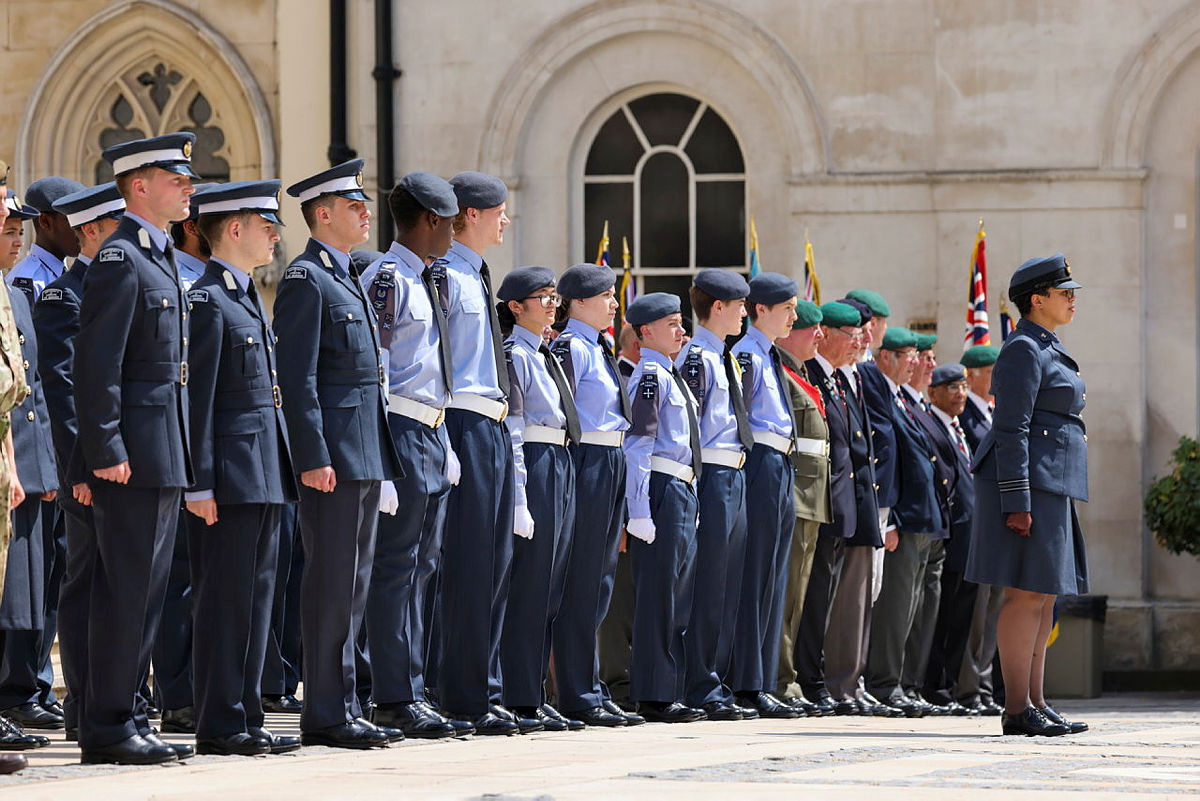
The planned 30 per cent expansion of the UK’s Cadet Forces has been pushed back by five years, the Ministry of Defence has confirmed, with the target date moving from 2030 to 2035 as part of measures the department says are required to increase the rate of Armed Forces transformation.
The confirmation came in a written answer from Defence Minister Calvin Bailey to Reform UK MP Andrew Rosindell, who asked what steps are being taken to increase the number of new cadets joining in 2026. “The Strategic Defence Review recommended an expansion of in-school and community-based Cadet Forces across the UK of 30% by 2030. This timeline has recently been re-set in the Defence Investment Plan to 2035 as one of the measures required to increase the rate of Armed Forces transformation,” Bailey said, as quoted in the answer.
“Nevertheless, we are continuing to invest to expand and modernise the Cadet Forces and improve opportunities for young people across the UK.”
The answer puts a figure on the ambition for the first time in this form, with the 30 per cent increase equating to an additional 40,000 cadets, and confirms that work to determine how the growth will be delivered remains at an early stage, with the department undertaking what Bailey called a detailed assessment of the enablers required to support expansion, described as a key element in setting the foundations for sustainable growth.
The expansion was among the more widely welcomed recommendations of the review, which pointed to the Cadet Forces’ role in social mobility, skills and the connection between the Armed Forces and society, and the Government’s own answer restates the case, citing evidence that participation improves school performance and employment prospects. Delivering growth on that scale though depends heavily on adult volunteers, the perennial constraint on cadet numbers, and the answer confirms a new Cadets Action Plan is in development focused on modernising the cadet experience, providing an attractive offer to recruit and retain volunteers, and ensuring cadets and the adults who support them have the right resources.
The answer also reveals that the first National Cadets Week will be held in October 2026 to raise the profile of what Bailey called one of the country’s most effective youth organisations, showcasing the MoD Cadet Forces and giving thousands of young people the opportunity to discover the cadet experience.








What a pity. I wonder what cost is involved, which presumably is the reason for the slippage?
OT – Update on Sting Ray with acknowledgements to Lisa
The British Sting Ray lightweight torpedo is now entering a critical era of modernization, transitioning from the current Mod 1 standard to the advanced Mod 2 variant. BAE Systems is undertaking this multi-phase overhaul, having secured an initial £60 million design phase followed by a £500 million Demonstration & Initial Manufacture contract with the MoD
While both variants share the same physical 324mm dimensions and baseline pump-jet propulsion chassis, the Mod 2 represents a major technological leap forward
The primary difference lies in the weapon’s processing brain, littoral capabilities, and target profiling. The Mod 1 standard was optimized for deep-water tracking of large nuclear submarines using standard active/passive digital sonar. In contrast, the Mod 2 introduces a “smarter,” high-bandwidth digital sonar seeker powered by advanced microprocessors. This software and hardware upgrade allows the Mod 2 to isolate targets in cluttered, shallow coastal waters where sonar reflections distort tracking. Furthermore, the Mod 2 features enhanced tactical algorithms designed to filter out modern acoustic countermeasures and decoys, specifically targeting ultra-quiet modern diesel-electric hulls, Air-Independent Propulsion submarines, and Unmanned Underwater Vehicles
Future planned deployments for Sting Ray span across the UK’s newest frontline combat platforms. For the Royal Air Force, a £260 million integration programme is underway to fit the torpedo onto it’s nine Poseidon MRA1 maritime patrol aircraft. Initial air-carriage and safe-separation flight trials have taken place in 2026. The RAF will initially deploy the Mod 1 alongside American Mk 54 torpedoes, before seamlessly upgrading to the Mod 2 standard in the early 2030s.
For the Royal Navy, deployment will look different on the new Type 26 and Type 31 frigates currently under construction. Neither ship class features fixed, hull-mounted torpedo tubes in their baseline designs. Instead, they will deploy Sting Ray indirectly via their embarked Merlin HM2 or Wildcat HMA2 helicopters. However, the Type 26’s flexible, modular mission bay leaves room for the future integration of weapon container modules, which would eventually allow the ships to launch Sting Ray directly. Beyond traditional platforms, the Mod 2’s open architecture is also being trialed for deployment from uncrewed heavy-lift cargo drones.
While exact manufacturing numbers remain classified, the procurement pipeline outlines that initial production through to 2032 will centre on refurbishing existing Mod 1 stockpiles to the Mod 2 configuration rather than building entirely new torpedoes. This upgrade approach forms part of a broader 10-year, £1 billion Sting Ray program meant to sustain thousands of frontline sovereign weapons for both the Royal Navy and Royal Air Force through to 2035
OT – Update on Sting Ray with acknowledgements to Lisa
The British Sting Ray lightweight torpedo is now entering a critical era of modernization, transitioning from the current Mod 1 standard to the advanced Mod 2 variant. BAE Systems is undertaking this multi-phase overhaul, having secured an initial £60 million design phase followed by a £500 million Demonstration & Initial Manufacture contract with the MoD
While both variants share the same physical 324mm dimensions and baseline pump-jet propulsion chassis, the Mod 2 represents a major technological leap forward
The primary difference lies in the weapon’s processing brain, littoral capabilities, and target profiling. The Mod 1 standard was optimized for deep-water tracking of large nuclear submarines using standard active/passive digital sonar. In contrast, the Mod 2 introduces a “smarter,” high-bandwidth digital sonar seeker powered by advanced microprocessors. This software and hardware upgrade allows the Mod 2 to isolate targets in cluttered, shallow coastal waters where sonar reflections distort tracking. Furthermore, the Mod 2 features enhanced tactical algorithms designed to filter out modern acoustic countermeasures and decoys, specifically targeting ultra-quiet modern diesel-electric hulls, Air-Independent Propulsion submarines, and Unmanned Underwater Vehicles
Future planned deployments for Sting Ray span across the UK’s newest frontline combat platforms. For the Royal Air Force, a £260 million integration programme is underway to fit the torpedo onto it’s nine Poseidon MRA1 maritime patrol aircraft. Initial air-carriage and safe-separation flight trials have taken place in 2026. The RAF will initially deploy the Mod 1 alongside American Mk 54 torpedoes, before seamlessly upgrading to the Mod 2 standard in the early 2030s.
For the Royal Navy, deployment will look different on the new Type 26 and Type 31 frigates currently under construction. Neither ship class features fixed, hull-mounted torpedo tubes in their baseline designs. Instead, they will deploy Sting Ray indirectly via their embarked Merlin HM2 or Wildcat HMA2 helicopters. However, the Type 26’s flexible, modular mission bay leaves room for the future integration of weapon container modules, which would eventually allow the ships to launch Sting Ray directly. Beyond traditional platforms, the Mod 2’s open architecture is also being trialed for deployment from uncrewed heavy-lift cargo drones.
While exact manufacturing numbers remain classified, the procurement pipeline outlines that initial production through to 2032 will centre on refurbishing existing Mod 1 stockpiles to the Mod 2 configuration rather than building entirely new torpedoes. This upgrade approach forms part of a broader 10-year, £1 billion Sting Ray program meant to sustain thousands of frontline sovereign weapons for both the Royal Navy and Royal Air Force through to 2035.
Any articles coming about the RAFs announcement for boom refueling for Tempest. Jane’s has run an article about it.
Seems to be quite widely reported.
Interesting as the P8; E7; RIVET and F35A all require boom so dual fit was inevitable at some point.
WTF are all the random comments about torpedoes in an article about cadets?
Additional random comment you know how many former Air Cadets were engineers in my last job?
All of us. Though wanted Top Gun got bed packs and people being weird about it. “Nah not for me like. Nerds.” = No RAF thanks.
Did set you up though. Did Navy stuff later and how to (not)behave in a Wardroom which came in handy. 😂
Pathetic! We need to encourage our youngsters and the cadet forces do this by giving confidence and determination. Why delay start building a responsible society with a determination to do better.
Speaks volumes when we apparently cant even afford Cadets.
One of the hundreds and hundreds of cuts implemented to make ends meet, despite HMG grandstanding, due to the money allocated being short of what is necessary.
These are evident in the latest MoD Accounts “losses” chart for 25/26.
Savings, no matter how small, all add up, and there are many.
Cut a Frigate? Or reduce the Cadets, the unsexy cut that most won’t even notice.
What would you choose?
“Cut a Frigate ?
ermm ….. 😁
With no recent news on HMS Kent, and there really should be, no jokes about more frigate cuts please.
and then, there were four !
This is truly pathetic, spending a bit of money on giving kids a bit of structure and some options outside of their normal activities that can / should make better citizens is a no brainer, it’s also good for integrating service leavers back into civilian life.
It says a lot about us that we are not willing to invest in the future..
There over 1M young adult neets. this is about a very poor recruitment process. Additionally are the armed forces actually trying to engage with civilians? Did see some adverts during World Cup.
On top of all this negative defence news related to Labour, scumbag Burnham is set to raise foreign aid back up to 0.7% according to the Independent
To hell with doing what Healey wanted and give into what his far left and muslim backbenchers want instead
I guess Pakistan needs a new airport
What can you expect from an endophobic and pro-Islamic government? I don’t know what you’re surprised about.
Got no camps to go to anyway! All being used for ‘other’ purposes aren’t they🙄
Being a former Air Cadet the phrase that comes to mind is “You reap what you sow” . A relatively small sum now would help produce adults, who even if they didn’t join the armed services, would be more conversant on the need to have a military. An issue whoever is in power will have to address, given the attitude of a lot of younger people.
Exactly it us about education and awareness.
This is an old story and not remotely surprising but why has it attracted so much chat about random subjects? Not surprised if Burn ham actually cuts defence spending rather than raises it.