

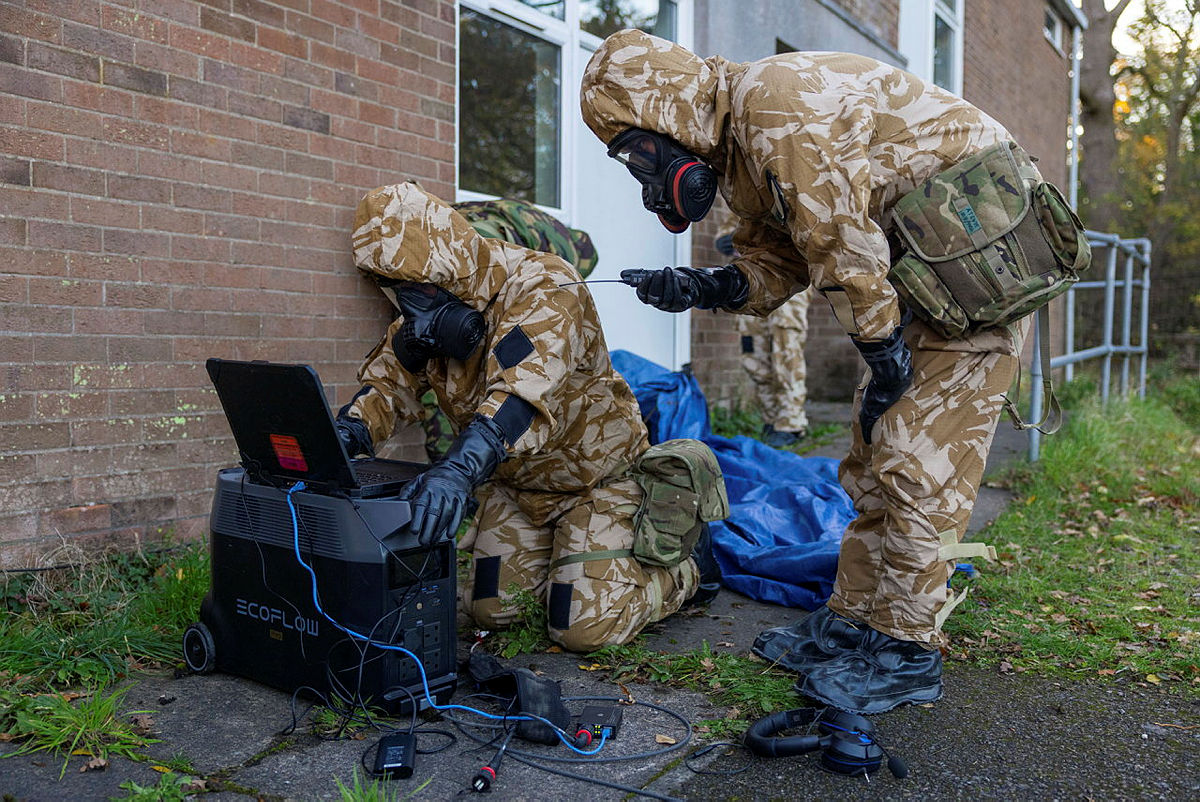
The United Kingdom will test its readiness for international hostilities affecting the homeland through the largest home defence exercise in several decades in 2027, the Government has announced, as part of an acceleration of Home Defence Planning that has included updating the government War Book.
The commitment was set out by Darren Jones, Chief Secretary to the Prime Minister, in the Government’s first Annual Statement on National Resilience to Parliament, delivered alongside implementation reports on the Resilience Action Plan and the Biological Security Strategy. “We have also accelerated our Home Defence Planning, including updating the government War Book and increasing the emphasis on aligning military and civilian efforts if international hostilities affect the UK,” Jones said, as quoted in the statement. “We will rigorously test these plans through the largest UK home defence exercise in several decades in 2027, to ensure that should the worst ever happen, we will always be ready.”
The War Book, the government’s classified playbook for the transition to war, dates in concept from the Cold War, when successive versions set out how Whitehall would respond to escalating crisis and conflict, and its updating reflects renewed attention to homeland defence at a time of heightened tension with Russia. Jones noted that defence spending will rise to almost £80 billion a year by 2029, describing it as “the biggest sustained boost to defence spending since the Cold War,” and said resilient public services and infrastructure are how the country safeguards its national security.
The statement accompanied publication of the latest National Risk Register, the public version of the classified National Security Risk Assessment, which lists 95 risks in total. Jones pointed to the conflict in the Middle East and Russia’s war in Ukraine as having exposed vulnerabilities in global energy supply chains, and warned that artificial intelligence “not only brings huge opportunities, but threats too if it is weaponised by criminals against us,” including novel ways of carrying out hostile cyber attacks against businesses and critical infrastructure. On climate change, he said the risks “cannot be underestimated,” citing record temperatures in May that were exceeded again in June.
A national resilience public awareness campaign will launch later this year to inform the public of what Jones called “the small but important steps they can take to be prepared in case of emergencies and disruption,” whether severe weather or a cyber attack affecting access to power, water, phone signal or food. The Government is also launching a Call for Views on the Civil Contingencies Act 2004, the legislation that has underpinned emergency preparedness across the UK for more than two decades, to gather evidence on where it may need updating, and will publish an Energy Resilience Strategy and a Transport Resilience Strategy later this year.
On biological security, Jones warned that a future pandemic or the use of biological weapons by hostile actors “could permanently scar the UK’s social and economic resilience,” and reported what he described as strong progress over the past year.
That includes the delivery of Exercise Pegasus, the largest Tier 1 pandemic scenario simulation in UK history, the establishment of a Network of National Biosecurity Centres backed by £1.83 billion of investment, Moderna’s new mRNA vaccine manufacturing centre, a Pandemic Preparedness Strategy supported by an additional £1 billion in health protection measures, and the operationalisation of a Biothreats Radar providing real-time data on biological incidents alongside new approaches to monitoring the convergence of AI and biology.











More Government Word Spaghetti….. “Commitments, Plans, Meetings, Strategy, Planning”….. “Biggest Defence Spending since the cold war”.
I bet Number 10 has a Verisure Doorbell Camera anorl.
I have just sharpened a pointy stick so tell HQ I’m ready.
Did you follow the proper protocol in your stick sharpening? A committee must be established to determine which is the pointy end of the stick and that is just the beginning.
How dare you, that’s an unauthorised modification to government equipment! The point is not approved yet. Its supposed to be a stick fitted for but not with a point! (All a bit pointless if you ask me, but what do I know?)
I did ask my MP about this here was its repsonse.
I will need to check the scope of the diversity guidelines. We may also be allowing garden forks, spades and broom handles to ensure balanced representation? We need to ensure diversity, after all. Also, if any houshold item item happens to self-identify as a fork, spade or broom handle, we’ll need to refer it to the relevant quango for a formal ruling. Then again, we as the Government are still looking at how to define a stick, we can’t simply assume that every straight piece of wood is actually a stick. 🙂
Disclaimer: This work is a piece of satire. Any resemblance to actual persons, organisations, departments, working groups, steering committees, quangos, sticks, forks, spades, broom handles, or other self-identifying items, living or otherwise, is entirely coincidental. No wood was stereotyped in the production of this post.
“Equipped for, not with pointy stick” 😉
So how to make sure the House of Commons and the civil service survive? 🎆👽
Just so
Already got my own household resilience plan in place…
I’ve turned my “Van” Into a sort of “Corporal Jones Battle waggon” … I stick my Weapon through the roof and show them my Sausage.
The kit you listed a few months back on here with your “Mobile Operations Centre” was certainly impressive, even the missus was deployed as an anti intruder/Claymore type role I recall!
Mate the starving masses will have that sausage for breakfast if you wave it around…
I understand it is a very small sausage so it wouldn’t go far.
It’s probably a compo sausage, so not only bungs you up, but stops you coming back for seconds.
Now that is a deterrent. UK arms forces with “compo-sausage weaponry”. Leaves foes bunged and buggering off!
You know it makes sense…..cyber and bio update to Hack Green
The War Book container d comprehensive plans for the continuation of government even in the event of an unbridled nuclear war. It was an impressive, well resourced plan. However, many of the facilities that the War Book envisaged being used in the event of WWIII have been sold off, scrapped or turned into tourist attractions during a bout of post-Cold War hubris.
Including the RSGs!
The main bunkers remained, though. The evac of various art treasures also fascinated me at the time.
War Plan UK by Duncan Campbell and the earlier Beneath the City Streets by Peter Laurie are bibles for the time for researchers.
It’ll hardly be Exercise Brave Defender.
Where are the plans to introduce more Civil Defence?
It was reported on here that such a force was being looked into in the build up to the SDSR. Rejected on costs grounds maybe?
Apparently there is going to be new civil defence legislation.. so fingers crossed.
Ah, good.
didn’t they get tied up in knots over whether it should be armed? Didn’t hear any more after that.
It was negligent for past Governments to have allowed the Government War Book to lapse. This very belated rewrite seems to be incomplete. It should cover more than grey zone preparedness or TTW. Grey zone conflict or hybrid warfare against us is already happening and has been for years, so the book is a bit late.
Previously the War Book included Military Home Defence in all its guises but this version seems to dabble – BW is included but seemingly not BMD or Key Point/Vulnerable Point defence against sabotage etc. The exercise is probably going to be very limited in scope.
Saw a report on the BBC news at 6 about it, they were gushing that ministers will be involved.
No shit…..Ministers have been doing that for years with exercises regards CT and UK AD against planes hijacked by lunatics.
Problem is there are no smokers in the cabinet….well not yet… maybe Angie can bring her vape box in lieu of the obligatory fag packet? We had these exercises annually for our office, not sure what they achieved but if there was any way to ensure the departmental creep was a casualty we managed it. They do say there is no such thing as wasted contingency planning but this shower in government will manage it because any lessons learned that cost money will be quietly forgotten.
Let’s hope Professor Neil Ferguson isn’t involved.
Of course “largest” is relative. If you haven’t had one for 30 years, putting the kettle on while you read the home defense manual constitutes the largest exercise in 30 years. It’s like increasing our Sabre buy to “double” our air defense capabilities. Sounds a heck of a lot more impressive than we are buying 6 more.