

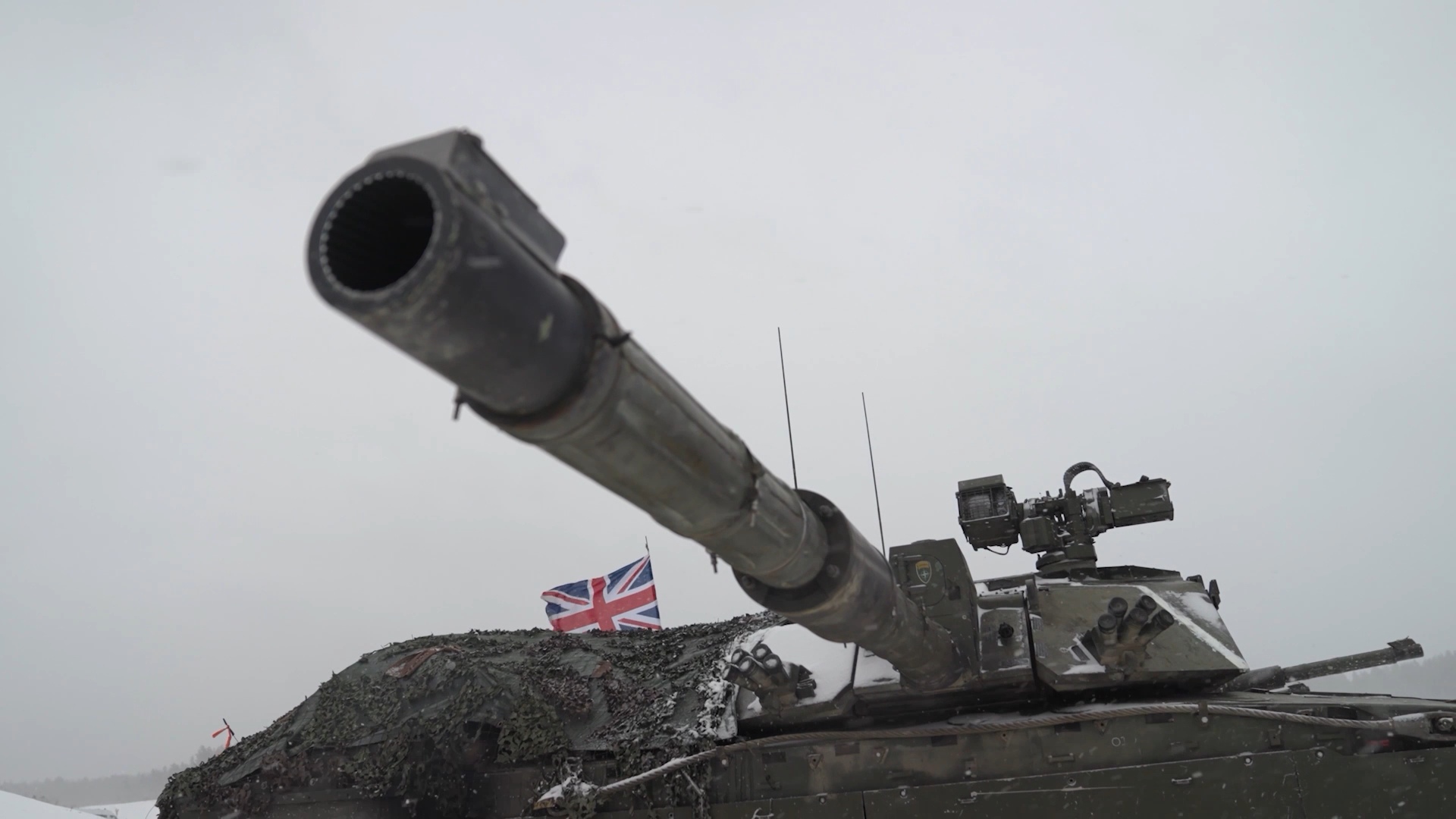
The United Kingdom’s tank-led armoured battlegroup in Estonia is to be replaced by a new Mobile Anti-Armour Force from April 2027, under a defence roadmap signed in Tallinn that will see British troop numbers on NATO’s eastern flank rise from around 800 to 1,200, the UK Defence Journal understands.
The transition, agreed between Defence Secretary Dan Jarvis and his Estonian counterpart Hanno Pevkur, marks the end of the armoured construct that has anchored the UK’s Forward Land Forces presence since British troops first deployed to Estonia almost a decade ago, a formation built around Challenger 2 main battle tanks and Warrior infantry fighting vehicles. In its place comes a force equipped with highly mobile vehicles, advanced weapons and drones, designed specifically for Estonia’s operational environment and integrated within the British Army’s recce-strike concept, which the Ministry of Defence says will be able to deploy, disperse and demonstrate combat readiness more rapidly than a traditional armoured formation.
The decision rests on extensive analysis, say the MoD, including comprehensive wargaming with Estonia, which the MoD also says showed the new force design would deliver greater operational effect than the current armoured presence, drawing on the lessons of a war in Ukraine in which massed armour has proven acutely vulnerable to surveillance and precision strike. The new force is intended to bring greater mobility, enhanced survivability through dispersal and deception, greater endurance supported by equipment stocks positioned forward in Estonia, and increased lethality through integrated intelligence, surveillance and reconnaissance, networked command and control, precision fires and expanded uncrewed systems.
“We are strengthening our deployment in Estonia to defend NATO territory and deter Russian aggression. This new roadmap reflects the realities of warfare today and shows how we are modernising our forces to meet the threats we face,” Jarvis said, as quoted in the announcement. “More people, better mobility, and the latest tech means a more lethal and effective force, ready to fight and win alongside allies.”
Pevkur said nearly 1,200 British soldiers will arrive in Estonia next year “equipped with modern weaponry that is well suited to the local environment,” while an entire British Army brigade in the UK remains at constant readiness to reinforce the country if needed. “Already this year, the United Kingdom will begin pre-positioning equipment and ammunition stocks in Estonia for our reinforcement brigade, enabling the unit to respond significantly faster in a crisis situation,” he said, as quoted in the announcement, adding that the additional troops reinforce “the United Kingdom’s long-term commitment to our shared security.”
The roadmap reaches beyond the force redesign, committing the UK to upgrade its Multiple Launch Rocket System equipment in theatre to be more precise and more lethal, to maintain short range air defence capabilities, and to continue modernising the force through future rotations as new technologies mature.
The two countries will also deepen collaboration on ASGARD, the UK’s battlefield digitisation and targeting programme, which brings together artificial intelligence, digital targeting and advanced command and control to deliver combat effects faster, and the agreement reinforces cooperation through the Joint Expeditionary Force alongside northern European allies.







Given the choice of being defended by armour or drones it appears that Estonia are putting their freedom and faith in drones.
Many here believe, I’m sure, that the decision to head in the direction of drones is based on cost.
I vote we order them in all shapes and sizes in the millions and keep the armour just in case. 🙂
I think based on the real world evidence that Ukraine has halted Russias ability to invade its country. The same Russia with vastly larger Armed Forces, and a defence budget 4 times that of Ukraine. Due, In large to drone warfare. And a big chunk of the Black Sea fleet sat on the sea floor due to drones. Cheap drones defeating large complex assets. Same in Iran. Israel and the US achieved air superiority in a few days. Yet the US is struggling for a way out because Iran is still launching drones and missiles and has held the US to political ransom over the straight of Hormuz.
Ukraine has battlefield depth that the Baltics lack.
Ukraine smaller budget is a bit of a false friend though. Most of russian tech was from soviet era updated under heavy corruption whilst in the years leading up to the invasion the US/UK and others gave a whole load of modern anti tank weapons etc to Ukraine. In numbers that their defence budget wouldn’t have been able to afford.
Had russian gear been properly maintained, troops, troops properly trained, and had they been a little less over confident of success (which they would have been able to achieve if their defence budget had actually been spent on defence rather than lining people’s pockets), Russia would have steamrolled Ukraine in the early days and this trench warfare style with heavy use of drones would never have happened. After all they weren’t that far off achieving it with the mess of a force they had.
Saying that most of Ukraine defence budget also went to corruption pre war so maybe that arguement is a wash.
I highly suspect if and when the Ukraine war ends, that heavy corruption will prevent Russia from rearming at any pace.
That is true. Which shows that training and capability can trump sheer numbers. Despite Russian superior numbers and mass, it counts for little it the tech, training and capability and the logistics chain is seriously lacking. The Russian Air Force on paper is still large, but after 4 years of fighting they still aren’t close to achieving air superiority over the battle space. That alone would have made the ground conflict look very different.
Yeah and if we were trained and properly armed, had decent modern tactics and knew what we were doing and led well we wouldn’t have ended up at Dunkirk. You learn the art of war through hard won experience, theory only goes so far as this war proves. NATO especially the US told Ukraine how to fight a war early on, Ukraine tried it and it mostly failed indeed cost them dear (you can argue the exact reasons forever) and two or three years later Ukraine is telling NATO how to fight a war and it for now at least seems far more valid.
True, Germany had changed the game with their blitz tactics of air and armour and the allies were slow to catch-up.
The saying that armies train for the last war not the next, has a lot of backing from history.
Altough in Russia case it was terrible maintance. If their supply trucks and armour had not got stuck in the mud thanks to poor tires then cold war tactics would have done it. Giving Ukraine time to regroup was ultimately fatal
Plus there is plenty of money being lost through corruption and political influence in the UK, not like we have a huge high morale ground over Russia. A lot better in UK procurement but no where it should be.
I had actually commented to the other half that I did not think they were going to go for it as they were coming INTO the muddy season in Ukraine. My presumption being they had all the historical experience of what that terrain entails for armoured warfare and the inability to go from A-B without sticking to the roads. Perhaps they presumed they could get in quick ………..as it turned out……….not so much. Or of course they just ignored historical knowledge or could not convince the boss man and had to commit at risk of a 9mm to the back of the neck.
I never got why they did go for it. The muddy season was a well known issue and waiting a month would have solved it. There didn’t seem to be a specific reason why it had to be when it was. In corrupt generals have some basic planning skills.
Corruption of Generals, inferior Chinese tyres were bought and saving syphoned off.
Spy, I find your analysis of Dunkirk a bit off. The BEF had the most modern equipment in the army, I have not heard that they were poorly led or poorly trained, albeit time for formation level training had been limited. A problem was being under command of the French so we had limited freedom of action and had to deploy to where we were told to by the French High Command. The Germans had more combat experience and had practiced high speed manouever warfare which enabled them to surround our troops and push them to the coast. The BEF was not forced into a pocket and forced to withdraw by ship because they were a useless force.
Not forgetting Arras. If Arras had been more coordinated with the French, Rommel would have been cut off. The Matilda 2s nearly punched through the German advance. It could have worked if the French tanks had radios. Neither the French or UK side could properly communicate with each other and therefore couldn’t coordinate their attack. Which enabled Rommel to first isolate the French and then deal with the Matildas. A sad case of what might have been!
The problem the BEF faced wasn’t even the French command; or the Germans having more combat experience. The simple fact was the Allied Plan played right into the German plan. The BEF and best mobile French forces advanced into Belgium to pre-empt the Germans only to be bypassed and have to withdraw.
Much of the French Armour in the DLM’s ended up being abandoned, broken down, after they’d advanced into Belgium, and then had to race back to France to try and avoid encirclement.
But also the BEF had issues. It was the only fully mechanised army (though the French Forces in the North alongside it where also fully Mechanised), but it also didn’t have a single Armoured Division. It had an Army Tank Brigade and Divisional Cavalry Regiments (primarily for Recce).
It’s worth remembering that we’ve seen these sort of supposed paradigm shifts before. At the end of the 19th century, the French developed the Jeune Ecole; basically, they said battleships and fleets were outdated and obsolete, and “modern” warfare should be conducted by torpedo boats for defence and fast cruisers for commerce raiding. The logic being that a swarm of torpedo boats could threaten and deter a fleet for a fraction of the cost, allowing more money for commerce raiders (and politicians).
For a time, this had merit. Battleships WERE slow and vulnerable to fast boats and torpedoes, and quick, powerful cruisers provided the long-range and offensive capability that small boats couldn’t deliver. However, what it failed to account for was that specialised capabilities that get countered quickly fail; and lo and behold, simple counters like sticking quick-firing guns on battleships and small craft neutered the Jeune Ecole within a few years, leaving the French scrambling to build battleships again. Torpedo boats remained a useful asset, but they become a part of the fleet instead of replacing it.
I have a strong suspicion that the current addiction to drones may go the same way, but unfortunately we’ve become the French in this example. We’re divesting ourselves of traditional, versatile assets in favour of systems that are inherently vulnerable to relatively simple counters; guns, lasers, and low-cost missiles are proliferating, and nobody has (publicly) found a solution to command and control of drones in denied areas.
Interesting comparison. Invention of the self detonating torpedo = Torpedo boats = “catchers” = torpedo boat destroyers = destroyers which then take over much of the role of the very boats they were designed to destroy and the fleet concept survives. That said even though there is a lot of questions remaining open regarding drones, simply because there is such a nominally convincing historical example it doesn’t mean every example has the same fate and then there is the timeline for when such an asset becomes ineffective. The tank is a good example there, it’s questioned as to its effectiveness today true but it has had a good run despite the fact that in the early days one would have thought technology would have made such a lumbering beast sitting ducks in short measure. It’s very difficult to predict so it’s best to have plan A/B even C where money allows.
I wouldn’t agree that no one has found answers to the denial of control through counter measures. There are presently at least two methods being used, firstly thin wire controlled drones (like many torpedoes) which are presently immune to this interference and for deeper strike drones camera equipped versions that once a target is acquired at distance where there is little to no interference approaches and as interference cuts in and physical control is lost, the camera is smart enough to keep the drone on target. Obviously as Ai develops further, other technologies no doubt introduced and control methods become even more immune to interference (Starlink is already excellent at this) the counter measures and counter, counter measure race will ebb and flow but I don’t at this point see a time when the drone will become ineffective. Certainly in Ukraine there is no indication of this, Ukraine has hit well over a hundred ships in the Black Sea and Sea of Azov this past week or so, put Russian ferries to Crimea out of action and effectively cut Crimea off from the rest of Russia. Russian progress at the front has been almost totally neutralised at great cost to troop losses and equipment and there are now extensive queues at petrol stations in parts of Russia because of so much damage to refineries and movement of fuel itself. So far from seeing an end to drone supremacy it is still heading upwards.
In the end it’s cost that will dictate where this goes, drones work despite high attrition rates so if cost for counter, counter measures gets too high it may lose its advantage over more exquisite systems. But in the end even that latter can be countered and to a great degree their effectiveness have been much enhanced by being used in coordination with drones as distractions and attacks on the very radar facilities that detect them. This is certainly the case with Storm Shadow. I think this is going to be an ebb and flow scenario, in exactly the same way missile technology is, effectiveness will always be there, just not in a linear fashion.
The key lesson I take from the tale of the Jeune Ecole is that one-trick ponies cannot function as replacements for conventional assets. In that example, the issue wasn’t the idea that torpedo boats and commerce raiders weren’t effective tools; the problem was a belief that asymmetric warfare could function as a total replacement for traditional power, and a lack of foresight that counters would be developed that would redress the balance and leave the French fleet neutered to an extent it never recovered from.
Tanks are an interesting study in this. Unlike ships and jets, tanks have a much narrower set of uses; primarily, they provide mobile, direct firepower. Usually, that’s as part of a combined force, although Ukraine appears to also be using them as lone ambushers (anyone feel free to correct me on any of this; modern tank tactics are not my area of expertise).
That is a mission that could potentially be provided by a huge number of other options; big gun-armed IFVs in support of armoured infantry like the Stryker MGS or CV90105, overwatch vehicles like the Brimstone-armed Boxer variant, future wheeled/tracked drones, and likely others. There are still similar obstacles regarding command and control and kill authority when it comes to the automated options, but there is a strong case to be made that the capability offered by a tank could more effectively be provided by a combination of other options now.
To go back to a naval example; battleships weren’t replaced by torpedo boats, but they were ultimately supplanted by aircraft carriers. Instead of trying to do one of the battleship’s missions differently, carriers could do effectively all of their missions better, while also fulfilling additional roles. Sinking ships, sea control, recon, air defence, power projection ashore, ASW, humanitarian aid, etc. In comparison, drones replacing manned platforms is very much on a case-by-case basis.
I would hesitate to use the Ukrainian naval war as too much of a reference point for the future. For one thing, the Russian Navy was in a pretty poor state to begin with, and Ukraine is fighting a defensive war against a direct neighbour; not something most Western nations need to prepare for. More importantly though, this is the birth of real drone warfare, put straight into a trial by fire by the needs of war. Both sides are learning and adapting as they go, but at such an early stage you can’t bank on what is the best long-term counter.
The best historical example I have is the U-Boat campaigns of both world wars. Initially devastating against an unprepared opponent, their effectiveness dropped dramatically once tactics and weapons adapted to them. In both wars, that happened within a few years.
Ultimately, I agree with you; this is very much going to be an ebb and flow scenario, where unmanned systems are going to wax and wane in viability at different scales. Until Skynet seizes control and wipes us out, of course.
I suspect France were just before their time and the tech wasn’t quiet there, as that logic would still add up today. Altough effectively the fast boats have been replaced by planes.
Not fully. Endurance of ships is highly valuable. A plane is not persistant on any choke point.
A ship would be a sitting duck on a choke point in a modern war though. Ships best defence is not being found.
Should it be one or the other though ? Surely they complement each other and would significantly increase lethality if deployed together.
Drones always complement, never replace.
I’ve detailed why I think this is happening further down.
Or another view us the Estonians are putting a brave face on it since we seem to be taking away our expensive stuff, in terms of usage and maintenance, and replacing it with a bunch of cheap stuff.
Well reportedly in recent war games in the Baltic States, small Ukrainian teams with drones have pretty much decimated UK forces so I suspect that may have had an effect on this change.
Reality is russian forces might not be the best trained in the world but they now have serious experience with dealing with drones and things aren’t getting any better for them. If a western army thought it would be able to counter them no problem, it just indicates they are in serious denial.
I am aware, but “British Forces” consists of a single tank squadron and an infantry battalion. Not exactly an invasion force.
It wasn’t. It was a composite force from 4th Light Brigade, mostly on Foxhound.
It remind me of an ongoing debate between tracks and wheel. It seems that wheel is interesting, but not if you want to face a 20mm + flying steel. In France, we thought we could get rid of tracks. Though Ukraine just showed us we need track, just may be not with a 120mm gun, but with a lighter gun rapid firing. At the moment, experiment are done with an AMX 30, no crew aboard, a 20mm turret from Belgium. The chassis can go anywhere, without flipping over. The gun can engage most of what it has to face. It is intended to work with fighter bomber drone. The first fighter drone unit has been created and all regiment will have a drone fighter squadron in 2027. The first drone bombing squadron will be operational by end of 2026. We believe this way of combining assets will recreate an offensive capability. Jaguar, Griphon and Serval still exist to carry infantry and fight. Leclerc still exists. But the constitution of shock troups for assault is rapidly changing. So a cheap tracked chassis is badly needed. All elements on the contact line of an assault troup could be unmanned soon.
I perfectly understand the British high command decision.
I would agree with Robert.. it’s based on the fact that Ukraine has shattered endless Russian formations using drones and that the drone battlefield requires light mobile troops with lots of recce and protection against drones.. the tank is not really a defensive asset and it’s now know that offensive manovering combined arms needs massive levels capability in the near surface battlespace before you can throw it forward…
Essentially the British army does not want to lose its core heavy manoeuvre group in a drone saturated environment it could not survive in…
In the end the British armies core role in NATO is to form the backbone of the ARRC with a heavy and light division.. then when its ready undertake a counter offensive.
I gather that the British Army is moving to three downsized tank regiments each of a nominal 44 Challenger 3s, add in 16 for training, testing and trials purposes and that is it. Every single one of the 148 CR3’s allocated! No reserves, zilch. No wonder the Army wants to keep them in bubble wrap and located as far from harms way as is possible. If 12 Armoured Brigade is ever deployed operationally, it will be as the last resort because every tank it loses for any reason (including accidents) will be irreplaceable.
Basically yes.
I mean if that happens expect the British Army on M1 tanks that US has by the thousands after a 2 weeks of combat unable all Challengers.
Alex, Ukraine MoD stats has it that just two CR2s have been lost to enemy action in Ukraine since Sep 2023. The Russians claim 4. Your predicted casualty rate numbers are unduly pessimistic.
I am sorry but i cannot even comprehend how someone can say something so absurd like that.
Alex, facts are never absurd. From wiki which uses good references:
Ukrainain MoD claim of two destroyed…On 4 September 2023, a video emerged from Robotyne which showed the first combat loss of a Challenger 2 tank.[Ref#48] A 9M133 Kornet missile triggered a fire that apparently cooked off the Challenger 2’s ammunition charges….In August 2024, British news media reported that Challenger 2 tanks were participating in Ukraine’s Kursk Oblast incursion.[Ref#76] During the incursion a Challenger 2 tank was destroyed by Russian forces using a Lancet loitering munition; this would be the second confirmed loss of the tank during the war.
Russian claim of a further two destroyed:”The third Challenger 2 tank was damaged on 14 November 2024 after a Russian FPV drone struck the driver’s position while the tank was parked in a tree line. Russian sources claimed the vehicle was destroyed.[74][77][78][79] A fourth Challenger 2 tank was damaged south of Malaya Loknya during the incursion on 5 January 2025 after a Russian FPV drone struck the gun mantlet. As with the third example, Russian sources claimed the vehicle as destroyed.
Facts with references are better than wild speculation.
If we look at the US and Australian supplied M1s, which I believe totalled 80, over 20 have been destroyed. So by rights, the Chally has “technically” performed better than the M1. Regardless, both types of tanks have so far allowed their crews to escape from a knocked out tank relatively unharmed. Which clearly can’t be said for any T series tank.
The problem is that people who think they know what they’re talking about will look at the casualty rate of multiple combined arms armies across a thousand mile front, and then apply that to two brigades and go “they’ll be gone in two weeks” as if those brigades would be holding the entire front.
I know another solution that let the crew escape everytime. Without mamouth costs… just take your old chassis and put a light turret uncrewed on it…
In France, we did this with an AMX30 chassis. As far as I know, UK use to have Chieftain tank with superior capabilities to the AMX30. May be it is possible to concert them to drone? That could rapidly enlarge UK ground assault forces for cheap…
Math, I had to laugh about your suggestion that we take a few hundred of our old Chieftain tanks, replace the old turret with a new uncrewed light turret and convert the vehicles to unmanned operation.
Half of the 900-strong Chieftain MBT fleet was withdrawn and sold or scrapped when Challenger 1 was fielded from 1983.
The remaining Chieftain MBTs were withdrawn and sold or scrapped when Challenger 2 was fielded from 1998.
We have not had any Chieftain gun tanks in the British Army for nearly 30 years!
I agree with Robert on this. We need to 1. Adapt to the lessons in Ukraine 2. Be seen to be a potent force drone equipped to destroy. C2 and Warrior force wouldn’t last long against a mass of drones sent in by Russia. The battlespace has changed. Russia will think twice knowing they face a professional drone equipped force.
That’s the problem isn’t it, tanks are a liability in a defensive scenario especially one where you are caught by surprise and generally immobile. That would be the scenario in the Baltics if Russia attacked, thousands of drones would be the first you would know about it and a large proportion of your force wiped out and the rest in a confused state and in little position to defend itself let alone counter attack. An effective drone equipped force with light vehicles is a different target entirely and will almost certainly retain its capability to strike at Russian tanks and forces crossing the border. Makes sense to me as the early stages (probably beyond) of any conflict there will be defensive and thus presenting yourself as static targets is madness. Flexibility and nimbleness will be the key and I think recent wargames have demonstrated that.
Spot on. Add in mass casualties and the ensuing casevac nightmare. Retaining C2/ Warrior force as the first line of defence is no longer viable – arguably it’s akin to using spears against rifles
There are definite lessons to be learned from the Ukraine War, don’t get me wrong, but it shouldn’t be used as the baseline for what future war will like like, especially if NATO is involved!
The crucial main difference is that NATO would quickly gain both local air superiority as well as strategic superiority. By allowing air superiority and following a continuous SEAD/DEAD campaign. This would allow ISTAR (Intelligence, Surveillance, Target Acquisition, and Reconnaissance) and ELINT (Electronic Intelligence) aircraft to operate much closer to the front lines. Similarly aircraft such as the MQ-9 in a close air support (CAS) role, would also be able to operate much nearer to the front line.
It cannot be understated what this capability brings to the table. Neither Russia or Ukraine have this capability. The NATO ISTAR/ELINT aircraft will hoover up all RF communications, fingerprinting it, then geolocating it. Similarly battlefield surveillance radar, will record the pattern of life at and behind the front line. Thereby allowing the discovery of logistics hubs, HQs, maintenance areas, along with billeting areas. Making them much easier to target.
It will make a drone operator’s life very difficult, as they won’t be able to continuously use the same launch point. But also, by recording say a week or two’s worth of pattern of life. You can rewind events, to follow the logistic trail. Thereby finding where the drones are stored prior to them be shipped to the front line.
Without the mass threat from drones, manoeuvre warfare can then be employed.
This as well. One thing a lot of us forget is NATO already does a lot of what Ukraine does with Drones with fast air and PGM’s. People also forget that Ukraine uses tanks and IFV’s defensively ALL the time. The use of IFV’s to grab infantry off of positions about to be overwhelmed or just as fire support is a regular feature, and armour in general is used as a firebrigade to backstop Russian advances after the drones and artillery thin them out (you know, like NATO fast air and artillery would).
On the launch points, the Ukranian drone operators currently have a very happy position because the front has been very static, so a drone operator can easily sit in a underground dug out with an antena on the roof and damn the enemy fires.
I would not get rid of land forces… Protect your concentration of force with missiles and drone fighters. After all, land force are the one that will hold the ground.
Couldn’t agree more. What worries me that if at some point an effective defence against drones becomes available, then in the absence of our own armour 1,000 (or 10!) T-72s heaving into view suddenly become a bit of a headache. Better to keep the Challengers just in case, they can’t be replaced overnight, if at all.
Fact is even if a lab/test based overwhelmingly effective defence against drones exists it’s a very different job sustaining that on the battlefield as and where you need it, especially over time and the ebb and flow of the battle goes off the planning map. We have weapons that are far more predictably lethal against tanks (especially in testing) yet tanks are still a useful asset as many argue here.
Think back to the start of the war when Russia had large numbers of tanks, it wasn’t drones that destroyed them it was NLAW / mines/artillery. Drones just add anothet layer to that threat.
Mark, this is a joint decision to change the British force structure, not solely an Estonian one. It will be interesting to see if the AFVs are put into pre-positioned hangars in Estonia or moved back to our hangers in Germany.
Overall I think it’s a good idea tbh. 11 Brigade finds a great use and can happily sit in Estonia either as whole, or a composite BG rotating through, and 3rd Armoured doesn’t loose a Battlegroup from it’s orbat. Win-Win IMO.
So with starmer in the Ukraine today does this mean he’ll give them our Challenge 2s while we make do with drones in Estonia ? We all know what a bad deal maker he is 🙄
No, because Ukraine does not need them. Why? Precisely the reason that Ukraine has learnt that heavy armour is vulnerable and Precisely why we are taking the lessons of Ukraine. It even seems the Russians are learning that massed armour is vulnerable.
I don’t know the figures but I keep hearing that a large proportion of the Abrams have been knocked out and questions are being asked back home. I’m sure before any decision on the Baltics was taken Ukrainian advice and experience played a very important part in it. On this one I won’t criticise the Govt out of hand, unless and until at least evidence to the contrary is known. I was always a little concerned about what a small tank force there might achieve when it’s one of the few places that Russia would have a big initial advantage and heavy reinforcement tough to achieve. I fear it would be more of a flexible holding situation and light effectively armed forces the best defence with air assets doing the heavy hitting.
It has been difficult for the traditionalists to admit that any future campaigns will be led by drones.
Heavy armour has always been seen as a sign of strength designed to impress. All of the evidence in Ukraine suggests heavy armour such as tanks have had thier day on the modern battlefield.
A number of exercises have been held in the UK and US and yes the Ukrainians were involved but were dismissed and not taken seriously. That changed once these exercises were concluded.
One exercise was ENDEXED 2 days into a 7 day exercise ( a complete wipe out.)
Various scenarios were run with the same result heavy armour supporting infantry would lead to a complete and total loss in material and lives.
The US is loathed to give up their MBTs and there is a conviction that technology will come up with an answer that will protect the theatre of operations from unmanned systems.
To be honest this is probably a good call, especially now the British army’s big role in any NATO Russia war is to form the ARRC and punch Russia in the face back.
Part of which isn’t going to be a reserve as it’s going to Estonia.
Be it rhe current 3 Division assets or replacement 1 Division assets, duel hatting is taking place.
If a large chunk of either divisions capability is on the front line in Estonia it isn’t a SACEUR Strategic Reserve, it’s committed.
The Army is now that small in the key war fighting elements.
11 Brigade, as a drone heavy force and doctrinally set up to work with Eastern European TDF’s surely.
I thought of 11 Bde, but read it was 1 Div taking the role from 3, with bulk of 4 Bde still in UK.
11 Bde in their Toyota Hilux and Drone heavy sounds like such but by my understanding they’re LSOF which isn’t a 1 Division asset
So I’d ruled them out as providing the bulk, didn’t think they had 1200 personnel to deploy either.
If I recall at the start of the war, the Ukrainians stopped the Russians the old fashioned way. With Tanks, Artillery and a flood of ATGMs. I think that should not be forgotten. It was after that the drones really came into their own.
The problem is they also attacked with armour, artillery and missiles. Now they attack with drones we need to defend in kind.
There were no drones to use in the beginning
Could we recycle Ten Billion £££’s of useless PPE and turn It Into Drones ?
Just a thought.
(In my defence, I do have these little moments sometimes….)
“Sometimes”. !
Cutting through the spin.
3 UK Division has been providing the EFP in Estonia.
It has CH2 Tanks and Warrior.
CH2 is being replaced by CH3. Just HOW do 3 small Regiments fullfil Estonia, re equip, and form SACEUR Reserve Corps at the same time?
I know Starmer et al care not about the inconveniences of double or triple hatting with their grandstanding but that’s real world reality.
Warrior is going next year, loops, sod all to replace it. NATO wanted the Army to get an IFV, the DIP has zero sign of one.
So Boxer, Ajax mash up it is, when they arrive.
Till then, bye bye British Armoured capability in Eastern Europe, courtesy of HMG.
👏 👏 👏 👏 👏 👏
The commitment is being taken over by 1 UK Division. 1 UK Division has no formations with these assets.
4 Brigade I believe are the Brigade in question, the Black Rats.
3 UK Division is already being robbed of CS CSS formations in the usual rob Peter to pay Paul merry go round as 1 UK lacks assets of all kinds. To be fair, great progress has been made to try and arrange the ORBAT into something that makes an iota of sense for a “Corps” of 2 Divisions!
No wonder it’s all about Drones, we have no Armour in 1 Div to use, 4 Bde has but a Regiment of Jackal.
7 Bde in better shape, but don’t think they’re involved here.
One will note that for all the spin about Drones, Armour remains in the other Battlegroups in Eastern Europe.
This is forced by events of our own making, no matter how much HMG spin it as a futuristic concept.
Estonia has no tanks nor any plans to acquire them. They have CV90 and Patria and deploy ATGMs.
Thinking about the fighting in Estonia in 1941 and 1944, it was, compared with other fronts relatively light in tank use. With over half the country covered by dense forest, armour was generally used in an infantry support role. So perhaps the UK switching to the kind of tactics that Estonia has judged most useful is a sensible choice.
As a keen student of the Russian Front 41 to 45, you’re quite right. Army Group North had little Armour, especially after Barbarossa when Manstein initially pushed towards Leningrad.
Hi DM. If you got any ideas on good books for Army Group North let me know. Regards novels a good one is ‘If this be Glory’ by Hasso G Stachow it’s worth a read if you haven’t already ( author fought in Army North).
Hi mate.
Mine are mostly very general stuff regards the various battles and periods on the Eastern Front. Some unusual ones I bought in specialist book shops back in the day, like unit histories of the Latvian Legion, went on to be the 15th SS Division. North was a bit of a side show compared to AG’s Centre and South, I don’t have anything specifically on AG North.
If you want real detail on some of the day to day fighting from June 41 and into 42 from a Waffen SS perspective, then I’d say “Soldiers of Destruction, the SS Death’s Head Division” by Charles W Sydnor. Although the book details the whole history of the Division, a large chunk is devoted to Totenkopf’s campaign with AG North during Barbarossa, in which it started in reserve, but ended up committed and remained so until it was finally pulled out of Demyansk.
While elements were simply murderous thugs killing Jews, which is where the Division actually came from, the fighting part ended up being fanatically effective, same with the Waffen SSs premier Divisions generally.
Two things can be right at once. We can be pulling tanks back to redeploy 3rd armoured division and we can establish that a a lighter force with more men based around drones and missiles is better to be placed in Estonia.
Any force in Estonia is going to be operating on a very small battlefield with little cover which is drone saturated. Even though Ch2 has proven it can survive multiple drone strikes, logistics will be a nightmare. Any battle in Estonia will be conducted at the very far end of NATO’s logistics chain.
This new force seems significantly more capable in that environment allowing tanks to be returned to a full maneuverer force instead of penny packets scattered in a defensive operation they are not well suited for.
Honestly, I think everyone is overthinking this…
Warrior is going out of service and Boxer isn’t there in strength yet.
We need the C2s back to be converted to C3.
SHADER is drawing down – so 1 Div “need” an operational tasking.
So we’ve situated the estimate so to speak. Light role force, with a kill web and drones. Not actually what we want to defend Estonia, but still achieves the effect of a British force on the Eastern flank as a deterrent (and guarantee of Article 5 being triggered if RUS invades.)
Yes.
Another translation that HMG will never admit to….
“The British Army will be unable to maintain an Armoured Battlegroup in Eastern Europe.”
Whether it wants to or if it is desirable to do so or not.
Seems to be a bit early in drone development to be putting all our eggs in that basket…
I think putting everything into the drone basket is premature. They are fine for a grind it out, static slog, or long range strikes, but at some point you have to assume fire and maneauvre will be necessary. Otherwise we are back to the Maginot line mentality and we all know how that worked out.
Hope some worse case scenario thinking involves having back up hardware like tanks, artillery and helicopters. If the while drone thing is disabled, destroyed and fails the barbarians will be through the proverbial gate and we’ll have to deal with that and with what? Hope there’s adequate c-uas RWS on all crewed vehicles deployed. The Ajax and CR2/3s don’t seem to have this?
*Hope there’s…
Yes but Estonia is building a big wall and massive mine field to generate a grind it out slog. Before Ukraine halted Russia we never expected to hold Estonia. A retreat in contact moving back down the Baltic coast until further reinforcements arrived was likely the plan.
Now with the success achieved by both sides in the Ukraine war through drones and static defence the entire Baltic plan has changed.
The British army force being described here sounds like the extract force Ukraine rapidly deploys to counter any Russian offensive.
The issue is what is the solution. Don’t forget russian and Ukraine armour has been wiped out by RPG/NLAW, mines, artillery. So even removing the drone threat, heavy armour is still highly vulnerable. It’s too slow moving and loud, once you can identify it, it’s going to be highly vulnerable especially in urban warfare where mobility warfare is restricted, which would be any war in Europe.
I agree just sitting targets especially as they have to wait for the Russians to strike first before they can even be used. Trying to hide them will be the biggest task over how they can be actually used.
I think the drone potential is not even realized.
Technology are making comparatively simple air based weapons possible to destroying everything in land and sea.
Air have the great advantage of being the medium with less resistance to movement.
I agree entirely with their thinking . Estonia is only abput 220 miles deep to Russian bprder . That means today Estonia is entirely in no mans land. The only safe place for any army in Estonia will be cities . Every vehicle will be destroyed. Ukraine and Russia currently still have the geographicsl depth to be able to use vehicles. My guess is its only from poland and further west that vehicles will be safe . The 3 baltic states in a precarious position. Fortunately Nato still has a useful Airforce which can swing the balance me thinks
Yes I agree, especially the logistics vehicles. Keeping 14 tanks going in such a small AO would be difficult. It’s going to be a battle on a fixed line fortification as well so there won’t be much for tanks to do.
I’m just going to point out that the Ukranians have been using armoured vehicles to move infantry up to contact in their Zaphorizia counter attacks, far from everything being destroyed.
It was a toothless deployment anyway.
Lifespan of around six hours
It was a trip wire force, there is a difference, much the same as the Berlin brigade in the Cold War. You can’t expose a large force in an area where it can be rapidly cut off. The force is there to generate a political deterrent.
Somebody gets it, thank you. That’s why we have a “battlegroup” there and not an Armoured brigade.
Exactly. What’s the advantage of having heavy armour in a tripwire that you would expect to be rolled over in the case of an invasion? If we were putting enough troops in place to halt a Russian attack until reinforcements arrived, you could argue it was worth it, but we aren’t.
Any attacks on Estonia are likely to start as a greyzone operation creating political confusion. Not something either tanks or drones are capable of repelling. And how do you repel the little green men that follow?
1200 infantry with drones seems like a good way to repel little green men, tanks not so much 😀
A tank parked on a street corner is an underestimated way of conducting coin just saying.
David. Given Russia debacle in Ukraine I think you must mean six YEARS!.
£££££££
should be in addition to not instead.
Baltics may have high GDP / defence figures, but it doen’t amount to much in terms of actual capability. the 3 Baltics can’t even field a single squadron of jets.
Ukraine has made very good use of drones, but they still have many troops on the ground. in fact Ukraine has the largest army after Russia in Europe, and had substantial stockpiles of cold war era equipment while they were awaiting deliveries of much needed NATO weapons.
Baltics simply don’t have much depth in terms of defence and could easily be overrun if Russia wasn’t busy in Ukraine because the distance to their capitals is quite short, unlike Kiev
No so, the Baltics are doing what NATO need them to do, they are concentrating on men and building static defence. NATO has fast jets coming out of its ears. Russia has proven completely incapable of over coming the kind of fixed defence system the Baltics are deploying when that system is supported by drones. Factor in NATO Air power and the Baltics now have a significant chance of holding the line long enough to be reinforced.
FYI it’s about a 30 min drive to Vilnius Lithuania from Belarussia -> 35km
Tallinn Estonia is 2 to 3 hours -> 140km
Riga is about 4 hours -> 280km
those 3 countries are easily geographically isolated by Russia / Belarus / Kaliningrad / Baltic Sea
not sure NATO decision making can respond in minutes, especially if US are not leading the charge … and i have serious doubts Trump would lift a finger other than offer to sell more weapons.
remember that NATO was set up to defend West Germany
the 3 Baltics joined after the collapse of the Soviet regime during the “peace dividends” time and are much harder to reinforce/resupply
Yes but it’s highly unlikely Belarus will get involved and if it does along with large forces employed in Kaliningrad our intelligence services will probably know all about it long before.
Before 2022 we were planning to right off the Baltics and fight from Poland but now we have a very good chance of holding in the Baltics especially with Finland and Sweden onboard and the massive fixed fortifications being built in Estonia. Russia may find it’s pushing all its forces up against a very hard wall on Estonia only to find 45 commando showing up at Murmansk after a quick trip from Camp Viking and the Finish army cutting the road for reinforcements.
Russia is much much more vulnerable than it was in 2022. It simply can’t afford to go all in on Estonia and Belarus probably won’t help. Kaliningrad is on the verge of declaring independence as well and five eyes probably knows what the Russian army is going to do before the Russian army even knows what it’s going to do.
No but the Baltics do have (relative to their size) very large and capable territorial defence forces. They simply put their money where they get the most bang for their buck.
Also funny how you say the distance to the Baltic Capitals is quite short UNLIKE KYIV (not Kiev comrade).
As you said, Talinn and Riga are both well over 100km from the border.
Kyiv is 80km.
Now I understand what AJAX is for. Send them to Estonia push them into a preplanned position, dig them in ( deep). And there you have it worlds most expensive bunker. At least the crew won’t suffer vibration sickness.
I have an uneasy feeling that there is a principal flaw in this new ‘deep strike reconnaissance’ posture being pursued by the army, both in a wider land warfare context and thus intrinsically in the defence of a forward position like our participation in the defence of Estonia.
A deep strike recon light infantry brigade, blunting the enemy build up and manoeuvre plans by long range precision fire and one-way drone attack, may sound like a battle-winning strategy. However, we can assume that the enemy will be doing the same, hitting our forces with long range fires and waves of FPV drones, so we will not achieve any great battlefield advantage. If the enemy is able and willing to take the initial losses, as Russia currently is, then a rushed armoured/ mechanised strike would quickly mop-up any dispersed light infantry units we have in the field.
We basically do not have the mass to meet even a division scale of enemy attack, and we do not have the right brigade ORBAT to handle both the close armoured/mechanised battle for position and the relentless overhead missile and drone attack. To meet the latter,
* A brigade-level formation would need a Sky Sabre.battery for local area air defence
* … plus an organic low-level air defence/counter UAV capability, basically a Stormer replacement that can fulfill both roles like Germany’s Sky Ranger, which sports a 30mm cannon to knock down drones and a Starstreak-type missile to handle low-flylng aircraft, fast drones and helis.
* All vehicles having the basic protection against UAVs by the addition of bolt-on metal mesh cages
* … plus all frontline combat vehicles additionally having automatic protection systems (APS) likethe Israeli Trophy
Being stretched for money, we opt to provide none of the above or, if provided, in too few numbers to signify.
.
Regarding Estonia, 1,200 troops is at least better than 800, but would be far too few to hold out long enough for reinforcements to arrive and deploy. They might avoid encirclement and defeat for 48 hours, while deployed reinforcements would take 7-14 days to arrive let alone fight as a formed brigade. So basically, our NATO ‘tripwire’ is less a deterrent than an invitation to invade. Our stance in Estonia compares unfavourably with the German army EFP units in Lithuania: we are going from a small armoured infantry battle group to a light infantry one they are going from a small armoured infantry battle group to a full armoured infantry brigade. Guess which is the more likely to deter Russian adventurism…
We at least admit our weakness, by announcing that 4 Bde will be the reinforcement bde for Estonia. As 5 of the formations nine battalion-size units are voluntary reserve ones, which will inevitably take some time to equip and deploy, there is the distinct possibility that Estonia and the other Baltic states would have fallen long before they arrive.
It all looks like a cost-saving strategy that no-one really expects to succeed, it is just a token gesture that attempts to mask our weakness of our greatly-reduced army numbers and major equipment shortfalls.
Ukraine has admitted that large parts of its very long 1000 odd kilometres front has basically no infantry anymore. Its entirely guarded by the drone wall that was set up. They don’t have any conventional defence at all. This is the model that would be deployed in any future war with Russia.
It’s not “enitrely guarded by the drone wall.” What Ukraine is doing is putting Infantry in OP’s to stay hidden and call in drones when they see movement. It’s also not a model to follow, it’s not even what the Ukrainians want to do, they’re doing it because they don’t have enough infantry to defend to entire line and maintain reaction forces. It’s a system that is very vulnerable to infiltration attacks and part of the reason why Ukraine lost so much ground in 2025, only finally slowing down now when Russia itself is running low on Infantry.
That’s why we are building a massive wall in the Baltics with huge mine fields, lots of artillery and massive air and missile defences. Estonia will be providing almost all the mass.
Most of the boarder is also a lake and the Russians are completely useless at amphibious assault.
Estonia would be a blood bath for the Russians. It’s terrible terrain for a mechanised assault and they would be surrounded by NATO on all side now that Finland and Sweden have joined. Every chance an assault by them quickly collapses and a counter attack grabs st Petersburg and Murmansk.
Give how unpopular Putin is every chance the residents of st Petersburg are flying NATO flags as liberators.
These “highly mobile vehicles,” are they going to be Jackel’s or something with weather protection as they will be operating in an environment totally different to the sunny places they have been used in up to now.
Have we ordered the New drones?
Will we receive them by 2027?
For boggy Estonia, will we see RM releaved of their Vikings? I suppose we could mount a Drone launching system on the second part of that vehicle.
The announcement does sound like a cost cutting exercise to me. Politicians still not waking up to the situation.
Maybe they will employ more human rights lawyers. That will sort them out.
‘Boggy Estonia’ you may have answered your own questions perhaps.
🤦. Bring back the Stormer pickup, flatbed, ute, or whatever it was called.
Have the Jackel 3 extenda’s been ordered for this?
We also need counter UAV, and I know this is another subject, but what about ballistic missile defense for the UK.
Other countries have it.
Good thinking…for so many different reasons.
‘Hessian screen’ tactics to make a comeback as a force multiplier on forest tracks.
Deja vu all over again…
You wonder why the UK hasn’t already ordered the Boxer Skyranger 30mm like some other sensible countries have? And I think DM mentioned before that the shorad could be CAV based. Why not have both? For Army, RAF and homeland/Port defence regiments?
I do wish we weren’t so convinced about the future of warfare being like it is in Ukraine. Ukraine have an 800 mile front with two huge facing armies that have been essentially static for a year. It so like WW1 with drones. How is a Russian invasion of West Europe going to end up like that? I can’t see it being anything other than very mobile and not very long one way or the other but what do I know. Personally I agree everyone sees drones as cheap and the future of warfare. Exactly how many proper UAVs have the Yanks lost to the destroyed armies of Iran? How many tens of thousands of shaheds have hit Ukraine and to what end as nothing much seems to have changed. Drones by the score have been fired by Iran but to what end? Well I guess we will see who is right one day sadly. President Burnham is speaking in 5 minutes, let’s see if he mentions DIP once? I reckon defence will be at the bottom of the back page of his to do list. he will be hoping everyone in Europe takes up the slack and Trump ends up in clink as soon as next year.
The lessons of Ukraine are slightly different:
‘In operational reality, manoeuvre warfare is not obsolete. Instead, it is being reshaped by a new balance between detection and denial. The contest is shifting toward who can better integrate drones, EW, deception, and armour within combined arms formations. Events on the battlefield in Ukraine suggest that advantage will accrue to forces capable of suppressing enemy sensors long enough to enable movement and mass effects at decisive points. While drones have raised the cost of manoeuvre, they have not eliminated its necessity.’
Dr Oleksandra Molloy March 2026
Estonia is over 50% forest. Forests are not great for manoeuvre warfare. This particular realignment makes good sense. Whatever the approach to defence may be of the incoming PM, there will be no more CR3 in the pipeline so we had better make best use of the finite (and pathetically inadequate) number that we will have.
Meanwhile, Ukraine sacks Federov for maxing out on drone warfare