

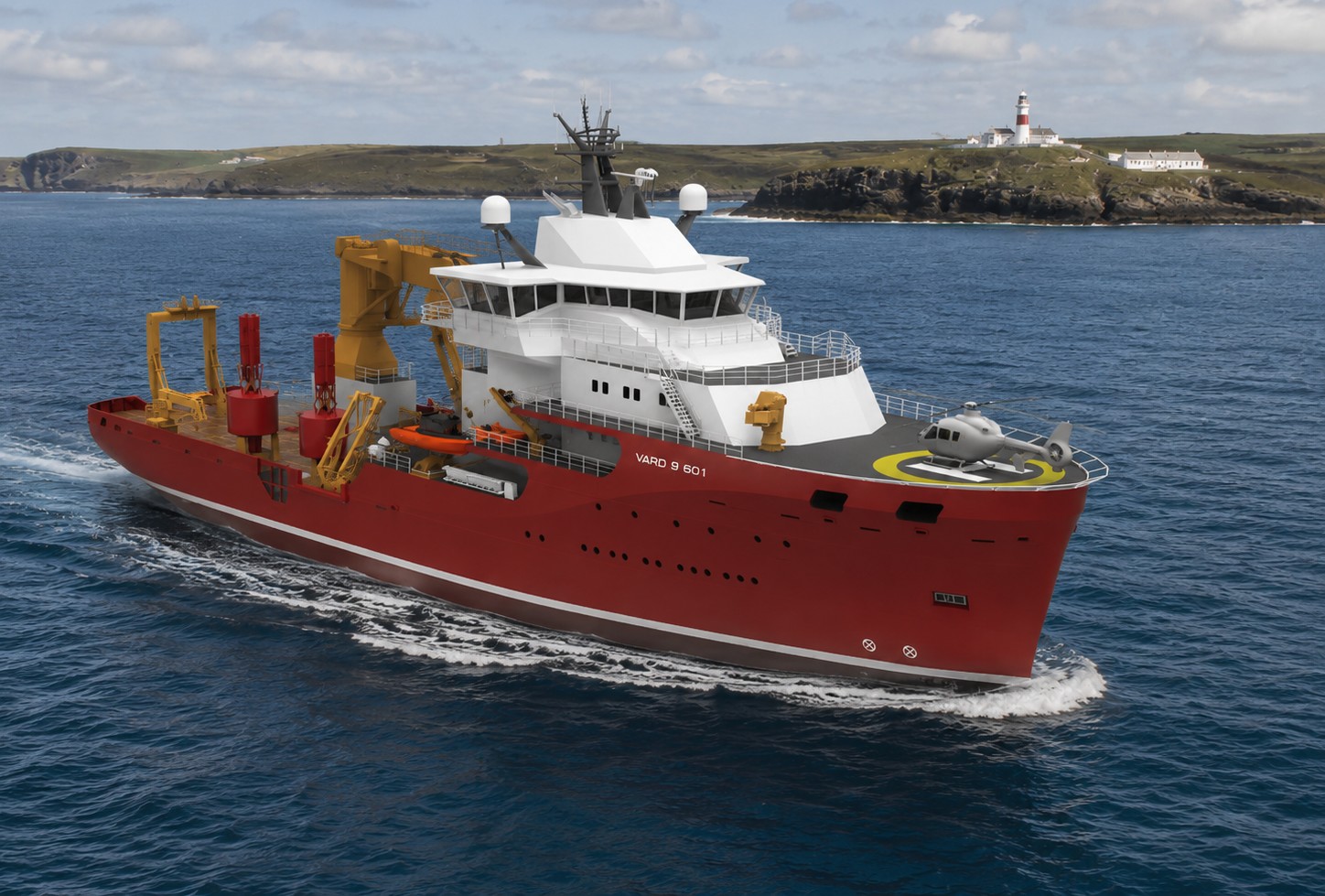
Trinity House, the General Lighthouse Authority for England, Wales, the Channel Islands and Gibraltar, has awarded a contract worth more than €220 million to VARD, the Norwegian subsidiary of Italy’s Fincantieri, to design and build two multi-function buoy and lighthouse maintenance vessels, according to the company.
The award forms part of Trinity House’s fleet renewal programme, with the two new vessels replacing the existing THV Patricia and THV Galatea. According to Fincantieri, the ships will support aids-to-navigation services, hydrographic survey activities and emergency response operations across UK waters.
The vessels will be based on VARD’s 9601 design and will feature hybrid propulsion systems and battery energy storage solutions, alongside modern digital and cybersecurity capabilities. According to the company, the ships will also be prepared for potential future conversion to methanol fuel.
VARD, headquartered in Norway, operates as part of the Fincantieri group, one of the largest shipbuilding concerns in the world, with the Italian state as its principal shareholder. Trinity House, a maritime charity and one of three General Lighthouse Authorities in the United Kingdom and Ireland, is responsible for the provision and maintenance of navigational aids including lighthouses, buoys and beacons across its area of jurisdiction, funded largely through light dues levied on commercial shipping.
The vessels being replaced have served Trinity House for a number of years. THV Galatea entered service in 2007, while THV Patricia has performed a dual role as a working tender and, unusually, offered a small number of berths to paying passengers wishing to observe the authority’s operations at sea. Both ships carry out the physical work of tending the thousands of aids to navigation that mark hazards and shipping channels around the coasts of England, Wales, the Channel Islands and Gibraltar.
The VARD 9601 design underpinning the new ships is a multi-purpose platform, and the contract specifies a build incorporating hybrid propulsion and energy storage as Trinity House moves toward lower-emission operations, with the methanol-ready provision leaving open a route to further reductions in the vessels’ carbon footprint over their service lives.





Part of the T26 offset.
Seems like a reasonable purchase. I would always prefer to see ships designed and built in the UK however with the amount of money the Norweigans are spending with us on Type 26 it would just offset their costs slightly.
Considering it is just two vessel’s I would imagine a UK design and build would likely come in over budget and with substantial delays. This is cost effective and good for International relations.
I wonder what the update is on the MCMV mother ships from Norway. I think it is very optimistic to get three ships for 90 million, unless that is just for the basic ship and then added cost for fitting out ect?
It’s a great offset deal. Norway churns out excellent OSVs at a competitive price, so it makes sense for us to just buy from them as COTS. And Norway come to us for our ASW expertise in return. I suspect the MCMV budget will be uplifted at some point. There’s a number of political reasons why they could have started with a low figure, such as waiting for a wider MOD budget uplift, or avoiding complaints about UK yards not getting the work.
Its a refreshing change to buy off the shelf for such a small order. In addition to it being cost effective I struggle to see any UK yards with capacity anytime soon if we are building 13 frigates plus Norways order, FSSS, MRSS (or whatever it is now called) plus 4 for the Dutch. That should be a healthy order book for UK yards!
I wonder if the RB1s will get replaced or extended in service?
Yes exactly, the major yards have plenty of work. I think it’s likely that the Rivers will be replaced by identical or similar ships to MCMV, there are huge advantages to having a common fleet of standard ships that can be assigned for various different tasks. It’s exactly what the Norwegians are doing. But the RN will probably start with just the three MCM to see how they go, before they make decisions about purchasing more. It’s not like the Rivers are falling to bits so their OSD can be moved either way to suit.
Isn’t there already talks to sell the B1’s to some South America nation?
Probably but they can wait. The market isn’t exactly flush now with decent used NATO standard ships.
I dare say a lot of folks will moan it’s not a British Design and not being built here, but other than dedicated Naval ships nothing is these days. It just so happens that the go to country for this sort of ship is Norway and they have pretty well collared the Market with VARD & Kongsberg designs.
The galling thing is Kongsberg uses derived versions of the RR Marine design company which RR sold to them.
RFA Proteus and HMS Stirling Castle are also Norwegian designs and we will be buying more ships like these, so it’s a good deal and allows Norway to offset part of the £10 Billion buy of T26 Frigates.
RFA Proteus and HMS Stirling Castle are also Vard.
It very likely Vard wont even build them in Norway they’ll build them in their shipyards in Romania or Vietnam do the Fitting out in Norway and they are civilian ships so shouldn’t have anything to do with Type 26 Frigate offset which is nonsense to start with
Hope they dont put electric power points on the deck like Stirling Castle was as kept getting earth’s daily
Liebour government. Give much needed ship building jobs to other countries. Clowns and traitors in power. That’s on top of selling off all our defence companies and tech companies to other countries.
^^^^ Average Reform voter 🤪
grow up.
I don’t believe this has anything to do with the Type 26 offset agreement, which shouldn’t have been tied to this procurement in the first place. Any work that can reasonably be carried out in the UK should remain in the UK.
The argument that this contract is linked to the Type 26 offset agreement also seems questionable. VARD has, in recent years, commonly built hulls at its yards in Romania or Vietnam before completing fitting out and final delivery in Norway. If the same approach is taken with these vessels, the majority of the construction work may not even take place in Norway. Given that these are civilian buoy and lighthouse maintenance vessels rather than naval warships, it is difficult to see how carrying out much of the work outside both the UK and Norway would meaningfully contribute to any Type 26 industrial offset. That makes the “offset” explanation far less convincing.
This appears to be more a question of whether Trinity House is willing to support British shipbuilding. Equally, UK shipyards need confidence that their bids will be be evaluated fairly alongside those from overseas competitors. If yards believe the outcome is already leaning towards a foreign builder, they may decide it is not worth the time and expense of preparing a tender.
As an executive non-departmental public body sponsored by the Department for Transport, Trinity House should be acting in a way that aligns with the Government’s National Shipbuilding Strategy and its stated priority of supporting UK shipbuilding wherever value for money and capability allow.
These buoy and lighthouse maintenance vessels are only around 84 metres long. They are well within the capabilities of UK yards such as Ferguson Marine or Cammell Laird and A&P (Balaena Group), all of which have the facilities and capacity to build ships of this size.
The key question is: did those yards actually submit bids? If not, why not? Did they conclude that they had little realistic chance of success, or were they simply not interested? If UK yards did not bid, was that because they believed the competition would not be genuinely level, or were there commercial reasons for not participating? Without knowing whether British shipyards competed in the tender and how the bids were assessed, it is difficult to judge whether this was a failure of UK industry to compete or of the procurement process itself.