

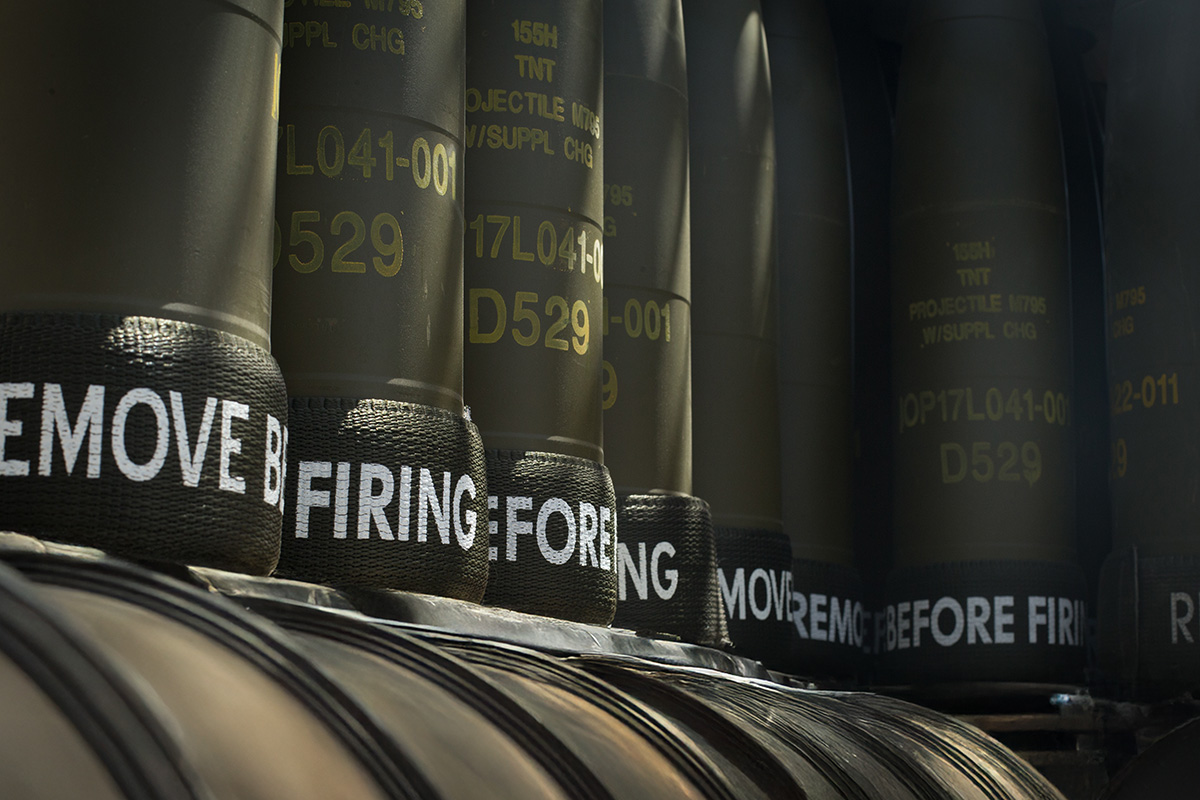
Twenty-two companies, including British small and medium-sized enterprises, are to receive contracts worth up to £300,000 each to carry out feasibility studies on possible sites for new UK factories producing the energetic materials used in munitions, the Ministry of Defence has announced.
The contracts will benefit businesses in England, Scotland and Wales. Energetic materials are the explosives, propellants and pyrotechnics that form essential components of weapons ranging from small arms, artillery and mortars to countermeasures, bombs and missiles.
The studies will focus on which sites could be used to build at least six new munitions factories, part of what the government describes as its work to rebuild the nation’s homegrown ammunition and energetics manufacturing capability. The Ministry of Defence framed the effort as re-establishing a sovereign, “always on” pipeline for munitions supply, citing the war in Ukraine as evidence of the importance of fast resupply of munitions by industry.
Minister for Defence Readiness and Industry Luke Pollard MP said:
“This Government is building the munitions and energetics factories of the future, restoring Britain’s sovereign manufacturing capabilities after decades of decline and helping us to re-industrialise. By investing across England, Scotland and Wales, we are strengthening our warfighting readiness and security of supply, while creating at least 1,000 high-skilled jobs in the future in communities that have long been the backbone of British industry and will be again.”
Each selected company will receive up to £300,000 to develop detailed proposals for manufacturing energetic materials and for the sites at which production could be based. The companies are expected to return their findings by the end of September 2026, with construction of the new factories planned to begin by the end of the year.
On completion of the feasibility studies, the strongest proposals will be offered Front End Engineering Design (FEED) contracts worth up to £5 million each to develop engineering designs for at least six new munitions and energetics factories.
In November 2025 the government announced that at least 13 potential sites had been identified across the UK for the manufacture of munitions and explosives, including locations in Monmouthshire, Cumbria, Dumfries and Galloway, North Ayrshire, Shropshire, Cheshire, Derbyshire, Essex, Worcestershire, Hampshire, Pembrokeshire and Falkirk.
The studies follow £11.1 billion allocated through the Defence Investment Plan for munitions and weapons, which the Ministry of Defence says will increase UK stockpiles and ensure the Armed Forces have what it calls the right “high-low” mix of capabilities to defeat the full range of targets.
Commodore Caroline Dix MBE, Deputy Director Lethality and Protect in the National Armaments Director Group (Materiel), said:
“National Armaments (Materiel) is pleased to announce the award of feasibility study contracts to a diverse cohort of companies, from innovative SMEs to major defence primes and major chemical industry partners. This is a significant step towards rebuilding the UK’s sovereign energetics industry.
“The studies will identify how we can grow UK production of the explosives, propellants and pyrotechnics that underpin military capability, driving investment, innovation and skilled jobs across the country.
“Above all, it will help ensure the Armed Forces have a secure and resilient supply of the munitions they need to fight and win.”












Good news on building plants, but as Ukraine is doing to Russia, they are vulnerable to drone and sabotage. Pro pal communists seem to be able to walk through security.
They will be a target for hybrid warfare. More air defence and internal security is needed
…and judging by the RAF experience in recent times modern fencing might be a useful start.
Feasibility Studies to look like something’s happening and then nothing will be done…
This beggars belief. The need to build 6 new munitions factories was stated in SDR, well over a year ago. I thought the project would be well advanced by now, at least that sites had been identified and purchased.
We now hear after all this time that 22 companies are between them going to spend up to £6.6m of taxpayers money to work out where to build them!
Why 22 companies and not just one? Why not do this activity in-house with MoD personnel? What about the delay now occasioned? When will they be built and up and running? It seems to be 5 or 6 years away for that at best. The big war is meant to be happening by 2030!
Going by the track record of the government’s over the years, it’s no real surprise really.
Someone here told me they’d probably use existing factory sites and just expand.
If that were true, could officials from DIO not just liaise with BAES and find plots of land adjacent to existing sites?
This seems like a feasibility study that’ll be bogged down in red tape and other governments will be doing the building and the paying, rather than Pollard’s “this government.”
Still, around the same time we also had the 7,000 missiles story and I’m sure some still believe that as well.
BAE Systems have already had support to scale up their existing explosives site, and open a new shell factory in Sheffield. But having all our eggs in one basket isn’t great for resilience if things turn hot (or some tourists visiting a cathedral happen to be nearby when a fire mysterious starts)
Hi Waffling, first time I’ve chatted with you.
I agree on resilience. The poster did not name the one site, though, but all of the existing munitions and explosive factories, I understand that there are several.
Hi M8, It’s not all waffle or inactivity, the original RFP was issued to just 13 identified possible suppliers, so it’s a bit of an opening gambit to get industry thinking about it. Defence isn’t just the equipment, logistics, manpower etc it’s also about having robust, flexible industry that can supply equipment, so doing this is a very sensible move.
This stage is to 22 identified possible suppliers to actually fund them to carry out feasibility studies for production contracts, so this process has shaken the tree and 9 extra Apples dropped.
It’s never ceased to surprise me that when a RFP is issued to U.K industry you sometimes get some very unexpected but pleasant surprises. A certain company procurement dept was tasked to get a certain set of very specialised components that had to be manufactured within the U.K and could demonstrate experience of working in a highly confidential environment.. Timescales were very tight and these items had to be made of specific high end metallurgical materials with precise characteristic’s and be machined to very high tolerances.
An RFP was issued to industry with the full expectation that the usual “known” suspects that had been doing this sort of work for decades would be the only replies that could actually do the work.
Imagine the surprise when 6 companies from a completely different field of Engineering replied with excellent proposals and proof that they could do the job. Spookily they were all based in Northants, Bucks or Oxfordshire, some may have foreign names on their products but fact is all if their R&D and manufacturing is UK based and they know how to keep a secret.
Indeed. Make UK Defence issue out quite a lot of requirements for tender, although TBF many of it members are generally already interested in the defence sector, there are others on the fringes
The tech corridor has a lot of interesting things going on in it.
Thing is that the old days of RO needing a mega site to make propellant and fill are over with dynamic synthesis. So a relatively small machine can make the material and for example fill shells – dynamically.
So you could set the fill machine to be linear with the metal forging, machining, bashing line for a super efficient system.
Graham, the MOD reacts with all the speed of a “striking sloth”. Many, many committees will have met just to get to this point!
Ian, I am not unfamiliar with the MoD, as I was an army officer for 34 years and then worked for DE&S as a civilian for 2 years and then in Defence Industry with MoD as a customer for another 2 years.
There are a few examples of fast work, especially in UOR procurement, but there was a time when in-house staff were tasked to do things such as this and could do it quite a bit faster then contractors….not to mention the cost of contracting-out.
Hi Graham, yes, I’m familiar with your background as a REME Officer and value your opinions as well. As an ex REME Technician I’m also familiar with UOR’s but, and it’s a big but, the current MOD is stupendously slow at actually procuring what the guys and girls need.
Cheers
Ian
‘Just one’ was the modus operandi during the post-cold-war years and always lead to one of a very small clique of the usual suspects getting a big fat check and, more often than not, some combination going over budget, behind schedule, and/or under delivering. (Or buying overseas and getting slagged off for not investing locally).
This fits in with how they’ve run things like Brakestop, where they’ve tried to cast the net wider and get some nimbleness in to the projects. It’s not like our main source, BAES, haven’t already received investment to scale up their explosives plant in Gladcoed, or open their new shell factory in Sheffield. Enabling a few different suppliers to enter the market will both make the supply chain more resilient while introducing some price competition.
In related news, Poland’s big supplier of TNT has signed a letter of intent with BAES to open a factory in the UK. I wonder how the roll out of their continuous flow explosives manufacturing is going?
Good luck setting up a new traditional TNT factory in the UK with HSEs explosive specialists….
Continuous flow has huge advantages not least the lack of need for bulk manufacturing and storage of things that go bang.
The Ministry of Duffers and the Treasurettes are hoping the war between Russia and Ukraine will be over in the next few years allowing them to discontinue the build process and save spend.
Saving money on the project is probably an important target in their appraisals or whatever HR tool they use to measure their efficiency.
feasibility studies, says it all in a year nothing has been done, MOD does love its meetings and focus groups and round table talks but not so much doing any thing, A year to come up with a lot of nothing but studies, which have not even been done, at £300 000 each? by 22 groups for 6 sites so 16 studies will result in nothing, just a study.
Martin,
When people look at high stakes national security and demand instant, Hollywood style transformations, like expecting a complex, highly regulated chemical and explosives manufacturing plant to just “be built” overnight because a report was published, it usually stems from a fundamental disconnect with how physical industry actually functions.
Trying to bypass safety laws, chemical containment engineering, environmental zoning, and structural planning to fast track an explosives factory is how catastrophic industrial accidents happen!
Recognising that meticulous groundwork is a legal and physical prerequisite isn’t “bureaucratic defense”; it’s basic common sense. You cannot just pour concrete and mix high explosives. You have to map out 13 potential sites, clear intense environmental and safety zoning regulations … COMAH regulations for hazardous industries, map out chemical supply chains for 9 specific energetic materials, and evaluate 22 different industry proposals to ensure public money isn’t wasted on a design that fails.
So, taking a year to allow various individual companies to conceptulise their plans, formalise and present them, Then allow the MoD time to filter down the broad concepts and fund feasibility studies is standard industrial speed for heavy infrastructure, why? … because they are adults.
When the SDR set out the plan, the actual phases/words/explanations used were always mapped out sequentially …
Phase 1- Scoping and site selection. Months 1–12. Figuring out what types of explosives are needed most and identifying potential geographic plots.
Phase 2- Feasibility and engineering design. Months 12–24. The exact stage happening right NOW with the 22 companies, moving toward ‘Front End Engineering Design’ where the exact specifications, blueprints for the factory layout, chemical piping, blast-mound positioning, and safety containment systems are detailed. Nailing down firm cost estimates, material sourcing, and specialized equipment orders so there are no massive financial surprises once digging starts. plus finalising the heavy duty safety, environmental, and zoning documentation required to legally build and operate a facility that handles hazardous materials.
Phase 3- Planning permission, groundbreaking and construction. Years 2–4. Pouring massive amounts of reinforced concrete, installing specialized chemical processing units, and passing intense safety inspections.
Phase 4- Commissioning and safe batch testing. Years 5–6. Actually firing up the chemical mixing lines, verifying the quality of the explosives, and ramping up to full-scale mass production.
So while the public statements sound like factories should ‘magically’ appear within a year of an announcement, the hard engineering reality is that a greenfield high explosives plant takes about half a decade to go from a government policy document to churning out live ordnance. It’s not rocket science to understand these basic premises.
i know, but a year and NOTHING only now saying they will pay 22 groups to do studies for 6 sites, a year of what? meetings? And not expecting site built , and working in a year or even under construction but not in a year, no rush then,
ffs…
Whilst there are formidable regulatory hurdles to overcome this one year phase of paper shuffling isn’t essential to that.
This is peace time mentality speed not wartime mentality.
Safety rules don’t need to be broken to do things faster – the will needs to be there.
Something like this isn’t just about having the technological where with all to produce a munition. It’s also about getting the raw materials in and the end product out and where it is supposed to be. It might be more efficient and cheaper, to convert an existing location to produce, for example, bullets because it has excellent lines of communication (i.e. roads and railways) rather than upgrade an existing plant expansion might be time consuming and costly. As Rodney points out, something might unexpectedly come out of left field that is perfect for our needs.
What I think might be a good idea, is that we have a couple of facilities that has the capability to produce on a war footing. i.e lots of bullets and/or artillery rounds, but work on a fallow field principle, starting up and shutting down elements of the facility as needed. Maybe even on a rotational basis. The maintenance could be Govt subsidized but it will avoid the panic of not being able to maintain our pipeline and it can be quickly expanded in times of need.
Then the mothballed plants are not brought back into action because of in-year savings and the Albion-Bulwark story.
If certification of an explosives site is not continuous it is a nightmare as it would need to be decertified to the current standard not that standard at point of build.
During COVID we had no vaccine manufacturing capacity. Then £40M was avaiable, then cancelled when they thought it was all over. Now vaccines are made in India. Remember when we made TV’s and washing macines. Most goverments seem to prefer coffee shop jobs for work these days.
Rob whitrow,
Today, vaccines used by the NHS and distributed in the UK come from a mix of domestic production sites, major European hubs, and global networks, rather than a single source like India.
While the UK lost a vast amount of high volume vaccine manufacturing capacity over the late 20th century, it still retains key high tech footprint … Today the UK has moved closer to having a semi-decent capability, primarily through a major structural shift toward mRNA technology rather than traditional bulk vaccine bottling.
The turning point for domestic capacity is the Moderna innovation and technology centre at the Harwell science and innovation campus in Oxfordshire, this facility features a dedicated ‘Drug Substance’ manufacturing plant capable of producing 100 million doses annually under normal operations, scaling up to 250 million doses per year in a declared pandemic emergency. Tied into a 10 year strategic partnership with the UK Health Security Agency, it supplies commercial mRNA vaccines directly to the NHS seasonal programmes … such as updated COVID-19 formulations.
The UK finally possesses a state-of-the-art, sovereign anchor for advanced mRNA surge manufacturing. Although, traditional mass market viral vector and global routine vaccine supplies still rely heavily on international networks … such as GSK’s footprint in Belgium or production hubs in India and the US.
Your failling to understand basic economics 101 vis-à-vis why TV’s and washing machines are no longer made in the UK is beyond my scope.
There was quite a bit of room on BAE Radway green, sadly from what I can tell there been quite a bit of building work gone on and BAE also don’t own the site