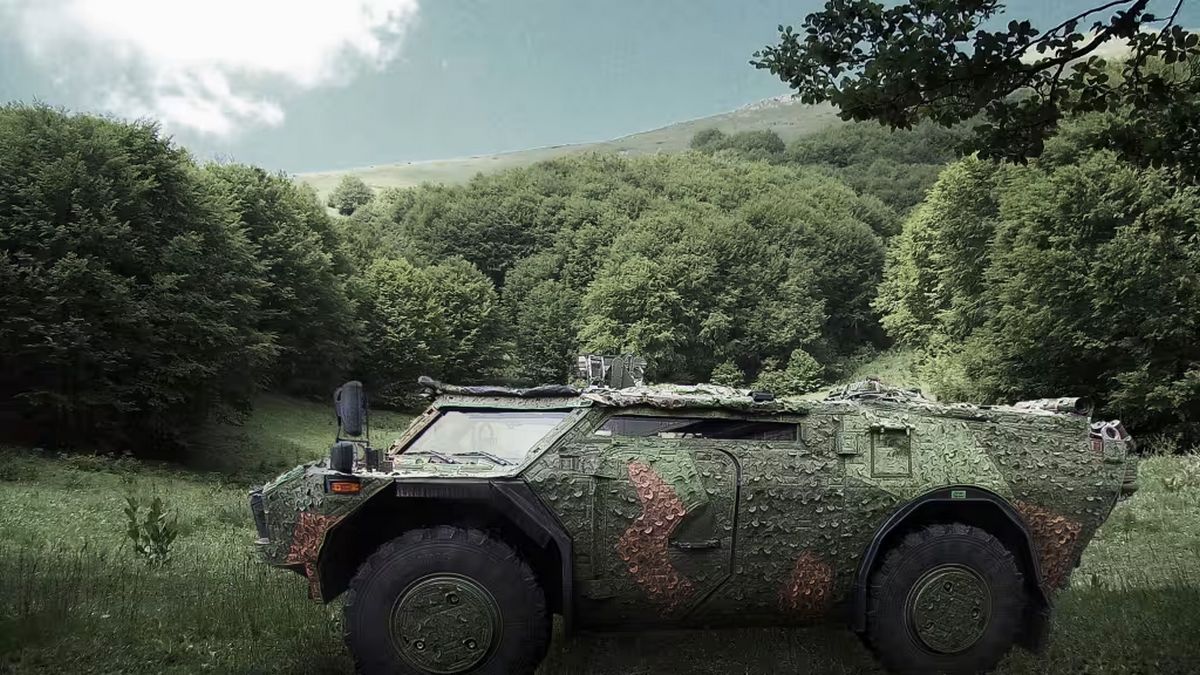
The Netherlands Ministry of Defence has signed a multi-year agreement with Saab covering the Barracuda Mobile Camouflage System, with an initial order placed for equipment to be fitted to Royal Netherlands Army Fennek reconnaissance vehicles and Panzerhaubitz self-propelled howitzers, according to the company.
The agreement announced by Saab on 27 August will allow the Netherlands to place further orders for the camouflage system over its duration. Options are also included to extend the equipment to additional vehicle types in the Dutch Army fleet.
Saab said deliveries associated with the first order will take place over the coming years. The company did not disclose the value of the agreement in its announcement.
The Barracuda Mobile Camouflage System is designed to be fitted directly to military vehicles and reduce their detectability across multiple parts of the electromagnetic spectrum. According to Saab, individual installations are tailored to the vehicle concerned and can be produced in camouflage patterns intended for woodland, urban or Arctic environments.
The system forms part of Saab’s wider Barracuda camouflage family, which includes products intended to reduce the visual, near-infrared, thermal infrared and radar signatures of personnel, vehicles and fixed positions. Mobile camouflage systems are designed to remain fitted while vehicles are moving and operating rather than being limited to static concealment.
Henning Robach, head of Saab’s Barracuda business unit, said in the company’s release: “We are proud to support the Royal Netherlands Army with our advanced multispectral camouflage solutions, helping to protect its vehicle fleet from detection across the modern sensor spectrum, strengthening survivability and mobility on the battlefield.”
The first Dutch vehicles covered by the agreement include the Fennek, a wheeled reconnaissance vehicle used extensively by the Royal Netherlands Army, and the Panzerhaubitz 2000, the tracked 155mm self-propelled artillery system operated by Dutch forces.
Both vehicle types can operate relatively close to the forward area and are potentially exposed to a growing range of surveillance systems. Modern battlefield reconnaissance increasingly combines optical cameras, thermal imagers, radar and uncrewed aerial systems, placing greater emphasis on reducing vehicle signatures across several sensor bands rather than relying solely on conventional visual camouflage.
The Netherlands operates Fennek vehicles in several configurations, including reconnaissance and command roles. Developed jointly for German and Dutch requirements, the platform is designed around a low profile and wheeled mobility, with specialised sensor equipment fitted to reconnaissance variants.
The Royal Netherlands Army also operates the Panzerhaubitz 2000, commonly known as the PzH 2000, as its principal heavy self-propelled artillery system. The German-designed vehicle carries a 155mm gun and has served with several European NATO armies.
Saab said the Barracuda system supplied under the new agreement will be adapted specifically to the vehicles on which it is installed. The modular nature of the agreement also gives the Dutch Ministry of Defence the option to bring further elements of its vehicle fleet under the same arrangement in future.