

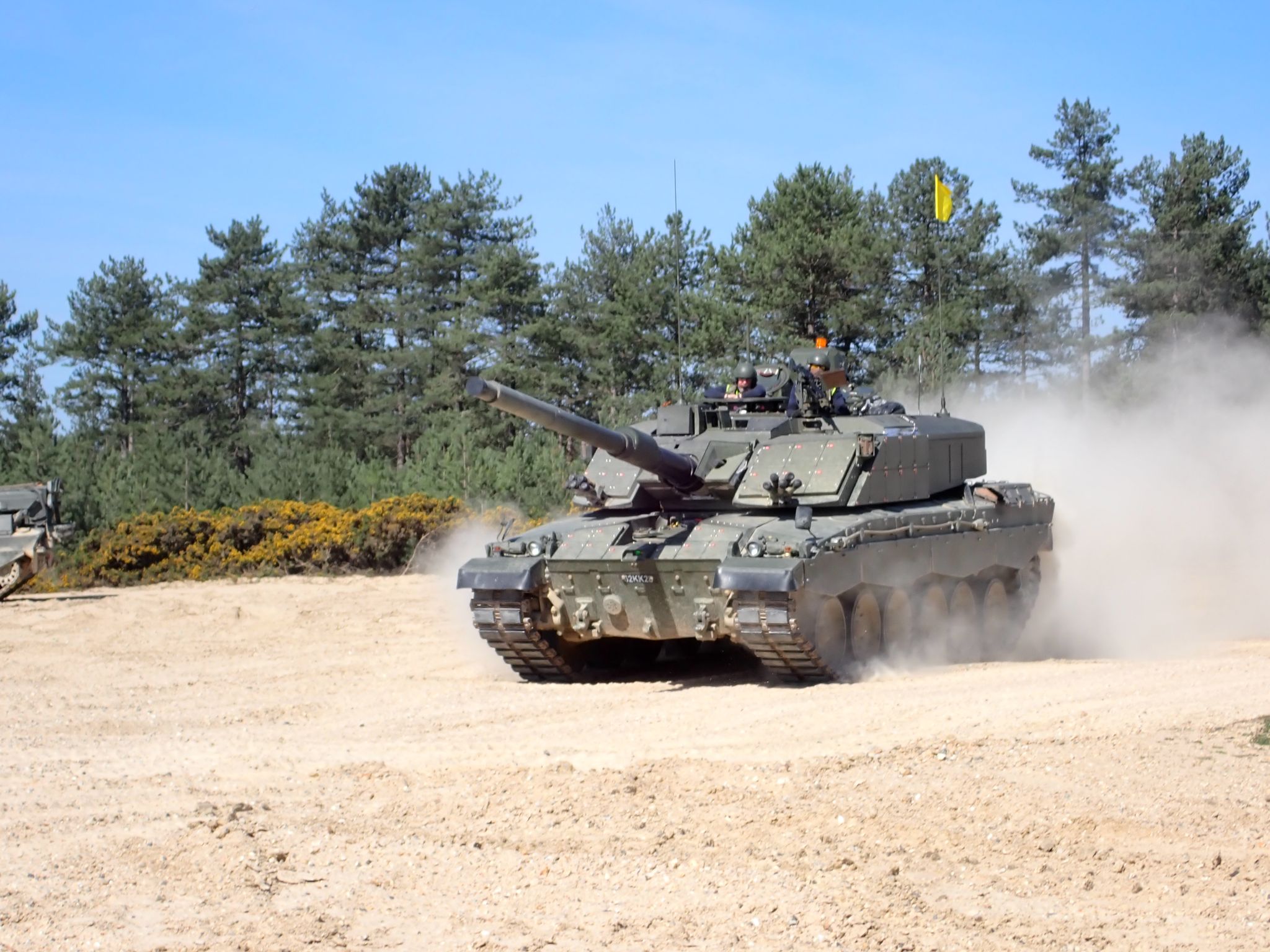
There has been a bit of a flurry of interest recently over the British army’s ‘new’ armoured fighting vehicles, following on from the long-delayed publication of the government’s Defence Investment Plan (DIP), which in turn laid out how the 62 recommendations of George Robertson’s Strategic Defence Review (SDR) of June 2025 were to be funded.
Leave aside for the moment that the SDR was out of date before the ink was dry, and the DIP vague and underwhelming. Lots of new military equipment is now in development or on offer, but still with little detail on how it’s going to be paid for.
Let’s take the British army’s armoured fighting vehicle (AFV) programmes as an example. Without getting right down into the weeds, there are three main vehicle types we should consider: Challenger 3 (CR3), the army’s ‘new’ main battle tank (MBT); the troubled Ajax armoured cavalry vehicle programme; and Boxer, the new eight-wheeled infantry fighting vehicle (IFV) plus variants.
CR3 is arguably not a new MBT at all, but an upgrade to the current Challenger 2 tank which officially entered service in 1998, so at 25+ years old it is mighty long in the tooth for a tank which has had no major upgrades since then. The new Challenger basically takes the old hull and plonks a new turret on top. And at long last a British tank will mount the Rheinmetall 120 mm smoothbore gun, firing ammunition which is compatible with that of our NATO allies.
It will not be a bad tank at all, but it has several flaws. It retains the same 1200hp engine as its predecessor, which the Ukrainians have flagged up as being underpowered for their current needs. Only 148 are being procured on current plans, which means that they might last a fortnight in a peer-to-peer conventional conflict. And only 60 active protection systems (APS) – which automatically intercept incoming missiles and projectiles – are being bought, meaning 88 CR3s will be without.
My personal view, however, is that it will probably be the last western MBT designed and built to an outdated, nay obsolete, design philosophy.
What do I mean by that? Well, there is an emerging consensus that the current generation of western MBTs – Leopard 2, M1A2 Abrams, and now CR3 – are now too big, too heavy, too expensive, and too vulnerable to favour continuing their particular design parameters. They represent, essentially, putting all your eggs into one basket. And, as we have seen in Ukraine and elsewhere, one relatively cheap drone can eliminate such expensive and sophisticated vehicles given a bit of luck.
Next, Ajax, a slow-motion car crash of a project and a prime example of how not to do military equipment procurement. Suffice to say it is over 10 years late, has cost approximately £6.3 billion to date, and those vehicles which have been completed and delivered can’t be used because the noise and vibration they generate have permanently damaged the health of some of their crews.
And time has moved on. It was designed in the pre-drone era and is now very vulnerable on the modern battlefield. So Ajax is now a legacy vehicle – which doesn’t work – looking for a role. At 42 tonnes, with a huge thermal (thanks, crew heaters!) and acoustic signature, it’s basically a target just waiting to be taken out. Putting our boys and girls in it will be bordering on the criminal. It should have been cancelled years ago.
Thankfully, there is some optimism when it comes to Boxer, the eight-wheeled IFV now coming into service with the British army. Originally a joint Dutch/German initiative, it is in service with a large number of operators around the globe. Typically, the UK was part of the original consortium to produce the vehicle, withdrew from the project in 2003, and rejoined in 2018 after domestic initiatives failed. Britain now has 100 vehicles delivered plus another 523 on order.
Despite the delay, the good news for the British army is that Boxer is now a combat-proven and mature vehicle design. I still have some concerns about its size and weight – and cost – and am not so sure about the RCH-155 self-propelled artillery model ordered by the UK in May of this year – it looks a bit top-heavy to me – but by all accounts it seems to be very capable. So for once it looks like the army is getting an IFV which does what it says on the tin.
But there’s no hiding the fact that equipment procurement for the British army is a bit of a mess. I have written about this extensively in the past and don’t need to repeat the arguments here, but the root causes are a sclerotic MoD rooted in practices which might have been acceptable in the 1950s but cannot hope to keep up with the pace of modern technological advances, plus a pathological fascination with ‘gold-plating’ every requirement.
The answer lies in a complete revision and remodelling of the MoD. Is Andy Burnham the man to pick up the challenge?
This article is the opinion of the author and not necessarily that of the UK Defence Journal. If you would like to submit your own article on this topic or any other, please see our submission guidelines.





Here we go again, trying to justify why we don’t need a big MBT. These views are exactly why we are ending up with 148CH3. During the last twenty years, debates within UK tank circles have been about the relevance of a heavy battle tank on the modern battle front, leading to virtually zero upgrades to Challenger2. I don’t agree that the CH3 is out of touch with contemporary thinking, as our foes continue to build them in considerable numbers, meaning that their use is still relevant. However, I could be persuaded to accept the modest CH3 numbers as their roles could become more specialised but the heavy horse is not dead yet.
I agree, whatever my doubts about heavy tanks, it would be stupid to disregard their merits at this juncture because while you don’t want to be fighting yesterdays outdated wars equally you don’t want to be preparing for tomorrows computer generated wars based on faulty presumptions and input. What looks overwhelmingly lethal today may be so mainly because we are still in the early days of actually combatting it and the next ‘image of tomorrow’ maybe somewhat different. So logic says prepare as best you can for tomorrow but be cautious about rejecting the experience of yesterday and today. Getting the balance right in that regard (especially within financial restraints) is the greatest problem, for as we know things can change pretty quickly on the battlefield and presumptions and preconceptions questioned and likely always will.
Maurice I totally agree, especially as we have not so far had a peer vs peer MBT engagement, where one of the vehicles has a reliable active protection system (APS) fitted. Until Hamas and Hezbollah figured out (probably with Iranian help), that the Merkava fitted with the Trophy APS had a blind spot directly overhead. In over 10 years of active service, no Merkavas fitted with Trophy were lost to RPGs or ATGMs attacks. Even when facing multiple coordinated attacks, where if the tank was knocked out, the attackers were going to get a massive financial reward.
At the moment none of Ukraine’s tanks have an active protection system fitted. Some of Russia’s T90s have been using the Arena-M active protection system, with not very favourable results. The Israeli company Rafael has been working with Leonardo to make the system lighter, but also to increase the depth of the Trophy magazine’s ready rounds. But following the attacks by Hamas and Hezbollah, they have been looking to address the dead zone above the vehicle.
But so what? If Trophy could be used to protect the tank from ATGMs and perhaps drones, how would this change the battlefield dynamic? I think you would see a re-emergence of manoeuvre warfare. As vehicles would be able to defend against a number of attacks. The question would then be, how many drones/ATGMs could one vehicle’s APS deal with? As at some point the magazine will run dry.
Our MoD is looking at how to use a vehicle’s remotely operated weapon system (RWS), as a means of countering drones. If the RWS was linked to the radar of the APS. You would then have the capability of not only detecting drones earlier, but taking them out at much greater stand-off distances, than the Trophy’s effectors (possibly from 500m to 1km). When used in conjunction with the Trophy’s computer, it could be used decide to use only the RWS for the slower targets, whilst the effectors are used for the faster ATGMs etc.
Until, this concept is tested and proven flawed, I still feel that heavy armour has its place.
Yes mate, all the ingredients are there, just need to tie them together.
No idea how reliable this was but a Ukranian source was saying the other day that they attacked a Russian tank platoon which had Arena-M fitted, and where saying they needed 15 drones per vehicle to strike the tank, and then only managed it because the APS ran out of Ammunition. So not sure if the results truly are not favourable, or if it’s just a case of needing a deeper magazine (which lets face it, an MBT definitely can take).
He’s not wrong about Boxer regards its cost. So much so, that the batch 2 order of Boxer is nowhere to be seen. It was reported at one time that over 1,000 would be procured.
Beyond some recovery variants and the RCH155s, might not see many more.
On the RCH155s, assume they will come out of the existing Boxer order, an easy win for HMT.
I think also it’s well known amongst defence watchers that Nick isn’t a Challenger fan and never has been, preferring Leopard 2.
So I wasn’t expecting a glowing aprisal as we’ve had articles like this before.
Going OT, reports on X that cameras installed on our 20 K3 Scout USVs have been discovered to be sending data back to China! “Heartbeat” or “Handshake” signals that can I understand compromise the USVs location.
Apparently MoD have now acted on this apparent breach.
Boxer is a great vehicle with plenty of uses but we don’t need 1000 and never did. It should be reserved for high end roles like RCH155 and front lines with the Patria 6X6 which is four times cheaper making up the bulk of the multi wheeled fleet. It’s not a utility vehicle.
Germany is doing this as well.
Totally agree. I’m still hoping for a big order of Patria CAVS.
If we can’t afford to fit the whole Army fleet with Boxer then Boxer is too expensive, that was the whole point of the programme. What makes it so much more expensive than the Patria that means we have to shift to a smaller vehicle incapable of all of the roles? How much does high level protection really matter when APS will get cheaper?
The Patria 6×6 vase vehicle has a really low STANAG 4569 level 2. Which is only proof against 7.62×32 AP rounds and shell splinters. It can be up-armoured to level 4 via modular kits. But this adds a lot of weight. Which I believe stops them from being amphibious. Boxer starts off at level 4, but we’re getting the level 6 version based on the Australian version. This gives the vehicle protect against 30mm AP rounds over the frontal arc and I believe 14.5mm AP protection on the sides and rear. This gives the vehicle the same protection as Warrior fitted wth its additional armour kit.
Sadly armour protection doesn’t come cheap. Which is why our Boxers are a lot more expensive.
Also if you go inside a Boxer the interior is very gucci, lots of cameras for situational awareness etc, I believe CAVs are much more basic.
Nick? Apologies. Stuart.
Yes just heard about this, this is pretty natural activity it seems used by companies to check that their chips are operating correctly and within parameters, it is not of itself a direct attempt to infiltrate and deliberately gather intelligence as it may be naturally and understandably perceived upon hearing it, ie a deliberate back door for spying. However equally, such a capacity in military drones can potentially supply useful information about when, how often and where such a drone is being used (for instance the Straits of Hormuz) which can obviously be useful not only to the Chinese Govt, but if they pass it on, to Iran in particular. So rightly the Navy is rightly keen to make that possibility impossible be it through not using the drones currently and/or preventing them accessing the internet.
What concerns me beyond this is that we have a similar problem with the US. Now previously any such risk would have been perhaps anything from inconsequential, through unlikely, theoretical or low risk to tolerable as allies. But under the present and likely future US regimes indeed becoming increasingly hostile, especially where US companies by law have to supply information to the Govt and with secret service operations abroad having legal restrictions eliminated under Trump, the ramifications could be rather greater than this present risk if the potential is fully exploited. I fear the potential for sending information to the US may be far greater if there is confrontation.
Hopefully the issues sorted now.
I would like the British Army to get Boxer Skyranger 30 for mobile GBAD against drones & attack helicopters, even if we could only afford 15-20 of them.
So would many! The Army seem to dislike AA cannon for some reason.
Being pedantic, I would like the author here to stop calling the Boxer an “IFV” which it clearly isn’t.
Since IFV as we meant no longer exist, anybody can call the Boxer an IFV. No IFV can stand on front line supporting infantry with 20mm rounds. This kind of mission is obsolete.
What makes CH3 and Ajax vulnerable and Boxer do not in author text? i did not see any discrimination.
In what ways, specifically, is SDR outdated? The writing team took full cognisance of the Ukraine war.
Colonel Stuart insists that the Boxer as ordered by Britain is an IFV. It is not. It lacks a cannon. It is an APC intended to fill the Mechanised Infantry Vehicle requirement in 1 Div. (Of course due to the bad decision to cancel WCSP and also to retire Warrior from service (not mentioned by Stuart), the Boxer has been forced to fill the vacated role in 3 Div which it will probably not do well, but it has not suddenly become an IFV as a result of its reassignment). No concerns expressed about mobility of Boxer in thick glutinous mud or snow or its ability to keep up with the tanks in its new role. Also we have not ordered enough Boxers (or a cheaper alternative such as a Patria).
Stuart thinks that 148 CR3s will not last a fortnight in combat. 148 tanks are not in the field force – it might be three Type 44 regiments ie 132. Since Sep 2023, just two CR2s are confirmed to have been destroyed by enemy weapons…so how are 148 or 132 going to be destroyed in a fortnight, especially those with Trophy APS and all having even better armour than CR2?
CR3 retains the CV12 set to deliver 1200hp but this one will have a few improvements. I know the tabloids consider it to be underpowered but does the Ukrainian Army say that? In many YouTube videos I have seen the Ukrainian crewman praise the tank but do not mention any lack of power. Due to its superior suspension it can match Leo2 for cross-country speed. The CV12 is tweakable to deliver up to 1500hp but at the expense of higher fuel consumption and potentially reduced reliability. I agree that all tanks should have APS. It would have been useful if Stuart could have said something more about the tank after CR3, or that we are observers on the Franco-German tank programme.
Is it true that Ajax can’t be used? Three or four enquiries were launched. The conclusion of the H&S-orientated one was that Ajax could continue to be trialled or evaluated providing crews and REME follow certain stringent procedures…and that is now happening. Surely Ajax is not looking for a new role because of the drone threat? Are other AFVs being reroled because of the drone threat? Is that ‘a thing’? Doom and gloom about enemy attack drones with no recognition that counter-measures exists and are being developed all the time.
Agreed. Good post.
Good post Graham. Crawford doesn’t deserve the print.
The Challengers in The Ukraine are used selectively. If they were in combat continuously, which they would be against Russia, the attrition rate would more than likely be much higher. The quality across the different versions vary, but the Ukranians have still lost nearly 1.5k tanks. The terrain is way different than the wide open spaces of the Desert seen in Gulf I and II.
Some slightly wrong assumptions there. Especially when quoting the loss of Ukranian tanks. Because the loss rate is over an entire front, well over 1,000 miles long, with continous contact with the enemy for a war that has now outlasted the Soviet contribution to WW2. The British Challenger 2 fleet would represent 2 Brigades worth of frontage for the entirety of NATO. That’s way less of an apples to apples comparison than comparing British Challenger 2’s to the 82nd Airborne Brigade (and FYI MBT’s never stay in combat continuously, simple maintenance needs prevent that).
I think APS would be made available for any number of CH3s that neded to be deployed for live Operstions. The money would suddenly be available.
UOR’s are definitely a thing. The real question is would enough Trophy’s be on the market for a UOR to aquire them, assuming a lot of our allies would be buying them up too.
Theoretically Ajax could also provide a degree of anti-drone protection, due to its sights and the high elevation of the CTAS40. However, it could be significantly improved in this role if fitted with a APS that uses radar as its primary sensor along with programmable air-burst munitions with proximity fuzing. The radar for the APS so long as it has a range of around 4 to 5km, should be able to detect larger drones past 1km, whilst the smaller quadcopter ones from 500m. Perhaps, someone in MOD, should float the idea of using Ajax in an anti-drone role beside the recce and force protection roles?
The Blackjax demonstrator from DSEI had its turret modified to improve anti-air performance for drone defence. I don’t know what the status of that is at the moment.
I do find Blackjax interesting as it seems GDUK knew the issues with Ajax, then developed another vehicle to address them (uprated suspension and band tracks). But it does show what an Ajax based IFV could look like, that still has a crew of 3, along with 8 dismounts, but still include the CTAS40 but in a remote turret.
Blackjax is also fitted with the Iron Fist APS. Which has the radar, so I’m hoping the main gun is also linked, so it could be properly used for anti-air. But like Trophy, Iron Fist has a limited magazine capacity of two effectors per turret. I don’t believe Iron Fist can be reloaded from inside the turret, so some bod has to climb out and reload the turrets. I think 4 effectors were probably sufficient before the drone threat became a major issue. Now 4 effectors could be quickly overcome by swarming, unless the main gun is used primarily to counter drones and the APS is used for only ATGM, but also the final inner layer defence. Otherwise the turrets will need either a lot more ready rounds, or a means of quickly reloading from a stacked magazine..
CTAS40 is the wrong gun for air defence – Spins up too slowly, too low a ROF, too short a range, blisteringly expensive ammunition, almost no one uses it.
Air burst 30mm and 35mm natures are now common currency.
And if you want a heavy AA gun, 40mm Bofors walks all over 40CTAS.
I’m not so sure. On one hand the CTAS40 has a significantly higher muzzle velocity than the Bofors 40mm/L70 when using AP rounds, but a lower muzzle velocity when firing HE and Anti-Air rounds at 900m/s vs 1012m/s. It does fire at a slower rate of 200 rpm vs 300rpm. However, the CTAS40 has a smaller dispersion than the Bofors. Both guns use a point detonating/proximity fused anti-air round, that has a significantly better kill radius than 30mm or 35mm rounds. Plus the effective range between the two weapon systems is very similar at 2500m to 3000m for airborne targets. Though I get ammunition the cost difference.
The French Navy have decided that the CTAS40 is good enough for the CIWS role on their ships.
I await SDSR30 with interest, I fully expect them (with the current direction of travel) to announce Chally3 to be gone by 2035 and an end to the UK MBT.
We’ve reduced it to a niche capability anyway.
Right or wrong, its the next low hanging fruit, ripe to pluck by 2030.
Massed conventional warfare will be won by who has the largest number numbers of direct and in-direct fires and equally vast numbers of counter systems. More specifically, who has the industrial capability to mass manufacture the above quickly and in quantity.
After all, you can have as many regional/ local/ point layered air defence systems, all the way down to individual protection like Trophy, as you like, it isn’t stopping the thousands of cheap attack drones you are likely to be facing post 2030, especially if they are being employed by a country spending many billions on it, like the US or China.
It is difficult to reconcile “gold plating” with a warmed over obsolete MBT with an engine that isn’t powerful enough.
😂
The kind of in depth analysis we are use to from Senior Army officers and especially Stuart Crawford 🤦♂️
I tend to agree with some of what he says (not the Boxer 155mm mind, need more expertise than just looking top heavy) but then I am no technical expert just working on gut instinct about Ajax becoming increasingly obsolete during the time it’s been delayed and the concept of such heavy tanks being survivable; the ‘land battleship’ might be more relevant a description than they thought when that term was coined. BUT when someone who left the service 27 years ago is peddling the idea of what is or is not relevant today I am rather more questioning about what he has learned and experienced over the intervening years before I congratulate myself upon having similar doubts to a so called military ‘expert’. Otherwise that is someone advising us how to fight WW2 based on his experience in WW1. So it begs the question what is his direct acquired expertise, who are his clients since his military service, that makes him a worthwhile ‘commentator’ that we can rely upon for objective technical and strategic review. Because there are plenty who call themselves that and make a good living at it too, who talk utter gibberish and it would be nice to be able to somewhat filter them. And yes I as an armchair commentator on much of the stuff covered here can get away with it but ‘it looks rather top heavy to me’ really doesn’t cut the mustard if you want your opinion as a supposed actual ‘expert’ to resonate.
The RHC- 155 was a Sunak deal . The Army were putting various Artillery platforms through trials until Sunak made is defence deal with Germany .Would of been interesting to see what the Army would of chosen . It’s sad the Army had no say in the matter. Never kew former PM Sunak was an expert in Artillery . And yes I agree RCH -155 does look too heavy .
Your absolutely right anyone who understands how Artillery work’s known that today’s Battlefield you must be able to shoot and scoot .Personally I think the Army would be better off with Archer has it’s already in service, although only 14 platforms sadly . Let’s not forget RHC-155 wasn’t built from bottom up originally has an Artillery platform in mind and does look top heavy. However RCH -155 was has I stated earlier a Sunak deal to keep the Germans happy. 👍
You can have 3 or 4 Caesar for the price of one RCH 155mm… Who said « mass is a quality »?
Yeah that article is an example of “phoning it in .” I don’t get how he thinks Ajax is vulnerable to being attacked by drones, yet Boxer somehow isn’t, or is more survivable. Such stellar in depth analysis.
The battleship used to be defined as a ship that required another battleship to defeat. That was the case to a certain extent for tanks and AFVs but it decidedly is not now, and we need a shift like at the end of WW2 towards a more flexible and capable mix of ships. I wonder what will be the aircraft carrier in that analogy?
Ajax has been a car crash of a project, but a lot of this article does seem to just be making the mistake of thinking drones can do anything and everything.
Exactly. There’s quite the argument to be made that the age of the drone in its current form might be a short one, given anti-drone tech seems to be catching up fast. They’re very useful, but the future of modern warfare? Not so sure.
The power plant is not the same as the cH2 one, it has a upgraded fuel injection system and cooling system. The new upgraded power pack for CH3 is rated from 12000 – 15000 bhp. This is coupled with an upgraded transmission and suspension. This will result in a much more mobile vehicle and not the one we see in Ukraine. I think however the idea of a large maned recon vehicle has had its day and we should have ditched Ajax in favour of unmanned vehicles.
Especially as Ajax is not getting Active Protection System which is now a vital requirement for modern battlefield servivability. The Army is bringing into service an obsolescent under protected platform. The Army leadership are obviously not in the modern world.
Well that has increasingly been my view of Ajax, an increasingly obsolete concept. Tbf I have been waiting for those with greater or more direct knowledge to convince me otherwise. So far even where it is defended I have heard nothing that suggests its role is convincingly viable. So please those who think it is, say something convincing we can hold onto, because a terrible delayed programme producing a vehicle that may still not be fit for purpose, is bad enough, but if it has no real purpose at all especially as time passes, then that’s beyond hellish to contemplate on so many levels. Worse still if it’s persisted with purely to keep people in jobs, to cover the guilt of those involved and to suppress even worse media than already experienced, then it’s beyond words.
Yes the takeaway from Ukraine is tgat tge line of contact is now owned by drones and as soon as an vehicle emerges into the open it is spotted and potentially attacked. God help an Ajax crew in that no APS and a massive vehicle …. not a chance… if you doubt my thinking test one in Ukraine and see how long it lasts….
Hi Spy, I am still in favour of Ajax. But I think you are correct in that its primary scouting role can be replaced by drones. Ajax and Ares should have their own organic drone capability. Where it can drive to an area, then use its drone/s to scout ahead, whilst it has the armour protection to be near the front. Something you definitely wouldn’t want to do with the Patria 6×6!
However it does not neglect the fact that the sensors, sights and CTAS40 fitted to Ajax give Ajax a formidable combination. In the past CVR(T) was never just used for recce. It also did a lot of force protection along with flanking roles for the heavy armour. Similarly when used with Warrior in Aghan, CVR(T) gave us the ability to overmatch the Taliban in both ambushes and planned ops. I am presuming Ajax would fulfil a similar role if we ended up in another asymmetric/policing conflict. Where heavy armour wasn’t really needed, but was missed.
However, there is one role for Ajax, that is not being spoken about. Which is using Ajax in the anti-air role. The current passive sensors and sights are very good. But it could be better, if linked to the radar of an active protection system (APS). Taking Trophy as the example, the system’s computer can use the radar data to plot the location of the shooter. Then point the turret and gun at the location, giving the option of returning fire. Trophy can track and engage supersonic targets. So in theory this data could be used in a surface to air mode with the main gun. Which if using the specific air burst round with proximity fuzing. Would go a long way to mitigating the drone threat.
That could save Ajax if it’s Deep Battle Recc role is now too vulnerable to Drones.
Ajax Troops dispersed amongst all formations, all with APS.
Love this.
The British army is and always has been out of its depth on vehicle procurement. The CH3 was a good move as it was cheap and it’s a very useful stop gap that didn’t not allow senior army leadership to fanny around with 2,000 pages of requirements like it did for Ajax.
Military vehicles are easy to acquire and our army leadership needs to stop pretending that it has any insight that the rest of NATO doesn’t have. We should either buy off the shelf with minimal modifications under UOR program or join Germany on multi national programmes.
Germany has proven to be the world leader in this regard. We should focus on UK only projects for aircraft, missiles and ships all of which we are excellent at rather than armoured vehicles which we have always been very mediocre at.
“The British army is and always has been out of its depth on vehicle procurement”
What sort of effing crap is this? Even coming from you, usless little faggot
The FV4007 (A41) Centurion was the primary main battle tank of the British Army during the post-World War II period. Introduced in 1945, it is one of the most successful post-war tank designs, remaining in production into the 1960s, and seeing combat into the 1980s and over 200 still in service in the 1990’s
Why don’t you just give up?
Jesus christ this was a nuts response, even for you. You ought to be embarrassed
Agreed this response was totally inappropriate and extremely rude. You should be banned from this site.
I was actually shocked by it, first time ever here perhaps, a disgusting rant.
As for the content truth is it’s ludicrous to claim we have always been bad in this sector, post war we were considering financial limitations damn good at it. However due to the deluded idea that with shrinking forces we could design and build exclusive platforms with little export ability only exacerbated by then few orders even getting through or even upgrades to those platforms we did have then any capacity to build anything new pretty much disappeared and not working with others the last and lost opportunity till now what’s left was forced on us with the rump surviving Bae capacity effectively being bought by the Germans. So I guess both sides of the argument have their truths in the end even if presentation leaves a lot to be desired.
The truth is we can build excelent vehicles and have done so in the past. This is true of guns too. The Centurion, Scimitar/Scorpion, Chieftain… and we made some good guns e.g. the NATO 105mm canon. However the UK defence industry has been held back by lack of political commitment and funding. Especially a lack of investment in innovation and productivity. This has all resulted in cash starved projects and small production runs tgat mean we have more expensive unit costs.
The shame with Ajax is that it is driven by politics and a dated military concept of operation. Ir is now seen as too big to fail. And to avoid any blame for a failed programme ir must be brought into service regardless. It is a tribute to Ego and hubris and a liability on a future battlefeild.
Hi Rob, you just have to look at how few export orders we ever achieved for any of those platforms to measure their success. Very little since Centurion.
We have a history of designing very bespoke equipment for our Army that no one else ever wants to use. Riffled gun’s on challenger 2 being the primary example, 40 tonne Ajax on metal tracks being another.
Our army is obsessed with making everything bespoke or creating requirements that can’t be met without breaking the laws of physics. They need to accept good enough capabilities designed for NATO militaries and stop thinking that they have some unique war fighting capability that the Germans, French, Americans etc don’t have.
We are stuck in the same trap as the USA but we don’t have the billions to piss up the wall that they do.
You mean besides Cheiftain that went to multiple middle eastern countries, Saracen that went all over the gaf, Scimitar that went to Belgium, Jordan and Latvia, and Challenger 1 that went to Jordan?
The Rifled gun on Challenger 2 isn’t bespoke equipment that nobody else wants to use, that’s a rather blatant mischaracterisation. The L11, aka the 120mm Rifled gun we use (the L30 on challenger 2 is basically the same gun, just with slight improvements) entered service in 1966, when everyone in NATO was using rifled guns (the British L7 105mm in fact, or derivatives thereof). The Rheinmetall 120 L44 didn’t enter service until 1980, and not on the M1 until 1985. Far from a piece of bespoke equipment that was an obsession that nobody else wanted to use, the L11 was a sensible upgrade that did legitimately steal a march on the German competition during the majority of the cold war, and after even after the 120mm smoothbore came along switching guns would have probably involved spaffing a lot of money up the wall.
Missed your meds?
I’m all for OTS in some areas, as a way to save money, time, and get mass. ( Patria looking at you. ) We do have the knowhow if we so wished, all a question of money and priorities. This is a modern nation that can do anything it wishes if the will and money is there.
That’s true our underlying expertise is incredibly strong, the financial or political will to do so is the underlying problem. Having 4 of the top 10 universities in the World is always going to give you great potential to do things even if you can’t afford to carry that potential through industrially thereafter. Where that money is available, in F1 (and associated technologies like electric motors/drive systems) for example you see an unmatched capability to be and produce the best even if sadly other Countries are better at branding that capability and indeed in investing in our capabilities.
I don’t think it’s a fault of industry, lack of capability or even a lack of cash. It’s an Army that thinks an off the shelf solution comes with a 2,000 page requirement document and that some how getting a “fixed price” contract from a US defence contractor with a questionable track record makes everything fine and as soon as it goes Pete Tong is time to blame the politicians. Spending £6.3 billion on such a small capability as 589 armoured reconnaissance vehicles shows the Army has no lack of cash.
Agree, they’ve had lots of money, and spent it badly for what has been bought compared to the French, which again J has detailed in comparison.
As for who to blame. Who actually chose Ajax? Army, politician? I don’t think anyone outside of themselves actually knows for sure?
I don’t think the Army chose RCH155 either.
Recriminations are all well and good if anyone ever takes responsibility, I’ve not seen that from any ex senior officers moaning on TV and in the newspapers, and certainly not in any talking head politicians either.
Ironically, for all the abuse you get from David Lloyd, I remember him distinctly calling for more OTS purchases and not letting MoD get their mitts on programmes and over complicating them.
Something you seem to be in agreement with.
Twaddle.
The UK, in the past has been capable of producing the best tracked tanks in the world. It now needs re-industrialisation of the country to produce a modern CH4 design fit for the 21st Century. For example with long-endurance tethered and roving drones, and active self defence. Moreover they need to be designed and produced in the UK in numbers (300+) sufficient to make a difference on a battlefield over time. Uncle Andy says he wants the UK to re-industrialise. Come on then Andy. Start with MBTs. Holds breath…
The UK often makes the bets tanks in the world on its own assessment of what makes the best tank. But no one else buys them since Centurion so are they really that good?
Look at Lepoard. The Challanger series has in theory better armour and guns for most of it’s development and we sold almost none despite having significantly more political weight for sales.
Round and round in circles..that report was like the 1960s with the leopard 1 and amx30 ..thin armour and light ..all light tanks have failed . Only good for recon with MK1 eyeballs .
CH3 will be the last British MBT for sure, the MOD has neither the will, the industrial means, or the finances to develop anything new.
As the article referring to the Boxer as an IFV, has no-one informed Mr Crawford that the army is getting the APC variant?
usless little faggot… why is this kind of comment allowed in an apparently serious journal. The contributer should be banned. That’s just normal netiquette.
Well said if that doesn’t get you banned what does? Cue argument on soreness I fear.
The philosophy is changing back to early post war thinking. No longer is it going to be a five minute war but one of attrition. Lots of smaller manufacturers using their ingenuity to build prototypes and avoid the current beaurocacy.
Good point, we were missing the true guidance all along perhaps.
Yep it’s bizarre how the west has been stuck in the short sharp campaign wins the paradigm when the evidence that it’s utter bollox has been slapping it in face since well forever really..
The Korean War 3 years 1 month
Vietnam war 20 years
Angolan civil war 27 years
Soviet Afghan war 10 year
NATO Afghan war 20 years
US/UK Iraq war2 8 year 9 months
Ukraine war 4 years and counting
Iran Iraq war 8 years
And there is a good hundred more
It’s like they stuck their heads in a bucket sand… when an existential war starts it generally only stops when one side suffers an exhaustion of a key requirement to continue
1) will
2) manpower
3) industrial capacity
4) economic capacity
I think one of the issues is the west sort of knows in its heart it’s not got the will for a long war and is more hope than anything else that has it focused on short wars.. it’s why China thinks in its heart it can and would beat the US.
I think there is something to be said about the future of MBT design.. at present there is to much flux and I don’t think anyone really can predict what a future MBT will need to have, because the old triangle of mobility, firepower and protection is really dead and we are looking at a new probability pentagon or hexagon of design…
Mobility
Firepower
Protection ( that now has 3 elements and not one.. passive, active and ECM and is omni directional.. the omni directional element is huge)
Awareness ( ISTAR capability)
Stealth ( Reduced signature )
Connectivity/networking and awareness
This means AFV design is going to go through a transformational time and MBTs probably most of all.. what is the correct way to deploy protected, mobile and sustained direct fire and what does that look like.
In reality legacy MBTs are designed to protect from large kinetic and chemical energy rounds hitting from the front and smaller threats from an omni directional point of view.. they had very little reduction in signature, no ISTAR and primitive connectivity.. they probably will not work well in a battle field where your hidden infantry man has stealth on his side as well as drones and precision fires at his fingertips…
But at present we don’t have a better way to deliver mobile protected direct fires.. so the MBT as was is still it. This probably means developing and buying brand new MBTs is a silly waste of money at present.. but rebuilding the legacy MBTs to keep them current for 20 years is a very good idea.. especially at 5.4 million a pop.. if this is the last 60 ton physical armour to the front, direct fire capability we have we should probably convert all of them.. a new MBT costs 25million a challenger 3 5 million.. even if scraping up the worst hulls to convert takes the cost to 10 million for some of the m it’s still worth it… yes in 20 years an MBT may be totally different.. more distributed lighter physical armour, with more active defence, more signature reduction, better sensors, awareness and connectivity.. hell drones may even become the defacto delivery vehicle of direct fire and they may not even have a physical crew… we just don’t really know yet, it’s all to fluid.
Re active defence system.. the evidence from Israel is that if you send MBTs without active defence into a missile rich environment even against portly trained irregulars they get knocked out in droves.. but putting an active defence system on them massively reduces their chances of getting knocked out.. every front line AFV should have an active defence system.
Active defence is vital I agree. My only question that arises however, which the Israeli experience doesn’t really answer, is how reliable is replenishment going to be in a real European conflict. How quickly does active defence become depleted, what do the vehicles do while getting new effectors? That is going to be the problem that is going to be very difficult to determine in computer or real time simulations I suspect almost totally unrelated to the technologies ability to take out incoming missiles etc. Thus I suspect the ability of non active defences will be the crucial element or and laser/RF/spoofing defences or new capabilities of this nature where storage limitations of a live effector are not the crucial element.
“we should probably convert all of them.. a new MBT costs 25million a challenger 3 5 million.. even if scraping up the worst hulls to convert takes the cost to 10 million for some of the m it’s still worth it…”
If we are talking about engine replacement, or everything below the platform. I can assure you; it’s not worth converting the worst hulls. They’re in such a bad state … it would cost far less to buy brand new hulls or order completely new units rather than try to fix up the worst ones (not that I’m advocating it). However, if we are talking about turret-replacement-only, then this is possible and certainly doable. A turret replacement alone would also cost far less too. I mean; far less than the 5.4 mil spent on the previous C3s that had engine replacements. Also the cost will be less for simple turret replacement because much of the work has already been done already on that front (conversion of worst hulls would be a later batch and may cost less for this reason).
Click bait.
It seems to have worked.
What brand new MBT has been designed and produced this century by any Western country?
Abrams is a 1970s design, continuously rebuilt and upgraded.
Leopard 2 is a 1970s design similarly rebuilt and upgraded.
Leclerc is a 1980s design with @ 200 being upgraded
Ariete is a 1980s design with @90 being upgraded to C2 standard.
Ch2 is a later design than any of these and has the best passive protection. The CH3 upgrade retains that armour superiority.
It seems that no country is sure about what a future MBT will look like. More protection seems unlikely because of weight constraints. Increased firepower is probably unnecessary.
But the high unit cost of brand new tanks is likely to restrict numbers acquired.
Is there a more affordable way of delivering mobile protected firepower? Wheeled platforms like Centauro and the Japanese T16 offer a high mobility option. But experience with the Stryker AGS has led to its deletion by the US army.
The experience of two gulf wars showed that used as part of all arms operations with air superiority, Western MBT losses were very low. Ukraine has shown that poorly handled without adequate air support, attrition rates are like those of WW2.
Panther KF51 ?
Western?
My mistake. I was thinking about the SK K2.
Isn’t the KF51 a new turret on a Leopard A4 hull?
Modified structural hull and mechanical layout of the Leopard 2A4.
But it is being pitched as a new tank.
One of 2 contendors for any future AFV procurements?
I discount anything from Korea because geographically they are too close to China, which would be a massive supply
chain risk should war break out.
We’ve not had the impetus to design a new one. Since the end of the 20th century a 1970’s tank will do just fine and so just upgrading them is easier.
Good post Graham. Crawford doesn’t deserve the print.
I have no idea why Crawford hates the CH2 so much.
Has it not proved itself to be good in combat Iraq 2003)?
In a (now less likely) tank on tank battle the CH2 is statistically most likely to meet T-72s or T-90s ( or local derivatives of)
It can still obliterate both types hands down.
No idea what his beef is but he constantly denigrates the AFV’s being brought into service.
There was a rather large contigent of the RAC in the 1990’s that believed vehemently that the Army should have gone Leopard, and never fully forgave it for buying CR2 (CH2 is Cheiftain MkII, not Challenger 2 btw) I rather suspect Stuart is one of them.
Hmm Challenger 3 far better than buying a brand new set of MBTs. It was ultimately a good decision. I disagree about the engine. I am pretty sure it has been upgraded.
AJAX not so bad I think in reality. Most of it just media negativity. Maintenance is difficult and expensive for the vehicle, which is less to do with the vehicle itself and more to do with external factors (like trying to source component parts). For instance, the vibration was rumoured to be caused by the hulls which were sourced from a 3rd party supplier, not GD’s fault per se. The vehicle needs constant TLC to keep running and this costs money, but it’s still much/far better than not having the capability at all. AJAX does seem to be in some ways a bit of a toxic asset because of the maintenance requirement, but there have been much worse and much more expensive blunders in the MoD historically and it’s worth noting that AJAX still retains a value. There is no known vehicle that can replace AJAX (and do that securely) in it’s entirety and other options are much more expensive in-practice and/or more risky for the MoD.
Boxer vehicle is largely brilliant.
I agree RCH-155 might have some problems along the way.
With both the AJAX and the RCH-155, the difficulties are to do with the systems-of-systems approach to design and deferred responsibility. Much like what we are seeing playing out with the Kracken drones, some of the component parts sourced from 3rd parties contain flaws and this has a knock-on affect on the entirety of the vehicle. It’s very easy to say “don’t rely on more risky parts” but without relying on them, capabilities can be easily lost so I don’t really know the solution to that. I’m ‘fraid.
Remember the Fox armoured car?
A century of people saying the tank is dead. Yet we still have it. I won’t hold my breath waiting for its demise just yet…
Given the level of research going into anti drone tech I wouldn’t go all in on them being the silver bullet that replaces everything either.
How much for an updated new-build cvrt fleet? 😁
FFS he still doesn’t like Challenger does he? Col Stuart it is NOT a rehash of CR2 apart from the basic hull it is a brand new tank! Now if this were Leopards we were going on about he would be creaming him self despite the fact that they are basically the same vehicle updated with extra bits added on and some newer electronics!only now are new hulls actually being produced but let’s not let facts get in the way of prejudice🤬
Ajax is just a national embarrassment now – Politicians past and present plus the MOD have shown their utter incompetence and lack of understanding and leadership.
I doubt Ajax will ever fulfil its intended purpose/mission – it’s being reported they are breaking down constantly after trials restarted.
The British military has been vandalised by the legacy political parties with their horrendous cuts and underfunding.
It will be the British people and British military personnel that will suffer the consequences of the vile – disgusting – traitorous legacy parties moronic decisions and incompetence.
Well yes, one reason why I won’t vote for any of them.
Of course Boxer with a 155 turret on top will be top heavy…we just don’t know how bad the problem will be. Boxer without a turret is apparently the same height as Ajax with a turret. Nevertheless, route planning software will no doubt allow RCH-155 to get to firing positions without falling over. However a turreted IFV requires a great deal more mobility than a turreted Boxer would probably provide.
The unmanned autoloader RCH-155 turret and its hull interface does however give British manufacturers a chance to study how a next generation manned/unmanned tracked MBT with unmanned autoloader turret might work.
Presumably the shortage of CR3 Trophy systems is to allow updates on a half fleet replacement basis as technology within fielded combat proven systems develops?
It’s become a noticeable feature this Century of purchasing What’s good for British Industry for our Armed Forces rather than what’s good for The British Military….!
Army didn’t want RCH155, it was imposed on them.
K9 was a front runner. It’s almost as if the Army knew wheels and European mud don’t work.
Old.men.clingin to an older failed doctrine, we stopped innovating and have stagnated
Sorry I think this article entirely misses the point that should be learned from the Russia/Ukraine Conflict.
Firstly the age old adage. Loose the air war and you can’t win the war. Drones are just cheap aircraft. Now remotely piloted. Just as tanks where/are at risk from Attack Helicopters or A10’s the point is with a Trophy defence system Drones then can’t attack the tank.
Second as per WWI & WWII without armoured infantry, engineers and tanks any modern warfare develops into a trench warfare meat Grinder. Neither Ukraine or Russia have enough Trophy protected or anti Drone Fighters to.provide cover for first the engineers to clear the minds.on the front line and then use tanks to burst through with tracked IFV troops to wreck havoc behind the front line. Tanks & Armoured Vehicles are key unless you want to wage a war of attrition in money building equipment and in young men dying. I don’t want to refight WWI so you need to find a way to break through.
Finally I do agree that Ajax is now pointless as a Reece vehicle. It can be useful however with an upgraded main weapon of 104/120mm size that is designed to take to provide a medium infantry tank. This allows the CR3’s to do there job of anti armour illumination. At 48t on theatre entry mode with a Trophy system Ajax can easily survive the modern battlefield. It also allows the British Army to field 3 proper Armoured Brigades on 3 Div Armoured Div formation. With 42 CR3’s per Tank Regiment Per Brigade and 56 Ajax. The cure for the.proboems as everybody knows is Rubber Tracks. Why the British Army just doesn’t get on with it is beyond me.
Add in 11 Brigade as a Drone Brigade made up of 4 Infantry Regiments,.plus a Divisional Artillery support (which at the moment is jokingly referred as a separate Brigade in the British Army and nowhere else) you have a pretty good Heavy Armoured Brigade that can break through Russian trenches. The fact is the death of the tank has been talked about since 1916 yet nobody explains how you get across a drone patrolled l, atgw, minefield front line and end wars quickly.
Somewhat disagree – the cannon on the Ajax is a highly advanced and well designed piece of kit, it should be capable of engaging drones, providing great support for infantry (ammunition that fuses on time to airburst over dug in troops) all in all I think Ajax might find a place as a mobile control vehicle for drones/infantry support vehicle. Ironicially the scimitar and its relatives have been highly successful in Ukraine
Rumoured Ajax is referred to in closed circles as the ELVIS..
‘Shake, Rock and Roll.’!.