

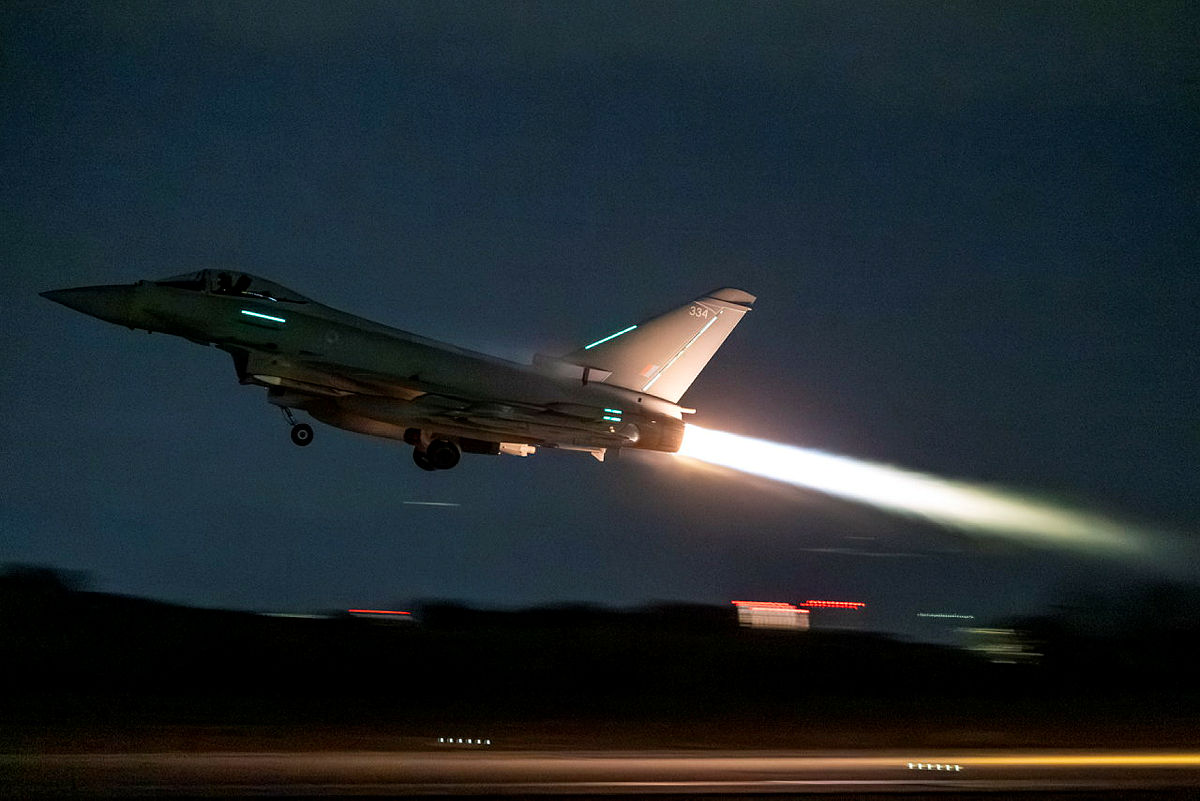
RAF Typhoons were scrambled from RAF Lossiemouth on Friday night in response to an unidentified aircraft approaching UK airspace.
The Quick Reaction Alert sortie saw Typhoon fighters launch from the Moray base with support from an RAF Voyager tanker. The aircraft that prompted the response remained sufficiently distant that an interception was not carried out, and the RAF aircraft were subsequently observed returning to base.
Open-source flight tracking showed an RAF Typhoon departing Lossiemouth on a north-easterly heading, with a Voyager also airborne in support, squawking the transponder code for NATO air policing. The activity drew attention online because it took place outside the station’s typical flying hours.
Quick Reaction Alert, usually shortened to QRA, forms the UK’s permanent system for responding to unidentified aircraft or aircraft whose behaviour raises concern as they approach British airspace.
The RAF maintains QRA forces at two principal locations. RAF Lossiemouth provides coverage for the northern approaches to the United Kingdom, while RAF Coningsby in Lincolnshire covers the south. Aircraft, aircrew, engineers and supporting personnel are maintained at readiness around the clock, allowing fighters to be launched at short notice when required.
Potential incidents can range from military aircraft operating close to UK-controlled airspace to civilian aircraft that have lost communications with air traffic control or are otherwise behaving unexpectedly.
The air picture around the United Kingdom is continuously monitored, including through the Control and Reporting Centre at RAF Boulmer in Northumberland. Information from military and civilian sensors is used to build a recognised picture of activity around UK airspace. Where an aircraft cannot be readily identified or its intentions require further investigation, a decision can be taken to launch QRA fighters to investigate.
An interception does not necessarily mean an aircraft has entered UK sovereign airspace. Typhoons may be sent to identify an aircraft visually, monitor its movements, establish communications or escort it away from an area of concern. Equally, a QRA launch does not always result in fighters reaching the aircraft involved. The situation can change while the Typhoons are airborne, including where the aircraft alters course or remains sufficiently distant that an interception is no longer required.
The Eurofighter Typhoon has carried out the UK’s QRA role since 2007. The twin-engine fighter was designed with air defence and interception among its core missions and is capable of operating at more than twice the speed of sound at altitude. RAF Typhoons used for air defence can carry air-to-air weapons including the short-range ASRAAM and long-range Meteor missile, alongside the aircraft’s internally mounted 27 mm Mauser cannon. Its radar and passive sensors allow crews to detect, track and identify airborne targets at considerable distance. For longer sorties, Voyager tanker aircraft can provide air-to-air refuelling, extending the time Typhoons can remain airborne and allowing them to operate farther from their home station. Voyager provides both the RAF’s air-to-air refuelling capability and strategic air transport.
Lossiemouth’s location makes it particularly important for monitoring the northern approaches to the UK and the wider North Atlantic. Typhoons based there routinely support both the UK’s national QRA commitment and NATO air policing missions.


It’s that’s SNP motorhome again! Thought that’s was impounded by the Jock plod!
They have an airborne motorhome? Don’t give Halfwit ideas.
He’s gone again.
Got moderated and decided to leave even though George said he should stay.
Exactly the same scenario years ago with Captain Pugwash, who I think is the same person by the way they post, their humour, wording style in posts, liking of bikes, proximity to USAF bases, obsession with fake profiles, obsession with up and down voting,
Hakfwit even talked of havimg rows with Herodotus, which gave him away straight away for me, as those rows here were with Captain PW!
Back then, George also told him he’d prefer it if he stayed, but no, off he went.
It’s so funny that he denies it’s him.
So hello whoever you are, see you next time in whatever guise you decide to turn up in.
👋
That is really too bad. I attend this site to learn more about military issues and the UK in particular but Halfwit is always a breath of fresh, off-the-wall, irreverent air.
And thank you for your insights DM. There are a select few that have taught me a lot! I miss Sailor Boy’s enthusiasm too.
He’s still here! Just changed his ID.
Torpedo Joe.
I wondered about that. That is very good to hear!
As in, Sailor Boy, not HW.
Yup, got it! If and when Halfwit returns he will have a more, let us say, unconventional moniker 🙂
He’s had several by my count.
Let me know if you spot him and I’ll do likewise. 😆
Sounds like a plan! 😉
He doesn’t need any more crazy ideas 👍
You are probably right but that’s the unavoidable nature of Halfwit.
Kremlin officials continue to reiterate the war criminal Putin’s unwillingness to engage in any meaningful peace negotiations that fail to fulfil Russia’s demand for Ukraine’s complete capitulation. Despite Zelenskyy’s repeated negotiation efforts
The thoroughly unpleasant, foul-mouthed and obstreperous Russian “Foreign Minister” Sergei Lavrov re-emphasized on August 14 that Russia is “unwilling to accept a ceasefire that freezes the current frontline” and reiterated Russia’s commitment to continue the war in Ukraine, until Russia can secure a “long-term, reliable, and sustainable” settlement – on its own terms
The deranged alcoholic Dmitry Medvedev – who has repeatedly threatened the UK with a nuclear strike – claimed on August 12 during a meeting with the United Russia Party’s “expert council” that Russia will suspend or end the war in Ukraine “exclusively” on Russia’s terms
Russian forces intensified their strike campaign against Ukrainian port infrastructure and internationally flagged vessels in the Black Sea throughout June, July, and August 2026, in order to degrade Ukraine’s economy and disrupt Ukraine‘s ability to export grain. And also because they are unable to find any worthwhile military targets inside Ukraine, as most of the hospitals, bomb shelters, kindergartens, local produce markets, primary schools etc have been bravely destroyed already.
On Saturday night Ukraine long range Flamingo cruise missiles hit the Russian Progress Space Rocket Centre in Samara City, Samara Oblast (roughly 1,488 kilometres from the Russian-Ukrainian border) Geolocated footage published on August 15 shows smoke rising over the target. This facility used to make rockets that launched Russia’s equivalent of Starlink
Ukrainian forces also struck the Savasleyka Air Base in Nizhny Novgorod Oblast (roughly 680 kilometers from the Russian-Ukrainian border) The airbase houses Russian MiG-31K fighter jets that Russia uses to launch Kinzhal missiles against Ukraine.
Source ISW
Thank you for the deatil. My worry is that whomever replaces Putin is bound to be worse. Incidenatlly, yours is the first mention of Lavrov I have seen ina while. Has he been ill? Nothing trivial, I trust?