

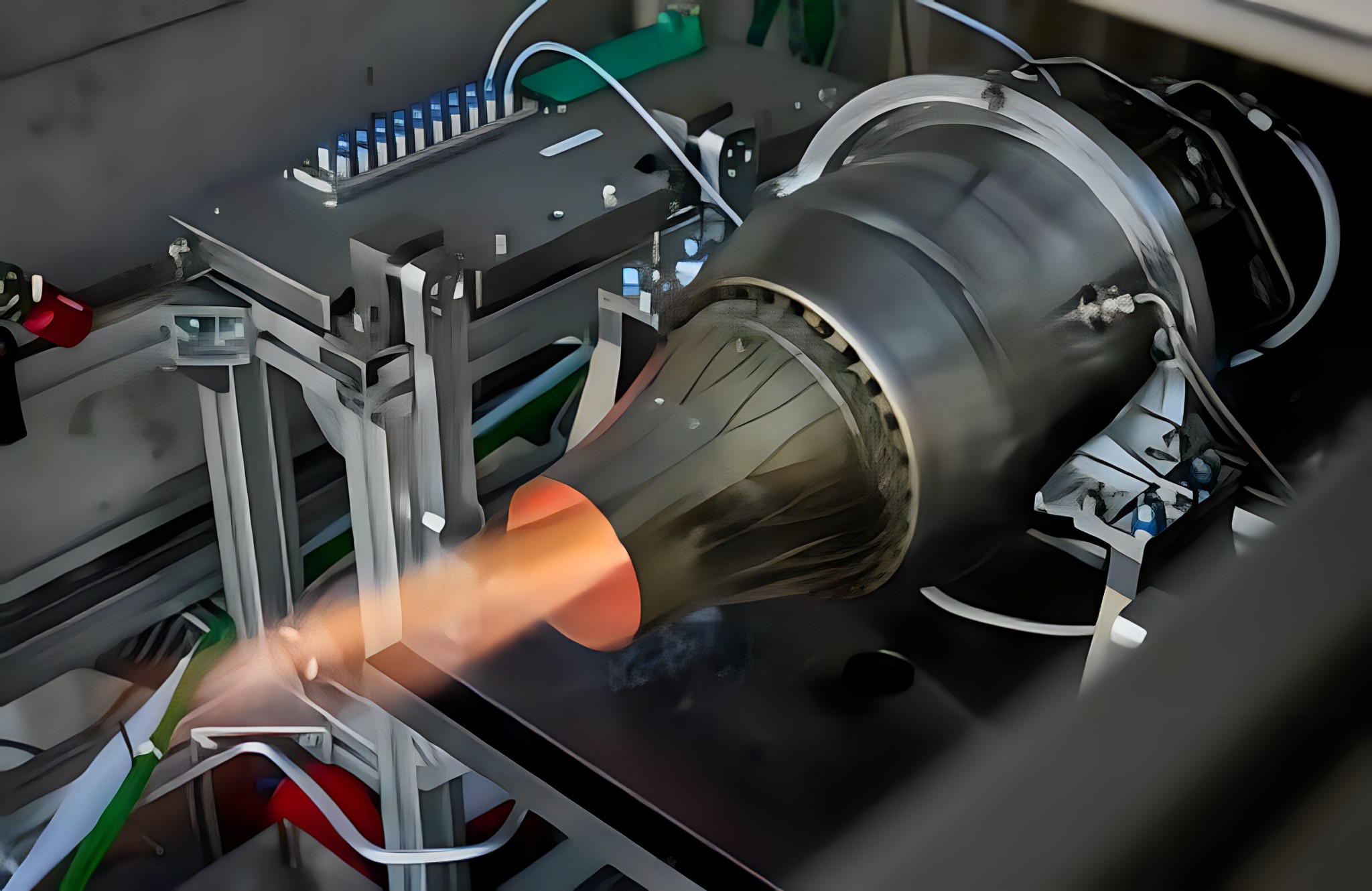
Britain has developed a new family of domestically produced turbojet engines, with one design taken from the drawing board to the air in less than seven months and a smaller engine already entering serial production, the Government has announced.
The programme is being run by the Ministry of Defence’s Strategic Capabilities Office with UK start-up Alloyed, combining government investment with matched funding from the company to establish a sovereign British propulsion capability for future weapons and aircraft.
The family spans engines producing between 30N and 2,000N of thrust, covering potential applications ranging from relatively small uncrewed aircraft to larger systems.
Two engines have already moved beyond the initial development stage. A 300N-class engine has completed flight testing and is now in serial production in the UK, while a larger 1,100N-class design progressed from its initial concept to flight-ready status in less than seven months.
The Government said the work had established the ability to design, manufacture, test and support this class of engine domestically, reducing reliance on overseas propulsion supply chains.
Defence Readiness and Industry Minister Luke Pollard said: “Taking a jet engine from concept to flight-ready in just a matter of months shows how defence and industry can work together to deliver capabilities at the speed required by today’s world.”
He added: “The threats we face demand the ability to produce cutting-edge technology on demand and at scale – this programme delivers that, combining sovereign manufacturing, digital engineering and industrial innovation to ensure our Armed Forces retain an operational advantage, while delivering good jobs for working people here in the UK.”
Digital design and production
The engines have been developed using a digitally led engineering and manufacturing process intended to reduce the time between design, testing and production.
Alongside the engines themselves, the programme has established a UK-based digital design and modelling capability which the Government says can be used to develop new propulsion systems and variants in months rather than years.
The approach combines digital engineering with modular design, allowing elements of an engine to be changed or improved without requiring a complete redesign of the propulsion system.
Alloyed chief executive Michael Holmes said: “Working alongside the Ministry of Defence has enabled Alloyed to bring to bear its world-leading metals technologies to mature and demonstrate advanced propulsion systems at remarkable pace while building a lasting capability in the UK.”
He added: “This programme shows the power of combining defence expertise, digital engineering and industrial innovation.”
The 30N to 2,000N thrust range would allow the underlying technology to be applied across systems of markedly different sizes, while the modular architecture is intended to make later adaptations easier as operational requirements change.
Production expanding in Britain
More than 60 engineering and advanced manufacturing jobs have already been created through the programme, according to the Government, with a further 45 positions expected during the next 12 months as production increases.
The work also involves more than 40 suppliers across the UK, most of them small and medium-sized businesses.
The co-development model differs from a conventional procurement in which Defence specifies a finished system and then purchases it from industry. Instead, the Strategic Capabilities Office and Alloyed have jointly funded and developed the technology, with the aim of shortening development cycles and retaining the resulting industrial capability in Britain.
The Government said the programme supports commitments in the Strategic Defence Review to strengthen the domestic defence industrial base and increase the speed at which new technology can be developed and fielded.
There is also an export ambition, as Ministers said the propulsion technology could eventually be offered to allies seeking domestically supportable or resilient engine solutions, although no export customers or specific overseas programmes have yet been announced.
For now, the most concrete result is the move into production of the 300N-class engine and the rapid development of the larger 1,100N design, giving Britain a new domestically based turbojet development and manufacturing capability spanning a much wider family of future systems.











Two 2kN class engines is what is supposed to power MGI’s Vortex ultra cheap ACP, so being able to produce a lot of them is a good thing. Also the 1.1kN designs power MGI Tigershark, for Project Brakestop.
For old fashioned people like me, who are used to thrust being quoted in pounds, a newton equals 0.224808943 pounds of thrust.
Thank you.
Cor! I bet Rolls Royce, BAEs and the Usual Defence Contractor Suspects are spitting nails at this hyperspeed development by small and emerging companies!
Actually I believe some of the big companies are working with SME’s to exploit their responsiveness and innovation. If I remember correctly both Babcock and BAE Systems have schemes / relationships in this space. I believe that BAE Systems also own an SME but has kept it as a separate entity so as to maintain it’s business agility.
Sorry I can’t remember the specifics of each example…
Cheers CR
Kirintec is an SME owned by BAE
I would imagine the design considerations for conventional aircraft engines can be largely disregarded. Hence the rapid development time.
As the engines won’t have a long life, little consideration to fatigue resistance of components is required.
Heat resistance of materials again so long as the turbine can resist the heat for 1 mission is all that is required.
Possibly no requirement to drive an external gearbox and ancillary components.
Possibly a much simpler fuel system, with little need fir altitude fuel flow compensation if the drones only fly at low level
Great news! Industry can move quickly but is usually hamstrung by HMG indecision and prevarication – Then foreign predators come and buy up our best ideas. We end up losing the tech edge, exports, jobs. Hopefully this will not happen on this occasion.
Alloyed were founded in 2017 and are an Oxford University spin off using digital design and 3D printing. This has the advantage that their end product is ITAR and export restriction free. I believe they intend to franchise local manufacture to friendly allies and pass digital manufacturing files.
Will give PBS Aerspace and others a run for their money
O/T but drone related. The DT is reporting that Burnham is considering helping Saudi Arabia defend its east-west pipeline pumping stations from Iranian drone attacks.
This must be fake news because from what I have heard Britain is shit at everything.
It’s that same shitness that just saw Britains education system rated by PISA scores in the top ten in the world and Britain record the fastest growth in the G7.
All the news that no one in the UK main stream media wants to publish because Russian bots don’t magnify it on the internet.
“Britain’s education system rated by PISA scores in the top ten in the world”
Thanks to the Conservatives, right?
Good for the international reputation of the UK. I think Michael Gove will claim the credit. The downside has been the normalising of an academic template on the school curriculum through to age 16. The realisation now is dawning that this approach has led to neglect of vocational and technical streams which are more appropriate and motivating for large numbers of pupils post 14. Hence the current emphasis on pathways to apprenticeships.
Yep. The sole focus on a few subjects at the expense of the rest, especially the creative subjects. Which have earnt this country a great deal of money in the past.
Hopefully, they will manage maintain what we currently do well while improving the vocational and technical streams rather than flip flopping from one extreme to the other. If they do manage that perhaps folks will realise that building on the achievements of previous governments rather than simply undoing everything out of political dogma is far more effective.
We need to achieve more political consensus between parties if we are to weather the developing economic storms and potentially international conflict.
Cheers CR
The 1944 education act envisaged grammar, technical and secondary schools: not dissimilar to the (succesaful) model the Germans ran with for a long time. But post war there was only the money for 2 types of school – grammar and secondary, which did good technical / vocational training. The movement to comprensive schools espoused the idea of ( high status) grammar (academic) education for all. In so doing it implicitly denigrated secondary ( and therefore technical and vocational) education. The labour push for 50% of pupils to go to university and the conversion of polytechics to universities reinforced the trend. We now see the result – disenchanted and indebted university graduates, disillusioned and disenfranchised school young people not in training or enployment and skill shortages in key defence industries. This is result of electing political leaders with Oxford degrees in PPE , Classics and Geography….Brexit means Brexit!
Hi Paul I suggest you read the German press and see what they are saying about their PISA scores.
The Germans are certainly not praising their education system and singing its praises as the continue narrowly emerges from four years of recession.
My knowledge of the german system is a generation out of date: the gymnasium, hauptschule, realschule model was based on the psychology of how people tend to learn whuch is fairly good simplification but by definition can be limiting. I understand that some states have introduced gesammtschule ( comprehensive) schools but most states still rely on their traditional system. Its served them well – i like my Neff oven and Bosch tools.Thing is the world is changing so it needs to change. Smartest thing the UK govt is proposing is technical / vocational streams at 14….a lot of dissillusioned pupils will bw heaving a sigh id relief…school attendence will improve a lot
Well done Paul. p got to find those negative comments some where. Can’t just be a well done to the UK for once 😂
Well done achieving the target….sadly management by target usually results in perversion of process, bad impact on morale and poorer overall qualilty. The process needs to be fixed. (W Edwards Deming). This govt are on the case.
P.s. The Lord loves a repentent sinner….even a labour one😂
😀
Exactly.
Correct Paul. Our education system is far too inflexible – and prejudiced.
It’s been a long journey. Govts of all colours have been moving ‘at pace’ to implement the technical and vocational ambitions of the 1944 education act. Here we are in 2026 and we have already decided to introduce technical and vocational pathways at age 14. Makes you proud to be British. 🙂
Yes and labour too. Not everything has to be party politics and it’s taken a long time to get the UK to that world class level over successive governments. The most important thing the Tories did for the scores was allowing mass migration from Asia and Africa (Boris’s Wave) as the immigrants children have performed significantly better than white ethnic British who are the lowest scorers in the UK.
They did a good focused bit of work on improving English and maths.
But they were shocking at vocational qualifications.
There is no such thing as British education. England, Scotland, Wales, and Northern Ireland have been pursuing their own education policies for quite some time.
England has done okay, the rest not so much…
Blair’s Britain
I suggest you read the OECD report.
In references at the United Kingdom (commonly referred to as Britain) in all international comparisons.
The OECD do not run education in Britain.
England, Scotland, Wales, and Northern Ireland have been pursuing their own education policies for quite some time.
Education (a devolved matter) in Scotland, Wales is a disaster, in Northern Ireland going backwards…
Blair’s Britain
Yes but they do run the PISA test which is what we are discussing
There is no such thing as British education. England, Scotland, Wales, and Northern Ireland have been pursuing their own education policies for quite some time, PISA results showing England, where the curriculum is significantly different, pulling consistently ahead of Northern Ireland, Scotland and Wales.
Blair’s Britain
‘Run by the Organisation for Economic Cooperation and Development (OECD), the Pisa tests assess teenagers on their ability to solve problems, think critically and communicate, before asking them a wider range of questions about their education in a questionnaire.
Although the UK performed well overall, the rankings varied significantly again, with results showing England, where the curriculum is significantly different, pulling consistently ahead of Northern Ireland, Scotland and Wales.’
BBC 08 Sept 2026
Yes, that’s my exact point.
As you will no doubt be aware almost everyone (vast majority) of people who live in Britain live in the southern part of the island commonly referred to as England.
England, Scotland, Wales, and Northern Ireland have been pursuing their own education policies for quite some time, PISA results showing England, where the curriculum is significantly different, pulling consistently ahead of Northern Ireland, Scotland and Wales.
Blair’s Britain
Nuffin rong with welsh education, we woz brung up rite to speak propper english like wot I does init!
Scotland and wales have run their own education systems for hundreds of years. Tony Blair not involved.
1998 Scotland Act devolved responsibility for education to the Scottish Parliament. In 2010, the SNP, with the support of other parties, introduced the “Curriculum for Excellence”. It downgraded the status of knowledge and adopted a competence-based approach, emphasising the development of transferable skills and interdisciplinary learning.
This is in line with a growing movement in western education that discipline-based knowledge is becoming outdated in a world of Google and artificial intelligence, and that we would be better off focusing on skills children can one day apply to jobs that don’t even exist yet. It’s a theory with considerable traction. But the problem is that it is only that: a theory, based on zero evidence.’
Blair’s Britain
Wow, great news and much better than millions and years spent having a think about something!
Interesting that the lead picture is computer generated.
Good progress for sure. With British engine expertise I’d have thought this to be pretty simple.
Unless Drone engines are such a different beast?
Well this isn’t the bleeding edge of tech stuff. This is good enough to do the job. Which is all you need for the low/mid level effectors.
What till the Good Ideas Committee get at it and “if only we could do that” and “that isn’t too much of an ask” loop a few hundred times as your nice simple cheap items has turned into…..
You get the idea…..
Hello mate,
As SB says the manufactured tech isn’t necessarily the leading edge tech…
So I guess it depends on the role and size of the drone. Small usually means much simpler. I remember being shown a small single cyclinder engine for model aeroplanes when I was still at school. It was very very simple but had a very impressive power to weight ratio and that’s the point small usually leads to simplicity plus these guys are into 3D printing which can produce components that historically could only be produced as a sub-assembly. So these engines will be pretty straight forward to build, although that isn’t same as low tech. The technology used in the design and manufacturing sounds pretty Gucci to be honest.
Bigger the drone gets, the bigger engines will get and so more complex as you will need more electrical power for systems and bigger lumps of metal retain head better, for example, than small objects so you need more cooling and lubrication meaning bigger engines get more complicated.
So to answer your question Drone engines are different beasts but size and mission will determine just how different they are. With drones different would usually mean simpler and cheaper, especially for the one way variety, but for bigger recce strike drones the engines would likely be very similar, if not actually the same, as those used on light aircraft.
Hope this helps, mate.
Cheers CR
Thank you mate. 👍
No not really, the lower powered versions are nothing more than scaled up RC jet engines.
The vast majority of these low powered jet engines use a centrifugal (1 or 2 stage) compressor with an axial turbine section layout rather than a pure axial flow. As this gives good enough performance, but is significantly cheaper to design and build. This starts to get a bit more interesting in the 2000N/200kg range. As we start to see a mix of centrifugal, centrifugal hybrid (includes some additional axial flow compression) and straight axial flow designs. A pure axial flow is a relatively complex beast and requires the correct number of compression stages to be effective, which adds to the complexity and cost.
For a one way effector, you want an engine that is cheap and quick to produce, is pretty robust, so can be manhandled in the field. But is also very reliable, as it can sit on a shelf for 5 years. But with fuel and ignition, must be capable of starting up first time on demand. The centrifugal engine, is probably the best suited for this low power requirement, as the engine’s main shaft will only need a few bearings to hold the compressor and turbine section. Where slip bearings would add robustness and longevity, when placed in storage.
I’m pretty certain that Alloyed are metal 3D printing the centrifugal compressors in a single piece, rather than having to have them 5-axis milled or having complex multi-part axial designs.
The simple fact is that western development times and production rates are generally way down on what should be acceptable. Using and developing present technolgy and having the support of a government willing toinvest in defence with orders rather than making everything cutting edge, brand new technology and still in the research stage slows the time to get a product ready for production while not having enough orders slows delivery times. We can’t afford all that these days.
Yes your right Rob, China did way better on developing jet engines quickly which is why they now have a massive domestic aerospace industry 🤔🤦♂️🤣
Some corners just can’t be cut 😀
They can be cut if you copy other folks design via espionage and ignore intellectual property rights.
Fingers keepers, losers weepers the Chinese are a pragmatic bunch.. if you can buy it buy it if you cannot buy it steel it.
On the other hand you don’t have to start everything from scratch.
Yes, they tried that but unfortunately for them there is alot more to Airbus and Rolls Royce or Boeing and GE than you can simply copy. The C919 has been a commercial disaster even using large amounts of western components and a total rip off of Airbus design.
The Chinese did a shitload more than just “tried it”.