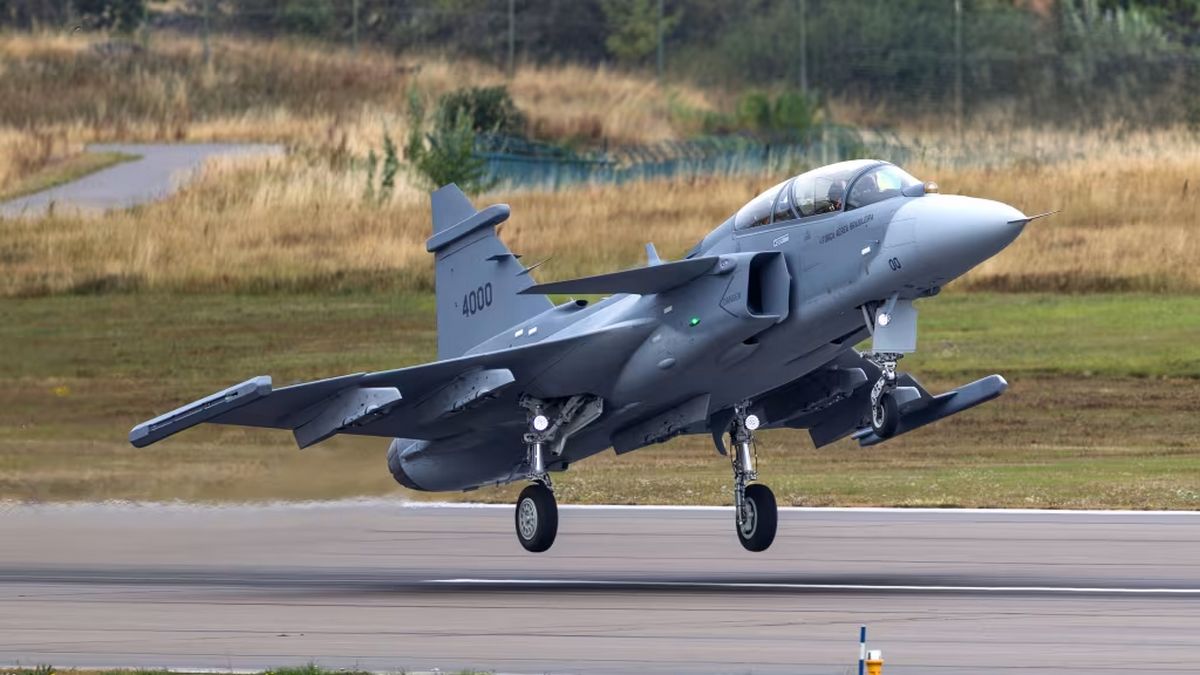
Saab has won an order worth 1.3 billion Swedish kronor, around £100 million, from the Swedish Defence Materiel Administration to develop a new generation flight control computer for Gripen, with deliveries planned during 2030, according to the company.
The new computer will replace the version currently flying, and Saab said it has been designed to meet long-term requirements for availability, performance and security of supply. The work will be carried out in close cooperation with FMV, the Swedish procurement agency.
Marcus Wandt, head of Saab’s business area Aeronautics, said: “We look forward to continuing our close collaboration with FMV. The new flight control computer will contribute to Gripen’s capability and performance for decades to come.”
Saab described the flight control computer as a central component in Gripen’s flight control system, contributing to safe and precise manoeuvring of the aircraft. That understates it. Gripen is aerodynamically unstable by design, a configuration chosen to make it more agile, and the aircraft is only controllable because the flight control system makes continuous corrections faster than a pilot could.
A flight control computer designed in the 1990s runs on processors and components that stopped being made years ago, and keeping a fleet airworthy eventually means buying obsolete parts from brokers or redesigning the box. Sweden is choosing to redesign it, and specifying a new one now lets the design use components the country can be confident of sourcing through the 2050s, which is how long Gripen E is expected to serve.
The order follows a pattern set earlier this month, when Saab reached an agreement with GKN Aerospace covering the Gripen engine, the RM16 that GKN’s Swedish operation builds from the General Electric F414 under licence. Taken with this contract, Sweden is working methodically through the parts of Gripen that depend on foreign supply chains and bringing what it can under domestic control.
Gripen E has had a strong run commercially over the past few years. Brazil is building the type under licence, Thailand has ordered it, Peru signed for a batch last year, and Ukraine and Sweden have signed a letter of intent covering a potential order of up to a hundred or more aircraft.
The British connection runs through GKN Aerospace, headquartered in the United Kingdom, whose Trollhättan site in Sweden produces the Gripen engine, and through Saab’s growing British footprint.