

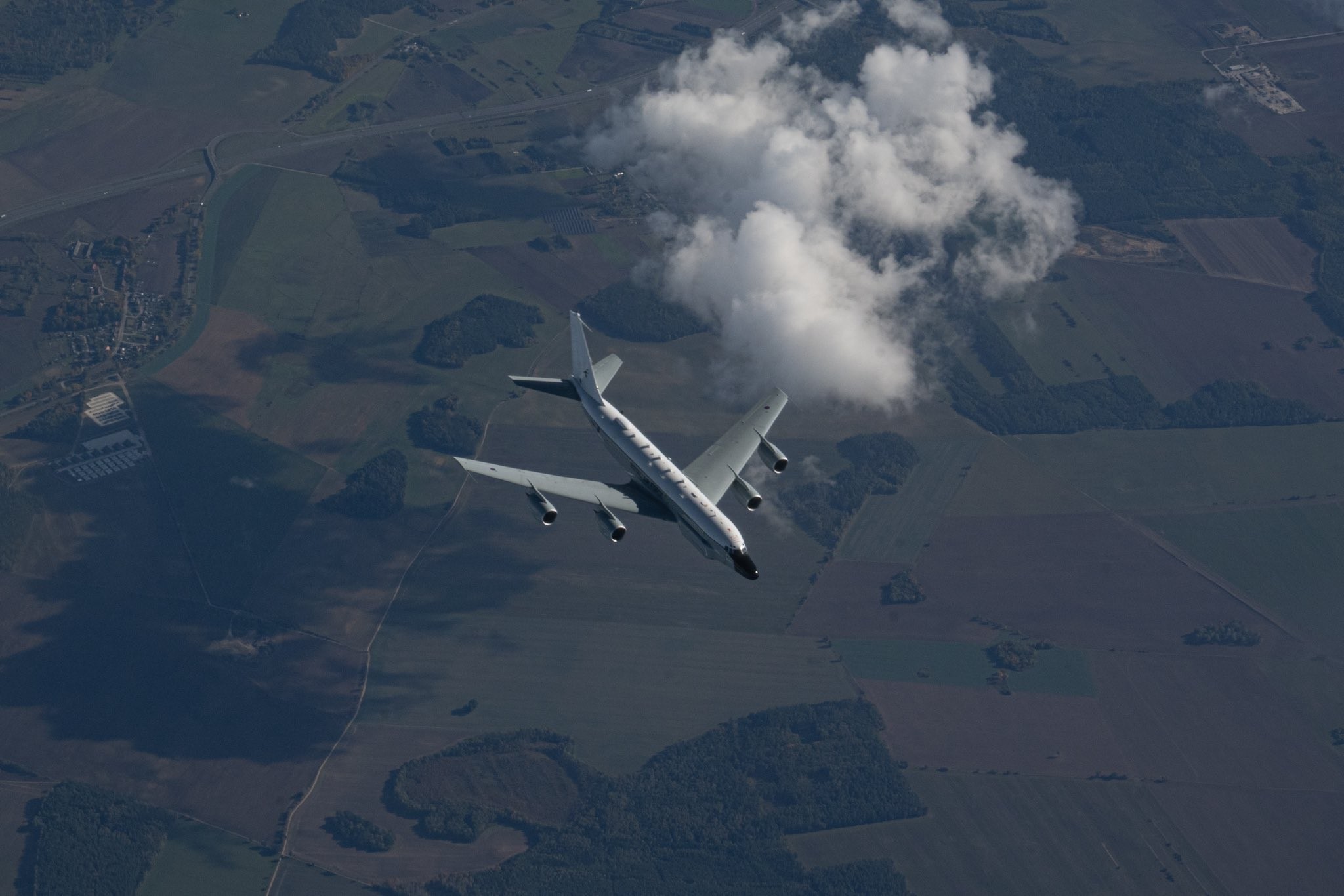
An RAF Rivet Joint has deployed to Ørland in Norway for a week-long exercise with the Royal Norwegian Air Force, including training intended to improve interoperability with Norwegian F-35A fighters.
An RAF Rivet Joint intelligence-gathering aircraft has deployed to Ørland in Norway for Exercise Arctic Stone, where British personnel are training alongside the Royal Norwegian Air Force and working with Norwegian F-35A fighters, the UK Defence Journal understands.
According to an RAF news update, the activity is intended to strengthen interoperability between Rivet Joint and Norway’s F-35A fleet while contributing to NATO’s situational awareness on its northern flank.
Operated by 51 Squadron, the RAF’s Rivet Joint specialises in gathering intelligence from signals across the electromagnetic spectrum. Sensors aboard the aircraft allow its crew to intercept and analyse signals while airborne, providing strategic and tactical intelligence that can contribute to a wider picture of military activity and the surrounding security environment. Ground-based specialists from No. 54 Signals Unit also process and exploit the information gathered by the aircraft.
The RAF described the aircraft’s role by stating: “The aircraft specialises in monitoring signals across the electromagnetic spectrum, giving it the ability to deliver real-time strategic and tactical intelligence in a way few other assets can match.” It added that the combination of airborne crews and ground specialists provides commanders with improved situational awareness “day and night, whatever the operational conditions.”
Exercise Arctic Stone is using that capability in two connected roles. RAF personnel are training directly with their Norwegian counterparts, including activities designed to improve cooperation between the Rivet Joint and Norway’s F-35A force, while the intelligence gathered during the deployment is intended to give commanders a clearer assessment of the operating environment.
The RAF said the exercise would allow both air forces to improve their ability to work together within NATO operations.
Norway’s location makes it particularly relevant to NATO operations in the High North, where the Alliance maintains air, maritime and surveillance activity across an area extending towards the Norwegian and Barents Seas. The RAF said the deployment reflected what it described as the region’s “growing strategic importance” and its increasing relevance to NATO’s northern defences and wider European security.
The service said: “As the security picture in the region continues to evolve, the presence of RAF assets working alongside key allies and partners in the area is becoming an ever more important part of how NATO maintains stability on its northern flank.”
Rivet Joint’s role differs from that of conventional airborne surveillance aircraft because its principal focus is the detection and analysis of electromagnetic emissions rather than visual reconnaissance alone. The RAF argues that modern intelligence operations increasingly require information from multiple sources to be combined, particularly as military communications, sensors and other systems become more digitally connected.
The deployment also provides an opportunity to test how intelligence collected by the aircraft can support other platforms operating in the same battlespace. Integration with Norwegian F-35As is intended to improve the exchange and use of information between different aircraft types, while giving personnel experience of operating within a multinational NATO environment.





Good to see the RAF operating in the high north with our Norwegian friends.