

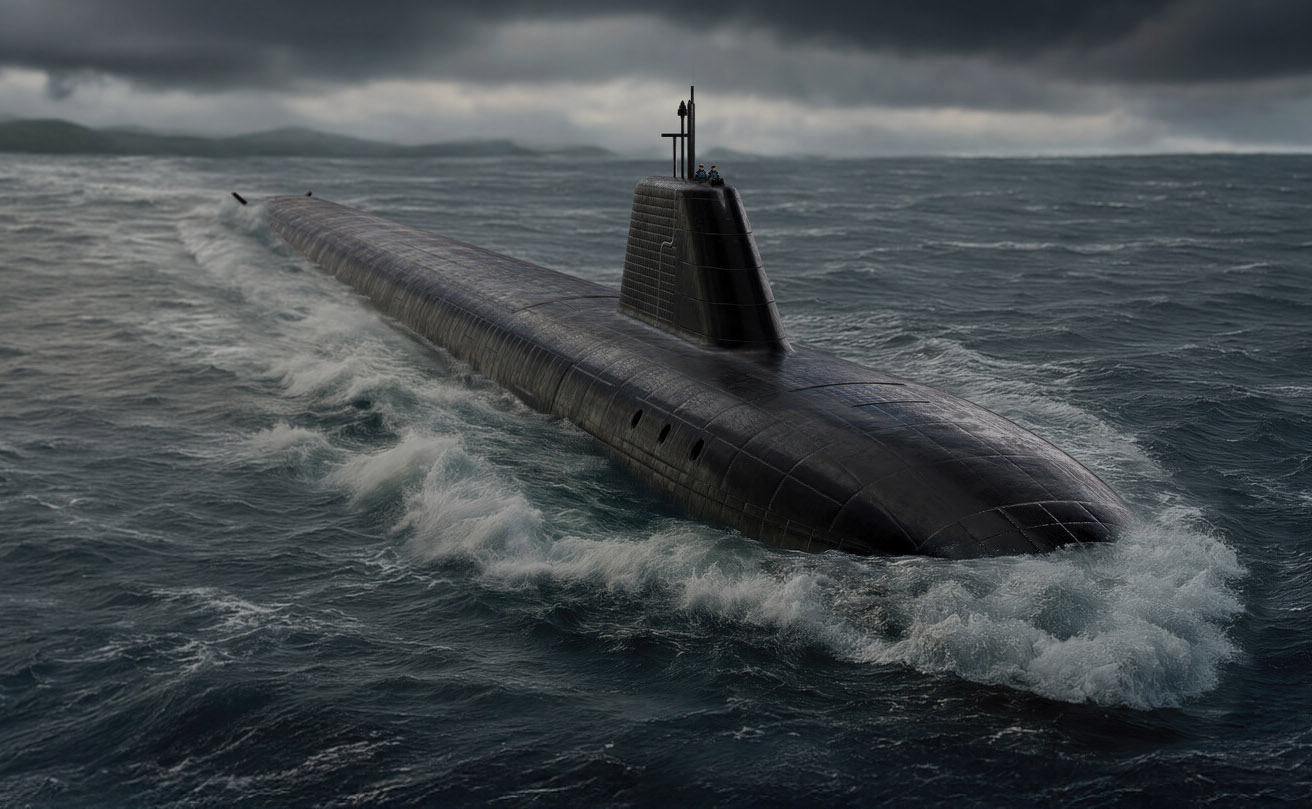
A contract within the supply chain for Britain’s new Dreadnought-class nuclear ballistic missile submarines was terminated following security reviews by the Defence Nuclear Enterprise, the Ministry of Defence has confirmed.
The disclosure came in response to a written parliamentary question from Conservative MP Ben Obese-Jecty, who asked the Defence Secretary about a “fruitless payment” associated with the Dreadnought supply chain recorded in the MOD’s Annual Report and Accounts for 2025-26.
Defence Minister Luke Pollard replied: “A contract within the Dreadnought supply chain was terminated following security reviews by the Defence Nuclear Enterprise. The detail is unsuitable for disclosure due to the classification and sensitivity of the programme.”
The answer does not identify the contractor, of course, or the part of the Dreadnought programme affected or the circumstances which led the Defence Nuclear Enterprise to terminate the agreement.
The reference to a fruitless payment comes from the MOD’s annual accounts. Such payments are recorded in government accounts where expenditure has been incurred without the intended benefit being received, although Pollard’s answer does not provide the value or nature of the payment associated with this particular case.
The Dreadnought programme is delivering the four submarines intended to replace the Royal Navy’s existing Vanguard-class boats and carry the UK’s submarine-launched nuclear deterrent. Construction is centred at BAE Systems’ submarine shipyard in Barrow-in-Furness, supported by a large industrial and nuclear supply chain across the country.
The programme sits within the wider Defence Nuclear Enterprise, which covers the organisations, infrastructure, personnel and industrial capacity needed to support Britain’s nuclear deterrent. Security controls around the enterprise are correspondingly stringent, with detailed information on individual suppliers and sensitive components often withheld.
The first Dreadnought-class submarine, HMS Dreadnought, is being built alongside the other boats in the class as the Royal Navy prepares to transition from Vanguard while maintaining continuous at-sea deterrence.






OT.
Seen a graphic being shared on X of scale comparisons between Brontanax, Typhoon, and Tempest.
If accurate, Tempest is huge. I wonder if it’ll fit in the RAF HAS.
Talking of HAS, the MoD is looking for 120 pre cast concrete barriers for the dispersal areas at RAF Akrotiri.
Better than a sunshade tent, but why do we not build proper HAS? Better than nothing, our assets remain lined up like skittles.
And why are the RE not being tasked for this? This was standard back in RAF Germany when airfields had a RE ADR Squadron allocated.
Finally, reports that the Army is being told to stop all non essential training for non deploying to save £30 million.
If true, another example of penny pinching while politicians talk a good game about war footing and expansion, the money simply isn’t there yet, and probably never will be.
It’s a ridiculous state of affairs, our government is happy for us to become the laughing stock of NATO. How can we keep our citizens safe if we can’t train the men and women tasked with doing just that?
Yep, I am intrigued as to what ‘non-essential training’ for the Army actually is, but I’m sure Messrs Burnham,Healy,and Streeting have that accurately defined & designated. I’m confident ,for example.,that any diversity training modules would be excludef from any cut – far too important for the safety of the UK.
Tempest is big, but only to Europe. It’s not significantly larger than the Japanese F-15Js or the Russian and Chinese Flankers.
I have seen costs upwards of £200m, and even up to £500m, per unit, though the latter to me seems highly, highly, unlikely.
Same dimensions as big fighters like the F15 or Flankers, but the big delta gives much more internal volume than on any single seat aircraft yet. Will probably be quite a bit heavier.
658038735954465 I can see that unit price dropping considerably if it is an export success, and it looks like it could be the best available for export. The Americans won’t want to export the F47 (or else a very dumbed down version with lots of strings attached), the French led FCAS project has collapsed and other than China there is nobody else with a credible 6th gen project.
The problem is with those two vertical stabilisers in the mock-ups; the Tempest cannot be 6th gen, more 5.5. That’s why the F47 and the Chinese 6th-gen rely on thrust and horizontal control surfaces, with flexible skins covering the gaps between them and exhaust mixed with cold air to reduce the tail heat source. Unless BAE has been throwing everyone off the wrong track, Tempest will not be 6th-gen. So you have to wonder why it’s costing so much when it did so much of the work on the F35, or am I wrong?
As I understand it the model airframe is not the final design, it was something thrown together at an early concept stage that has not yet been finalised. Even the demonstrator scheduled to fly in the next year is not going to be the final airframe design, it is just there to demonstrate some of the capabilities it will have.
The finished produce will probably look very different to what we have seen. I doubt BAe Systems is incapable of building airframes with tail-less designs because Tarranis didn’t have them, but it remains to be seen.
I’m so confused by Labour promises. They’re making a higher % of GDP available for military spending… while demanding the military saves hundreds upon hundreds of millions. They recently promised energy prices would fall from October, but immediately after that, fuel prices went up. I’m not sure what kind of broken logic this is but I can’t follow it.
I mean 30m saving for training seems like the wrong thing to cut on imo BUT in principle we should always be looking for value for money or even with more money spent we won’t get the outputs we are all expecting
Also annoyingly politicians (and Businesses) claim efficiencies while delivering LESS capability and talking it up as more — so the ‘efficiencies argument’ has a genuinely bad rep, rightfully so given how it’s abused
On energy, as I understand it the causal factors are the Iran war, that’s unavoidable while all our energy is priced on the global market. The real break through with all this energy generation capacity being built would be when we break the link between energy we generate and it being priced against the global market
No matter what you think of net zero, its role as party of our security strategy is good for the UK: It’s a partial reason why global powers including the US have influence on us (one way or another) because 1) Our Bases 2) They know global events impact us too, so it becomes in our interest to intervene globally, perhaps even more than we would actually like to in some cases)
I know the cost of net zero energy generation is trending cheaper than fossil fuels buuuut it would be nice to see how this positively translates to me as an everyday consumer
Yes Tempest has been designed from the outset for range and payload. The range although classified is said and I quote ‘phenomenal.’
The graphic I saw had it dwarfing a Typhoon and closer to a Vulcan, a huge, huge wing area.
Yes I was told the wing area is slightly larger. Don’t be fooled by the size it’s agility will match any fighter.
No worries, I’m not. It needs to be big.
From what I have seen it’s 15% larger than the F15. No where near large as the Vulcan. It will need the legs as that’s the Japanese main consideration. It will easily cross the Atlantic on internal fuel tanks.
I see Tempest as more along the lines of the Avro Arrow for high Arctic long-range interceptions. If it also can carry a chunky size stand-off missile, or hard-iron gliding thing along the lines of a Tallboy or better then also great. Else we are going to have to get some strategic bmers.
I have also mentioned on this forum the need to standup more RAF squadrons and reclaim at least one aerodrome for that, and far away from Marham. In terms of large hardened aircraft shelters I like the proper jobs at former RAF Hullavington and Kemble as examples. If pushed Upper Heyford still has a runway and American hardened shelters. Last time I looked it still had all the F111 aircraft tallies up un the Ops Board in the HQ.
Replied, but it ended up down thread, sorry.
Only problem is those aren’t HAS, they are just RAF WW2 Standard D (Kemble) and L Type (Hullvington) steel framed hangers. They are decades older than NATO HAS and there are numerous examples around the country. Interestingly during the Cold War some of them were reinforced and turfed over for camouflage but they are not bomb proof, spookily they have mainly had that turf removed and had to have the roofs replaced.
…thought they could at least help with small FPV drone attacks.
Ah, is that what they are called…always wondered, thanks mate.
The ones I have in mind look like HAS, but much bigger, Shawbury houses the reserve fleet in some.
“Such payments are recorded in government accounts where expenditure has been incurred without the intended benefit being received…” – that’s a dangerous precedent to be setting. The idea of the taxpayer actually getting what we paid for….
hide it, hush it up, and say its all ok nothing to see here while really its a shambbles like most things over budget, late, and taking up too much of our defence budget thats not really gone up its just clever accounting,
More dodgy Chinese components?
Share everyone’s concerns regarding cutting training, and for a paltry £30m…Something the Goverment wastes Every few hours…!
The termination of Contract…I hope the Relivant Committees in Parliament pick up on this and ask the right Questions to those Responsible..!
Did someone leave the WiFi on?
Hullavington ( now Buckley Barracks ) has large shelters? I can only visualise, not having looked at the place for a while, like those at Shawbury and Colerne, didn’t think they were hardened? Heyford has the HAS, thought the runway was part dug up and now an industrial estate, like Greenham, Bentwaters and Alconbury.
No shortage of HAS, just Sqns, aircraft and ground crews/station Wing staff to utilise them.
Boscombe, Leeming, Leuchars are available, and further HAS sites at Wattisham, Woodbridge, Honington, St Mawgan, though all with issues to make fully usable.
Leuchars and Leeming for me.
Just to say this doesn’t seem to have replied to the post you intended it to 🙂
Oooo thanks for the heads up.
I’d add St Mawgan as a dispersal site for the F35B as it’s nearer the carriers and the furthest HAS West in Western Europe ! Damned pretty place to boot. I worked it out once and we have over twice as many HAS in UK as the RAF has Fast Jets.
Hi mate. Yes, St Mawgan was on my list at the end.
I remember your story about you hanging out outside.😆
If the RAF got it’s act together, given the means, quite a few HAS as you say to disperse fast air in.
…yes Upper Heyford is compromised – though about 10-years ago the runway was still intact(ish). Binbrook for me, but think it is now stuffed. Just as long as we disperse any new squadrons and increase number of bases.
Binbrook has not been an MoD site for a long time, and is rudimentary, never having investment like HAS as the Lightning Force was drawing down.
Coltishall, now part prison I believe, was another example, no HAS as the Jags were to forward deploy to the flanks with AMF. Likewise Wittering and Cottesemore, the TTTE no HAS built or with Harrier meant for dispersal.
Ironically, some of these sites could act as dispersal for our few assets today if HMG invested in the people and facilities needed, which they won’t.