

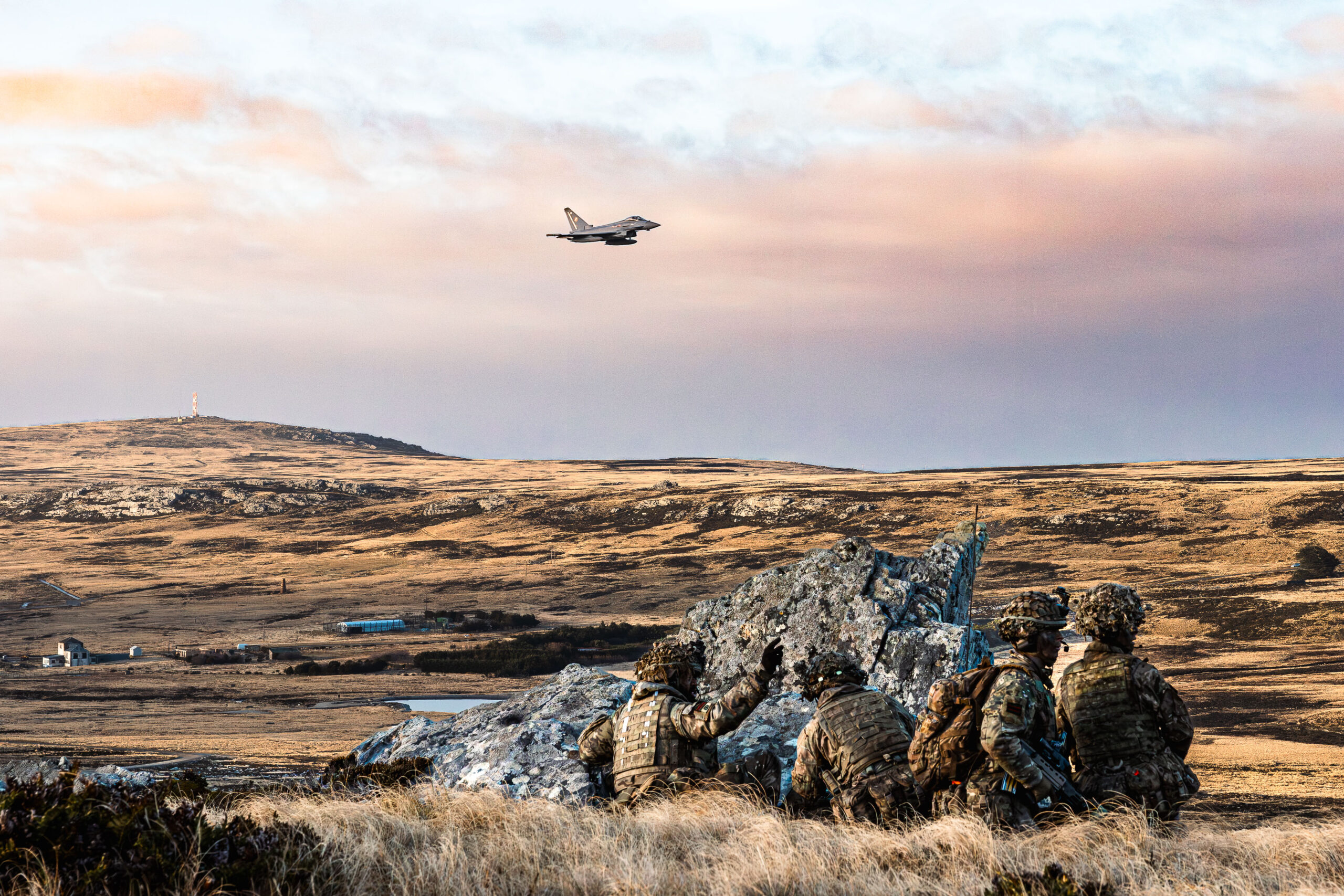
The four Tranche 1 Typhoons held by 1435 Flight in the Falkland Islands are to be replaced by four Tranche 2 aircraft drawn from the existing fleet during the rotation planned for late November to early December 2027, the Government have again confirmed.
Luke Pollard, Minister of State for Defence Readiness and Industry, was responding to Ben Obese-Jecty, the Conservative MP for Huntingdon, who had asked what steps have been taken to replace the aircraft when they are decommissioned in 2027.
Mr Pollard said: “The four Tranche 1 Typhoon aircraft currently assigned to British Forces South Atlantic Islands are scheduled to be replaced by four Tranche 2 Typhoon aircraft from the existing fleet during the aircraft rotation planned for late November to early December 2027. Following their return to the UK, the four Tranche 1 aircraft will be withdrawn from the Military Aviation Authority Register and enter the disposal process.”
He added: “UK F-35 Lightning remain available for global operational tasking in line with Defence priorities.”
The same answer was given to a separate question from the same member asking what discussions have been held with the American counterpart and the F-35 Joint Program Office on the future use of the F-35B in the defence of the islands.
Tranche 1 Typhoons are the earliest production aircraft, delivered from the early 2000s and built to a standard that has not been carried forward through the upgrade programmes applied to later aircraft. They have been progressively retired since 2019, and the remaining airframes have largely been used for training and for the Falklands commitment, where the demanding requirement is quick reaction alert rather than the full spectrum of modern combat capability.
Tranche 2 aircraft carry a more capable radar, avionics and weapons fit, and have received successive capability upgrades including the Phase 3 Enhancement package covering Storm Shadow, Brimstone and Meteor.
The replacement therefore represents a capability improvement for the South Atlantic rather than a like-for-like swap, though it is drawn from the existing fleet rather than from new production, which means the aircraft come from elsewhere in the Royal Air Force’s order of battle.



I have been looking into which Eurofighter has been in the Falklands and been very confused. One source would say Tranche 1, but another would say FGR4. Even the RAF website from 2023 says it has 4 FGR4 in the Falklands with images. This entry is on their site ‘2009 1435 Flight equipped with Typhoon FGR4’ At least I know now.
The tranche 1 interceptors are Typhoon F2, the F standing for fighter. The later tranche 2 and 3 aircraft, with their secondary ground attack capability, are FGR4, the FGR standing for Fighter/Ground attack, or maybe Fighter/ground attack/recon.
AFAIK, we have never based FGR4s in the Falklands. Suspect RAF website is simply wrong.
Why bring them back? If they are still operational keep them there and send four Tranche 2 aircraft down. Then we would have 8 total giving us more flexibility in allowing some being down for maintenance!
Problem one is that we would increase the maintenance burden, as the two types have different radars, sensors, weapons etc.
Problem two is that the RAF has a very limited number of fast jet combat aircraft, air crew and ground crew to spread around. We only have 5 Typhoon combat squadrons in the UK and they are down from 12 frontline aircraft to 10. That thin force gets even thinner when we send flights off to Estonia, Cyprus or wherever. The bottom line is that our Typhoon force is far too small to meet air defence needs and there is no prospect of increasing numbers, as the combat air budget for the next ten years is all committed to purchasing 27 F-35s and the big investment in Tempest.
Have they formally ordered the new F-35s yet?