

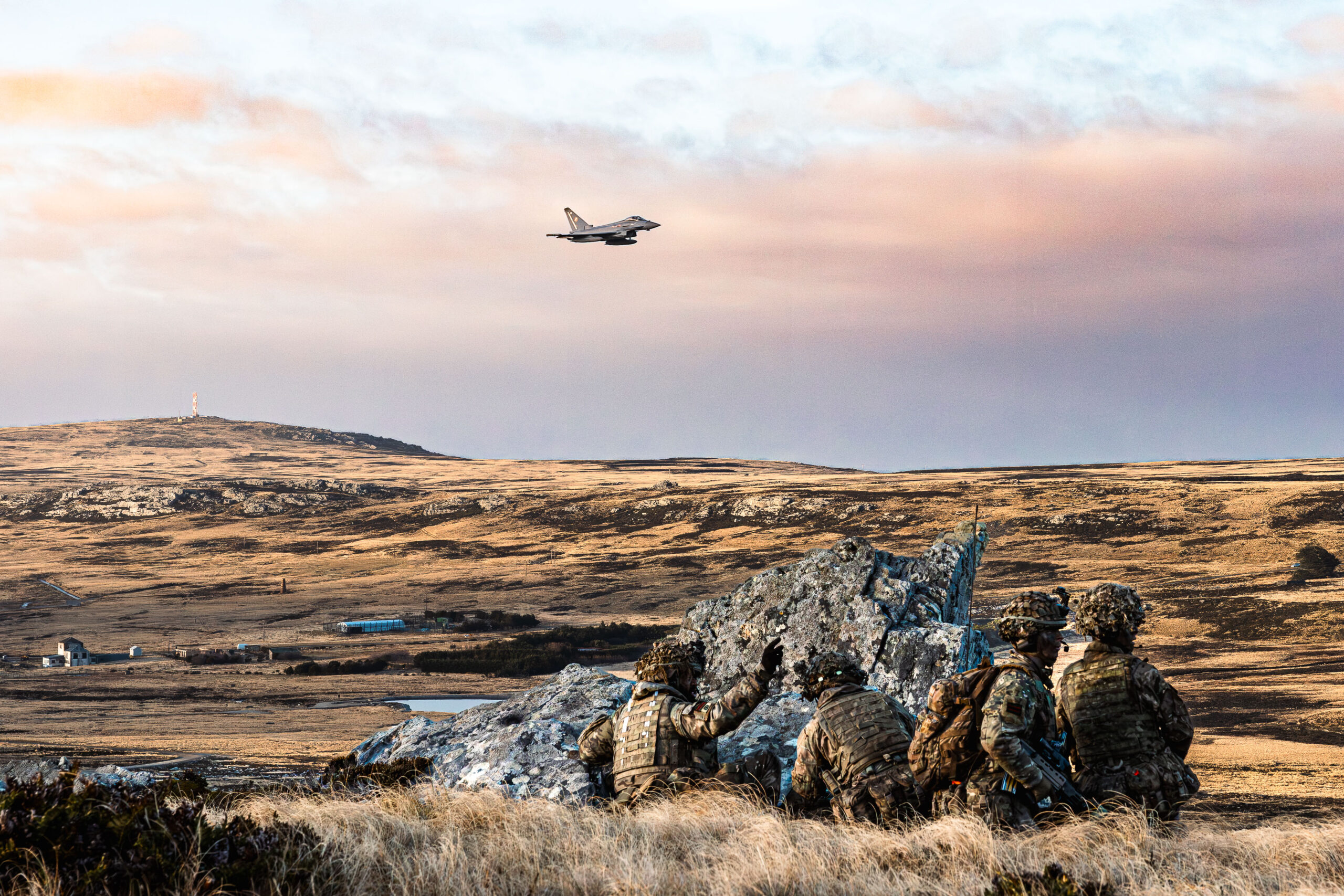
The four Tranche 1 Typhoons held by 1435 Flight in the Falkland Islands are to be replaced by four Tranche 2 aircraft drawn from the existing fleet during the rotation planned for late November to early December 2027, the Government have again confirmed.
Luke Pollard, Minister of State for Defence Readiness and Industry, was responding to Ben Obese-Jecty, the Conservative MP for Huntingdon, who had asked what steps have been taken to replace the aircraft when they are decommissioned in 2027.
Mr Pollard said: “The four Tranche 1 Typhoon aircraft currently assigned to British Forces South Atlantic Islands are scheduled to be replaced by four Tranche 2 Typhoon aircraft from the existing fleet during the aircraft rotation planned for late November to early December 2027. Following their return to the UK, the four Tranche 1 aircraft will be withdrawn from the Military Aviation Authority Register and enter the disposal process.”
He added: “UK F-35 Lightning remain available for global operational tasking in line with Defence priorities.”
Readers will note that this is, obviously, unconnected to the current tensions, but it’s important to remind people.
The same answer was given to a separate question from the same member asking what discussions have been held with the American counterpart and the F-35 Joint Program Office on the future use of the F-35B in the defence of the islands.
Tranche 1 Typhoons are the earliest production aircraft, delivered from the early 2000s and built to a standard that has not been carried forward through the upgrade programmes applied to later aircraft. They have been progressively retired since 2019, and the remaining airframes have largely been used for training and for the Falklands commitment, where the demanding requirement is quick reaction alert rather than the full spectrum of modern combat capability.
Tranche 2 aircraft carry a more capable radar, avionics and weapons fit, and have received successive capability upgrades including the Phase 3 Enhancement package covering Storm Shadow, Brimstone and Meteor.
The replacement therefore represents a capability improvement for the South Atlantic rather than a like-for-like swap, though it is drawn from the existing fleet rather than from new production, which means the aircraft come from elsewhere in the Royal Air Force’s order of battle.
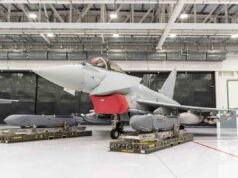



I have been looking into which Eurofighter has been in the Falklands and been very confused. One source would say Tranche 1, but another would say FGR4. Even the RAF website from 2023 says it has 4 FGR4 in the Falklands with images. This entry is on their site ‘2009 1435 Flight equipped with Typhoon FGR4’ At least I know now.
The tranche 1 interceptors are Typhoon F2, the F standing for fighter. The later tranche 2 and 3 aircraft, with their secondary ground attack capability, are FGR4, the FGR standing for Fighter/Ground attack, or maybe Fighter/ground attack/recon.
AFAIK, we have never based FGR4s in the Falklands. Suspect RAF website is simply wrong.
I get the letter designations. I was just confused which information was correct. At least this being a newer article confirms what is happening.
Pretty sure it’s the latter, as the RN Phantoms we’re FG.1 whereas RAF variant was FGR.2, suggesting the R is for reconnaissance
Why bring them back? If they are still operational keep them there and send four Tranche 2 aircraft down. Then we would have 8 total giving us more flexibility in allowing some being down for maintenance!
Problem one is that we would increase the maintenance burden, as the two types have different radars, sensors, weapons etc.
Problem two is that the RAF has a very limited number of fast jet combat aircraft, air crew and ground crew to spread around. We only have 5 Typhoon combat squadrons in the UK and they are down from 12 frontline aircraft to 10. That thin force gets even thinner when we send flights off to Estonia, Cyprus or wherever. The bottom line is that our Typhoon force is far too small to meet air defence needs and there is no prospect of increasing numbers, as the combat air budget for the next ten years is all committed to purchasing 27 F-35s and the big investment in Tempest.
Quite right, “a stitch in time !!!”
Prevention is far better than cure – in lives saved, equipment saved and money saved.
It also sends out a message of intent to a Third World Dictatorship
For goodness sake yes.
Have they formally ordered the new F-35s yet?
no – not yet
The cuts to my former service continue. We’re not fit for sustained operations at scale. The major problem will be in a few years time as the failure to order more airframes puts Typhoon force in a similar position to the T23 fleet. Sheer madness from a govt hell bent on self destruction
As a sign that the UK Gov takes current threats seriously, I’m using the purchase of a batch of 40+ Typhoons, as a litmus test. Obvs more pilots, ground crew, squadrons, and bases needed too. Needles to say, it has not come.
No, because the money is not available. The money available is going on Typhoon upgrades, F35 and Typhoons replacement, Tempest. Have you any idea how much it’s costs for 40 more Typhoons? And the extra pilots/engineers/maintenance and through life cost?
It’s a choice Robert: head in the sand or lean the lessons from history? I see this as a 1938-type moment as far as UK/Russia goes. Add in the Argies looking for the slightest weakness to land say special forces after which then there is no-way the UK will be able to retake the islands given current circumstances. So show strength and spend now into UK defence industry to deter a conflict, and save a whole lot of money in the long-run if the balloon goes up.
I’m sorry, but Argentina landing special forces on the Falklands is just fantasy. Nothing is going to approach those islands without us knowing about it.
The money is squandered. Bang for buck the UK gets a fraction of the conventional capability for the amounts allocated to conventional capabilities. Look at RAAF for a robust orbat for a nation with only 40% the GDP of the UK and their navy is heading in same direction…robust bang for buck!
Yep, but Australia is not required to spend 50% of its defence procurement budget on the defence nuclear programme, as the UK is now doing. We could buy a lot of fighter aircraft, armoured vehicles and warships out of the £8bn we are currently spending.on defence nuclear. And it gets worse, as that will increase to £15bn a year over the next seven years.
It is why we are so strapped for conventional equipment, we can’t even afford to replace the older equipment on the books like for like and have to keep reducing numbers and gapping replacements.
Residual 50% ( if thas correct) is still 20% higher than Aussie 100% and they get more . UK simply squanders so much .
The withdraw of the T1 fleet was announced years ago. All the others went in March 2025. I’d guess and say most people didn’t even realise 4 T1 jets are still in service.
What trade was you in the RAF?
J2
Our force levels are vastly insufficient to the threats we face and our operational commitments. What was your trade in the RN?
Sorry, I don’t know what J2 stands for. AEM. Air Engineering Mechanic P. (Avionics) Leading Hand (Corpral) Spent 6 years at RAF Cottesmore with Joint Force Harrier. Sea Harrier FA2 before that.
👍 J2 – Air/Joint intelligence (11 years)
It’s a shame there isn’t the opportunity for responses in these questions, it’s incorrect to say the 4 tranche 1 will be replaced with tranche 2. More appropriate to say the tranche 1 will be cut from Falklands and the RAF will have to reduce available UK aircraft to support the Falklands commitments. Lucky we are overrun with aircraft in the UK so have some spare!!!
Although it would be nice to keep the T1 and possibly send additional T1 down there for spares and/or additional aircraft…the upgrade is worthwhile for the additional weapon capability. Especially in the anti ship department.
Do agree that we might be heading for a T23 moment later on though??
AA
Meteor is the real upgrade they’ll get Vs F-16 Amraam.
yes- we are
Need more than four.
Barely able to maintain a cap
With Argentina now getting F16 and a limited number of (36) AMRAAM C it’s now time to upgrade the Typhoons in the Falkland islands to Tranche 2 standard equipped with Meteor.
This maintains UK air superiority by continuing to be a two generations ahead of the Argentine airforce.
Four Typhoons plus the Sky Sabre system is easily enough to deal with any threat from the Argentine airforce. We need as many aircraft in Europe as possible to deal with the threat from Russia.
We should also look to tighten sanctions once again on the Argentine airforce, there will likely be significant components in an F16 that the UK can restrict to Argentina. We previously rescinded these restrictions to get US support for F16 to Ukraine but the time is now here to put them back in place.
Just waiting for the Yanks to reduce the number of air assets they have in the UK…