

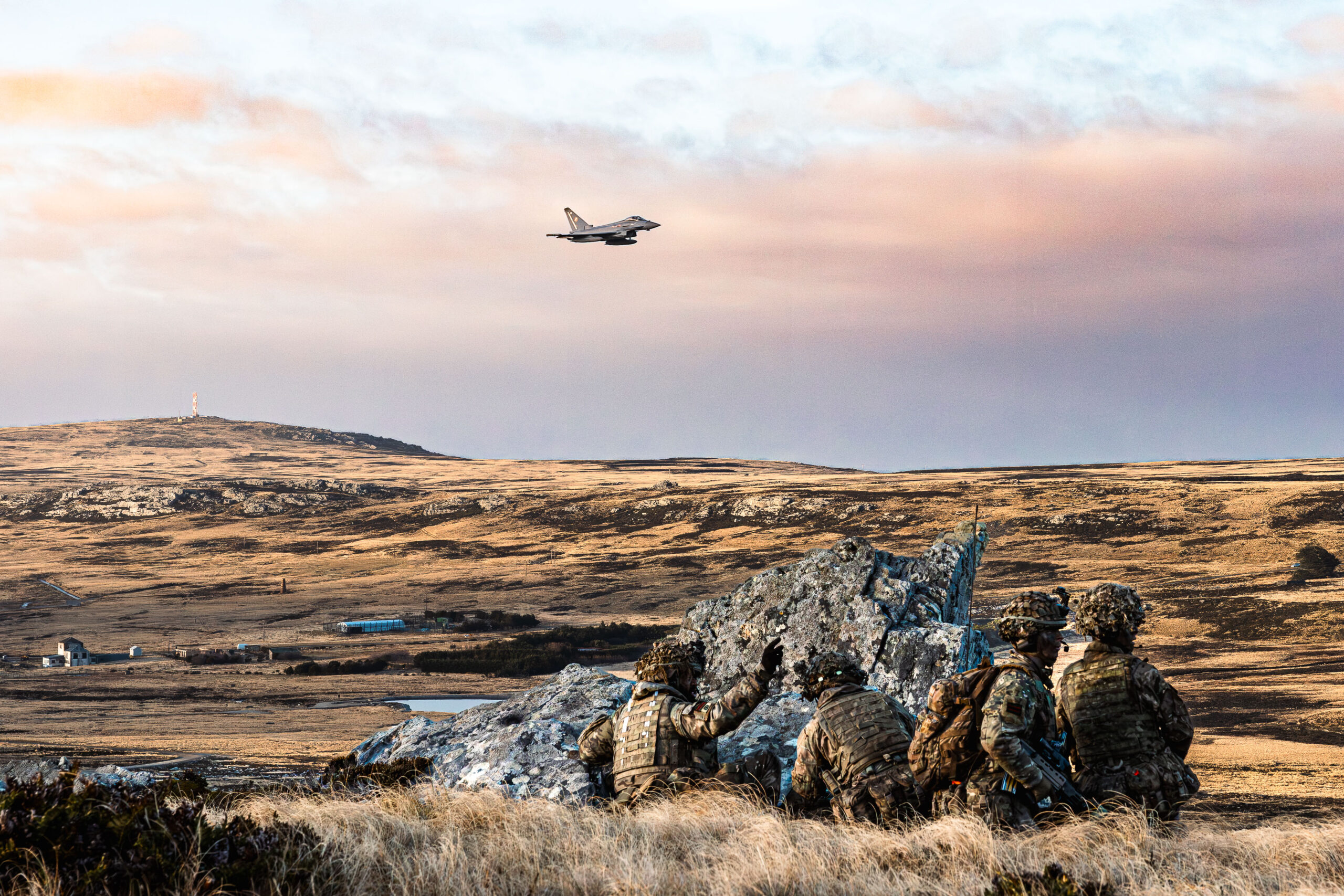
The four Tranche 1 Typhoons based in the Falkland Islands are to be replaced by four Tranche 2 aircraft in late 2027, with the older jets then stripped of usable inventory to support the remaining RAF Typhoon fleet before disposal.
The aircraft, operated by 1435 Flight, will be replaced by four Tranche 2 Typhoons drawn from the existing fleet during the rotation planned for late November to early December 2027, the Government has confirmed.
Luke Pollard, Minister of State for Defence Readiness and Industry, was responding to Ben Obese-Jecty, the Conservative MP for Huntingdon, who had asked what steps had been taken to replace the aircraft when they are decommissioned in 2027.
Pollard said: “The four Tranche 1 Typhoon aircraft currently assigned to British Forces South Atlantic Islands are scheduled to be replaced by four Tranche 2 Typhoon aircraft from the existing fleet during the aircraft rotation planned for late November to early December 2027.
“Following their return to the UK, the four Tranche 1 aircraft will be withdrawn from the Military Aviation Authority Register and enter the disposal process.”
A subsequent parliamentary answer has now provided more detail on what will happen to the four aircraft once they return from the Falklands.
Asked specifically about the disposal plans for the remaining Tranche 1 FGR4s, Pollard said: “When the four Tranche 1 Typhoon aircraft return from the Falkland Islands in 2027, ahead of disposal the aircraft will undergo a ‘Reduce to Produce’ programme to increase the inventory and help support the in-service Tranche 2 and Tranche 3 Typhoon aircraft which shall remain in service until at least 2040.”
The process will therefore see the retiring Falklands aircraft used to bolster stocks supporting the later Tranche 2 and Tranche 3 fleet before the airframes themselves are disposed of.
Pollard had also said in the earlier answer: “UK F-35 Lightning remain available for global operational tasking in line with Defence priorities.”
This timetable predates the current tensions and is not connected to them, but the distinction is worth stressing given the attention presently being paid to the defence of the islands. The same answer was given to a separate question from Obese-Jecty asking what discussions had been held with the United States and the F-35 Joint Program Office over any future use of the F-35B in defence of the Falkland Islands.
Tranche 1 Typhoons are the earliest production aircraft, delivered from the early 2000s and built to a standard that has not been carried forward through the upgrade programmes applied to later aircraft. They have been progressively retired since 2019, and the remaining airframes have largely been used for training and the Falklands commitment, where the enduring requirement includes quick reaction alert.
Tranche 2 aircraft have received successive capability upgrades and can employ a wider range of modern weapons, including Meteor, Storm Shadow and Brimstone. The replacement represents a capability improvement in the South Atlantic rather than a like-for-like swap, although the four aircraft will come from the existing RAF fleet rather than new production.
The answer also, quite interestingly, shows that the Falklands Tranche 1 aircraft will continue contributing to the Typhoon force after leaving frontline service, with their recovered inventory helping sustain the Tranche 2 and Tranche 3 aircraft expected to remain in service until at least 2040.



Another cut in fast jet numbers
This will take the number of single seat FGR4s to 101 ( 6 of the tranche 2 typhoons are 2 seater trainers)
Those 101 jets have to cover:
6 front line squadrons
3 (Fighter) Squadron
XI (Fighter) Squadron
1 (Fighter) Squadron
II (Army Cooperation) Squadron
6 Squadron
IX (Bomber) Squadron
As well as active squadrons:
12 Squadron (Joint UK-Qatari operational squadron)
1435 flight
Finally:
No. 29 Squadron (Operational Conversion Unit)
No. 41 Test and Evaluation Squadron
Now if we consider your average RAF typhoon squadron a decade ago had 13-14 FGR4s and 1-2 two seaters ( most squadrons were listed with 15 aircraft in an FOI I have from 2016).. it’s also had about a 20% sustainment fleet not allocated to squadrons as well. let’s strip that back and say a reasonable minimum for a squadron is 12 aircraft.
The 6 front line squadrons = 72 aircraft
12 squadron = 12 aircraft
1435 flight = 4 aircraft
OCU ( now once this had 18 aircraft) but say 6 FGR4s ( and the 6 two seaters)
Test and Evaluation 4
That’s about 98 FGR4s.. the RAF is also meant to have a 20-25% sustainment fleet.. so it should have about 20 for a total of 118… not 101… they should have never have removed the tranche 1s if they were not going to source 20 new typhoons..
Because now if the run all the squadron they have they will need to run with no sustainment fleet ( not possible in the long run).. or have profoundly limited aircraft numbers in each squadron ( about 8-10).. or knock off another squadron.
What is telling is the RAF will no longer tell you which jets are in the sustainment fleet and which are in each squadron.. which they happily did a decade ago…
It’s called meddling and peddling of false narratives. This is the standard SOP adhered to by politicians and political theorists, based on the TINWATM theorem, reinforced by the TINWTWAINATT memorandum, which has been in place since the end of the cold war.