

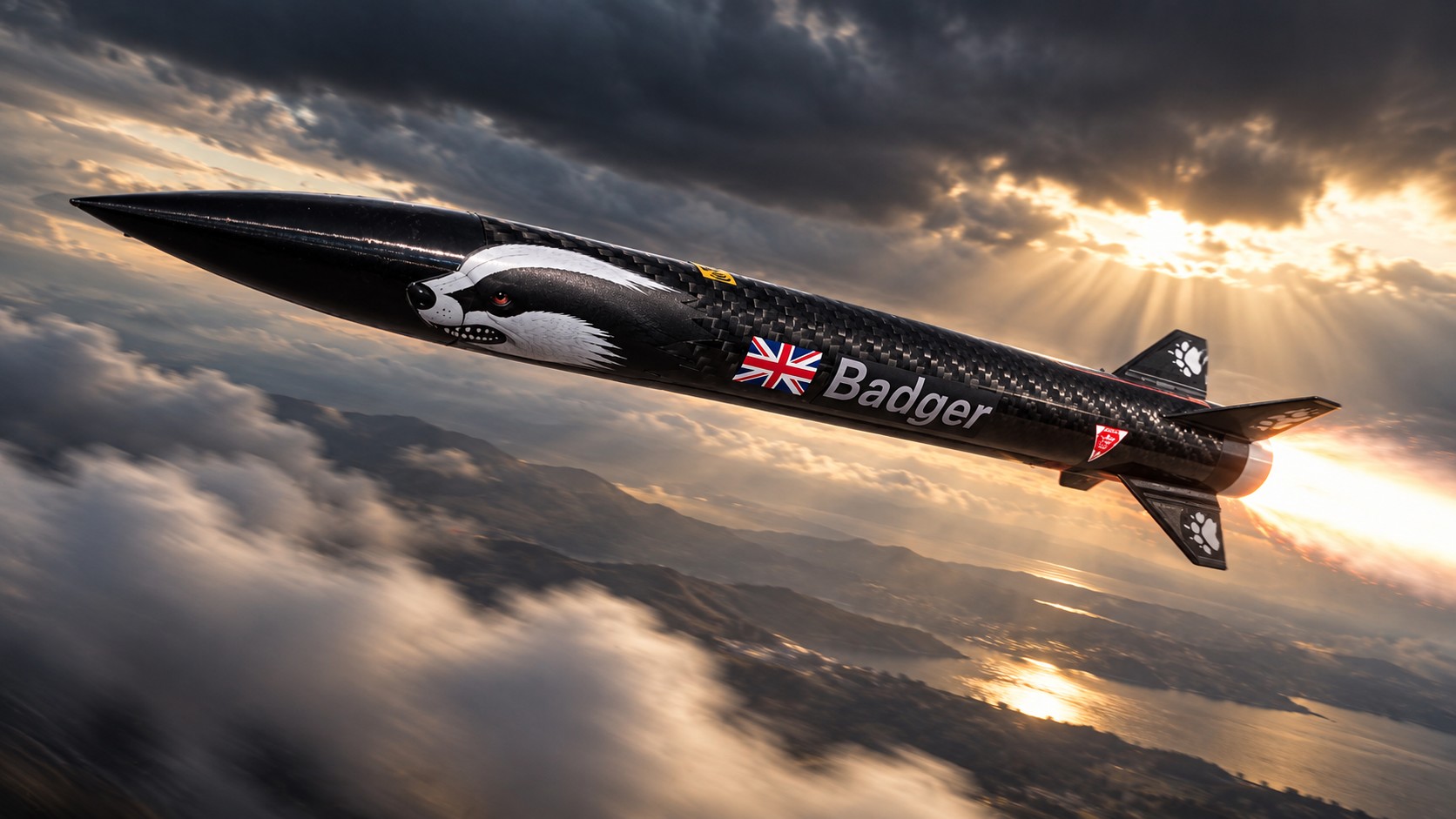
A British company founded in February has announced its first missile and the factory it intends to build it in, aiming at a replenishment cycle of under a year against the three years it currently takes to replace a stockpile, its founder told the UK Defence Journal at Apex Europe in London.
Henry Price spent fifteen years at primes and tier one suppliers before setting up Cody Aerospace and Defence, and the frustration that came out of it is what he says drove him to start the company.
He told me: “Fifteen years working for the bigger companies, producing amazing capability, but the cost and the lead time, and having to apologise to end users for those issues running some of the programmes, is kind of the frustration that drove me to say, okay, let’s go and do this ourselves, and we can prove that capability and offer something to the end users that they really need, in the timescales they need, at the right cost.”
The number he keeps returning to is the one that defines the market he is entering. “If you look at the problem statement of seven to ten days of stockpiles on the shelf for the UK in intensive warfare, and three years to replace it, that’s all we need to solve,” he said.
“We today released Badger, which is our ground-to-ground strike missile, in a containerised launcher, so an ISO container converted for that use,” he said. “And then a couple of years after that, being realistic, we’re also looking to integrate an interceptor missile into that same strike package. So from a commander’s perspective, you’ve got both strike and intercept capability in the same platform, which I think is quite a unique proposition.”
Radar and fire control come with the package, and his pitch is that the customer gets a complete capability instead of a product they then have to integrate themselves.
The factory was announced on the same day as the missile and the launcher. “All underpinned by our factory, which is called Ordnance One, which we’re also announcing today, and that’s going to be the key in terms of the industrialisation that we need to do for the product,” he said. The plant is intended to build Cody’s own designs and to produce other companies’ and other countries’ equipment under licence.
Badger is in the design phase and the company is raising pre-seed capital. “We’re looking to raise capital to bring that to a development maturity within eighteen months, two years, including the testing,” he said, with key components taken off the shelf from existing suppliers of seekers, rocket motors and guidance to reach a high technology readiness level quickly.
Those timings add up to his argument against buying off the shelf from the United States. “If you added that into what’s the replenishment cycle look like, we’re targeting under a year. I’d love to say six months, but say a year. So if you do the two years plus the year of replenishment, you’re actually under three years, if you go and buy off the shelf from the US or all those countries today,” he said.
American orders also carry a complication British buyers have run into before, “The other piece with the contracts from the US side is they’ve got DPAS ratings in terms of who gets the priority, and it’s generally given to the US customer first, as you’d understand,” he said. “So that three years could become four or five quite quickly, as we’ve seen with what’s going on in the world today.”
Sovereignty is the third strand of the business, and he was careful not to overclaim on it. Partnerships are being put in place with British suppliers for energetics and the rocket motor, though he was clear that rare earths and composites run into supply chains nobody in Europe fully controls.
He said: “I’m cognisant of just coming out of a UK factory isn’t necessarily all sovereign, but it’s better than we’ve got today. If it was all purely UK, there’ll be three, four times the cost. That’s what we’ve been told by the supply base, and it’s a reality today.”
Obsolescence management is where he thinks the real time is lost, and he gave an example from his own career. “It’s a seven dollar chip, very small, and the replacement is ten dollars, and that is the difference between two and a half years or six months. So the qualification is the key piece,” he said. Cody intends to fire Badger with old and new components in it to prove changes quickly and hold the design authority itself.
He put the same point more plainly a moment later, and it is the line his engineers will recognise. “I want engineers to be delivering capability, not managing obsolescence,” he said.
His read of the customer base starts from how thin the stocks are. Most NATO members have a multiple launch rocket system capability and can therefore tick the box, with inventories somewhere between twenty and eighty depending on the country, and the rule of thirds puts one third in maintenance, one third in training and one third on the front line. From there he moved to a challenge aimed at the alliance as a whole, he says.
“Why do we not have a standardised effector? If you take Ukraine as an example, you’ve got three different systems from three different countries with similar sized munitions. They can’t fire each other’s product,” he said, arguing that a commander on the front line should have the flexibility to fire a similar-sized munition from whatever launcher is to hand, in the way that artillery shells and small arms ammunition already allow.
Cody’s software and fire control will be open source, he said, whether or not the company ends up shooting anybody else’s rounds.
His message to the Ministry of Defence was also pretty clear, he said “We’re not saying as industry we want more budget, which might be a strange thing for me to say,” he said. “We want to spend the money in a better way. The Defence Investment Plan was explicit. There was eleven point one billion pounds earmarked for stockpiles. My challenge to MOD is we can help you spend that money better. Let’s start with one product named Badger with the containerised launcher. Let’s go to the interceptor. Let’s go into the air-to-air domain. Why is it two million pounds every time you fire an air-to-air missile? They’re very capable, but you’ve got to wait three years to get another one.”
Torpedoes are on his list too.
Asked where the company should be by Apex Europe in 2030, he was modest about it. “I’m probably being conservative and maybe British in my approach to growth. A lot of companies out there will show thirty products. I’ve come from this world, I know the pain it takes to do the integration and the development, so I’m saying let’s start with a handful,” he said.
Longer ranges would follow, and products built for snow, sand and water instead of designed around one war. Other ideas he is turning over include airdropping the Abode launcher and moving it on uncrewed vehicles, since shoot and scoot is how artillery survives and taking the crew out of that lowers the risk case.
He finished on where he thinks all of this work should be happening, telling me “My frustration is we keep sending it to other parts of the world. Let’s do it in the UK. Let’s use the testing houses that we know are here. We’ve got the catapults. We’ve got the universities. We have everything in the UK,” he said.
“If the government wants to talk about growth and the agenda of defence, let’s back companies like Cody, and we can actually make that difference.”











Very good luck to him. I hope that this a British Anduril in the making. I hope that it doesn’t get smothered by bureaucracy, risk-aversion or ideology from Labour.
Hope this game, sett and match.
5m long, 160km range, Mach 3 and 100kg payload.
Wonder what their Swift interceptor will look like.
Fire point have taken one of the S300 missile variants to make the FP7 and a BM version .
I think the UK has joined the Freyja project based on the Ukraine system for a cheaper interceptor with SRBM capability.
Presumably Badger could be adapted as a similar solution? But it’s now competing with lots of other systems.
The Govt needs to commit some money into these startups asap.