

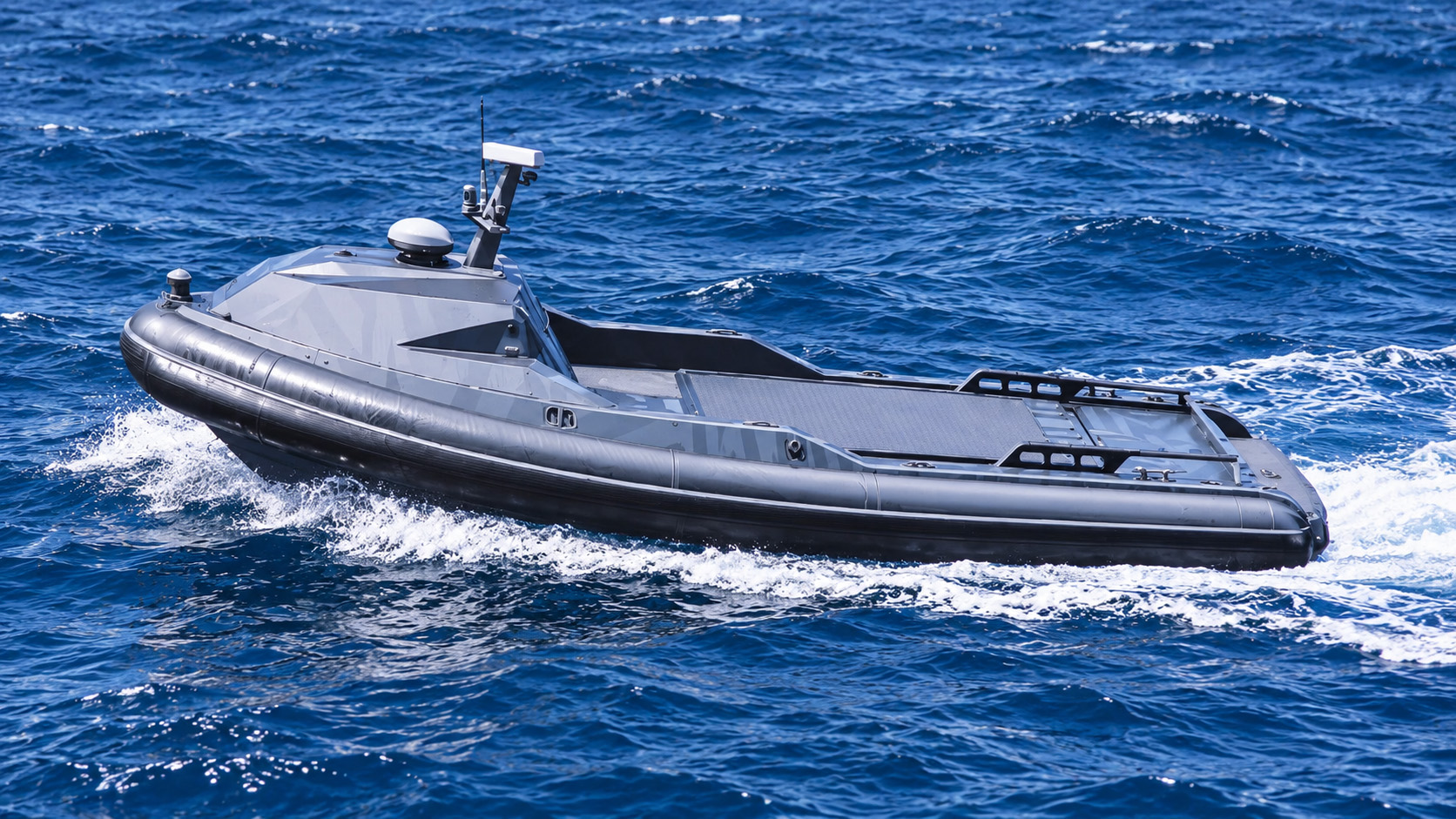
A British company has launched an uncrewed vessel designed to carry, launch and recover as many as a hundred strike drones, controlled with the boat itself through a single command and control layer, the Apex Europe conference in London heard on Wednesday.
Matthew Le Maitre, chief technology officer at Seeing Systems, introduced the vessel at the end of a capability presentation. “Today, I am proud to announce that Seeing Systems stands ready to meet the challenge posed by this new paradigm,” he said. “Apex, please meet Reaver.”
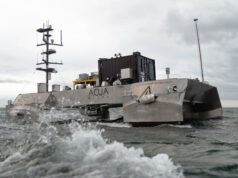
Reaver 101 combines the strike power of UAVs with the endurance of an uncrewed surface vessel, and one command and control layer covers both sea and air for the whole mission. Maximum range is 2,000 nautical miles, it operates far from shore without a support ship, and it moves by road or inside a C-17 to wherever it is needed.
The four payload fits shown covered littoral strike against targets ashore, anti-surface strike against enemy vessels at sea, reconnaissance drones pushed out ahead of the force, and offshore air defence using interceptors against one-way attack drones. Reconfiguration is quick. “When the threat changes, the payload changes. The vessel does not,” Mr Le Maitre said.
“An adversary has no way of knowing which Reaver is doing which job, so every one of them has to be treated as an all-capable threat,” he said. “That is the decisive advantage of autonomous mass. It forces the enemy to solve thousands of problems at once.”
“Mass on its own is a useful advantage,” he said, “but it only becomes truly decisive if it can be controlled effectively. A thousand platforms that each need their own crew are not mass, they’re a manpower problem.” Autonomy allows one team to set the vessels’ routes and the drones’ tasks from a single interface.
The waters a Reaver would fight in will be jammed, spoofed and hostile. Navigation continues when GPS is denied, using inertial dead reckoning cross-checked against radar, and when communications degrade the system steps down through defined levels of autonomy so the mission continues until the link is restored.
The vessel carries its own autonomous deployment and retrieval system, designed and built by the company, which launches drones while the boat is under way and recovers them for reuse. “Recovery capability is what turns a single strike into a sustained operation,” Mr Le Maitre said, adding that the system has already launched and recovered drones at sea in trials.
Open architecture and standard drone protocols allow new airframes and sensors to be integrated without redesigning the vessel. Production runs on live lines in the United Kingdom, the hull from a partner that has already delivered uncrewed boats to the Royal Navy, and the drones from the company’s own lines. “The capital ship takes a decade to build. Reaver’s production lines are already running,” he said.
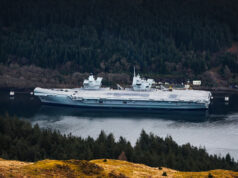
Mr Le Maitre built the case for the vessel on the cost of the ships it is meant to supplement. “For centuries, navies have measured their power by the size of their capital ships, and since the Second World War, the aircraft carrier has been the capital ship around which the rest of the fleet has been built,” he said. “Capital is a highly relevant word here. In today’s money, each of the Royal Navy’s two Queen Elizabeth class carriers would cost close to 4.6 billion pounds.”
“Now they are undoubtedly extraordinarily capable ships, but these vessels are so important to the Royal Navy that they also represent an extraordinary target. Our adversaries know that, and they plan accordingly. Protecting them effectively is now one of the hardest problems the fleet faces.”
Ukraine and the Middle East have exposed an asymmetry that upends the warfighting conventions of this century, in his account, and cheap mass-produced uncrewed systems are overwhelming platforms that used to dominate. Improvements in AI targeting and swarming will make those weapons more lethal over time, and efficiencies in mass production will make them cheaper.
“Iran has been severely disrupting shipping through the Strait of Hormuz for over seven months, despite the US Navy committing three carrier strike groups to the region,” he said. “They’ve achieved this via a combination of drones, mines, small boats and USVs.” Iran managed it with a degraded green water navy and an air force heavily damaged by joint American and Israeli strikes.
“Just as Ukraine proved on land, Iran is proving at sea that the new asymmetry can be leveraged to frustrate a much stronger military adversary,” he said.
The arithmetic he showed sets one carrier against 4,600 fully armed Reavers. Each is designed to carry up to 100 Havoc strike drones carrying a two kilogram high explosive payload apiece, which across the fleet comes to 460,000 strike drones and more than 900 tonnes of warheads.
“An adversary facing an aircraft carrier has one rather large target to find and eliminate,” he said. “An adversary facing a comparable Reaver fleet has 4,600 targets to contend with.” Losing one costs a fraction of a per cent of the force, in his account, and “the rest of the force keeps fighting.”
The capital ship made sense while manpower was the limit on fielding mass, he argued, and autonomy has removed that limit.
“The Royal Navy has already announced its strategic shift to a hybrid navy,” he said. “We believe that Reaver will be an integral part of that new navy. Reaver will be ready to defend the UK as we move into a more uncertain world.”




Had they seen Firefly when choosing that name?