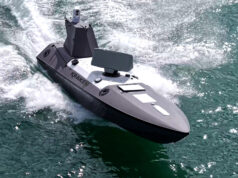
An uncrewed surface vessel has been navigated through the Solent using radar matched against stored maps of the coastline rather than satellite positioning, in a demonstration staged for the Ministry of Defence, according to Voyant Innovations.
The Liverpool University spin-out ran its software aboard a Kraken K3 Scout autonomous vessel, using particle filter algorithms to compare live radar imagery against pre-existing reference maps of the terrain and work out the vessel’s position without any help from the Global Navigation Satellite System. The demonstration took place on 5 October and forms part of a wider departmental effort to find resilient technologies for operating where satellite navigation is contested or congested.
James Norwood, chief executive of Voyant, said: “Reliable navigation is fundamental to maritime operations, yet we are entering an era where access to GNSS can no longer be assumed. Working alongside Kraken and the Ministry of Defence, we have demonstrated a practical capability that supports the safe and effective deployment of autonomous maritime systems in challenging operational conditions.
“The demonstration represents another milestone in the UK’s continued investment in sovereign technologies that strengthen resilience, enhance operational freedom and support the next generation of autonomous defence capabilities.”
The littoral is the hardest place to do this, which is why the Solent was chosen. Coastlines, changing terrain and dense infrastructure degrade satellite reception on their own, before any adversary sets out to deny it deliberately, and an autonomous vessel that loses its position close inshore is a hazard to everything around it as well as a loss to its owner.
Voyant’s approach fuses radar returns with probabilistic algorithms to estimate where the vessel is relative to its surroundings, and crucially also to estimate how confident it is in that answer. Rather than listening for a satellite, the system continually matches what it can see against geographic features it already knows about.
The company was founded on more than twenty years of research at Liverpool and sells software intended to extract more from sensors a customer already owns, working with radar, sonar, electronic warfare, electro-optical and infrared systems without requiring new hardware.
Voyant is exhibiting at Apex Europe in London on Wednesday and Thursday, and has a second release out covering a software-defined approach to anti-submarine warfare.