

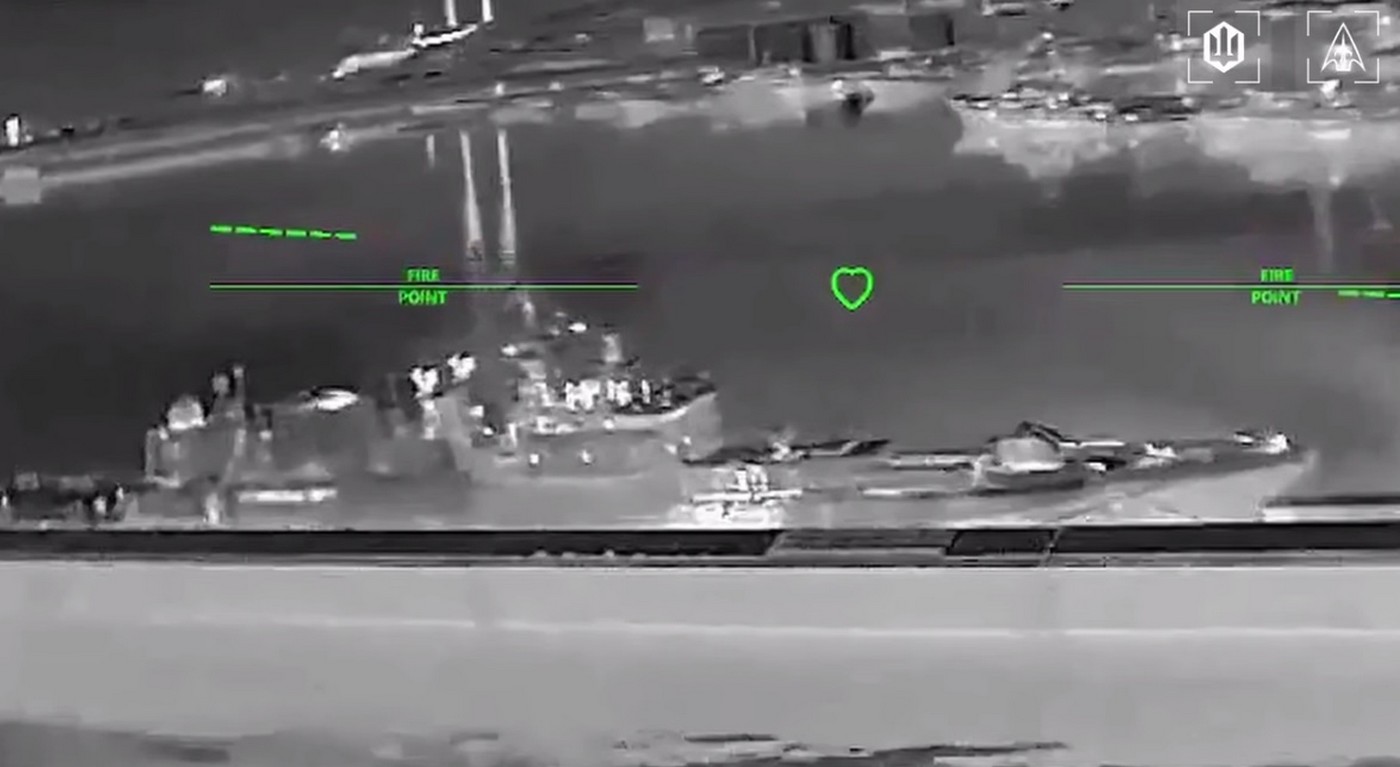
A single Ukrainian drone attack on Novorossiysk has significantly degraded the land-attack cruise missile capability of Russia’s Black Sea Fleet, accounting for forty per cent of its Kalibr-capable surface ships, according to a Defence Intelligence update published by the UK Ministry of Defence.
In its update on Thursday, Defence Intelligence said: “Ukraine has launched two large scale uncrewed aerial system (UAS) attacks against the Russian Novorossiysk Naval Facility and Commercial Port within the last two months. The 08-09 September 2026 attack led to successful strikes against a GRIGOROVICH class frigate and a SVIYAZHSK light-frigate.”
It went on: “Both vessels have likely sustained sufficient damage to prevent them taking part in KALIBR Land-attack Cruise Missile (LACM) firings into Ukraine, likely for the short-medium term. This single attack has significantly degraded the LACM strike capabilities of the Black Sea Fleet, representing 40% of the KALIBR-capable surface fleet.”
Two ships out of action amounting to two fifths of the capability says as much about the size of the remaining fleet as it does about the damage. Russia has been firing Kalibr missiles at Ukrainian cities and infrastructure from Black Sea platforms since the opening days of the full-scale invasion, and the surface ships able to carry them have never been numerous.
The Admiral Grigorovich class are Project 11356R frigates, the newest conventional surface combatants the Black Sea Fleet has, each able to carry Kalibr in a vertical launch system. Defence Intelligence describes the second vessel as a Sviyazhsk light-frigate, a smaller Kalibr-armed surface combatant.
Ukrainian strikes drove Russian warships out of Sevastopol over the course of 2023 and 2024, and the Krasnodar Krai port became the main operating base for what remained. Pushing the fleet east was supposed to put it beyond easy reach.
Defence Intelligence uses a probability yardstick in which “likely” sits between 55 and 75 per cent, so the assessment that both ships cannot take part in Kalibr firings is a confident judgement without being a certainty. The phrase short to medium term carries no fixed definition, though repairs to a vertical launch system and the surrounding structure on a frigate are not quick work, particularly in a yard under periodic attack.
UK Defence Intelligence publishes its guidance on the use of probabilistic language at this link.




Excellent news, keep slugging away at the Russians…
Most people massively overestimate the size of the Russian navy.. especially its modern surface fleet:
Three Admiral Gorshkov class frigates , 5500 ton frigates all based in the northern fleet. With 2 more likely to commission in the pacific fleet in 2028. With 5 building for the northern fleet that will be ready between 2030 and 2036.
3 Admiral Grigorovich class 4000 ton frigates.. 2 of which are in the Black Sea constantly getting bits blown off them by Ukrainian drones.
2 20 year old Gepard light frigate/corvettes 2500 ton light ASW frigates 6 active frigates
That’s it for modern major surface combatants.
It then has its antiquated ships
4 antiquated ASW frigates that are 36 to 46 years old
7 Udaloy class destroyers 36-46 years old
3 cruisers of 36-40 year vintage..
Remember as well only 11 of these ships are in the Black Sea fleets ( 3 new 8 old) and so relevant to the UK.
At 24-29 years old the remaining 5 T23s are spring chickens compared to the Russian fleet and 6 T45s are something the Russian fleet just does not have ( it has no modern large air defence destroyers) add in the two carriers and F35s and you have a RN fleets in a better place that the Russian surface fleet.. even at it’s lowest.. and by the time it has 13 new frigates in 2035 it will be miles ahead.
Even its Nuclear submarine fleet is not that large
It only has 5 modern SSNs ( 3 in the northern fleet
Then it has 11 nuclear attack boats and SSGNs that are 30-36 years old ( with 5 are active in the nothern fleet )
It’s not the overwhelming advantage often portrayed and Even in it’s present pathetic state the RN would probably overcome especially if it could fully leaver its carriers and gets better availability on its SSNs.
our ships are less available than the Russian’s, always alongside or refit sometimes for decades at a time.
Perhaps checkout Russian refit times before making such an assertion ……
Jack, with knowledge like yours pal you should really consider the Daily Mail comment section, I’m not sure UKDJ is for you 😂
You start your trolling of new posters here Jim and you know what wil happen don’t you?
What? More irate grandads posting AI crap 😂
How do you know that? They have refits, maintenance periods and crewing issues too. They not all sat ready to go 365 days a year.
You are joking.. have you seen the readiness of the Russian fleet and how long it takes them to refit ships…
No, no, no Jonathan. That is correct.
Have you seen how long it takes the UKE to drop drones on Russian ships, surely.
We have zero defences at any of our bases. We are inviting an attack from the Russians.
Great summary Jonathan, the trolls bigging up the Russian “fleet” are the same a**holes constantly stating that Argentina can retake the Falklands and their is nothing the UK can do because we do have 50 gun armed frigates with sea slug any more.
They lack any understanding of modern military capabilities and just how much more capable (and expensive to operate) modern platforms are.
One T45 destroyer is more capable than the entire British fleet in 1982.
Most of these people want nothing better than to talk down the UK at every opportunity to support their own political narrative.
Yes the Frigate problem is severe but it’s not like the ships have not been ordered and paid for to replace them and as you have shown there is little real Russian submarine threat. The SSN availability issue is a big problem however the SSN’s we have are world class and we are on our way to solving the issue. Our SSN fleet out numbers and out matches Russians fleet on every metric. In the Cold War the Soviet Navy had a twenty to one advantage over us.
Every single other navy has major similar issues to us post COVID, especially the US which, like us also operates a very high end balanced fleet of ships.
👍
Couldn’t agree more!
Not disagreeing with the overall point, but claims like “One T45 destroyer is more capable than the entire British fleet in 1982” should always be made with care.
Yes, a fully-loaded T45 is individually more capable than any ship we had in the 80s, but the threats coming at us today are also far more capable and varied. In 1982, you’re either getting torpedoed by a submarine, bombed by a jet, or targeted with a cruise missile; today, those all still exist in far more capable forms, but there’s also a proliferation of weapons both higher and lower on the scale. Anti-ship ballistic missiles are a viable thing at the high end, while airborne, surface, and subsurface drones are available in serious numbers.
Capability should be defined against the threats a system needs to counter, not simply “this is better than what we had four decades ago”
Also, “Our SSN fleet out numbers and out matches Russians fleet on every metric. In the Cold War the Soviet Navy had a twenty to one advantage over us.” is just a ridiculous claim. Just looking at the Northern Fleet, they have more boats (supplemented by conventional boats, SSGNs, and special ops boats), with their modern SSNs carrying nearly twice the weapon load of an Astute. Yes, it’s highly probable that an Astute still enjoys a technological advantage in most areas, but the Cold War metrics are no longer relevant.
Previously, we had a good-sized fleet of SSNs for pushing north, alongside the large American SSN fleet, and conventional boats for closer to home, versus a generally far inferior but far more numerous Soviet fleet. As long as we had the numbers to cover the GIUK gap, we could be confident in winning any individual engagement. Now? We’re repeatedly struggling to put one or more boats to sea, the USN is focusing it’s overstretched SSN fleet in the Pacific, we have no conventional boats to cover the backline tasks, and the Russian fleet is operating SSNs that are much closer to ours in terms of capability. The relative numbers are closer, yes, but the tiny number of platforms in play and the reduced individual advantage we enjoy makes it far likelier that a Russian boat makes it past us or wins an engagement.
Well said.
We evolve, the threat evolves.
Three T42s could be in 3 places. One T45, lovely as it is, can be in one place.
Very nice “breakdown” of Russian assets (no pun 🙂 ) Jonathon.
Ah! An adult just walked into the room.
During the specific operational period from June to September 2026, official data provided by the UK Ministry of Defence (MoD) and the Royal Navy documents high-profile operations in the Channel monitoring Russian vessels. During this period both sides undertook live firing in the CHannel area
While broader 2026 data shows that dozens of Russian shadow-fleet tankers pass through the UK Exclusive Economic Zone (EEZ) on an ongoing basis, high-profile Channel transits during the specific four-month window June-September 2026 involved 4 explicitly named sanctioned vessels: General Skobelev (sanctioned cargo vessel), Sparta (sanctioned cargo vessel), Smyrtos (sanctioned oil tanker, which was boarded and subsequently detained near Portland), MV Vulkan (sanctioned shadow-fleet tanker)
To protect these vessels from western interception, Russia actively committed military resources. Between June and September 2026, 3 Russian warships were explicitly identified directly escorting or patrolling alongside these sanctioned fleets through the English Channel and North Sea: Admiral Levchenko (Udaloy-class destroyer), RFN Neustrashimy (Neustrashimy-class frigate) and RFN Admiral Grigorovich (Grigorovich-class frigate)
The Royal Navy logged a 25% spike in tracking activations during this period, spending 21 days out of the month of July alone shadowing these Russian ship movements, To maintain continuous observation as these Russian flotillas passed by HMNB Devenport and HMNB Portsmouth in international waters, the UK deployed 2 frigates, 1 destroyer, and 3 offshore patrol vessels, alongside maritime helicopters: HMS St Albans and HMS Somerset (both Type 23) HMS Duncan (Type 45 Guided-missile Destroyer), HMS Tyne, HMS Mersey and HMS Severn (OPV), Wildcat helicopters from 815 Naval Air Squadron and Merlin submarine-hunting aircraft
The Royal Navy maintained surveillance until the flotillas exited the Channel, at which point tracking responsibilities were handed off to NATO allies off the coast of France. During the summer the Russians re-routed most of their sanctioned vessels over the Northern Approaches past the west coast of Ireland to avoid the Royal Navy. As discussed here, the Irish government asked for British help to monitor them
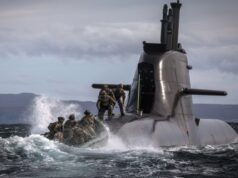
British Royal Marines recently trained with the US Navy in boarding operations, notably including live fire exercises.
The Ukrainians have developed a new way of fighting, through pure necessity and have shown legacy systems, while needed, are now having to fight in a different way. The learning curve is steep but good to see we are also learning these lessons. Top job by the Ukrainians, more to come methinks.
Hear,hear!
Slava Ukraini
Good comment Borners. On the money. The speed at which the Ukrainians have adapted, developed and deployed are a lesson in themselves. Hands up all those who think that will catch on in Whitehall.
Anyone else notice how the Ukrainians change the image centre target icon from a circle to a love heart 😀
From Ukraine with love 🫡🇺🇦💪
Yes seen, cheeky aren’t they!!!!
Fantastic from Ukraine. The capabilities being developed show the evolving threats posed across a range of scenarios.
years into a war that has become increasingly drone led, its hard to believe the russians still cannot defend their dockyards from attack. They are ultimately quite small pieces of territory, yet the Ukrainians keep getting through. I wonder if that says something about how hard it actually is to protect against drone attack?
While celebrating the good news, it is sobering to reflect that a merchant ship in the Channel could launch exactly this sort of attack on Portsmouth or Plymouth. What have we got to defend against it?
We have ORCUS to deal with this kind of attack.
The GB news crowd were shocked and horrified when they found out the UK is using high pressure water hoses on is SSBNs to defend against light weight commercial drones.. it seems the GB news crowed seem to think belting out a few hundred rounds with a HMG at a drone in the middle of the dockyard would be far more effective and less likely to lead to a bloodbath.
I for one think pumping out 40mm explosive rounds around our nuclear ballistic missile submarines to hit some £100 rc drones is a great idea. 😂
Just like we discovered in the Middle East that actually the RAF is not daft and they developed several secret systems like Rapid sentry to deal with drones, the RN is also not daft. There are likely systems in place but they can’t tell anyone so we have to put up with the endless parade of ex generals (always generals never admirals 🤔) telling us we are defenceless against drones, “because in 2003 when I left the army we had no defences against drones and I’m an ex general and expert on the navy” 😂
As a layman, I have never sat down and considered what could be used to down drones. High pressure water jets…who would have thought. What a superb weapon for a dockyard…does not have to be super accurate as I am sure the spread of water would be enough to either down or disrupt a small drone. Inexhaustible ammo. Perhaps a large scale fogging device might also do the trick…a wet smoke screen.
AA