

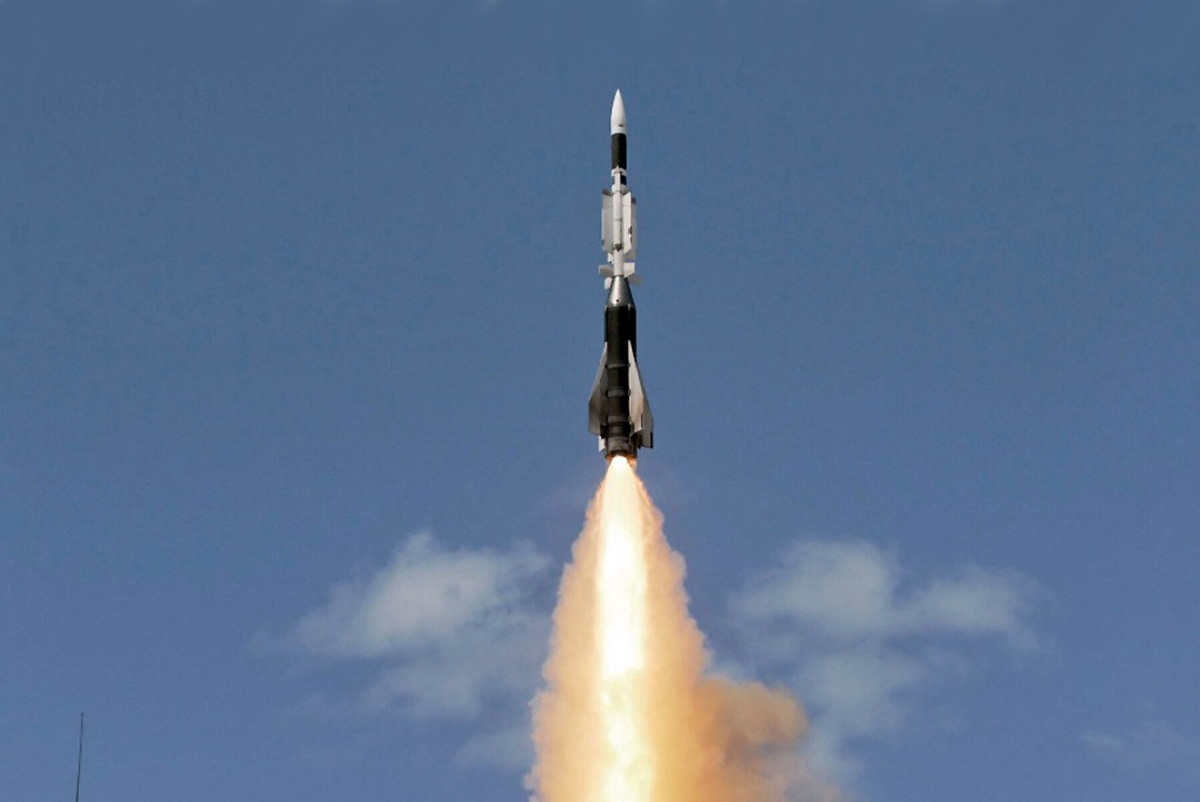
France has ordered four additional SAMP/T NG firing units, taking its total order for the ground-based air and missile defence system to twelve, according to eurosam.
The Organisation for Joint Armament Cooperation, known as OCCAR, placed the contract on behalf of France with eurosam, the Franco-Italian grouping formed by MBDA France, MBDA Italy and Thales. The units will be delivered to the French Air and Space Force in a multi-layer configuration combining Aster and MICA VL missiles.
The company said: “This order is an additional step towards the renewal of the European Long-Range Air and Missile Defence ground capabilities, following the SAMP/T NG development launched in 2021.”
It added: “OCCAR-EA, eurosam and its members, MBDA and Thales will continue to lead the way in state of the art and sovereign air and Missile defence systems for the benefit of European defence. These advanced air defence systems are crucial in the current global context to respond to increasingly challenging threats.”
A SAMP/T NG firing unit holds up to forty-eight Aster missiles ready to fire, carried across up to six launcher modules of eight rounds each, alongside a multi-function radar and identification module able to detect and identify targets beyond 350km, and an engagement module. The whole system is mobile and eurosam says it can be operational in under thirty minutes, offering 360-degree coverage and engaging targets beyond 150km.
The system is designed around the Aster 30 B1 and the newer Aster B1NT. The B1NT uses a Ka-band seeker and new interception algorithms to give what the company describes as a hit-to-kill capability against short and medium range ballistic missiles, low manoeuvring targets and hypersonic missiles.
Britain has a stake in the wider programme, since the United Kingdom is a participant in the FSAF-PAAMS arrangement that OCCAR manages, and the fourteenth amendment to that contract, signed in Paris in January 2024, covered supplementary procurement of equipment allowing Britain to carry out mid-life upgrades to its own Aster missiles. Aster is the weapon carried by the Royal Navy’s Type 45 destroyers as part of the Sea Viper system, which HMS Diamond used against Houthi missiles and drones in the Red Sea.
France and Italy have supplied SAMP/T systems to Ukraine, where the type has engaged Russian ballistic missiles.
The order lands while Britain has no ground-based long-range air defence system assigned to the defence of the United Kingdom. Luke Pollard, the Minister of State for Defence, confirmed this week that a further £790 million will be invested in homeland integrated air and missile defence, covering enhanced command and control, improved sensing and radar systems, counter-drone capabilities and more effective layered defences.
The Defence Committee reported yesterday that anti-strike capabilities for shooting down ballistic, hypersonic and cruise missiles and drones are among the capabilities European NATO members lack in sufficient numbers, and that replacing American military capabilities with European weapons has been costed by the Kiel Institute at an extra €50 billion each year over the next decade.
Sky Sabre gives the British Army a medium range ground-based system, currently deployed in Poland and the Falkland Islands. This publication has reported on continuing work on the potential of British destroyers in the ballistic missile defence role and on when those destroyers will receive their missile upgrades.












The DIP also ‘commits’ the UK to procuring long-range ballistic missile defences in the 2030s.
SAMP/T NG isn’t ideal for the role; we’d want something more akin to THAAD or Aegis Ashore. But as a starting point, with Aquila hovering in the future, it becomes more viable.
Realistically, though, our best path forwards for a true BMD shield is distributed naval launchers controlled by a mesh of land-based early warning radar, and medium-sized terminal defence guidance platforms.
Don’t disagree with having naval launchers however land based mobile launchers seem to me to be a simpler solution for most scenarios.
Precisely this. It’s the Robert Watson-Watt adage “Give them the third best to go on with; the second best comes too late, the best never comes.” At least with Aster it’s also less dependent on temper-tantrums from the White House, and exploits our experience of the system(s) in the naval realm.
Twelve seems like a small number to me. Twelve hundred seems like you can protect France effectively.
A single SAMP/T unit usually has 6 trucks carrying 8 missiles, giving a battery 48 ready missiles. With 12 units, that could be 576 missiles ready to go.
Point taken. However France is what, maybe 250,000 sq miles, of potential juicy targets.
Ukraine has endured years of near constant attack.
A satisfactory deterrent would be to be able eliminate all attacks whilst at the same time being able to replace the missiles used.
Now clearly Aster would not be needed on drones and other lessor threats.
Would France not also want to distribute some of these asset to other allies.
It seems to me that we need a production line of these assets being shipped to all NATO allies which need them.
Those types of systems just dont and wont ever exist. Maybe Isreal with Iron Dome but no chance with a country like France. Its just too expensive. The amount of ordnance needed would take Frances entire state budget.
Come on UK. Do something…
There’s still a lot that can be done with Aster in the meantime. The latest Aster NT puts it in the same ballpark as Patriot PAC-3 SME, so should be good to engage targets up to 80,000ft (25km). However, Aster should retain more energy as it’s a two stage system (1st stage booster which separates from the 2nd stage Dart), unlike the PAC-3’s single stage which includes a dual pulse rocket motor. Meaning Aster even with the strakes should have less wetted area than the PAC-3. But because of the strakes should be more manoeuvrable at higher altitudes, as the strakes help to generate lift. Though the PAC-3 is a wider and longer weapon at 290mm diameter & 5.3m long vs Aster’s 180mm diameter dart 2nd stage and 380mm diameter 1st stage & 4.9m long. Means the PAC-3 stores a bit more fuel, allowing it to reach a higher altitude. Additionally, having the reaction jet paced around the CofG of the Dart, means it should be more manoeuvrable, when operated at much higher altitudes.
But Aster could be made to go much, much higher! The Aster 30 1st stage booster is 2.3m long, making the Dart about 2.6m long. If the Dart’s overall length can’t be changed, the 1st stage booster, most definitely can. The Aster 30 is fired from the Sylver A50 vertical launcher. This is a launch cell with a depth of 5m. The longer A70 or even the strike length Mk41. Would allow for an additional length of 2m for the 1st stage booster, if the 10 cm difference was kept. Thereby Aster could be made to be 6.9m long.
The 1st stage has a burn duration of only 3.5s, yet propels the missile to around Mach 4 at separation. If an additional 2m worth of propellent was added to the first stage, this would almost double the burn time. The additional time on boost will significantly raise the terminal speed, the predictions say over Mach 6. Which would give the missile an effective range of 250km to 300km. Perhaps more crucially, an interception altitude of 50 to 70km (165,000 to 230,000ft). Which is higher than THAAD and on the threshold of going exoatmospheric. So c’mon MBDA pull you finger out, there’s a quicker option available!
Well at least they have some SAM cover whilst the UK has ZERO (discount the Navy, were only 2 of 6 fitted vessels are operational at best). The UK needs something together with other Air Defence systems to protect our vital infrastructure like power stations and military bases etc. Just where does the MOD spend all its money? Oh on folks that shine their trousers in nice warm comfortable buildings whilst service personnel suffer with shortages in every field. The non uniform numbers need to be cut by at least 50% and the funds used to fund the UK’s actual defence and kt to keep the expensive kit working.
Still I have a long bow, will that help?
The question really is should the UK opt back into the programme and go for aster as its ground based long range air defence missile.. to be honest it’s probably worth while..
I’m not sure I would trust US supplied options anymore if we got into a shootout with the Russia as the US now has a clear history of using critical supplies as a lever against its own allies if it thinks it’s to its geopolitical advantage.
I find it amusing that apparently the UK doesn’t need GBAD due to our geographical location, yet France, equally in the rear of ENATO is getting off its backside trying to defend itself.
The UK meanwhile has:
A handful of Rapid Sentry and, I assume,Skyhammer.
A “Regiment” of Sky Sabre, half of whose Barreries reportedly don’t have the kit, so in reality half a Regiment.
And a Regiment of SHORAD, so elderly HVM Stormer, less than 30 active reportedly, when once we had them in the hundreds. Alongside a few Batteries of LMM in the same Regiment.
Labour talk of an integrated system at £700 odd million that won’t even tickle the problem, and Stormer replacement is delayed as the money isn’t there, by Charlatan Pollards own words a few weeks ago.
Is it any wonder that forces veterans and other voters are turning away from the uni party?
Words, more words, then words.
Bravo, France.
And France does this, and a lot more than the UK generally, on a smaller defence budget. Something is very, very wrong with the MoD….