

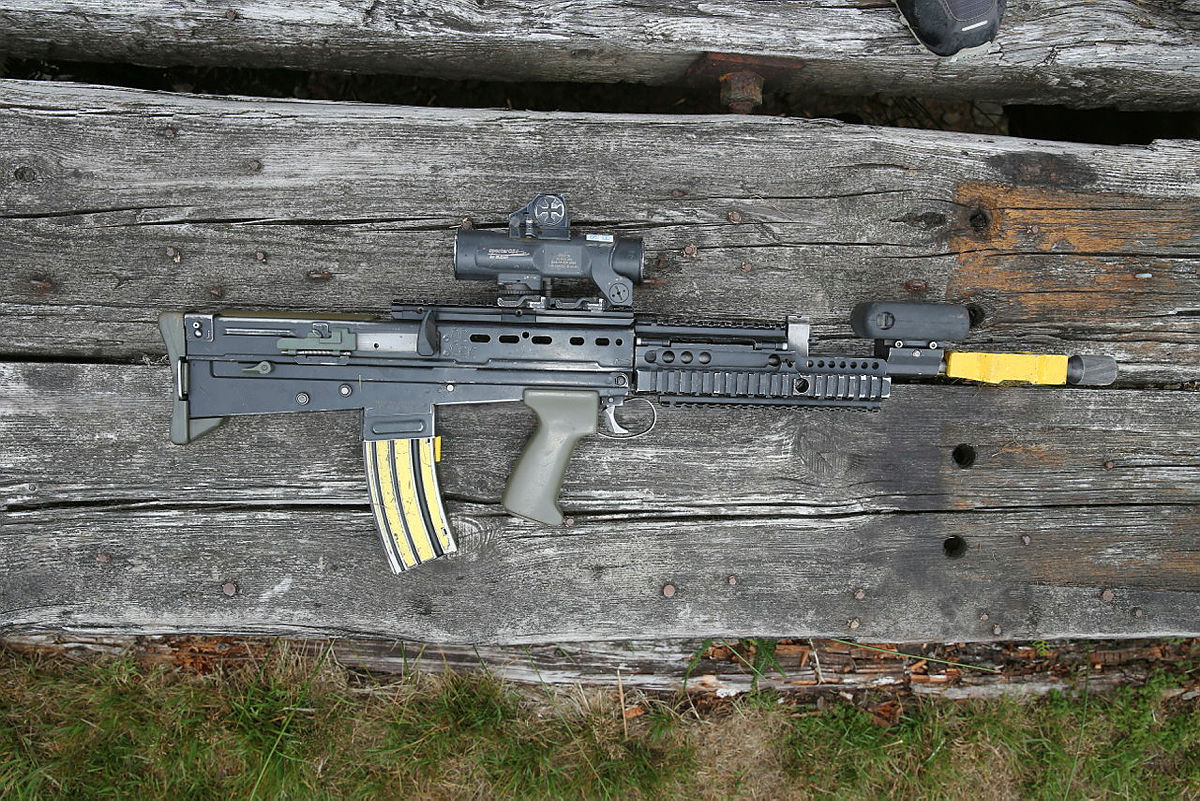
The programme to replace the SA80 family of weapons carries an estimated value of £2 billion including VAT, and the contract is expected to run from July 2029 until the end of March 2045, according to a contract notice published by the Ministry of Defence.
The notice, issued by the National Armaments Director Group on 23 October, announces an industry day for Project GRAYBURN, which is considering the future replacement of the SA80 and the provision of associated small-arms capability for defence as a whole. The estimated value excluding VAT is given as £1,666,666,666.67, and the tender notice itself is not expected until 2 July 2027.
The notice states that the authority “is at an early stage of developing the requirement and is using this engagement to inform its understanding of the market and potential delivery approaches”, and that “the scope and approach to any future procurement remain subject to further development and approval.”
It adds: “This notice does not constitute a call for competition, an invitation to tender or a commitment by the Authority to commence a procurement. The Authority has not selected a preferred procurement route, delivery model, supplier, product or contractual structure.”
Maria Eagle, then Minister of State for Defence, told Parliament in April 2025 that “due to the current phase of the project, we are unable to provide a formal cost estimation yet”, and said a figure would follow once the scope, timeline and complexity were confirmed. A senior defence official told reporters in July this year that the programme “is funded” while adding “I don’t think we’ve got the specific line in the document”, referring to the Defence Investment Plan, as this publication reported at the time. The notice now puts a number on it.
The dates have moved as well, and a procurement pipeline notice issued by Defence Equipment and Support in January gave indicative contract dates of 2028 to 2045 and carried no value, and this publication reported then that those dates were notional and should not be taken as a commitment to enter production at that point. The start has moved to July 2029, and a date has been attached to the tender notice for the first time.
The life of the weapon being replaced has stretched over the same period. Ministers gave the L85A3’s projected out of service date as 2030 through 2025 and into this year, including when Eagle told Rebecca Paul, the Conservative member for Reigate, that “the L85 rifle (‘SA80’) will be replaced over the coming decade through Project GRAYBURN”. By July officials were saying the rifle is expected to remain in service into the early 2030s. A contract starting in July 2029 and running to 2045 leaves the existing weapon carrying the load into the period the replacement is being delivered.
The January notice set out five planned variants, likely built on a common lower receiver: a standard dismounted close combat rifle to replace the SA80A3, a short dismounted close combat variant, a personal defence weapon to replace the L22 carbine, a generalist rifle to replace the SA80A2 and a cadet rifle to replace the L98. Requirements listed in that notice included United Kingdom manufacture to strengthen sovereign supply chains, a possible long-term strategic supplier relationship covering delivery, support and spiral development, the ability to defeat current and emerging adversary body armour, day optics as standard with rapid acceptance of in-line night vision systems, signature reduction on selected variants and reliability across all climatic and environmental conditions.
Luke Pollard, the Minister of State for Defence, confirmed in January that the programme covers the whole dismounted close combat weapons portfolio, from pistols to machine guns, and said it is “desirable for the project to create skilled employment in the UK” in line with the Defence Industrial Strategy. Answering Ben Obese-Jecty in February he said the department has “set clear expectations that Project Grayburn will be manufactured in the UK to enhance sovereign industry”, while “there is currently no specific definition for the future export potential of Project Grayburn.”
The industry day will be held as a hybrid event, with organisations attending in person or over Microsoft Teams, and each will be offered a single one-to-one session of no more than fifteen minutes. Attendance is by invitation only, organisations must register by five o’clock on 30 October, and the department intends to confirm attendance by 6 November. The engagement deadline is 27 November. The notice flags the opportunity as particularly suitable for small and medium-sized enterprises, and the one-to-one sessions will not be used to evaluate or down-select suppliers or solutions.
The SA80 entered service in the 1980s and has been through two major upgrades, the A2 rebuild carried out by Heckler & Koch and the A3 configuration that brought a new upper receiver and mounting arrangements. The calibre of the new weapon remains open, with performance, interoperability with allies and technological complexity among the factors under consideration, and approvals will run through the Combined Operational Effectiveness and Investment Appraisal process.
The project takes its name from Lieutenant John Grayburn of the 2nd Parachute Battalion, who was awarded a posthumous Victoria Cross for his actions at the Arnhem road bridge in September 1944.








Rumour (from the inside) has it that Sig has already been discounted because they won’t fulfil U.K. sovereign manufacture requirement.
Having watched BFBS news on the SIG weapon there is no way that a factory like they have could be set up here for the amount we would want! Saying that they could fill our requirements quite quickly if ordered.
Is that American or Swiss SIG? American SIG has an appalling track record in the last few years, the last thing we need is guns that go off when you drop them.
The timescale is interesting…
The cost depends whether we are bringing small arms ‘at scale’, not neich like Accuracy International, back to the UK.
If it’s an off the shelf procurement from an established supplier, it will obviously be cheaper.
However, bringing the capability back to the UK is vital in my opinion. I would suggest Fn are in the strongest position with an established UK base and an excellent rifle on offer.
As I keep saying the ultra necessary small and medium projects like this are remorselessly squeezed in the vice of the every cash hungry mega projects.
If they are serious about war footing, shouldn’t there be a rapid build up of 100,000 weapons that can be handed to conscripts, or do they hope that in an emergency workshops can churn out Sten guns?
Same for body armour, NvGs, radios, all the kit needed if there was a need to equip casualty replacements
A cynic would say there is other motive. This war footing just a drive to drive us closer/ into the EU by stating that Putin could invade.
Not sure wider public are convinced.
You have to take a step back and look at Defence estate and the stored equipment available.
The reality is, we divested ourselves of the ability to rapidly expand the Army at the end of the cold war, as it was no longer required!!
Successive defence reviews from Options for Change, to Front line first, cut defence estate, storage of War reserve equipment, firearms etc, as easy low hanging fruit for cuts.
Today we have the ability to mobilise, arm, equip and house reserves, both active and ‘selected’ reserve list personnel.
Anything above mobilising 40,000 ish people and we have no equipment, weapons, or places to put them.
We would likely have to requisition suitable estate and receive equipment and weapons from the US, if we were forced to mobilise quickly.
You can buy a lot of battlefield rifles for £2 billion (including VAT)
Sovereign production is key, the UK must have the ability to chutn out weapons at scale if war required it.
Rough estimate is around 250,000 rifles for this sum of money, including tooling and production site costs.
Sixteen years for a new rifle etc? According to W.S. we’ll be at war in 1000days.🤔
Speaking of cost savings this seems like an easy one. Assault rifles are a matured technology. It’s not going to be an enormous difference which flavour of 5.56mm AR-15 derivative you buy but you can get plenty for 1-2k with all the bells and whistles, so why is it apparently costing £20k per rifle?
I get the priorities around domestic production and indigenous designs but at the end of the day if it costs 10x as much as buying off the shelf, then you are getting a tenth of the capability for the same budget. There’s got to be a reasonable compromise.