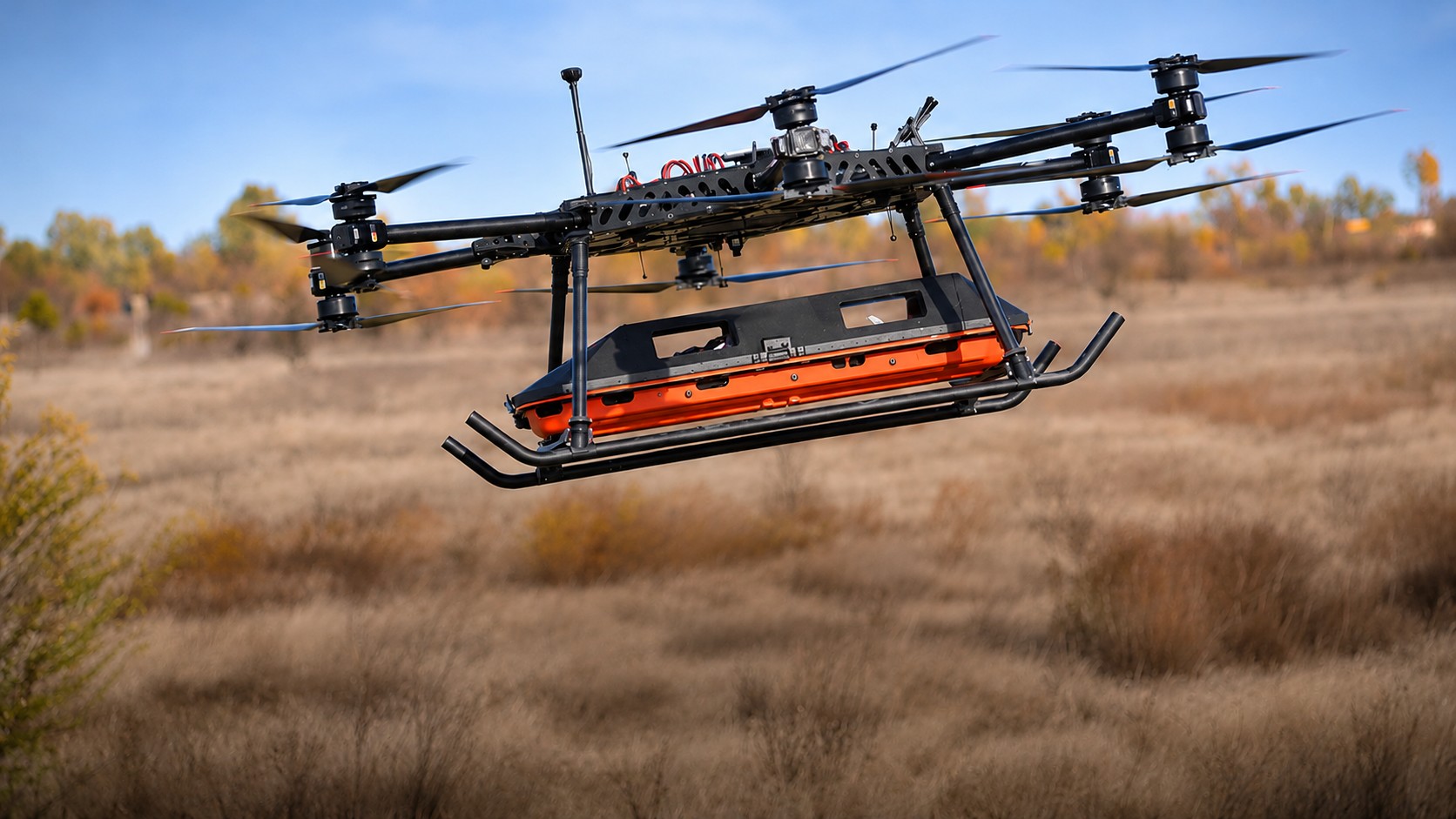
Ukraine has carried out the world’s first medical evacuations by heavy uncrewed aircraft, lifting wounded soldiers out of positions that could not be reached from the ground, and is developing evacuation drones as a dedicated capability of its own, according to the Ukrainian defence ministry.
Brave1, the defence innovation cluster working with the Ministry of Defence, set the requirement in 2024 after working with the military to define what such an aircraft would have to do. The criteria given to the defence technology market were that the aircraft must reliably carry 130 kilograms over a distance of at least fifteen kilometres and must carry an integrated communication system with at least three alternative types to survive in an electronic warfare environment, with lidar, optical stabilisation and navigation that works without satellites listed as options.
The first of those evacuations took place in October, when an infantryman of the 30th Separate Mechanised Brigade was lifted out of a position the enemy had blocked. A Heavy Shot Ayudag-6 hexacopter built by a Brave1 participant flew the mission, an aircraft weighing 98 kilograms with a payload capacity of 130 kilograms, and it covered more than fifteen kilometres on the outbound leg.
Preparation ran to months and drew on the experience of the uncrewed ground vehicle company of the 92nd Separate Assault Brigade. Equipment had been dropped to the soldier in advance and he had to secure himself to the aircraft’s winch without help, while adjacent units launched bomber drones to pull enemy interceptors away from the rescue aircraft.
A second system, Stargate, was built specifically for evacuation at the request of assault troops. It deploys in ten minutes, carries 150 kilograms at speeds up to 105 kilometres an hour and holds a medical module with a stretcher, and its software can plot a route and return to a safe area without help if navigation is completely jammed.
Assault troops of the CODE 9.2 regiment used it twice in a single week to bring out severely wounded soldiers from the grey zone five kilometres from the Russian border, where terrain, water obstacles and first person view drones ruled out any ground rescue. The aircraft flew nearly thirty kilometres each way and came back with the casualties aboard while under electronic attack, relying on artificial intelligence alone for navigation, with heavy strike drones suppressing enemy positions to cover the run.
Conventional casualty evacuation has become close to impossible along much of the front because the density of drone coverage turns any vehicle movement into a target, and uncrewed ground vehicles took over much of the work at the cost of speed. Survival after serious trauma depends heavily on reaching surgical care quickly, and a crawling robot moving along a mined route can take many hours to cover ground a helicopter would cross in minutes.
Ukraine’s Defence Procurement Agency has contracted three times as many uncrewed systems of all types this year as it did last year.